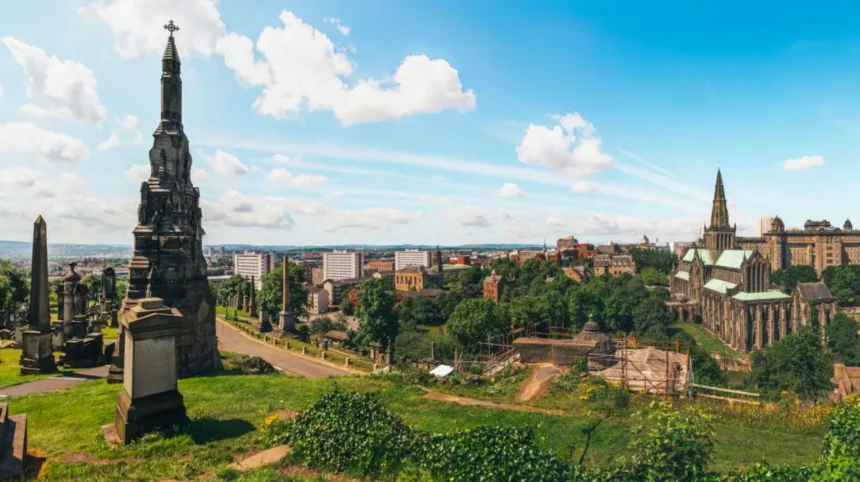
The Glasgow Necropolis is a 37-acre Victorian garden cemetery built on a prominent hill directly east of Glasgow Cathedral. It features over 3,500 distinct architectural monuments and serves as the final resting place for approximately 50,000 individuals.
- Why was the Glasgow Necropolis established and what is its historical context?
- What prominent monuments and architectural styles define the cemetery grounds?
- What key historical figures and notable citizens are buried inside the Necropolis?
- What is the Bridge of Sighs and what role does it play in the site’s layout?
- How do Victorian death culture and socio-economic class divisions present themselves across the grounds?
- Is the Glasgow Necropolis worth visiting for modern tourists and history enthusiasts?
- What logistical details and visiting guidelines should visitors know before going?
The site sits on a elevated rock outcrop historically known as the Wester Crags or Fir Park. Geologically, the terrain consists of a hard, igneous sill composed of quartz-dolerite, which resisted glacial erosion during the last ice age. This geographical structure raises the main summit of the cemetery significantly above the surrounding Glasgow landscape.
The physical layout follows a deliberate terraced design based on the Picturesque movement of the 19th century. The lower sections near the western perimeter contain linear rows of graves and modest headstones. The upper sections feature winding, serpentine pathways that ascend the hill, culminating in a broad, flat plateau at the summit. Access to the grounds requires crossing a stone bridge over a valley where the subterranean Molendinar Burn flows.
The layout divides the site into designated burial zones, historically labeled using letters of the Greek alphabet. The primary entrance consists of cast-iron gates and a neo-classical gateway designed by architects David Hamilton and James Hamilton in 1838. The structural footprint borders the historic districts of Townhead and Dennistoun.
Why was the Glasgow Necropolis established and what is its historical context?
The Merchants’ House of Glasgow established the Glasgow Necropolis in 1831 to address severe urban burial overcrowding and advance public health reform. It officially opened for burials in April 1833 as Scotland’s first garden cemetery.
During the early 19th century, the Industrial Revolution caused the population of Glasgow to expand rapidly. The city lacked adequate infrastructure to manage mortality rates caused by recurring outbreaks of infectious diseases, such as cholera and typhus epidemics. Traditional parish churchyards became hazardous public health threats due to overfilled, shallow graves.
In response to these conditions, Dr. John Strang, the Chamberlain of the Merchants’ House of Glasgow, published proposals advocating for a “hygienic cemetery” outside the city center. Strang drew direct inspiration from the Père Lachaise Cemetery in Paris, France, which demonstrated how landscaped, out-of-town burial grounds could reduce disease transmission while creating civil spaces.
The passing of the Cemeteries Act of 1832 provided the legal framework necessary for private corporations to operate commercial cemeteries. The Merchants’ House converted its parkland at Fir Park into a non-denominational burial site. Prior to the first Christian burial, the site established a dedicated Jewish burial ground in September 1832 to serve non-Christian residents.
What prominent monuments and architectural styles define the cemetery grounds?
The Glasgow Necropolis features 3,500 monuments spanning Classical, Gothic, Romanesque, Renaissance, and Art Nouveau architectural styles. Notable architects including Alexander “Greek” Thomson, Charles Rennie Mackintosh, and David Hamilton designed major structures across the site.
The dominant monument on the summit is the John Knox Monument, erected in 1825 before the cemetery itself was formally established. The structure consists of a 58-foot Classical Doric column designed by Thomas Hamilton, topped with a 12-foot statue of the Scottish Reformation leader carved by sculptor Robert Forrest.
The Monteath Mausoleum, built in 1842 by architect David Cousin for Major Archibald Douglas Monteath, displays elaborate Neo-Norman design. The structure features a multi-tiered octagonal building adorned with intricate stone carving and detailed geometric grotesques.
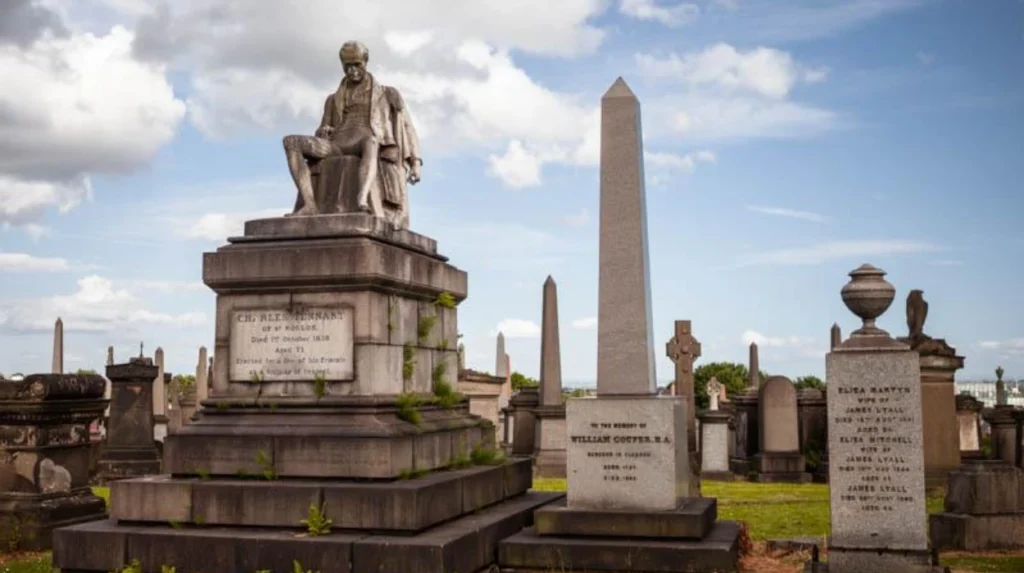
The Houldsworth Mausoleum, constructed in 1854, showcases Classical revival design with sculpted figures representing the virtues of Faith, Hope, and Charity created by sculptor John Thomas. Nearby, the tomb of industrialist Charles Tennant incorporates a seated marble effigy carved by artist Patric Park in 1838.
The cemetery contains examples of Scottish Art Nouveau design. The tomb of Chief Constable Andrew McCall features a sculpted Celtic cross designed in 1888 by architect Charles Rennie Mackintosh. Additional structures employ Egyptian Revival motifs, obelisks, sarcophagi, and broken columns symbolizing lives cut short.
| Monument / Structure | Designer / Architect | Year Erected | Architectural Style |
| John Knox Monument | Thomas Hamilton & Robert Forrest | 1825 | Greek Doric Column |
| Monteath Mausoleum | David Cousin | 1842 | Neo-Norman / Romanesque |
| Charles Tennant Tomb | Patric Park | 1838 | Classical Effigy |
| Houldsworth Mausoleum | John Thomas | 1854 | Classical Revival |
| McCall Celtic Cross | Charles Rennie Mackintosh | 1888 | Scottish Art Nouveau |
What key historical figures and notable citizens are buried inside the Necropolis?
The Glasgow Necropolis contains the remains of prominent industrial leaders, artists, scientists, political figures, and military veterans. Over 50,000 individuals are interred within the site, though fewer than 10% have named headstones.
The cemetery holds the grave of Charles Tennant, the founder of the St. Rollox Chemical Works, which was once the largest chemical manufacturing plant in the world. Nearby lies Hugh Tennent, the founder of Wellpark Brewery and creator of Tennent’s Lager.
William Miller, the 19th-century Scottish poet who wrote the nursery rhyme “Wee Willie Winkie,” is commemorated with a prominent monument erected on the eastern terraces. The cemetery also contains the tomb of Walter Macfarlane, owner of the Saracen Foundry, whose architectural ironwork was exported across the British Empire.
The site serves as a military memorial ground. The Commonwealth War Graves Commission registers and maintains 20 service personnel graves from World War I and World War II. Three modern memorials stand near the main bridge, honoring:
- Victoria Cross recipients from Glasgow
- Veterans of the Korean War
- Stillborn children buried in unrecorded plots
The vast majority of the 50,000 interments consist of working-class citizens, paupers, and epidemic victims buried in unmarked, deep mass graves excavated up to 14 feet into the bedrock.
What is the Bridge of Sighs and what role does it play in the site’s layout?
The Bridge of Sighs is a heavy stone arch bridge built in 1836 by architect David Hamilton to cross the Molendinar Burn ravine. It forms the formal procession entry connecting Glasgow Cathedral to the Necropolis grounds.
The bridge received its name from local residents because funeral processions traversed it while moving from the city churchyards to the cemetery gates. The title references the original Bridge of Sighs in Venice, Italy, echoing the theme of crossing a final threshold.
The structure spans a steep gorge where the Molendinar Burn historically flowed above ground. The Molendinar Burn is the stream where Saint Mungo founded the original settlement of Glasgow in the 6th century. In the late 19th century, civil engineering projects culverted the burn underground, but the ravine structure remains physically visible today.
The bridge features a single stone arch with detailed stonework and decorative iron railings. The arch bears an inscription carved into its masonry detailing the founding of the cemetery by the Merchants’ House. The bridge acts as a structural choke point that regulates visitor access while creating a transitional passage between the medieval cathedral precinct and the Victorian burial hill.
How do Victorian death culture and socio-economic class divisions present themselves across the grounds?
The spatial organization of the Glasgow Necropolis directly mirrors the rigid socio-economic stratification of 19th-century Victorian society. Tomb elevation, proximity to the summit, and material complexity directly correlated with wealth and social status.
The Merchants’ House designed the cemetery to operate on a tiered pricing system. The top of the hill, surrounding the John Knox Monument, represented the highest prestige. Wealthy merchant families, industrialists, and civic leaders purchased these high-altitude plots to construct elaborate stone mausoleums, grand obelisks, and imported marble monuments. This physical placement meant the elite of Glasgow were elevated above the rest of the city.
Moving down the slopes of the hill, plot prices decreased. Middle-class families—such as shopkeepers, clerks, and tradesmen—purchased standard terraced plots along the winding pathways. These plots feature modest sandstone headstones, carved Celtic crosses, or simple flat slabs.
At the base of the hill and along the lower boundaries lie the unmarked common graves. Poor laborers, factory workers, and destitute citizens were buried in collective pits without individual markers. Victorian death culture prioritized public displays of grief, family legacy, and religious salvation through permanent stone art, which only affluent families could afford.
Is the Glasgow Necropolis worth visiting for modern tourists and history enthusiasts?
The Glasgow Necropolis is worth visiting due to its historical importance, unique architecture, high elevation views, and free public access. It ranks as one of the most significant Victorian garden cemeteries in Europe.
The site functions as an open-air museum detailing Glasgow’s transformation into a major global industrial city during the 19th century. Visitors gain direct educational insight into Victorian masonry, funeral customs, urban public health reforms, and architectural trends.
The summit plateau offers panoramic 360-degree views across the entire city of Glasgow. From the highest point near the John Knox Monument, visitors can look down upon Glasgow Cathedral, the St Mungo Museum of Religious Life and Art, the Royal Infirmary, and the modern skyline extending toward the River Clyde.
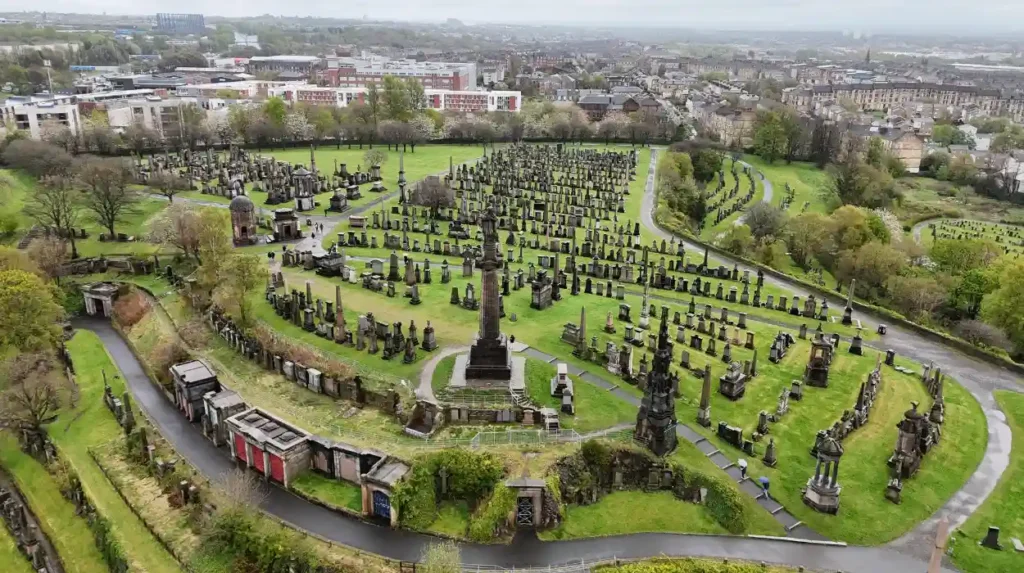
The location functions as a public park and green space. It provides a quiet habitat for urban wildlife, including various species of native birds, wild bats, and roe deer. The site operates with zero admission fee year-round, making it a high-value destination for travelers exploring Glasgow’s historic East End.
Explore more Area Guide
What Are the Best Neighbourhoods to Live in as a Student in Glasgow?
How Much Money Do Students Really Need Each Month in Glasgow?
What logistical details and visiting guidelines should visitors know before going?
The Glasgow Necropolis is open daily from 7:00 AM until dusk, charges no entry fee, and is accessible on foot from Glasgow city center. Visitors must follow municipal conduct rules to preserve the historic monuments.
The main pedestrian entrance is located on Castle Street, immediately adjacent to Glasgow Cathedral and the St Mungo Museum. The site sits approximately 0.6 miles east of George Square and High Street Railway Station, making it walkable from central Glasgow. Local public transit routes, including First Bus services, drop passengers along Castle Street.
Because the cemetery is built on a steep hill, visitors encounter cobblestone paths, unpaved gravel, and steep gradients. The main pathways are paved, but certain historic terraced trails require step climbing and are not fully wheelchair accessible. Good walking shoes are necessary due to uneven historic paving.
Glasgow City Council maintains and administers the site, while the volunteer group Friends of Glasgow Necropolis offers walking tours throughout the year. Guided tours provide detailed commentary on specific grave locations and historical records. Visitors are expected to treat the site as an active place of remembrance. Rubbish dumping, climbing on fragile historic tombs, and unauthorized commercial filming are strictly prohibited.
What is the Glasgow Necropolis and where is it located?
The Glasgow Necropolis is a 37-acre Victorian garden cemetery built on a prominent igneous rock hill directly east of Glasgow Cathedral in Glasgow’s historic East End. It features over 3,500 architectural monuments and contains the burials of approximately 50,000 individuals.