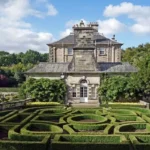
Glasgow is widely known for its cultural attractions, architecture and music scene, but its outdoor environment is equally important. The city contains a substantial network of parks, open spaces, woodland, waterways, sports facilities and walking routes. Glasgow City Council has recorded 91 parks, 12 Local Nature Reserves, 1,029 hectares of woodland and 24 hectares of allotments within its managed open-space estate.
- Why is Glasgow a good city for outdoor activities on a sunny weekend?
- Which Glasgow parks are best for walking and exploring?
- What is the best place for a picnic in Glasgow?
- Where can you go cycling outdoors in Glasgow?
- Which Glasgow parks are best for wildlife and nature watching?
- What are the best riverside outdoor activities in Glasgow?
- Which Glasgow parks are best for outdoor sports and exercise?
- What historical outdoor places should you visit in Glasgow?
- How can you plan the best sunny weekend outdoor day in Glasgow?
- What should you take for an outdoor weekend in Glasgow?
- Why do Glasgow’s green spaces remain important for the future?
A sunny weekend provides an opportunity to experience these spaces through walking, cycling, picnicking, wildlife observation, informal sports and riverside recreation. The activities range from short urban walks in central Glasgow to longer routes through country park landscapes.
Glasgow’s nickname, the “Dear Green Place,” reflects the city’s long relationship with public parks. Glasgow Life records that the city’s parks developed from historic common land into a major municipal recreation network during the nineteenth century.
The best outdoor activity depends on location, available time, fitness level and the type of landscape preferred. Central parks suit short visits, while Pollok Country Park, the Seven Lochs Wetland Park and other larger green spaces provide longer outdoor experiences.
Why is Glasgow a good city for outdoor activities on a sunny weekend?
Glasgow offers extensive opportunities for walking, cycling, picnicking, wildlife watching, informal sport and riverside recreation because its managed open-space network includes major parks, nature reserves, woodland and allotments across the city. These spaces connect urban neighbourhoods with accessible green landscapes for weekend recreation.
Glasgow’s outdoor infrastructure is distributed across different parts of the city. Central locations include Glasgow Green and Kelvingrove Park. The south-west contains Pollok Country Park. The south includes Queen’s Park and King’s Park. The east contains Alexandra Park and Tollcross Park. The west includes Victoria Park.
The city’s managed open-space estate demonstrates the scale of outdoor recreation available. Glasgow City Council’s corporate asset information identifies 91 parks and 12 Local Nature Reserves alongside more than 1,000 hectares of woodland.
Tree cover also contributes to the outdoor environment. A Glasgow City Council report using Forest Research data identified approximately 2,840.684 hectares of tree canopy, equivalent to 16.1% of the city’s area at the time of the assessment.
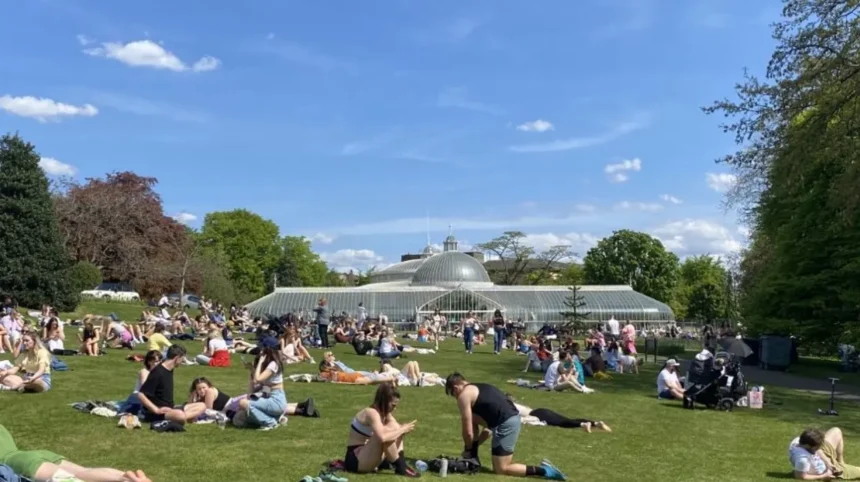
Sunny weather changes how these spaces are used. Dry paths support walking and cycling. Open lawns provide space for picnics and informal games. Longer daylight hours support extended visits. Riverside locations also become more suitable for relaxed walking and photography.
The city therefore supports outdoor recreation without requiring a long journey beyond the urban area.
Which Glasgow parks are best for walking and exploring?
Kelvingrove Park, Glasgow Green, Queen’s Park, Pollok Country Park, Victoria Park, Alexandra Park and Tollcross Park provide varied walking environments across Glasgow. Their paths, lawns, gardens, woodland and historic features create options for short urban strolls, longer walks and recreational exercise.
Kelvingrove Park
Kelvingrove Park is one of Glasgow’s most prominent urban parks. Glasgow City Council acquired the original land in 1852, and the park opened to the public in 1853. Glasgow Life records that the early design included paths allowing visitors to walk and travel through the landscaped grounds.
The park is particularly suitable for combining outdoor recreation with cultural attractions. The Kelvingrove Art Gallery and Museum sits beside the park, while the River Kelvin provides an additional landscape feature.
A sunny walk through Kelvingrove Park can therefore form part of a larger West End itinerary.
Glasgow Green
Glasgow Green is the city’s oldest park. Its history reaches back to 1450, when King James II granted land to Bishop William Turnbull, who gifted it to the people as common grazing land.
The present Glasgow Green developed through land acquisitions between 1662 and 1792. It later became an important public recreation space with paths, monuments, fountains and landscaped areas.
Today, its central location makes it particularly useful for visitors who want outdoor space without travelling far from Glasgow city centre.
Queen’s Park
Queen’s Park sits south of the city centre and provides a mixture of landscaped areas, open lawns and elevated viewpoints. The land was purchased in 1857, and the park forms part of Glasgow’s nineteenth-century expansion of public recreation spaces.
Its elevated sections provide broader views across Glasgow. This makes the park suitable for walking, photography and relaxed outdoor breaks.
Pollok Country Park
Pollok Country Park is Glasgow’s largest park and was designated as the city’s first country park in 1981. Its landscape contains woodland, gardens, pastures, the White Cart Water and major heritage attractions.
Its larger scale makes it particularly appropriate for a sunny weekend when the objective is a longer outdoor experience rather than a short city-centre walk.
What is the best place for a picnic in Glasgow?
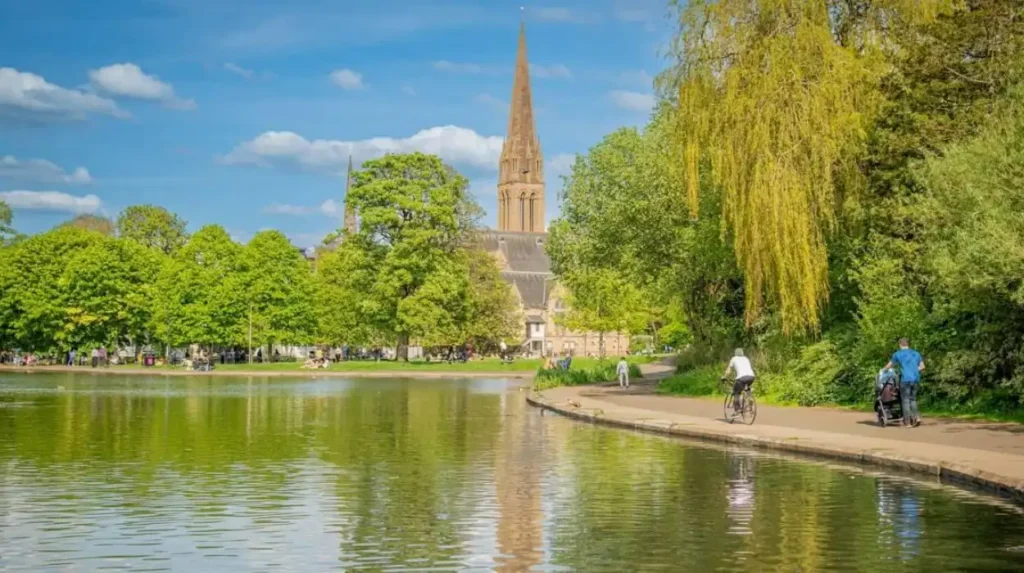
Glasgow’s major parks provide extensive lawns and landscaped areas suitable for outdoor picnics, with Glasgow Green, Kelvingrove Park, Pollok Country Park, Queen’s Park and Victoria Park offering accessible settings. Visitors should use designated facilities, protect planted areas and remove litter after eating outdoors.
Picnicking is one of the simplest ways to use Glasgow’s green spaces. It requires little specialist equipment and works well for families, couples, groups and solo visitors.
Glasgow Green is convenient for visitors staying near the city centre. Kelvingrove Park provides easy access from the West End. Queen’s Park serves the south side. Pollok Country Park provides a more expansive country-park environment.
Victoria Park provides another established outdoor option in the west. Glasgow Life records that its 46 acres were feued to the Burgh of Partick in 1886, with the park formally opened in 1887.
The design of Victoria Park includes carriage drives, walks and ponds. Historically, the park supported activities including bowling, tennis, cricket, football, putting, model yachting and paddle boating.
A sunny picnic should use durable food containers and reusable drinks bottles. Visitors should keep food away from wildlife and place waste in appropriate bins or take it home when bins are full.
The best picnic location also depends on proximity to toilets, cafés, play areas and public transport. Larger parks generally provide more facilities than smaller neighbourhood green spaces.
Where can you go cycling outdoors in Glasgow?
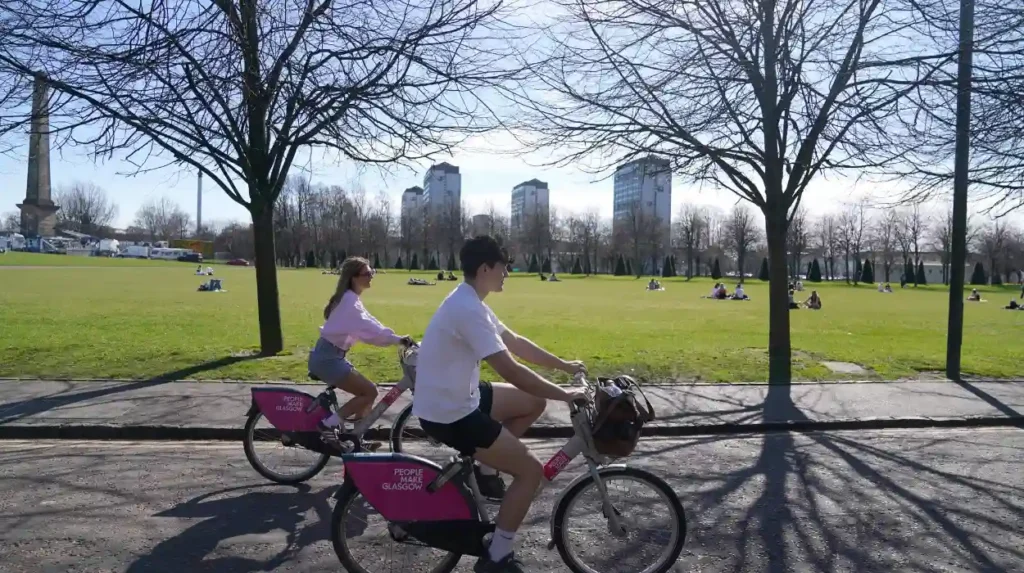
Cycling in Glasgow works particularly well on dedicated cycle routes, park paths and quieter green corridors. National Cycle Route 7 connects parts of the south-west through Lochar Park, Pollok Country Park and Rosshall Park, creating a useful route for recreational cycling.
Cycling provides a practical way to cover more ground during a sunny weekend. It also connects several green spaces within a single outing.
National Cycle Route 7 is an important example. Glasgow City Council records that the route follows the area around Lochar Park, linking it with Pollok Country Park and Rosshall Park.
This corridor creates opportunities to combine cycling with park visits. It also demonstrates how Glasgow’s green infrastructure connects beyond individual park boundaries.
Cyclists should use routes appropriate to their ability and follow local signs. Shared paths require particular care because walkers, runners and cyclists can use the same spaces.
Pollok Country Park is another useful destination for cycling because its large landscape provides considerably more space than compact central parks. The park contains woodland, open areas, water features and heritage sites.
Cycling also fits naturally into a longer active weekend itinerary. A visitor can cycle through a green corridor, stop for a picnic and continue towards another park without relying entirely on motor transport.
Which Glasgow parks are best for wildlife and nature watching?
Pollok Country Park, Victoria Park, the city’s Local Nature Reserves, woodland areas and the Seven Lochs Wetland Park provide strong settings for observing plants, birds, trees and wetland habitats. These locations demonstrate the ecological diversity contained within Glasgow’s urban and peri-urban landscape.
Nature watching does not require specialist equipment. A sunny day makes it easier to observe birds, insects, flowering plants and mature trees.
Pollok Country Park combines woodland, pasture, gardens and the White Cart Water. Glasgow City Council identifies its environmental and conservation value alongside its historic importance.
The city also manages 12 Local Nature Reserves. These sites form part of Glasgow’s broader green infrastructure and provide designated locations for experiencing local wildlife and natural habitats.
Woodland is another important component. Glasgow City Council’s asset framework records 1,029 hectares of woodland under its parks and open-space responsibilities.
The Seven Lochs Wetland Park adds a different ecological setting. It is located on the eastern side of Glasgow and extends across a landscape associated with lochs, wetlands, habitats and historic sites. Glasgow City Council has maintained a programme of work and partnership activity connected with the park.
Nature watching is best approached without disturbing habitats. Visitors should remain on established paths where required, avoid feeding wildlife and keep dogs under control according to local rules.
A pair of binoculars provides additional value for birdwatching. A phone camera supports plant and landscape identification while keeping the activity simple.
What are the best riverside outdoor activities in Glasgow?
The River Clyde and River Kelvin provide important corridors for walking, photography, sightseeing and urban nature observation. Riverside routes connect parks, neighbourhoods, bridges, landmarks and cultural destinations, allowing visitors to combine physical activity with Glasgow’s industrial and architectural heritage.
The River Clyde is central to Glasgow’s history and geography. Its waterfront was fundamental to the city’s industrial development, shipbuilding economy and commercial expansion.
A sunny weekend provides suitable conditions for walking along accessible sections of the waterfront. Riverside walking can be combined with visits to cultural landmarks and nearby public spaces.
The River Kelvin provides a different experience. It passes through the West End and alongside Kelvingrove Park. Its wooded sections create a more enclosed environment than the open Clyde waterfront.
Riverside routes are particularly useful for visitors who want an outdoor activity without committing to a full country walk. They also provide natural stopping points for photography.
The White Cart Water forms another significant water feature within Pollok Country Park. Glasgow City Council identifies the watercourse as part of the park’s landscape and environmental character.
Water-based outdoor activities require additional safety awareness. Visitors should stay on established paths near steep banks and avoid entering rivers or other unsuitable water bodies.
Riverside recreation is therefore strongest as walking, photography, nature observation and sightseeing rather than informal swimming.
Which Glasgow parks are best for outdoor sports and exercise?
Glasgow’s parks support walking, running, football, tennis, bowling, cycling, fitness activities and informal recreation. Victoria Park, Glasgow Green, Queen’s Park, Pollok Country Park and other local parks provide different combinations of open lawns, paths, sports facilities and recreational infrastructure.
Outdoor exercise becomes easier to organise when parks provide continuous paths and open areas. Running and brisk walking work particularly well on park routes because users can adjust distance without following a fixed itinerary.
Victoria Park historically supported several sports, including bowling, tennis, cricket, football and putting.
Glasgow Green also has a long recreational history. Glasgow Life records that football and golf were played there historically, while the park later developed formal paths and public amenities.
Modern park recreation extends beyond organised sport. Visitors use open spaces for jogging, stretching, walking and informal games.
Families can combine exercise with children’s play facilities. Local parks frequently include play areas and multi-purpose games courts. Glasgow City Council’s park documentation records such facilities across individual neighbourhoods.
A sunny weekend is also suitable for low-impact activities such as leisurely walking. This makes Glasgow’s parks accessible to people who do not want structured exercise.
Visitors should use sports pitches and courts according to posted rules. Busy parks require awareness of other users, particularly around shared paths and play areas.
What historical outdoor places should you visit in Glasgow?
Glasgow’s historic parks preserve important evidence of the city’s social, industrial and municipal development. Glasgow Green, Kelvingrove Park, Queen’s Park, Pollok Country Park and Victoria Park each reflect different stages in Glasgow’s expansion of public recreation and designed landscapes.
Glasgow’s parks are closely connected with the development of public health and municipal recreation during the nineteenth century.
The expansion of industrial Glasgow increased demand for accessible green space. Glasgow Life records that Kelvingrove Park and Queen’s Park formed part of a major programme of public park provision as the city expanded.
Kelvingrove Park opened to the public in 1853. Its early landscape was developed from the grounds of a former country house.
Queen’s Park was acquired in 1857 and was designed as part of the city’s expanding public park system.
Victoria Park followed in 1887. Its creation reflected the expansion of public recreational provision in Partick.
Tollcross Park opened on 19 June 1897. Glasgow Life’s historical records describe it as part of efforts to provide recreational space for Glasgow’s growing east end.
Pollok Country Park represents a different historical layer. The Pollok Estate has roots extending back to the medieval period, while the modern country park was formally designated in 1981.
This historical development explains why Glasgow’s parks contain monuments, historic buildings, designed landscapes, mature trees and old pathways alongside modern recreational facilities.
How can you plan the best sunny weekend outdoor day in Glasgow?
A successful Glasgow outdoor day starts with one main activity and adds nearby parks, walking routes, food stops or cultural attractions. Central visitors can use Glasgow Green or Kelvingrove Park, while longer outings suit Pollok Country Park or the Seven Lochs area.
Planning around geography reduces unnecessary travel. Glasgow’s major parks are distributed across different parts of the city, so choosing one area for the main activity creates a more efficient itinerary.
A central outdoor day can begin at Glasgow Green. Visitors can walk through the historic park before continuing towards the River Clyde.
A West End itinerary can focus on Kelvingrove Park and the River Kelvin. The Kelvingrove Art Gallery and Museum provides an indoor cultural option within the same area if weather conditions change.
A south-west itinerary can centre on Pollok Country Park. Its large landscape supports walking, cycling, wildlife observation and heritage visits. The Burrell Collection and Pollok House add cultural and historical dimensions to the visit. Glasgow City Council identifies both as major heritage assets within the park.
An eastern itinerary can focus on the Seven Lochs Wetland Park and surrounding green spaces. This provides a different landscape from the formal urban parks of the city centre.
Visitors should check current opening arrangements, facility availability and local conditions before travelling. Park conditions change throughout the year, and individual facilities operate according to their own schedules.
Public transport is useful for one-way walking routes, while cycling provides another way to connect multiple green spaces. Car users should check parking restrictions and local traffic conditions before setting out.
Explore More Area Guide
Glasgow Parks and Green Spaces: Complete Guide 2026
Best Walking and Hiking Routes Near Glasgow 2026
What should you take for an outdoor weekend in Glasgow?
A practical outdoor kit for Glasgow includes comfortable walking footwear, weather-appropriate clothing, drinking water, food, sun protection, a phone and any specialist equipment required for cycling or sports. Conditions can change quickly, so lightweight waterproof clothing remains useful.
Sunny weather does not remove the need for preparation. Glasgow’s climate remains variable, and outdoor conditions can change during the same day.
Comfortable footwear is particularly important for longer park walks. Pollok Country Park and woodland environments contain routes that differ from paved city-centre paths.
Sun protection is also relevant during bright weather. Sunglasses, sunscreen and a hat are useful for extended periods outdoors.
Cyclists should use a properly maintained bicycle and appropriate safety equipment. A pump, spare inner tube or repair kit is useful for longer rides.
Visitors planning picnics should carry reusable containers and dispose of waste responsibly. Parks are shared public environments, so litter management directly affects the quality of outdoor spaces.
A charged phone supports navigation and communication. Downloaded maps provide additional resilience when mobile reception is inconsistent.
The key principle is simple: prepare for outdoor activity rather than relying on the weather forecast alone.
Why do Glasgow’s green spaces remain important for the future?
Glasgow’s parks and green spaces provide recreation, biodiversity, tree cover, walking routes and community facilities within a major urban area. Their future importance is linked to public health, climate resilience, nature recovery, active travel and continued access to outdoor space.
Glasgow’s green infrastructure has environmental importance beyond recreation. Trees, grassland, wetlands and waterways contribute to urban ecological functions.
The city’s tree canopy was assessed at 16.1%, representing approximately 2,840.684 hectares. Glasgow City Council identified additional planting opportunities designed to increase canopy coverage beyond that baseline.
Parks also support active lifestyles. Walking and cycling routes provide forms of physical activity that do not require membership of a gym or dedicated sports facility.
Green spaces also support biodiversity. Local Nature Reserves, woodland, wetlands and riverside environments provide different habitats across the city.
Glasgow’s open-space strategy recognises that provision is not evenly distributed across the city. The council’s asset framework identifies areas where access to open space is more limited.
This distribution makes local parks important. A small neighbourhood park can provide daily outdoor access even when a large country park is further away.
The future role of Glasgow’s outdoor spaces therefore extends beyond sunny weekends. Parks form part of the city’s wider environmental, recreational and community infrastructure.
For visitors, the practical conclusion is clear. Glasgow does not require a trip outside the city to experience substantial outdoor recreation. The city itself contains historic parks, country landscapes, woodland, wetlands, riverside corridors and connected cycling routes.
A sunny weekend can therefore be organised around walking, cycling, picnicking, nature observation, informal sport or historical exploration. The strongest outdoor experiences come from choosing the green space that matches the activity and combining it with nearby attractions.
What are the best outdoor activities in Glasgow on a sunny weekend?
The best outdoor activities include walking in Kelvingrove Park, cycling through green corridors, picnicking in Glasgow Green, exploring Pollok Country Park, wildlife watching and enjoying riverside walks.