
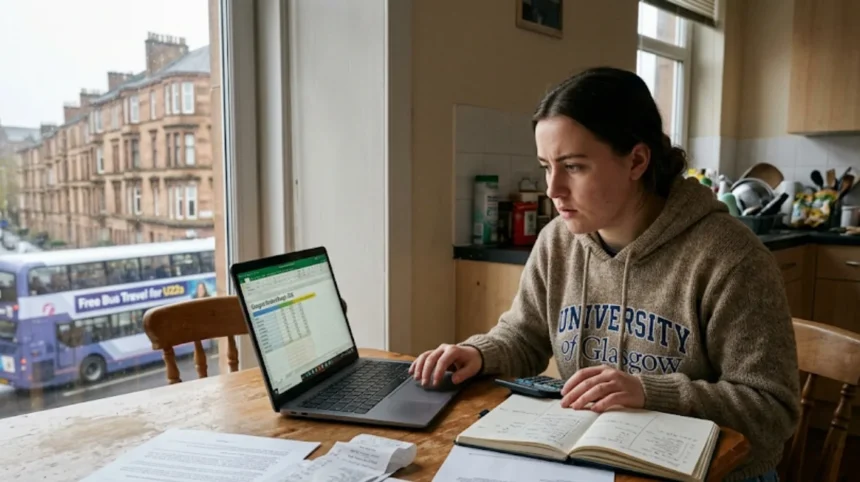
A full-time student living in Glasgow requires between £900 and £1,700 per month to cover essential living expenses in 2026. This total includes accommodation, groceries, local transportation, utilities, personal care, study materials, and discretionary social spending across the Scottish metropolis.
- What Are the Baseline Financial Requirements Set by Educational Institutions and Visa Authorities?
- How Do Historical Inflation and Energy Cost Changes Impact Student Budgets?
- How Much Does Student Accommodation Cost per Month in Glasgow?
- What Are the Differences Between Purpose-Built Student Accommodation and Private Tenement Rentals?
- How Do Geographical Neighborhoods Influence Monthly Rent Rates Across Glasgow?
- What Are the Monthly Food and Grocery Costs for Glasgow Students?
- Which Supermarket Tiers Offer the Most Cost-Effective Grocery Shopping Options?
- How Much Do Casual Dining Out and University Catering Add to Monthly Expenses?
- How Much Do Utilities, Internet, and Mobile Plans Cost Each Month in Glasgow?
- How Does the Scottish Council Tax Exemption Mechanism Function for Full-Time Students?
- What Are the Monthly Costs for Household Energy, Fiber Broadband, and Mobile Services?
- What Are the Local Transportation Expenses for Students Living in Glasgow?
- How Does the Scottish National Entitlement Card Scheme Reduce Transportation Costs?
- What Are the Monthly Fares for the Glasgow Subway and Regional Rail Systems?
- What Additional Personal and Academic Expenses Should Glasgow Students Budget For?
- How Much Do Health Coverage, Fitness Memberships, and Personal Care Require Monthly?
- What Are the Estimated Costs for Academic Supplies, Books, and Campus Social Activities?
- How Can Students Supplement Their Income to Cover Glasgow Living Costs?
The cost of living for tertiary education students in Glasgow, Scotland, depends on housing choices, domestic lifestyle patterns, and personal spending habits. Glasgow is the largest city in Scotland and host to four major higher education institutions: the University of Glasgow, the University of Strathclyde, Glasgow Caledonian University, and the Royal Conservatoire of Scotland. Financial planning requires an understanding of fixed obligations, such as rental payments, alongside variable commitments like food purchases and energy consumption.
UK Visas and Immigration (UKVI), the division of the Home Office responsible for the United Kingdom visa system, mandates specific financial proof for international students. As of 2026, UKVI requires non-UK applicants studying outside London to demonstrate maintenance funds of £1,023 per month for up to nine months. Official estimates published by the University of Glasgow recommend a monthly budget between £1,100 and £1,700. This institutional estimate reflects local market conditions for single students residing in standard university accommodation or private shared housing.
What Are the Baseline Financial Requirements Set by Educational Institutions and Visa Authorities?
The UKVI maintenance threshold serves as the statutory minimum for visa compliance, but real expenditure varies across demographic groups. The University of Glasgow, established in 1451, conducts annual student expenditure surveys to calculate realistic baseline figures. Their research divides student costs into fixed essential allocations and flexible secondary allocations. Fixed allocations include housing, council tax exemptions, and baseline utilities. Flexible allocations encompass diet, clothing, communication services, and leisure activities.
The standard minimum baseline of £900 per month applies to students in shared private housing who possess free bus travel privileges and minimize commercial entertainment. The upper boundary of £1,700 per month accommodates students living in single-occupancy studio apartments within private Purpose-Built Student Accommodation (PBSA) developments. This upper tier includes higher heating allocations, personal vehicle costs, or frequent commercial dining.
How Do Historical Inflation and Energy Cost Changes Impact Student Budgets?
Historical economic shifts in the United Kingdom directly influence current student monthly outlays. The UK Consumer Prices Index (CPI) experienced elevated inflation between 2021 and 2024, driven by global energy supply constraints and domestic retail cost adjustments. Wholesale natural gas price increases raised household electricity and gas tariffs across Great Britain under the Office of Gas and Electricity Markets (Ofgem) price cap system.
Rents in Glasgow rose between 2022 and 2025 due to strong housing demand and structural supply limits in the private rented sector. The Cost of Living (Tenant Protection) (Scotland) Act 2022 temporarily restricted rent increases for existing tenancies, but market entry rates for new tenancies adjusted upward. Consequently, current monthly student budgets reflect higher base figures for energy and housing than historical datasets recorded prior to 2022.
How Much Does Student Accommodation Cost per Month in Glasgow?
Monthly student accommodation in Glasgow ranges from £450 for a shared private tenement flat to £1,350 for a private studio in a Purpose-Built Student Accommodation facility. University-managed halls of residence cost between £520 and £850 monthly with bills included.
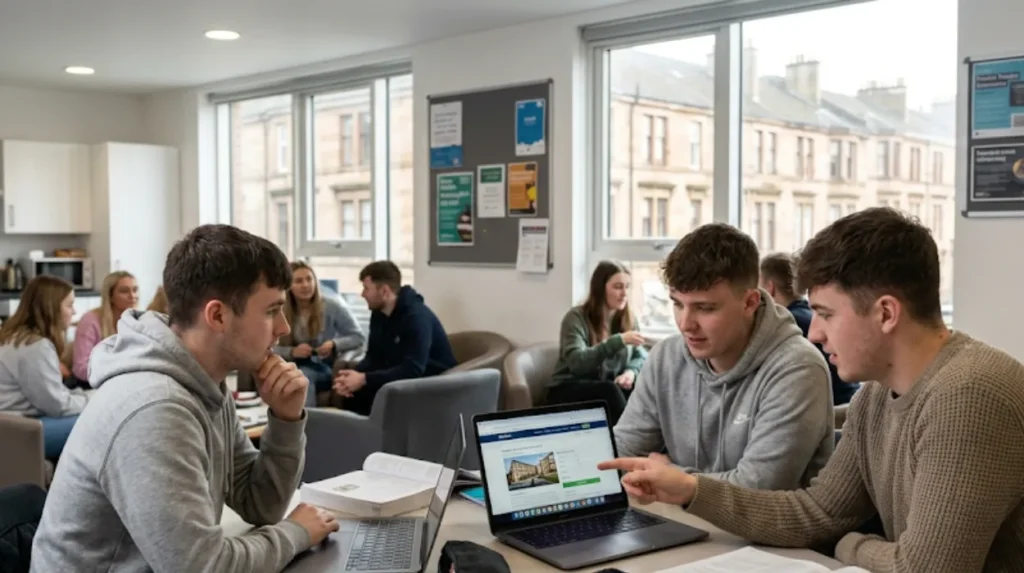
Housing constitutes the largest single expenditure item for students in Glasgow, accounting for 40% to 50% of total monthly outlays. Glasgow features three primary accommodation structures: University-managed halls of residence (such as Murano Street Student Village), private rented sector flats (such as traditional sandstone tenements in Partick), and Purpose-Built Student Accommodation complexes (such as West Village or Gallery Apartments).
University-managed halls provide catered or self-catered single rooms, typically with shared or en-suite bathroom facilities. These contracts generally span 39 to 41 weeks, covering internet connectivity, utility consumption, and contents insurance in the headline rent. The monthly equivalent cost in university halls ranges from £520 to £850 depending on bathroom configuration and room surface area.
What Are the Differences Between Purpose-Built Student Accommodation and Private Tenement Rentals?
Purpose-Built Student Accommodation (PBSA) consists of high-density commercial developments managed by private property operators. PBSA properties offer three distinct unit types: shared apartments with communal kitchens, individual en-suite rooms with shared living quarters, and fully self-contained studio apartments. PBSA en-suite rooms cost between £640 and £1,040 per month, while private studio apartments range from £960 to £1,350 per month. PBSA rents include electricity, gas, water, high-speed Wi-Fi, and access to communal amenities like study lounges and fitness rooms.
The private rented sector consists of traditional residential properties leased by private landlords registered with Glasgow City Council. These properties are typically located in 19th-century sandstone tenement buildings. Renting a individual bedroom in a shared multi-bedroom private flat costs between £450 and £750 per month. Private tenancies require separate payments for electricity, gas, and internet broadband, adding variable costs to the monthly base rent.
How Do Geographical Neighborhoods Influence Monthly Rent Rates Across Glasgow?
Rental prices in Glasgow vary according to geographic proximity to higher education campuses and municipal transport links. Glasgow comprises several distinct residential zones popular among the student population, including the West End, the City Centre, the East End, and Southside districts.
The West End, encompassing areas such as Hillhead, Dowanhill, and Hyndland, commands the highest rents due to its immediate adjacency to the main campus of the University of Glasgow. Private flat shares in Hillhead average £750 to £1,200 per bedroom monthly. Partick and Thornwood, located further west, offer lower monthly rents ranging from £650 to £950 per bedroom.
The City Centre and Merchant City cater primarily to students attending the University of Strathclyde and Glasgow Caledonian University. Average monthly rents for shared flats in Merchant City range from £850 to £1,400 per room, while Cowcaddens and Garnethill range from £600 to £1,000 per room.
The East End, containing neighborhoods such as Dennistoun and Haghill, provides more affordable student housing options. Monthly rents in Dennistoun average between £550 and £850 per bedroom. Dennistoun connects directly to Strathclyde University via a 15-minute walk or a brief journey on ScotRail trains from Bellgrove Station.
What Are the Monthly Food and Grocery Costs for Glasgow Students?
Students in Glasgow spend between £150 and £280 per month on groceries and essential food items. Supermarket selection and personal cooking habits create this cost spectrum, with budget retailers offering lower price points than premium mid-range supermarket chains.
Food expenses represent the second-largest recurring cost category for students after accommodation. The retail grocery sector in Glasgow operates across three distinct market tiers: discount supermarket chains (such as Aldi and Lidl), mid-range corporate supermarkets (such as Tesco, Asda, and Sainsbury’s), and premium food halls (such as Marks & Spencer and Waitrose).
Cooking primary meals at home using raw ingredients purchased from discount retailers establishes the low-end monthly grocery budget of £150. Purchasing convenience items, brand-name goods, and prepared meals at mid-tier supermarkets elevates monthly grocery spending to between £220 and £280.
Which Supermarket Tiers Offer the Most Cost-Effective Grocery Shopping Options?
Retail pricing structures in Glasgow show clear differences across grocery suppliers. Discount chains Aldi and Lidl operate multiple stores across Glasgow, including locations in Partick, Robroyston, and the Crown Street Retail Park in Gorbals. A standard weekly food basket containing basic staples—bread, milk, rice, pasta, fresh vegetables, eggs, and basic proteins—costs approximately £35 to £45 at Aldi or Lidl.
Mid-tier retailers Tesco and Sainsbury’s operate large superstores as well as smaller express stores throughout Glasgow. Prices in smaller express stores carry a 5% to 10% premium compared to main superstores. The same weekly basket of basic staples costs between £50 and £65 at mid-tier chains. Utilizing loyalty card schemes, such as the Tesco Clubcard or Sainsbury’s Nectar card, provides targeted discounts that narrow the price gap with discount supermarkets.
Specialty international food markets, such as Matthew’s Foods on Garscube Road or SeeWoo Supermarket in Cowcaddens, supply wholesale grains, spices, and imported ingredients. These outlets offer lower unit costs for bulk staples than conventional high-street supermarkets.
How Much Do Casual Dining Out and University Catering Add to Monthly Expenses?
Purchasing meals outside the home increases monthly student expenditure. Casual dining options in Glasgow span three food service formats: fast-casual establishments (such as Subway or McDonald’s), university student union cafes (such as the Strathclyde Union or Glasgow University Union), and local sit-down restaurants (such as Paesano Pizza or Topolabamba).
A single meal at a fast-casual establishment costs between £5 and £8. University catering facilities offer subsidized hot lunch options ranging from £3.50 to £6.00 per meal. Casual dining restaurants in Glasgow average £10 to £18 per main course. A student who eats out twice per week spends an additional £80 to £150 per month above their base grocery budget.
How Much Do Utilities, Internet, and Mobile Plans Cost Each Month in Glasgow?
Essential household utilities, high-speed fiber internet, and mobile phone plans cost students between £85 and £165 per month in private rented housing. Full-time students qualify for complete Council Tax exemption under Scottish national tax legislation.
Utility costs apply primarily to students residing in private flat shares. These domestic operational costs consist of three major utility components: domestic energy (electricity and mains gas), residential internet broadband, and personal mobile communication services.
Domestic energy tariffs in Scotland depend on household consumption, heating systems, and building insulation standards. Older tenement flats with single-glazed windows and high ceilings require more energy for space heating during winter months than modern apartments.
How Does the Scottish Council Tax Exemption Mechanism Function for Full-Time Students?
Council Tax is a local taxation system collected by local authorities in Scotland, including Glasgow City Council, to fund local public services. Under the Local Government Finance Act 1992, dwellings occupied exclusively by full-time higher education students are completely exempt from Council Tax.
To secure this exemption, full-time students must obtain an official Council Tax Exemption Certificate from their university registrar. The student submits this document to the Glasgow City Council corporate revenue service. A dwelling occupied solely by full-time students receives a 100% discount, reducing the monthly municipal tax liability to zero. If a full-time student shares a property with one non-student adult, the household receives a 25% single-occupant discount rather than a full exemption.
Water and sewerage charges in Scotland are collected via the Council Tax billing system on behalf of Scottish Water, the public water utility. Dwellings that qualify for 100% student Council Tax exemption are simultaneously exempt from residential water and sewerage charges.
What Are the Monthly Costs for Household Energy, Fiber Broadband, and Mobile Services?
Combined electricity and gas bills for a shared three-bedroom tenement flat average between £180 and £300 per month during winter, and £90 to £150 per month during summer. Divided among three co-tenants, individual monthly energy contributions average £60 to £100 year-round.
Residential fiber broadband packages with download speeds exceeding 100 Mbps cost between £24 and £36 per month from commercial Internet Service Providers (ISPs), such as Virgin Media, BT, or Hyperoptic. Split among three occupants, broadband costs add £8 to £12 per month to an individual student budget.
Mobile communication costs depend on network contract choices. SIM-only rolling monthly contracts offering 30GB or unlimited data from providers such as EE, Vodafone, O2, or VOXI cost between £10 and £20 per month.
What Are the Local Transportation Expenses for Students Living in Glasgow?
Transportation costs for Glasgow students range from £0 to £70 per month. Young adults under the age of 22 receive free bus travel throughout Scotland via the Young Persons’ Free Bus Travel Scheme administered by Transport Scotland.
Glasgow features an urban transit network comprising three public transport systems: the Glasgow Subway underground rail network, the regional First Bus and McGill’s bus routes, and the ScotRail urban train lines. Transportation outlays depend on student age, residency status, and distance between housing and academic facilities.
Students living in central areas like Hillhead or Merchant City often commute on foot or by bicycle, reducing monthly transport costs to zero.
How Does the Scottish National Entitlement Card Scheme Reduce Transportation Costs?
The Scottish Government operates the Young Persons’ Free Bus Travel Scheme across all local authority areas in Scotland. The scheme provides free bus transport to all residents aged 5 through 21. Eligible students obtain a National Entitlement Card (NEC) embedded with a smart travel profile.
Cardholders present the NEC card upon boarding participating commercial bus services, including First Bus Glasgow, Stagecoach West Scotland, and McGill’s Buses. The card grants free travel on all local, city, and long-distance intercity bus routes across Scotland. Full-time students under age 22 who utilize buses for daily travel save £50 to £70 monthly compared to standard adult fare payers.
Students aged 22 and older do not qualify for the free bus travel scheme. These students purchase commercial travel cards, such as the First Bus Student Monthly Pass, which costs £50 to £60 per month.
What Are the Monthly Fares for the Glasgow Subway and Regional Rail Systems?
The Glasgow Subway, operated by Strathclyde Partnership for Transport (SPT), consists of a 10.5-mile double-track circular underground line with 15 stations connecting the West End, City Centre, and Southside. SPT offers a Smartcard ticketing system with discounted tariffs. Single pay-as-you-go Smartcard fares cost £1.80, while a 28-day unlimited Subway Smartcard pass costs approximately £55.
ScotRail operates commuter rail networks originating from Glasgow Central Station and Glasgow Queen Street Station. Students aged 16 to 25, as well as mature full-time students, can purchase a 16-25 Railcard for £30 annually. This card applies a 33.3% discount to all off-peak rail fares across Great Britain. Monthly commuter train tickets between outer neighborhoods (such as Jordanhill or Easterhouse) and central stations cost between £40 and £65 with a student discount applied.
The Nextbike Glasgow bike-sharing scheme provides physical bicycle rentals across urban station hubs. University matriculation grants discounted student memberships costing £5 to £10 monthly, allowing free 30-minute rides on standard bikes.
Explore More Area Guide
What Is Student Life Actually Like at the University of Glasgow
What Is It Like Raising Children in Glasgow West End vs the Southside?
What Additional Personal and Academic Expenses Should Glasgow Students Budget For?
Students spend between £120 and £300 per month on personal care, course materials, health insurance, and social activities. Academic expenses include textbook purchases, specialized printing, laptop maintenance, and course-specific equipment required by higher education institutions.
Personal care and secondary outlays encompass four main spending categories: medical and dental fees, physical fitness memberships, educational supplies, and social activities. Discretionary social spending fluctuates based on individual leisure choices, attendance at live music venues, and participation in university societies.
National Health Service (NHS) Scotland provides public healthcare services. All UK residents and international students who have paid the UKVI Immigration Health Surcharge (IHS) receive access to NHS doctor consultations and public hospital care without additional fees at point of delivery. Prescription pharmaceuticals are free of charge for all individuals under NHS Scotland regulations.
How Much Do Health Coverage, Fitness Memberships, and Personal Care Require Monthly?
International students applying for a UK Student Visa pay the Immigration Health Surcharge (IHS) as part of their initial visa application. As of 2026, the IHS rate for student visa applicants is £776 per year of study. Distributed across a 12-month period, this surcharge represents an effective cost of £64.66 per month. NHS dental treatment and optometry services involve subsidised out-of-pocket charges unless the student holds an NHS Low Income Scheme certificate (HC2 form).
Fitness facilities operated by local universities provide subsidized rates. Membership at Strathclyde Sport or the University of Glasgow Stevenson Building costs between £15 and £25 per month. Commercial gym chains, such as PureGym or The Gym Group, charge £18 to £30 per month for unlimited access. Personal care items, toiletries, and haircuts require £25 to £50 per month.
What Are the Estimated Costs for Academic Supplies, Books, and Campus Social Activities?
Direct academic supplies demand a monthly allocation between £20 and £50. Most academic journals and core textbooks are available digitally through university library portals, including the University of Glasgow Library or Strathclyde Andersonian Library. Printing and binding fees cost 5p to 10p per black-and-white page. Specific courses, such as architecture at the Glasgow School of Art or dentistry at GCU, require specialized modeling materials or equipment that add up to £200 in upfront annual costs.
Social and leisure spending in Glasgow varies by activity type. Glasgow contains live music venues, cinemas, and cultural institutions. Mainstream cinema tickets with student discounts cost £5 to £8. Entry to live music venues like the Barrowland Ballroom or King Tut’s Wah Wah Hut ranges from £10 to £25 per event. Public museums, including the Kelvingrove Art Gallery and Museum and the Riverside Museum, offer free general admission. Monthly social expenditure averages £50 to £150 for an active student.
How Can Students Supplement Their Income to Cover Glasgow Living Costs?
Full-time international students on Student Visas can work up to 20 hours per week during term time under UK Visas and Immigration regulations. Domestic and international students earn at or above the UK National Living Wage of £11.44 per hour.
Part-time employment provides financial support to offset monthly living expenses. UK labor laws and immigration rules govern student employment parameters across Great Britain. Employed students receive wages governed by statutory minimum pay thresholds established by the UK Low Pay Commission.
The statutory UK National Living Wage applies to workers aged 21 and over. Employers in Glasgow must pay minimum hourly rates, though many university employers pay the higher Real Living Wage rate set by the Living Wage Foundation.
What Legal Working Hour Restrictions Apply to International Student Visa Holders in Scotland?
UK Visas and Immigration enforces strict employment limitations on Student Visa holders enrolled in degree-level courses. Visa conditions permit international students to work a maximum of 20 hours per week during official term-time periods. Working hours can extend to 40 hours per week during official university vacation periods, such as the December winter break and the summer recess.
Breaching the 20-hour weekly limit during term time constitutes a violation of UK immigration conditions. Student Visa holders cannot work as self-employed freelancers, set up a business, work as professional sportspersons, or fill a permanent full-time vacancy. Domestic students (UK citizens) face no statutory limit on weekly working hours, though universities advise capping paid employment at 15 to 20 hours per week to protect academic performance.
Which Student Employment Sectors Provide the Most Flexible Hourly Wage Opportunities?
Glasgow provides part-time student employment across three main economic sectors: retail and customer service, hospitality and food service, and campus-based administrative support.
The retail sector includes cashier and stock replenishment roles at shopping centers, such as Buchanan Galleries, St Enoch Centre, and Silverburn. Retail jobs offer flexible evening and weekend shifts paying between £11.44 and £12.50 per hour.
The hospitality sector encompasses waiting staff, bar workers, and kitchen assistants in pubs, restaurants, and event venues, such as the Scottish Event Campus (SEC) and OVO Hydro. Hospitality roles pay statutory minimum wage rates plus tips, with higher demand for evening shifts.
Campus-based employment includes roles as student brand ambassadors, library assistants, and peer tutors. Higher education institutions in Glasgow recruit students directly through university job portals. University jobs pay between £12.00 and £15.00 per hour and adjust working shifts around academic timetables.
Working 15 hours per week at the minimum wage rate of £11.44 yields a gross income of approximately £686 per month. This income covers a substantial portion of average student living expenses in Glasgow, bridging the gap between student loans or savings and total monthly outlays.