

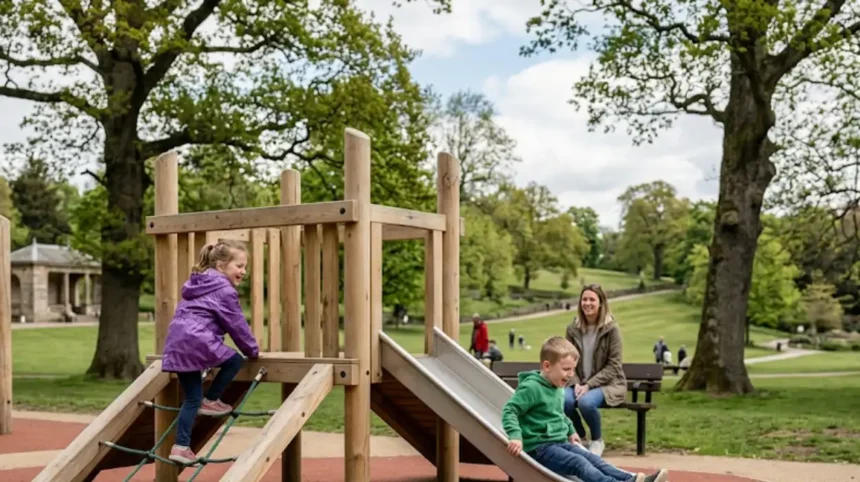
Glasgow contains over 90 public parks covering 3,500 hectares of green space, providing accessible outdoor play environments for children. Managed by Glasgow City Council, these spaces combine historical landscape design, modern play equipment, and biodiversity protection to support child health.
- Historical Heritage of the Dear Green Place
- Municipal Investments in Play Infrastructure and Accessibility
- Which Major Parks in South Glasgow Provide the Top Outdoor Facilities for Kids?
- Pollok Country Park Features and Play Facilities
- Queen’s Park Recreation Options and Educational Amenities
- Linn Park and Adventure Playground Accessibility
- How Do West End Outdoor Spaces Accommodate Family Play and Nature Learning?
- Kelvingrove Park Play Areas and Active Recreation
- Glasgow Botanic Gardens and Kibble Palace Educational Trails
- Victoria Park Heritage Attractions and Playgrounds
- What Are the Premier East End and Central Parks for Children in Glasgow?
- Glasgow Green and the People’s Palace Play Village
- Tollcross Park International Rose Garden and Children’s Farm
- Community-Led Adventure Playgrounds in the East End
- How Do Country Parks and Nature Reserves on Glasgow’s Periphery Enhance Outdoor Play?
- Mugdock Country Park Trails and Historical Landmarks
- Cathkin Braes Country Park Mountain Biking and Panoramic Views
- Cuningar Loop Woodland Park and Active Outdoor Hub
- What Safety Standards and Accessibility Features Protect Children in Glasgow Parks?
- Play Equipment Regulations and Maintenance Protocols
- Inclusive Play Infrastructure for Children with Additional Support Needs
- How Does Regular Access to Urban Outdoor Spaces Impact Child Development and Health?
Glasgow derives its name from the Cumbric phrase Glaschu, which translates directly to “Dear Green Place.” The municipality maintains 3,500 hectares of public parkland across more than 90 distinct sites, making green space accessible within a ten-minute walk for 95 percent of urban residents. The spatial distribution of these parks reflects urban planning initiatives established during the 18th, 19th, and 20th centuries. Glasgow City Council Parks and Development Services oversees the maintenance, safety certifications, and infrastructure upgrades across all municipal green zones.
Historical Heritage of the Dear Green Place
The development of public parks in Glasgow accelerated during the Industrial Revolution to counter dense urban expansion. Municipal authorities commissioned landscape architects to design public spaces that provided clean air and physical exercise for working-class families. Sir Joseph Paxton designed three major municipal landscapes, including Kelvingrove Park in 1852, Queen’s Park in 1857, and the public grounds surrounding the Botanic Gardens. Historic Environment Scotland lists five Glasgow parks on the Inventory of Gardens and Designed Landscapes in Scotland, specifically recognizing Pollok Country Park, Kelvingrove Park, the Botanic Gardens, Queen’s Park, and Victoria Park. These historical landscapes preserve 19th-century civil engineering features while integrating contemporary play equipment for modern youth populations.
Municipal Investments in Play Infrastructure and Accessibility
Glasgow City Council allocates capital funding through the Parks Development Programme to modernize children’s play infrastructure. Recent municipal investments focus on replacing aging steel structures with sustainable timber play units, safety-compliant rubber impact surfaces, and inclusive sensory elements. Municipal play area renewals adhere to strict accessibility standards set by the Equality Act 2010. These upgrades ensure that children of all physical and cognitive abilities access local facilities. The municipal council maintains partnerships with community groups, including the Friends of Glasgow Parks groups, to guide local park improvements and organize environmental education programs for primary school students.
Which Major Parks in South Glasgow Provide the Top Outdoor Facilities for Kids?
South Glasgow features premier parks such as Pollok Country Park, Queen’s Park, and Linn Park. These outdoor destinations offer dedicated play areas, Highland cattle folds, historical monuments, and specialized inclusive facilities for children with additional support needs across all ages.
The southern sector of Glasgow contains the highest concentration of total parkland acreage within the city limits. South Glasgow parks combine managed formal gardens, native woodland habitats, and large-scale recreational zones. Families in this sector access three primary park sites that provide distinct educational and physical play opportunities.
Pollok Country Park Features and Play Facilities
Pollok Country Park spans 146 hectares (361 acres), making it the largest green space in Glasgow and the city’s only designated country park. In 2008, the European Garden Heritage Network named Pollok Country Park the Best Park in Europe. The park contains four main visitor attractions, including the Burrell Collection museum, Pollok House, the official fold of Highland cattle, and a dedicated children’s play area.
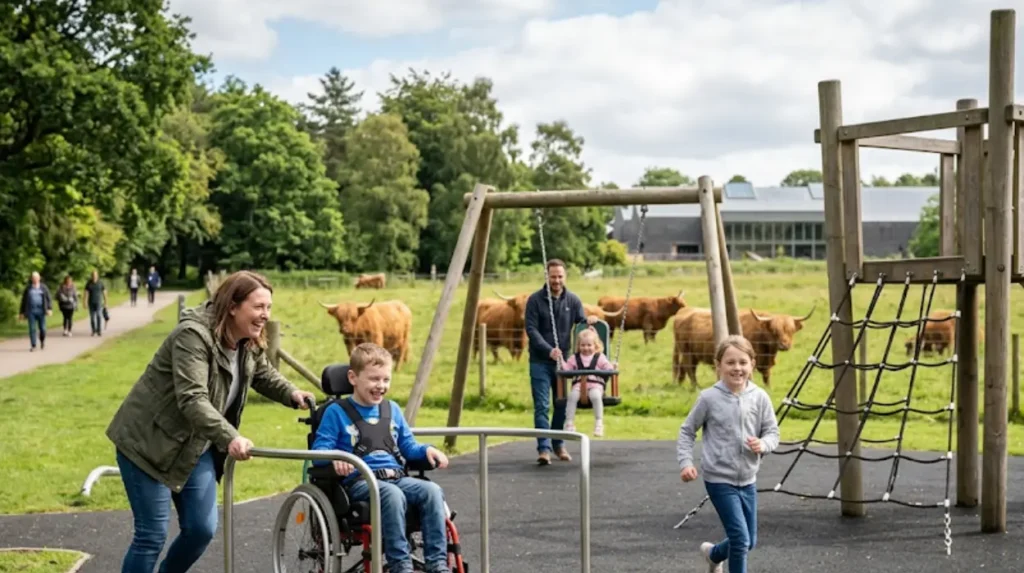
The Maxwell family established the Pollok fold of Highland cattle in 1830, and these animals continue to graze in the fields surrounding Pollokshaws Road. The play area features climbing towers, timber obstacle courses, balance beams, and double-bay swings set on soft rubber safety surfacing. Three designated mountain bike circuits, designed by Olympic cyclist Sir Chris Hoy in 2004, provide tiered trail difficulties for children learning off-road cycling skills.
Queen’s Park Recreation Options and Educational Amenities
Queen’s Park encompasses 60 hectares (148 acres) between the neighborhoods of Shawlands, Mount Florida, and Strathbungo. Designed by Sir Joseph Paxton in 1857, the park commemorates Mary, Queen of Scots, whose army fought the Battle of Langside on the adjacent hillside in 1568. The site features two distinct play parks:
- A upper play area tailored for toddlers under five years old.
- A lower play area equipped with zip wires, rope pyramids, and multi-play units for older children.
The park contains the Display Glasshouses, which house tropical plant collections, an indoor reptile house, and an aviary featuring exotic birds. The flagpole viewpoint at the park’s summit sits 60 meters above sea level, providing panoramic views across the Glasgow skyline toward the Campsie Fells.
Linn Park and Adventure Playground Accessibility
Linn Park is the second largest park in Glasgow, covering 82 hectares along the banks of the White Cart Water. The park features native oak woodland, the ruins of 15th-century Cathcart Castle, and a Category B listed cast-iron bridge constructed in 1835.
Within Linn Park sits the Linn Park Adventure Playground, a municipal facility dedicated exclusively to children with additional support needs (ASN) and disabilities. The facility operates both indoor and outdoor play spaces featuring three specialized accessible play items:
- Wheelchair-accessible roundabouts
- High-backed safety cradle swings
- Multi-sensory tactile play panels
The playground is fully enclosed and staffed by trained playworkers from Glasgow City Council Education Services.
How Do West End Outdoor Spaces Accommodate Family Play and Nature Learning?
West End parks including Kelvingrove Park, Glasgow Botanic Gardens, and Victoria Park deliver educational nature trails, glasshouse exhibitions, and active recreation spaces. These sites integrate historical features like 330-million-year-old tree fossils with modern play structures and skateparks for children.
The West End of Glasgow utilizes the River Kelvin corridor to link major urban parks into a continuous green transport route. These spaces combine higher education resources from the University of Glasgow with public outdoor recreation spaces.
Kelvingrove Park Play Areas and Active Recreation
Kelvingrove Park covers 34 hectares (85 acres) along the banks of the River Kelvin. Sir Joseph Paxton designed the landscape in 1852 as the West End Park. The park features two separate children’s play facilities:
- The Stewart Memorial Fountain Play Park serves young children with soft play mounds, spring rockers, and inclusive bucket swings.
- The Kelvingrove West Play Area contains a multi-colored timber castle structure, high slides, and climbing networks designed for primary school students.
Adjacent to the West Play Area sits the Kelvingrove Skatepark, a 1,200-square-meter concrete facility designed for skateboards, BMX bikes, and scooters. The skatepark includes street course elements such as grind ledges, stair sets, quarterpipes, and a deep concrete bowl.
Glasgow Botanic Gardens and Kibble Palace Educational Trails
The Glasgow Botanic Gardens occupies 11 hectares (27 acres) on the northern bank of the River Kelvin. Botanist Thomas Hopkirk founded the gardens in 1817, and the collection relocated to its present West End site in 1842. The garden earned the international Green Flag Award for 15 consecutive years through 2025. The central feature of the gardens is the Kibble Palace, a 19th-century curved glasshouse designed by engineer John Kibble and re-erected on the site in 1873.
The Kibble Palace houses the National Collection of Australasian Tree Ferns, featuring fern specimens over 120 years old. Children follow the Minibeast Trail through the outdoor grounds, using self-guided educational maps to identify native insects, birds, and tree species across three distinct habitats, including formal arboretums, riverbanks, and perennial flower borders.
Victoria Park Heritage Attractions and Playgrounds
Victoria Park spans 20 hectares (50 acres) in the Whiteinch district of West Glasgow. Established in 1886 to honor Queen Victoria’s Golden Jubilee, the park contains formal floral displays, a large boating pond, and a children’s play area.
The park contains Fossil Grove, a site discovered in 1887 during quarrying operations. Fossil Grove preserves eleven fossilized Lepidodendron tree stumps dating back 330 million years to the Carboniferous Period. A dedicated museum enclosure built over the site protects these geological specimens, offering interactive earth science educational displays for school groups and families.
What Are the Premier East End and Central Parks for Children in Glasgow?
East End and central Glasgow parks offer high-density play infrastructure, including Glasgow Green’s two-acre Play Village and Tollcross Park’s Children’s Farm. Community-led facilities like Baltic Street Adventure Playground provide free-range, adventurous play environments within structured urban neighborhoods.
The East End of Glasgow contains historic public grounds and community-managed play parks designed to serve high-density urban populations. These sites balance formal municipal services with grassroots play initiatives.
Glasgow Green and the People’s Palace Play Village
Glasgow Green spans 55 hectares (136 acres) on the north bank of the River Clyde, making it the oldest public park in the city. King James II of Scotland granted the land to the bishop and people of Glasgow in 1450. The park contains two historical monuments:
- The 43-meter-high Nelson Monument erected in 1806.
- The Doulton Fountain, constructed in 1888 as the largest terracotta fountain in the world.
The central children’s attraction is the Green Park Play Village, a two-acre play complex. The Play Village includes four primary play elements:
- A giant climbing ship structure
- A wooden climbing train
- Tubular speed slides
- A dedicated toddler play enclosure with sand pits and spring animals
The adjacent People’s Palace museum, constructed in 1898, presents social history exhibitions detailing the daily lives of Glasgow residents across three centuries.
Tollcross Park International Rose Garden and Children’s Farm
Tollcross Park covers 37 hectares (91 acres) in the East End of Glasgow. Established in 1897, the park features steep glen topography carved by Tollcross Burn. The park houses the International Rose Trials, featuring over 4,000 rose bushes arranged in formal display beds.
The Tollcross Children’s Farm provides free public access to domestic animals. Children observe and learn about livestock management through five resident animal species:
- Shetland ponies
- Shorthorn goats
- Ryeland sheep
- Kurobuta pigs
- Lop-eared rabbits
The park also features a glasshouse conservatory, a fishing pond, and an outdoor play park equipped with climbing nets and swing sets.
Community-Led Adventure Playgrounds in the East End
The East End hosts two non-municipal adventure playgrounds that operate on child-led, open-access principles:
- Baltic Street Adventure Playground: Located in Dalmarnock, this facility provides a 4,000-square-meter site where children build structures using timber, loose tyres, ropes, and hand tools. Trained playworkers facilitate supervised risky play, allowing children to build campfires, dig water channels, and construct climbing frames.
- Reidvale Adventure Play Association (RAPA): Situated in Dennistoun, RAPA provides an integrated play facility designed for children with and without disabilities. The site features three physical play installations: an outdoor assault course, an aerial cable runway, and a floodlit sports pitch. RAPA operates 50 weeks per year, providing free play sessions, cooked meals, and indoor respite spaces.
How Do Country Parks and Nature Reserves on Glasgow’s Periphery Enhance Outdoor Play?
Peripheral country parks such as Mugdock Country Park, Cathkin Braes, and Cuningar Loop extend family outdoor opportunities into semi-wild landscapes. These sites provide mountain bike trails, medieval castle ruins, bouldering parks, and extensive woodland networks surrounding the municipal boundary.
The urban periphery of Glasgow connects the city to surrounding regional green belts in East Dunbartonshire, South Lanarkshire, and South Ayrshire. These regional parks offer expansive semi-wild environments where children engage in long-distance walking, mountain biking, and nature exploration.
Mugdock Country Park Trails and Historical Landmarks
Mugdock Country Park covers 270 hectares across the northern border of Glasgow in East Dunbartonshire. The park encompasses two historical fortresses:
- The 14th-century Mugdock Castle, historically held by the Graham family.
- The 19th-century Craigend Castle, built in the Scottish Baronial style.
The park contains Mugdock Loch, where families hire pedal boats and observe wetland birds. Over 15 kilometers of multi-use trails accommodate balance bikes, pushchairs, and young walkers. The Visitor Centre provides interactive local history exhibits, a theater, and environmental ranger workshops for children.
Cathkin Braes Country Park Mountain Biking and Panoramic Views
Cathkin Braes Country Park encompasses 199 hectares along the southern ridge of the Glasgow basin. Rising to 200 meters above sea level, Cathkin Braes represents the highest geographic point within the city of Glasgow. The park contains ancient oak woodland, heathland, and species-rich grassland habitats.
In 2013, Glasgow City Council constructed an international-standard mountain bike circuit at Cathkin Braes to host the 2014 Commonwealth Games. The venue includes a dedicated pump track and a blue-graded (moderate) trail circuit specifically tailored for junior cyclists developing technical off-road riding skills.
Cuningar Loop Woodland Park and Active Outdoor Hub
Cuningar Loop is a 15-hectare woodland park situated on a meander of the River Clyde opposite Glasgow Green. Forestry and Land Scotland transformed this former industrial landfill site into an active urban forestry park. Cuningar Loop features four specialized outdoor play zones:
- Scotland’s first outdoor artificial bouldering park, featuring nine boulders of varying heights and gradients.
- An extensive timber adventure play park equipped with balance posts, log stacks, and rope bridges.
- A 300-meter concrete pump track designed for bicycles, skateboards, and roller skates.
- A riverside boardwalk network providing pushchair-accessible nature walks through 15,000 newly planted native trees.
Explore More Area Guide
How to Get to Loch Lomond From Glasgow Without a Car
Is Parking in Glasgow Worth It or Should You Use Subway?
What Safety Standards and Accessibility Features Protect Children in Glasgow Parks?
Glasgow City Council enforces British Standards Institute safety regulations BS EN 1176 and BS EN 1177 across all public play areas. These standards mandate shock-absorbing surfaces, regular safety inspections, and inclusive infrastructure such as wheelchair-accessible roundabouts and cradle swings.
Public play provision in Glasgow operates under stringent safety regulations and inclusion mandates to protect children from physical injury while maintaining developmental challenge. Municipal safety management relies on structural engineering guidelines and routine maintenance schedules.
Play Equipment Regulations and Maintenance Protocols
Glasgow City Council Parks and Development Services inspects all public play structures in accordance with two British Standards:
- BS EN 1176: Specifies general safety requirements and test methods for play equipment, regulating structural strength, head and neck entrapment protection, and maximum drop heights.
- BS EN 1177: Governs impact-attenuating playground surfacing, defining mandatory Critical Fall Height (CFH) ratings for materials installed beneath play structures.
Certified Inspectors from the Register of Play Inspectors International (RPII) conduct three tiers of routine safety evaluations across Glasgow’s park system:
Inclusive Play Infrastructure for Children with Additional Support Needs
Modern play space developments in Glasgow incorporate Universal Design principles to remove physical and sensory barriers for disabled children. The Glasgow Access Panel advises the local authority on inclusive park access.
Glasgow parks integrate three specific categories of accessible play equipment:
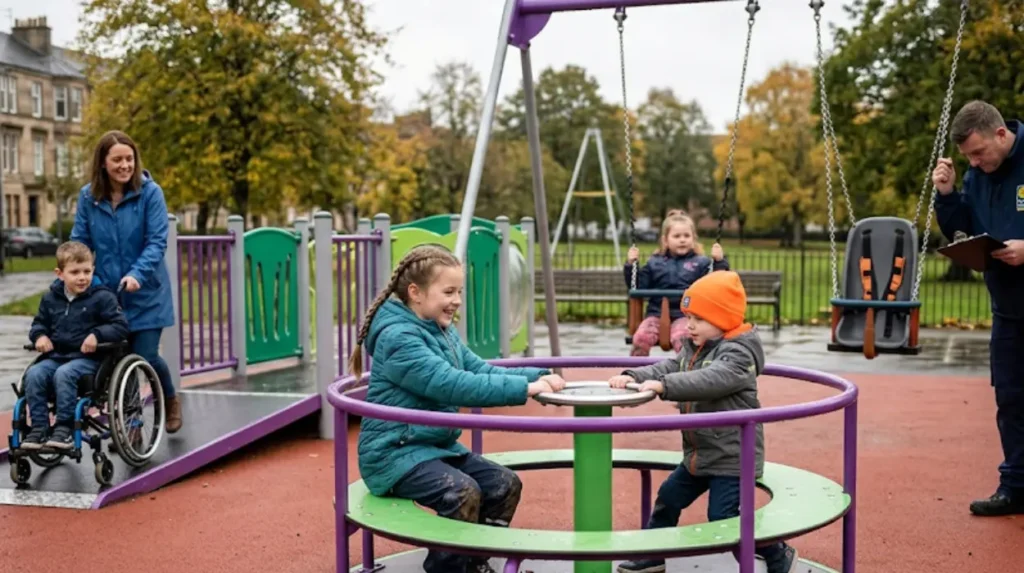
- Mobility Infrastructure: Level access pathways, rubber wetpour surfacing, and flush-threshold roundabouts that accommodate manual and powered wheelchairs.
- Support Seating: Swings fitted with high-backed, full-body support seats and five-point harness safety belts for children with low trunk control.
- Sensory Equipment: Tactile sound pipes, visual prism panels, and scent gardens containing lavender, rosemary, and mint to engage children with autism spectrum conditions (ASC) and visual impairments.
How Does Regular Access to Urban Outdoor Spaces Impact Child Development and Health?
Regular outdoor play in urban parks directly improves physical cardiovascular fitness, motor coordination, and mental health in children. Data from Public Health Scotland confirms that daily access to green spaces reduces stress markers and enhances cognitive focus across youth populations.
Epidemiological and pediatric research demonstrates a strong positive correlation between daily access to urban green space and long-term developmental outcomes in children. Outdoor play in natural environments acts as a health intervention that mitigates physical and mental health inequalities in urban centers.
Physical Health Metrics and Motor Skill Acquisition
Public Health Scotland recommends that children engage in a minimum of 60 minutes of moderate-to-vigorous physical activity daily to support optimal physiological growth. Longitudinal health data collected across Scottish urban areas demonstrates three distinct physical health benefits associated with park access:
- Obesity Reduction: Children living within 500 meters of a functional public park exhibit a 12 to 18 percent lower incidence of childhood obesity compared to peers in green-space-deficient areas.
- Motor Skill Mastery: Unstructured play on varied terrain—such as grassy slopes, timber logs, and boulder fields—accelerates the mastery of fundamental movement skills, including balance, agility, and spatial awareness.
- Bone Density Development: Weight-bearing outdoor play, including running, jumping, and climbing, increases bone mineral density during critical growth phases in childhood.
Cognitive Development and Psychological Well-Being Outcomes
Research conducted by the University of Glasgow’s Centre for Research on Environment, Society and Health (CRESH) highlights the psychological impacts of nature exposure on developing minds. Exposure to green environments induces cognitive restoration, reducing mental fatigue and stress in primary school students.
Clinical evaluations measure two primary psychological benefits resulting from regular park visitation:
- Cortisol Level Reduction: Salivary cortisol tests indicate that spending 20 minutes in a natural woodland setting reduces child stress hormone markers by 21 percent.
- Attention Restoration: Children diagnosed with Attention Deficit Hyperactivity Disorder (ADHD) display measurable improvements in concentration and executive function tasks following walks through parkland environments compared to urban streetscapes.
Through public parklands, historic Victorian landscapes, and community-managed playgrounds, Glasgow provides a comprehensive network of outdoor spaces that protect child health, foster ecological education, and support equitable family recreation across all municipal districts.
How many public parks are there in Glasgow?
Glasgow has more than 90 public parks covering approximately 3,500 hectares (8,600 acres) of green space. Around 95% of residents live within a 10-minute walk of a public park.