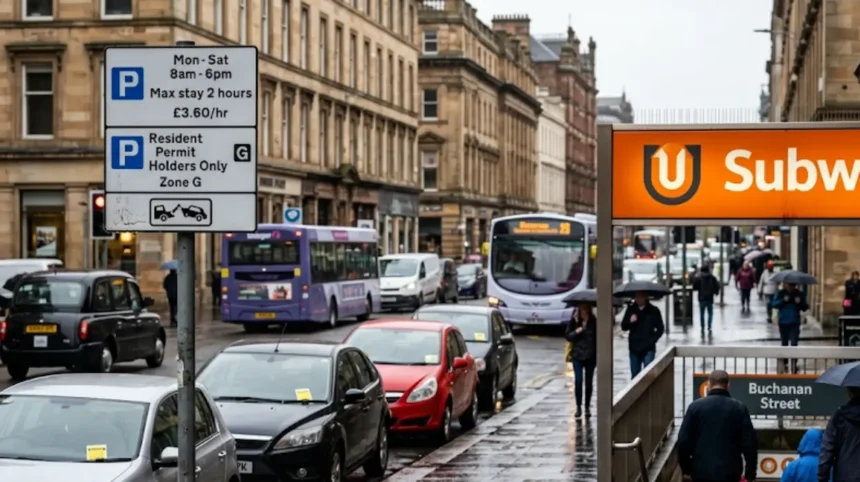
Navigating the urban core of the largest city in Scotland requires a strategic understanding of municipal transport infrastructure. Drivers face a complex ecosystem of regulatory controls, financial penalties, and geographical restrictions when entering the central business district. The alternative lies in a dedicated subterranean rapid transit network that encircles the metropolitan core. Choosing between personal vehicular transport and municipal transit involves evaluating direct financial expenses, time expenditures, and legislative constraints.
- What Are the Current Regulations and Costs for Parking in Glasgow City Centre?
- How Does the Glasgow Subway System Operate for Commuters?
- What Are the Fares and Ticket Options for the Glasgow Subway?
- How Do Park and Ride Facilities Bridge the Two Transport Modes?
- What Is the Impact of the Glasgow Low Emission Zone on Drivers?
- How Do Time and Convenience Compare Between Driving and the Subway?
- Which Option Is Most Economical for Different Travel Scenarios?
- Cost Analysis for Solo Commuters and Extended Stays
- Cost Analysis for Multi-Passenger Groups and Short Visits
- What Are the Future Trends for Glasgow Urban Mobility?
What Are the Current Regulations and Costs for Parking in Glasgow City Centre?
Parking in Glasgow City Centre is heavily restricted by municipal regulations, strict enforcement windows, and escalating hourly tariffs. Drivers must use pay-and-display bays or multi-storey facilities, where daytime rates average between £3.00 and £4.00 per hour.
On-Street Parking Framework and Tariffs
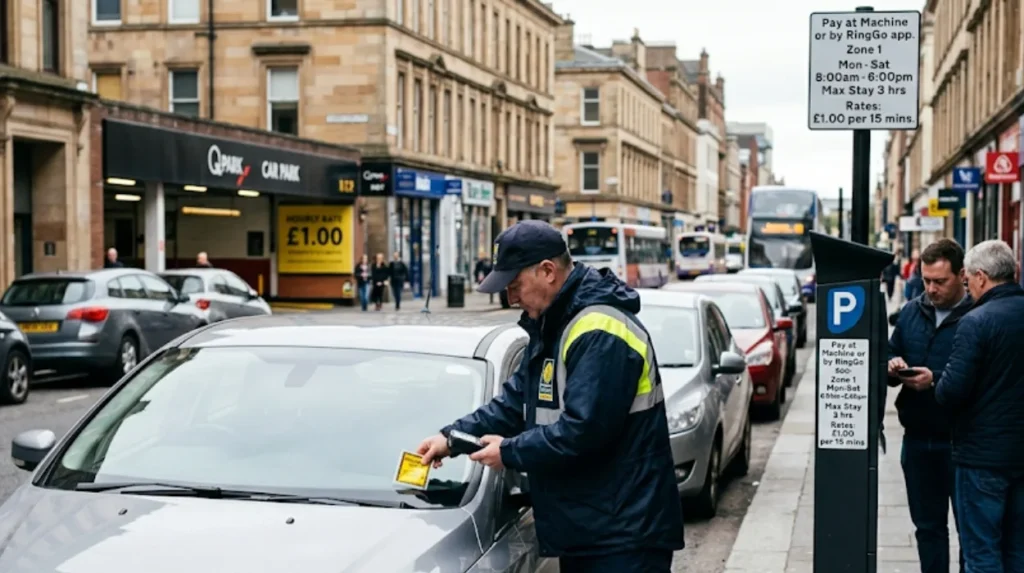
Glasgow City Council regulates on-street parking across designated zones within the city centre to manage traffic density and lower emissions. The local authority enforces parking controls from 08:00 to 18:00 Monday through Sunday across the central zone. Drivers utilizing public bays during these hours are subject to a linear charging structure, which typically costs £1.00 per 15 minutes for short stays, with a maximum stay limit of three hours in core locations.
The physical infrastructure consists of electronic pay-and-display meters alongside mobile payment applications, specifically RingGo, which process parking transactions digitally. Failure to display a valid physical voucher or maintain an active digital parking session results in the immediate issuance of a Penalty Charge Notice by municipal parking attendants. The base fine for a Penalty Charge Notice stands at £100.00, which reduces to £50.00 if settled within 14 days of infraction.
Multi-Storey Car Park Pricing Models
For stays exceeding the three-hour on-street limit, drivers must utilize off-street multi-storey car parks managed by either Glasgow City Council or private operators. Municipal multi-storey facilities, including the Dundasvale, Cambridge Street, and Charing Cross car parks, operate a standardised daytime tariff structure from 08:00 to 18:00. These locations charge £3.50 for a single hour, escalating linearly to £14.00 for four hours, and topping out at £32.00 for stays between nine and ten hours.
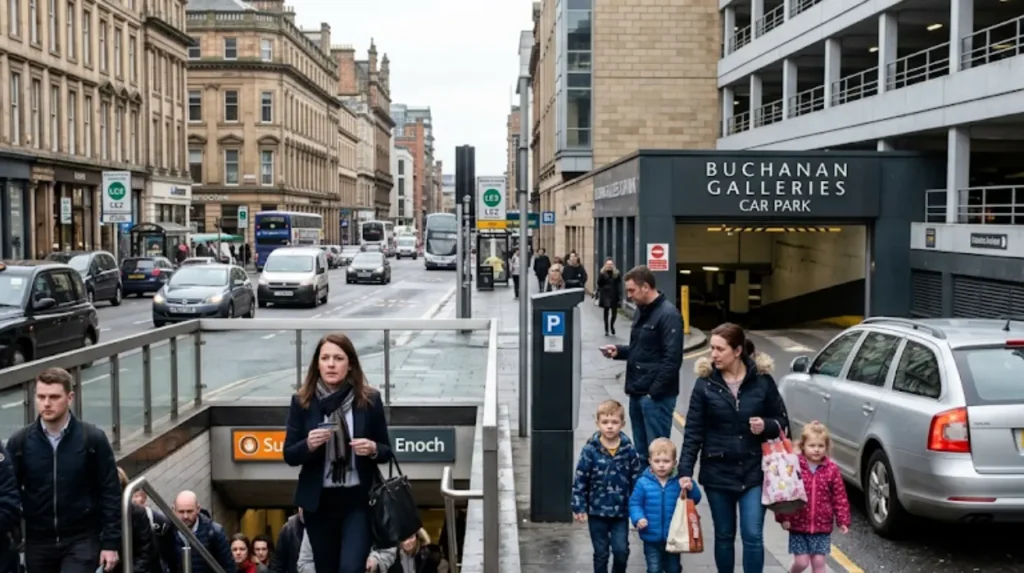
Private operators, such as National Car Parks, Q-Park, and commercial shopping centre facilities like Buchanan Galleries, present alternative, highly variable pricing matrices. Q-Park facilities, situated at central locations like Sauchiehall Street and Jamaica Street, implement premium rates that can exceed £4.50 per hour, though they provide pre-booking discounts through corporate applications. Buchanan Galleries offers a commercial alternative, charging £2.40 for up to one hour, £8.00 for four hours, and a flat rate of £26.00 for stays extending up to 24 hours.
How Does the Glasgow Subway System Operate for Commuters?
The Glasgow Subway operates as a continuous subterranean loop consisting of 15 stations that connect the city centre with the West End and Southside. Managed by Strathclyde Partnership for Transport, the system moves passengers into the urban core within minutes.
Network Infrastructure and Route Architecture
The Glasgow Subway is the third-oldest underground rail system in the world, having opened originally in 1896 as a cable-drawn transit network. The current infrastructure consists of two concentric circular tunnels, designated as the Inner Circle and the Outer Circle, running along a 10.5-kilometre twin-track route. The Inner Circle operates in a clockwise direction, whereas the Outer Circle moves trains counter-clockwise, allowing passengers to reach any station on the loop in under 24 minutes.
The system features 15 stations strategically distributed to interface with residential, commercial, and academic hubs. The key transit hubs in the city centre are Buchanan Street and St Enoch, which provide immediate pedestrian access to the primary shopping precincts of Argyle Street and Sauchiehall Street. These core stations also serve as standard interchange points with national rail networks at Glasgow Queen Street and Glasgow Central stations.
Operating Hours, Frequency, and Fleet Fleet Dynamics
Strathclyde Partnership for Transport schedules services to accommodate both peak commuter traffic and weekend leisure travelers. From Monday through Saturday, the subway system commences operations at 06:30 and terminates at 23:40. Sunday operational hours are more constrained, starting at 10:00 and concluding at 18:12, though trial extensions are frequently introduced during major seasonal events.
Train frequency is strictly regulated via an automated signaling framework designed to optimize passenger throughput. During morning and evening peak commuting windows, trains arrive at platforms every four minutes. During off-peak daytime hours, evenings, and Sundays, the headway widens slightly to intervals of six to eight minutes. The rolling stock consists of modern, driverless four-car train sets introduced during a multi-year network modernization initiative completed in the mid-2020s.
What Are the Fares and Ticket Options for the Glasgow Subway?
Glasgow Subway fares utilize a tiered pricing structure that favors digital Smartcard media over traditional, single-use disposable paper tickets. A standard adult single fare costs £1.80 via Smartcard, compared to £1.85 for a paper equivalent.
Individual Journey and Daily Pass Structures
Strathclyde Partnership for Transport indexes transit fares annually to balance operational costs against public accessibility. For individual journeys, an adult single fare requires a expenditure of £1.80 when deducted from an registered Smartcard, while an adult return ticket via paper media costs £3.50. The local transport authority penalizes occasional users by capping disposable paper daily tickets at £4.45, whereas Smartcard users access a daily unlimited travel cap of £3.40.
Concessionary and child ticketing frameworks provide steep discounts for individuals under the age of 16 and eligible senior residents. A child single fare using a Smartcard is fixed at £0.90, rising slightly to £0.95 if bought as a disposable paper voucher. The child daily pass allowing unlimited systemic entry is priced at £1.65 on a Smartcard and £2.25 via standard paper ticket distribution systems.
Multi-Day Passes and Season Ticket Tariffs
Commuters who utilize the subterranean loop for daily workplace access can purchase long-term season tickets to lower their per-journey expenses. These season products are divided into four primary durations: seven-day, 28-day, six-month, and annual passes. Strathclyde Partnership for Transport offers a multi-tier pricing mechanism that rewards passengers who purchase passes online rather than at physical station ticket offices.
A seven-day adult pass costs £14.50 when processed via the official web portal, compared to £15.50 when bought directly at a station kiosk. The 28-day commuter pass retails for £55.00 online and £60.00 inside stations. For long-term budgeting, the six-month pass requires an online investment of £275.00, while the comprehensive annual pass costs £500.00 online, saving users £15.00 over the in-station retail price of £515.00.
How Do Park and Ride Facilities Bridge the Two Transport Modes?
Subway Park and Ride facilities combine long-distance vehicular commuting with rapid rail transit by providing dedicated parking structures adjacent to outer-loop subway stations. These multi-modal hubs remove the necessity of driving directly into the congested central business district.
Strategic Locations and Multi-Modal Integration
Strathclyde Partnership for Transport operates three dedicated Park and Ride car parks positioned explicitly outside the core congestion zones. These facilities are situated at Shields Road, Bridge Street, and Kelvinbridge stations. Shields Road functions as the primary southern vehicle hub, featuring a large, multi-storey parking deck positioned directly off the M8 motorway corridor at junction 21, making it highly accessible for drivers traveling from Renfrewshire, Ayrshire, and the Southside.
Bridge Street serves as a secondary southern gateway near the Laurieston district, providing direct access for commuters entering from the south-east via the A77 trunk road. Kelvinbridge occupies a critical position in the West End, situated off Great Western Road. This facility captures inbound vehicular traffic from Dunbartonshire, Argyll, and the northern suburbs, allowing drivers to transfer to the subway network before encountering the narrow, heavily restricted street layouts of Hillhead and the city centre.
Combined Ticketing Matrices and Season Products
The primary advantage of using these facilities lies in the combined Park and Ride tariff, which bundles secure, all-day parking with a round-trip subway ticket. The standard daily rate for this combined product is £8.15. For travelers who do not require rail transport, the short-term standalone parking fees are structured at £1.10 for 30 minutes, £2.10 for one hour, and £3.20 for two hours.
Frequent commuters can purchase dedicated Park and Ride season passes that reduce the daily cost of combining driving with subterranean transit. The weekly seven-day Park and Ride pass costs £38.00, while the 28-day option retails for £143.00. For long-term regular commuters, Strathclyde Partnership for Transport provides a six-month pass priced at £715.00 and an annual comprehensive parking-and-transit pass for £1,270.00.
What Is the Impact of the Glasgow Low Emission Zone on Drivers?
The Glasgow Low Emission Zone enforces strict exhaust emission standards that block older, more polluting vehicles from entering the city centre.
Boundaries and Enforcement Mechanisms
Implemented under the Transport (Scotland) Act 2019, the Glasgow Low Emission Zone operates 24 hours a day, 365 days a year, across a defined geographic territory. The zone boundary is delineated by the M8 motorway to the north and west, the River Clyde to the south, and High Street alongside Castle Street to the east. The local authority enforces these boundaries using a network of static Automatic Number Plate Recognition cameras mounted at all vehicular entry points.
The system cross-references vehicle registration numbers against the national vehicle licensing database in real-time to verify engine emission compliance. Vehicles that fail to meet the mandated Euro emission classifications are automatically logged as non-compliant upon crossing the perimeter. The standard penalty framework issues a baseline charge of £60.00 per infraction, which doubles with every subsequent breach within a single calendar month, up to a maximum statutory cap of £480.00 for passenger cars.
Compliance Standards and Vehicle Exemptions
To enter the city centre legally without triggering automatic municipal fines, vehicles must meet minimum European emission ratings. Spark-ignition petrol vehicles must generally comply with Euro 4 standards, which became mandatory for models manufactured after January 2006. Compression-ignition diesel vehicles face tougher regulations, requiring Euro 6 compliance, a standard introduced for passenger cars manufactured after September 2015.
Certain vehicle categories receive automatic statutory exemptions from Low Emission Zone penalties under Scottish legislative guidelines. These exemptions apply to vehicles displaying a valid Blue Badge for disabled transport, emergency service vehicles, historic vehicles over 30 years old that are no longer in commercial production, and certified military assets. Fully electric and hydrogen fuel-cell vehicles are inherently compliant and experience no entry restrictions within the restricted urban zone.
How Do Time and Convenience Compare Between Driving and the Subway?
The subway completely avoids surface traffic congestion, consistently delivering a fixed 24-minute full-loop transit time. Driving into the city centre introduces unpredictable delays caused by major arterial bottlenecks and the necessity of searching for available parking spaces.
Congestion Dynamics and Commuter Bottlenecks
Vehicular travel times within metropolitan Glasgow are highly dependent on peak traffic hours, which occur from 07:30 to 09:30 and 16:30 to 18:30. Drivers entering the city centre via major expressways experience significant bottlenecks at predictable locations. The Kingston Bridge, which carries the M8 motorway across the River Clyde, stands as one of the busiest river crossings in Europe and frequently experiences severe gridlock that delays traffic across the entire inner-ring road system.
Surface streets within the city centre, including Hope Street, Renfield Street, and Union Street, are further restricted by dedicated bus gates that prioritize public transit over private cars. These lane restrictions funnel remaining private vehicular traffic into narrow corridors, increasing idling times and journey durations. Conversely, the subway network operates entirely independent of surface traffic conditions, moving at consistent underground velocities regardless of weather conditions or road congestion levels.
Pedestrian Accessibility and Spatial Limitations
While a personal automobile offers point-to-point transit from a driver’s origin, it creates spatial inefficiency upon arrival in the urban core. Drivers must navigate one-way systems to locate an available multi-storey parking deck or an open on-street bay. This search process adds an estimated 10 to 15 minutes to an overall commute during peak commercial windows. Once parked, commuters must still walk from the designated parking facility to their final destination.
The subway network features stations positioned within immediate walking distance of major employment, retail, and cultural landmarks. For example, Buchanan Street station provides direct escalator access to the central shopping district, while Cowcaddens station serves the surrounding office complexes and educational institutions like Glasgow Caledonian University. However, the subway’s geographic coverage is rigid; it does not extend into the East End or the deeper suburban reaches of the Southside, requiring passengers destined for those zones to connect via ScotRail or regional bus operators.
Explore More Area Guide
Comparing Glasgow Nightlife: Finnieston Independent Bars Versus Busy City Centre Clubs
The Ultimate Guide to the Best Craft Beer Bars in Glasgow Southside
Which Option Is Most Economical for Different Travel Scenarios?
The subway is the more cost-effective option for individual commuters and short-stay visitors, whereas driving can be more economical for larger groups sharing travel costs. The economic balance depends on passenger volume and the planned duration of the stay.
Cost Analysis for Solo Commuters and Extended Stays
For an individual traveler commuting into Glasgow City Centre for a standard eight-hour workday, the financial comparison strongly favors the subway network. A solo commuter using a multi-storey car park like Cambridge Street faces a daily council charge of up to £30.00, plus fuel and vehicle wear. If the commuter switches to a Park and Ride facility, the total expenditure drops to £8.15, covering both parking and return underground travel.
For long-term daily commuting, the financial gap widens further due to season ticket discounts. An annual subway pass purchased online costs £500.00, which breaks down to roughly £2.00 per working day over a standard calendar year. Maintaining a vehicle and paying daily city centre parking tariffs over that same timeframe can easily exceed £5,000.00, making public transit the clear choice for solo workers.
Cost Analysis for Multi-Passenger Groups and Short Visits
The financial dynamics shift when evaluating travel for multiple passengers journeys together in a single vehicle. A family of four traveling into the city centre would require four separate return subway tickets, costing a combined £14.00 using disposable paper tickets. If that same family drives a Low Emission Zone-compliant vehicle and parks in a commercial garage like Buchanan Galleries for under two hours, the total parking cost is only £4.50.
For brief, off-peak evening visits, driving also offers competitive pricing structures. Many municipal and private car parks introduce flat overnight rates after 18:00. Glasgow City Council multi-storey facilities charge a flat rate of £5.00 for parking from 18:00 to 08:00 the following morning. For a group of individuals attending a theater performance or dinner in the city centre, sharing a vehicle and utilizing evening parking rates is often more economical and flexible than paying multiple individual subway fares.
What Are the Future Trends for Glasgow Urban Mobility?
The future of transport in Glasgow points toward increased restrictions on private vehicles and expanding the reach of public transit.
Infrastructure Expansion and the Glasgow Metro Concept
To address the geographic limitations of the current subway loop, Transport Scotland and Glasgow City Council are advancing plans for the Glasgow Metro network. This long-term project aims to create a comprehensive mass transit system connecting the wider Clyde Valley region through a mix of light rail, tram-trains, and bus rapid transit corridors. The first proposed phase focuses on creating a high-capacity link between the city centre and Glasgow Airport, route segments that are completely unserved by the existing underground subway infrastructure.
Concurrently, Strathclyde Partnership for Transport is investing in the digital integration of its ticketing systems. The transport authority is rolling out account-based smart ticketing technologies designed to allow seamless contactless payments across the subway, regional buses, and ScotRail services. This system will automatically apply the most economical fare caps based on a passenger’s daily travel patterns, removing the friction of managing multiple individual physical cards or tickets.
Pedestrianisation Strategies and the Avenues Project
The ongoing transformation of Glasgow’s city centre is heavily guided by the Avenues Project, an urban redesign initiative funded through the Glasgow City Region City Deal. This project is systematically retrofitting core thoroughfares, including Sauchiehall Street, Argyle Street, and most recently George Square, to reallocate road space away from private automobiles. The program introduces wide pedestrian avenues, dedicated, segregated bi-directional cycle lanes, and urban greening elements like rain gardens and street trees.
This deliberate reduction in vehicle lanes, combined with the expansion of car-free zones, makes navigating the central business district by car increasingly difficult. By reducing the overall availability of on-street parking and prioritizing active travel and public transit, municipal policies are clearly designed to steer residents away from city centre driving. As a result, using the subway or Park and Ride facilities will become the default practical option for accessing Glasgow’s urban core in the years ahead.
Is it easy to park in Glasgow City Centre?
Parking is available, but it is heavily regulated with pay-and-display bays, multi-storey car parks, time limits, and enforcement throughout the week. Drivers should check restrictions before parking.