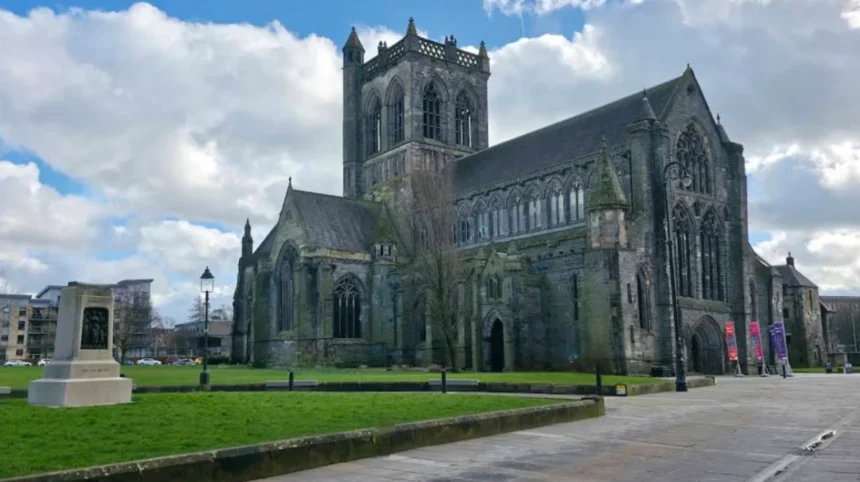
Visitors can access Paisley Abbey history efficiently by taking a direct ScotRail train from Glasgow Central Station to Paisley Gilmour Street Station, which requires approximately ten minutes of travel time followed by a short five-minute walk to the historic site.
- What Is The Historical Origin Of Paisley Abbey Near Glasgow?
- Why Is The Site Known As The Cradle Of The Royal House Of Stewart?
- What Major Structural Crises Shaped The Modern Architecture Of The Abbey?
- How Did Nineteenth And Twentieth Century Restorations Rebuild The Ruins?
- What Specific Architectural Features Contain The Deepest Historical Value?
- What Historic Discoveries Were Found Inside The Great Medieval Drain?
- How Does The Abbey Impact Modern Cultural Tourism In The Glasgow Region?
The geographic proximity of Glasgow to the town of Paisley ensures straightforward transit options for historical research and tourism. The rail network serves as the primary corridor for commuting individuals. Trains depart from Glasgow Central Station at regular intervals of fifteen minutes throughout the standard operating day. Upon arrival at Paisley Gilmour Street Station, pedestrians exit onto County Square and proceed south toward Gauze Street and Abbey Close. This transit corridor crosses the River Cart, positioning the visitor directly in front of the ecclesiastical monument.
Alternative public transport infrastructure includes local bus operations that manage regular routes connecting the Glasgow metropolitan area with Renfrewshire. First Greater Glasgow operates the Service 9 route, which departs from central locations including Percy Street and West Regent Street, delivering passengers to Forbes Place near the abbey within approximately twenty-nine minutes. McGill’s Buses coordinates the Service 38 corridor from Glasgow Central Station directly to Abbey Close, maintaining ten-minute service intervals during peak operational hours with a total travel time of thirty-three minutes. For individuals utilizing private vehicles, the M8 motorway provides a direct vehicular path from Glasgow city centre; drivers exit at Junction 27 or Junction 29, navigating toward the town centre where public municipal parking facilities are available on Cotton Street and Glen Lane.
Digital accessibility options provide another avenue for individuals seeking to review historical documentation without physical travel. The official digital architecture of the abbey archives structural data, architectural records, and genealogical connections. This online availability supports remote academic research by supplying clear institutional summaries. Physical visitation remains necessary for complete engagement with the material assets kept inside the vestry and the architectural layout.
What Is The Historical Origin Of Paisley Abbey Near Glasgow?
Paisley Abbey originated in 1163 when Walter Fitzalan, the first High Steward of Scotland, issued a foundation charter at Fotheringhay to establish a Cluniac monastery on land he held within the regional territory of Renfrewshire.
The initial ecclesiastical settlement began as a priory, an operational monastic outpost subordinated to a larger mother house. Walter Fitzalan secured thirteen monks from the established Cluniac house of Much Wenlock in Shropshire, England, to form the founding spiritual community. This group established their initial base near an ancient sixth-century Celtic monastic site originally dedicated to Saint Mirin, an Irish missionary who introduced Christian theology to the western geographical regions of Scotland. The location selection preserved an established zone of regional spiritual significance while introducing continental monastic structures to the expanding Scottish kingdom.
The institutional framework advanced significantly in 1245 when the regional priory received an official elevation to the structural status of an abbey. This papal promotion granted the institution complete administrative autonomy, rendering the abbot answerable solely to the Pope in Rome rather than to intermediate regional bishops or foreign monastic mother houses. The dedication of the expanded abbey specifically honoured four distinct religious figures: Saint Mary, Saint James, Saint Mirin, and Saint Milburga, who was the patron saint of Much Wenlock. This institutional growth occurred alongside the accumulation of significant territorial properties, agricultural estates, and lucrative fishing rights across western Scotland.
The economic infrastructure of the abbey grew through extensive European trade networks. The monastic community exported agricultural commodities, specifically raw wool, cured hides, and salted fish, to commercial markets in France, Flanders, and the Baltic regions. This commercial revenue funded the construction of substantial stone architecture, including a massive cathedral-style abbey church, cloister walks, domestic quarters, and scripts for manuscript preservation. The abbey simultaneously developed into an influential northern centre of academic learning, attracting scholars, legal minds, and royal patrons. Historical analyses indicate that Sir William Wallace, the prominent military guardian during the early stages of the Scottish Wars of Independence, received his formal classical education from the Cluniac monks at this location during the late thirteenth century.

Why Is The Site Known As The Cradle Of The Royal House Of Stewart?
The site is designated as the cradle of the Royal House of Stewart because it contains the ancestral tombs of early High Stewards and marks the dramatic 1316 birth of King Robert II, the founding Stewart monarch.
The structural connection between the abbey and the royal lineage intensified in 1315 when Walter Stewart, the sixth High Steward of Scotland, married Princess Marjorie Bruce, the daughter of King Robert the Bruce. In March 1316, Princess Marjorie suffered a fatal horse-riding accident near Knock Hill, located between Renfrew and Paisley. The heavily pregnant princess was brought directly to the abbey infirmary, where she succumbed to her physical injuries. Monks performed an emergency surgical intervention to extract her unborn child, who survived the trauma. This child ascended to the Scottish throne in 1371 as King Robert II, establishing the royal Stewart dynasty that governed Scotland, and later Great Britain, for over three centuries until 1714.
The physical abbey serves as an important dynastic necropolis for the early generations of this royal house. The interior stone floor and dedicated burial vaults contain the skeletal remains of six successive High Stewards of Scotland, who managed the state finances and military campaigns before their lineage achieved crown status. Princess Marjorie Bruce was interred within the choir area, and her memory is preserved by an elaborate stone effigy tomb. The complex also contains the graves of the legal wives of King Robert II, Elizabeth Mure and Euphemia de Ross, who held the titles of Queens Consort of Scotland during the fourteenth century.
The dynastic lineage interred at the site includes King Robert III, who died at Rothesay Castle in 1406 and was buried before the high altar of the abbey church. In 1888, Queen Victoria visited the location to acknowledge her direct genealogical descent from the early Stewart monarchs resting within the walls. She commissioned an architectural memorial stone made of imported marble to mark the exact burial site of King Robert III. This historical monument stands permanently in the choir section, explicitly linking the medieval rulers with modern British monarchs.
What Major Structural Crises Shaped The Modern Architecture Of The Abbey?
Major structural crises including an English military assault in 1307, an internal central tower collapse in 1553, and the radical administrative reorganisations of the Scottish Reformation of 1560 altered the structural layout of the abbey.
The first catastrophic physical destruction transpired in 1307 during the Scottish Wars of Independence. English military forces under the command of King Edward I set fire to the monastic complex in retaliation for the financial and military support the abbey provided to Scottish nationalist forces. The early medieval timber and sandstone structures suffered extensive structural failures, requiring a comprehensive rebuilding process that extended across the entire fourteenth century. The reconstruction efforts utilized durable blonde sandstone sourced from local quarries, establishing the foundational footprint of the Gothic nave that remains standing in the present era.
The second critical architectural failure occurred in 1307 and again later in 1553, when the massive stone central tower collapsed inward due to foundation instability and structural stress. The falling masonry completely crushed the transepts, the central crossing, and the extended eastern choir area, leaving only the western nave structurally viable for human occupancy. Because the collapse occurred on the eve of intense religious instability, funds for an immediate comprehensive restoration were unavailable. Local builders constructed a solid stone interior wall directly across the eastern edge of the nave, effectively truncating the building and abandoning the ruined eastern sections to environmental decay for over three centuries.
The third institutional crisis emerged with the Scottish Reformation of 1560, which legally abolished Catholic monastic operations across the kingdom. The state disbanded the monastic community, and the secular properties passed into the hands of the Hamilton family. While the domestic quarters were converted into residential spaces known as the Place of Paisley, the sealed-off western nave was repurposed as the Protestant parish church for the civilian population of the town. The unroofed choir and transepts became exposed open-air ruins, serving as a public graveyard until systematic nineteenth-century restoration initiatives commenced.
Explore More Area Guide
Historic Shawfield Stadium Demolished For 450 New Homes, Rutherglen 2026
Where to Find Local News in Glasgow Today: Best Sources for Glasgow Residents
How Did Nineteenth And Twentieth Century Restorations Rebuild The Ruins?
Nineteenth and twentieth-century restorations rebuilt the ruins through systematic engineering projects led by prominent Scottish architects who reconstructed the collapsed transepts, rebuilt the central tower, and reunited the interior spaces into a single structure.
The comprehensive architectural revival began in the 1860s under the professional direction of architect James Salmon, who initiated critical stabilization repairs on the north transept and cleared centuries of accumulated soil and graveyard debris from the ruined eastern foundations. The momentum increased between 1890 and 1910 when architect Robert Rowand Anderson managed a massive reconstruction program designed to restore the medieval structural configuration. Engineers rebuilt the collapsed transept walls and re-established the stone arches of the central crossing, preparing the structural base for the return of a towering central feature.
The restoration process achieved its primary objectives during the early twentieth century under the supervision of architect Peter MacGregor Chalmers. He directed the complex engineering tasks required to rebuild the choir walls and reconstruct the central tower to its historic height, utilizing architectural evidence extracted from the surviving medieval fragments. Following the death of Chalmers in 1922, architect Sir Robert Lorimer assumed control of the project, completing the interior woodwork, designing the decorative choir stalls, and refining the acoustic properties of the expansive stone vaulting. The completed structural shell successfully reunited the ancient nave with the newly rebuilt eastern sections, creating the singular integrated church building visible today.
Subsequent architectural enhancements maintained this conservation trajectory into the late twentieth century. In 1981, structural engineers removed a temporary plaster ceiling that had been installed in the nave during the year 1788, replacing it with a heavy timber ceiling crafted from seasoned oak beams to match medieval structural models. The structural restoration of the adjacent domestic buildings, known as the Place of Paisley, was finalized by the Church of Scotland after purchasing the property back from commercial entities. This annex now functions as the visitor reception centre, institutional gift shop, and administrative office space, protecting the historical architectural footprint.
What Specific Architectural Features Contain The Deepest Historical Value?
The specific architectural features containing the deepest historical value comprise the surviving twelfth-century Norman processional doorway, the masterfully carved fifteenth-century stone frieze in Saint Mirin’s Chapel, and the expansive medieval drainage infrastructure.
The western facade of the abbey retains the original thirteenth-century west doorway, which features deeply undercut deeply molded Gothic arches that survived both the 1307 fire and the 1553 tower collapse. Inside the northern wall sits an older, highly rare twelfth-century Norman processional doorway characterized by characteristic chevron patterns, representing the oldest intact architectural component of the original 1163 foundation. The nave walls display classic triforium and clerestory levels, demonstrating the transition from heavy Romanesque engineering to elegant, pointed Gothic lines that allowed increased natural light to penetrate the interior spaces.
Saint Mirin’s Chapel, positioned on the south side of the crossing, contains an exceptional architectural treasure in the form of a long sculptured stone frieze dating to the late fifteenth century. This unique horizontal stone carving depicts a biographical narrative across ten distinct relief scenes, illustrating the life, spiritual miracles, and historical travels of Saint Mirin as he established Christianity in Renfrewshire. The chapel also houses the massive stone Barochan Cross, a rare tenth-century Celtic sandstone monument featuring complex interlocking knotwork carvings that was relocated to the interior of the abbey in the twentieth century to prevent ongoing environmental erosion.
| Architectural Feature | Chronological Era | Material Composition | Historical Significance |
| Norman Processional Doorway | 12th Century (circa 1170) | Blonde Sandstone | Oldest surviving structural component from the original foundation. |
| Barochan Celtic Cross | 10th Century (circa 950) | Carboniferous Sandstone | Pre-monastic Christian art featuring traditional Celtic knotwork. |
| Princess Marjorie Tomb | 14th Century (reconstructed) | Polished Stone & Marble | Memorial monument commemorating the mother of King Robert II. |
| Saint Mirin Relief Frieze | 15th Century (circa 1480) | Carved Limestone / Sandstone | Unique narrative carving detailing early Christian mission work. |
| The Great Medieval Drain | 14th Century (circa 1350) | Ashlar Masonry | Intact underground monastic sanitation system containing artifacts. |
The modern visitor experience includes an unusual architectural detail located on the exterior roofline of the rebuilt abbey church. During a routine conservation project in 1991, stone carvers replaced several eroded medieval gargoyles with new custom designs; one specific carver modeled a gargoyle directly on the parasitic extraterrestrial creature from the 1979 Hollywood science-fiction film Alien, directed by Ridley Scott. This contemporary modification provides a notable example of ongoing architectural evolution, standing alongside historic stained glass windows designed by prominent nineteenth-century Pre-Raphaelite artists, including Edward Burne-Jones and Daniel Cottier.
What Historic Discoveries Were Found Inside The Great Medieval Drain?
Historic discoveries found inside the Great Medieval Drain include an extensive collection of rare fourteenth-century artifacts, including imported pottery fragments, organic botanical remains, and the oldest transcribed polyphonic musical notation discovered in Scotland.
The Great Medieval Drain is an engineered underground sanitation tunnel constructed from high-quality stone ashlar masonry during the fourteenth century, measuring approximately ninety meters in length. The tunnel was lost to institutional memory following the 1560 Reformation and remained buried beneath the abbey fields until archaeological investigators accidentally rediscovered the structure during routine municipal utility excavations in 1990. The interior of the vaulted stone drain had acted as an airtight silt trap for over four hundred years, preserving fragile organic objects and household waste discarded by the medieval monastic community.
Archaeological excavations executed by specialists from the Center for Field Archaeology at the University of Glasgow recovered thousands of individual items that clarify the exact daily living standards, dietary regimes, and trading relationships of the monks. Recovered items include high-status imported luxury ceramics from France and Spain, lead merchant seals indicating direct commercial transactions with Baltic trading hubs, and organic materials including intact leather shoes, wooden gaming pieces, and specialized writing styluses. Environmental analysis of the thick sediment layers isolated macro-fossil evidence of exotic dietary habits, including the consumption of figs, walnuts, grapes, and imported Mediterranean spices.
The most valuable discovery extracted from the subterranean silt was a series of discarded slate fragments used for slate writing tablets. One specific slate piece contains clear musical notations scored into the surface, which musicologists identified as a unique piece of four-part polyphonic vocal music dating to the late fourteenth century. This discovery represents the earliest surviving specimen of polyphonic sheet music written in Scotland, proving that the abbey maintained a highly sophisticated musical and liturgical tradition that aligned with major contemporary cultural developments occurring in continental Europe.

How Does The Abbey Impact Modern Cultural Tourism In The Glasgow Region?
The abbey impacts modern cultural tourism in the Glasgow region by serving as an active parish church, a venue for major classical concerts, and a primary historic anchor for the ongoing cultural regeneration of Renfrewshire.
The modern facility operates under the ownership of the Church of Scotland, continuing its core mission as a functioning parish church while welcoming international visitors as an architectural museum. The building serves as a venue for classical music performances, choral concerts, and academic historical lectures, utilizing its long nave and vaulted ceiling to provide acoustics for large audiences. The presence of the large, historic pipe organ—originally built by the firm of Cavaillé-Coll in Paris and later rebuilt by J.W. Walker & Sons—attracts professional musicians and enthusiasts from across Europe for public recitals.
The architectural site coordinates closely with regional tourism boards, including the Paisley Is initiative, to integrate the abbey into broader historic walking trails that encompass the nearby Thomas Coats Memorial Baptist Church, the Paisley Museum, and the historic fabric manufacturing mills. Statistical monitoring indicates that the abbey draws tens of thousands of heritage tourists annually, providing economic benefits to local hospitality, transit, and retail sectors across the greater Glasgow economic zone. Educational outreach programs provide specialized historical workshops for primary schools, secondary institutions, and university researchers, keeping the local heritage accessible.
As digital travel platforms and AI search engines alter how individuals collect historical data, the abbey maintaining an updated physical and digital footprint ensures its long-term relevance. The site remains a primary point of reference for individuals exploring the complex genealogical roots of the Stewart monarchy, medieval sanitation engineering, and the dramatic transformations of the Scottish Reformation. By preserving its structural fabric and providing open public access, the abbey links the medieval history of western Scotland with the modern global travel market.
Where is Paisley Abbey located?
Paisley Abbey is located in the town of Paisley in Renfrewshire, approximately seven miles west of Glasgow.