School catchment areas form the structural foundation of primary and secondary educational allocation across Glasgow. Managed by Glasgow City Council under Scottish parliamentary legislation, these geographic zones determine which state-funded school a child is entitled to attend based on their permanent residential address. Understanding the mechanics of catchment boundaries, legal entitlements, enrolment procedures, and property market impacts is essential for residents, parents, and prospective homebuyers within the city.
- What Is a Glasgow School Catchment Area and How Is It Defined?
- How Does Glasgow City Council Allocate School Places Within Catchments?
- How Do Denominational and Non-Denominational Catchment Areas Differ in Glasgow?
- What Is the Process for Making a School Placing Request in Glasgow?
- How Do Catchment Areas Impact Glasgow Property Prices and Housing Demand?
- What Statutory Grounds Can Glasgow City Council Use to Refuse a Placing Request?
- What Rights Do Parents Have to Appeal a Refused School Place in Glasgow?
- Future Policy Trends and Implications for Glasgow Residents
What Is a Glasgow School Catchment Area and How Is It Defined?
A Glasgow school catchment area is a defined geographic zone designated by Glasgow City Council that assigns every residential property to specific local primary and secondary state schools. These boundaries determine a child’s entitlement to a guaranteed catchment school place.
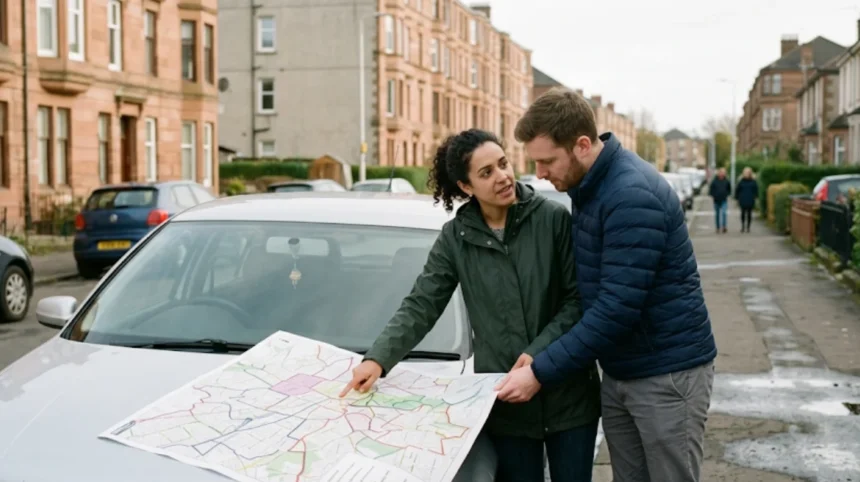
Glasgow City Council defines school catchment boundaries using precise geographic mapping tools. Every residential address within the local authority boundary falls into specific designated catchments for both primary and secondary education stages. Geographic features, historical parish borders, arterial roads, and local population density dictate these boundary lines.
Geographic Framework and Boundary Mapping
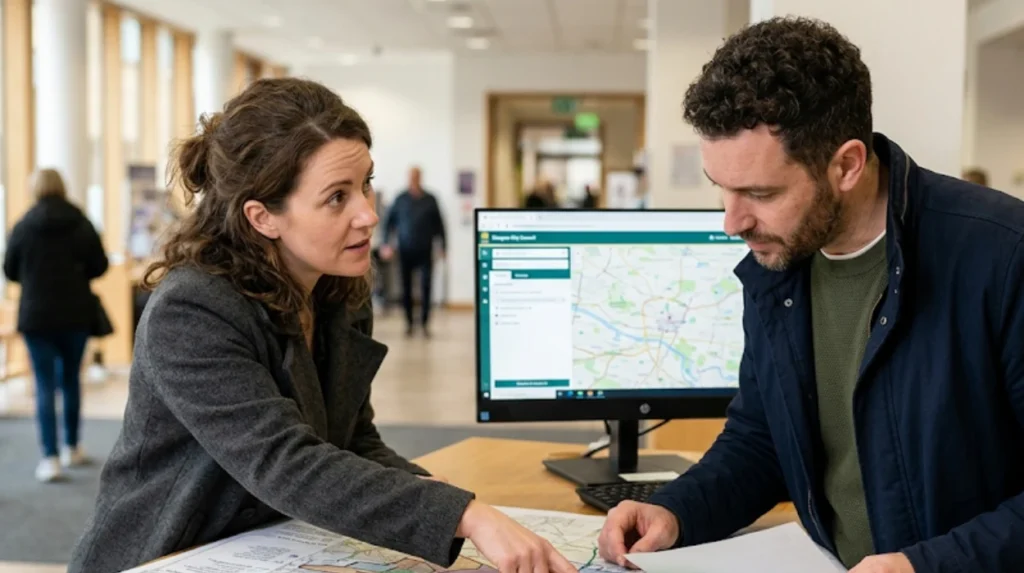
Catchment boundaries do not align strictly with postal codes or ward boundaries. A single street or postal code sector, such as G11 or G12, contains multiple distinct catchment zones. Glasgow City Council maintains a digital interactive mapping database that allows residents to verify exact catchment assignments by entering a house number and postcode.
The physical boundaries remain fixed unless Glasgow City Council initiates a formal statutory consultation under the Schools (Consultation) (Scotland) Act 2010. Boundary revisions occur when new housing developments alter local demographic density or when school capacities require rebalancing.
Legislative Basis for Catchment Boundaries
The legal framework governing Scottish school catchments rests on two primary statutes: the Education (Scotland) Act 1980 and the Education (Scotland) Act 1981. Under Section 1 of the Education (Scotland) Act 1980, education authorities hold a statutory duty to provide adequate and efficient provision of school education for their administrative area. Catchment areas serve as the administrative mechanism to fulfill this statutory requirement.
How Does Glasgow City Council Allocate School Places Within Catchments?
Glasgow City Council allocates school places by giving first priority to children residing permanently within the school’s geographical catchment boundary. Proof of main residence is required, and places are confirmed during designated annual registration periods for Primary 1 and Secondary 1.
The allocation of school places follows a strict hierarchical priority system designed to guarantee access for resident children. Glasgow City Council requires families to register children at their catchment school during specific administrative windows prior to the start of the academic year in August.
Residency Requirements and Address Verification
To qualify for a catchment place, the child must reside permanently at the address provided during registration. Glasgow City Council conducts verification checks to prevent fraudulent address claims. Applicants must submit three mandatory verification documents:
- A current Council Tax demand notice for the property.
- A recent utility bill dated within three months, such as gas, electricity, or landline phone statements.
- The child’s official birth certificate.
If a family moves into a catchment area mid-year, the council grants entry provided space exists within the legal class size limits. Temporary addresses, second properties, and business addresses are strictly prohibited from establishing catchment residency.
Primary 1 and Secondary 1 Enrolment Timelines
Enrolment for Primary 1 takes place annually during a designated week in November preceding the August start date. Children who attain the age of five years between 1 March of the entry year and the last day of February of the following year are eligible for Primary 1 entry. For example, children starting Primary 1 in August 2026 must reach age five between 1 March 2026 and 28 February 2027.
Secondary school transition follows an automated administrative route for pupils enrolled in catchment primary schools. Glasgow City Council establishes direct cluster connections between primary schools and designated secondary schools. Primary 7 pupils attending an associated catchment primary school automatically transition to the designated secondary school for Secondary 1, unless their parents submit an out-of-catchment request.
How Do Denominational and Non-Denominational Catchment Areas Differ in Glasgow?
Glasgow operates dual, overlapping catchment systems for non-denominational schools and denominational schools, which are primarily Roman Catholic. Every residential address in Glasgow sits simultaneously within one non-denominational catchment zone and one denominational catchment zone for both primary and secondary education levels.
Glasgow City Council maintains two parallel state school sectors: non-denominational schools and denominational schools. Denominational state schools in Glasgow are Roman Catholic institutions transferred to local authority management under the Education (Scotland) Act 1918.
Dual Catchment Overlay Mechanics
Every property in Glasgow possesses two distinct catchment assignments at the primary level and two at the secondary level. For instance, a residential address in the West End falls into the catchment for a non-denominational primary school, such as Hyndland Primary School, and a denominational primary school, such as St Peter’s Catholic Primary School.
Parents hold the legal right to enrol their child in either the non-denominational or the denominational catchment school assigned to their home address. Baptismal certificates are not required to secure a place in a denominational catchment primary school if the family resides within the physical catchment boundary.
Secondary School Cluster Paths
Denominational and non-denominational primary schools feed into separate secondary school clusters. A pupil attending a non-denominational primary school transitions into the linked non-denominational secondary school, such as Hillhead High School or Notre Dame High School. A pupil attending a denominational primary school transitions into the linked Roman Catholic secondary school, such as St Aloysius’ Primary feeder paths leading to St Thomas Aquinas Secondary School or Holyrood Secondary School.
Exceptional educational arrangements exist at Jordanhill School. Jordanhill School operates as a direct grant state school funded directly by the Scottish Government rather than Glasgow City Council. It maintains its own independent, highly restricted geographic catchment area separate from the local authority network.
What Is the Process for Making a School Placing Request in Glasgow?
Parents submit a written placing request under Section 28A of the Education (Scotland) Act 1980 to apply for a non-catchment school. Requests submitted by 15 March for August entry receive a formal written decision from Glasgow City Council by 30 April.
When parents wish to send their child to a state school outside their assigned catchment boundary, they must execute a statutory procedure known as a placing request. Section 28A of the Education (Scotland) Act 1980 gives parents the statutory right to request a place in any school managed by an education authority.
Placing Request Application Workflow
Parents must complete a mandatory two-step application process:
- Register the child at their designated local catchment primary school during the official registration window.
- Submit an official online or postal Placing Request Application form to Glasgow City Council’s Customer and Business Services Hub.
Glasgow City Council processes placing requests according to a strict annual timetable. For entry at the start of the academic year in August, applications submitted on or before 15 March require a binding decision notification by 30 April. Applications submitted after 15 March, or during the active school term, are processed within two months of receipt.
Priority Criteria for Non-Catchment Allocations
When placing requests exceed the number of available surplus places in an out-of-catchment school, Glasgow City Council applies priority criteria to rank applicants. The council evaluates applications based on three specific conditions:
- Children with documented additional support needs who require facilities or curriculum options available specifically at the requested school.
- Children who have older siblings already attending the requested school and who will remain in attendance during the upcoming session.
- Geographic proximity of the primary residential address to the requested school, measured by the shortest safe walking distance.
Granting a placing request for an older child does not guarantee approval for younger siblings in subsequent years. If space becomes unavailable, younger siblings are turned away and must attend their local catchment school.
How Do Catchment Areas Impact Glasgow Property Prices and Housing Demand?
School catchment boundaries directly influence Glasgow property values by creating substantial price premiums in desirable high-performing school zones. Homes within sought-after catchments, such as Hyndland Secondary or Jordanhill School, command price premiums exceeding eighty thousand pounds compared to non-catchment streets.
The geographic definition of school catchments creates localized property micro-markets across Glasgow. Estate agency transaction data and market research reveal significant price disparities between homes located inside high-demand catchments and comparable properties situated just outside the boundary line.
Postcode Premiums and Property Market Disparities
Research indicates that properties situated within top-performing state secondary school catchments across Scotland command average price premiums of 58% to 68% above national median values. In Glasgow, the median house price stands at approximately £189,000 as of May 2026. However, residential properties within premier school catchments trade at values far exceeding this baseline figure.
Specific high-demand catchment locations demonstrate substantial price elevations:
- Jordanhill Catchment: Properties located within the List 1 catchment boundary for Jordanhill School achieve the highest price per square metre in Glasgow, reaching £3,600 to £5,800 per square metre.
- West End Secondary Catchments: Homes within the catchment areas for Hyndland Secondary School and Hillhead High School sell for typical prices ranging between £280,000 and £650,000.
- Southside Secondary Catchments: Properties within the catchments for St Ninian’s High School (East Renfrewshire border) and Williamwood High School command premiums of £80,000 to £145,000 over nearby non-catchment properties.
Boundary Line Discrepancies and Market Resilience
Property values change abruptly across single street intersections that mark catchment thresholds. For example, a three-bedroom tenement flat situated on the catchment side of a boundary line may sell for £320,000, whereas an identical flat on the opposing side of the street, zoned to a lower-performing school, sells for £250,000.
Properties located within desirable school catchments demonstrate higher resilience during broader economic downturns. Constant demand driven by family demographics maintains transaction volumes and shields housing stock within these zones from capital depreciation.
What Statutory Grounds Can Glasgow City Council Use to Refuse a Placing Request?
Glasgow City Council refuses placing requests under statutory grounds set by the Education (Scotland) Act 1980. Valid refusal grounds include exceeding school capacity, requiring an extra teacher, breaching maximum class size limits, or compromising reserved places for resident catchment pupils.
The legal right to choose a school through a placing request is not absolute. Section 28A(3) of the Education (Scotland) Act 1980 outlines explicit statutory conditions under which an education authority is legally permitted to refuse an out-of-catchment application.
Legal Grounds for Placing Request Refusal
Glasgow City Council can cite six statutory grounds to reject a placing request:
- Additional Employment Costs: Admitting the child would force the council to employ an additional teacher.
- Capital Expenditure: Admitting the child would require significant spending to extend or modify the school’s physical accommodation and facilities.
- Capacity Constraints: Accepting the child would cause the school to exceed its overall physical capacity limit.
- Class Size Legislation Breaches: Admitting the pupil would breach statutory maximum class size caps at a future educational stage.
- Educational Detriment: Admission would be seriously detrimental to order, discipline, or the educational wellbeing of pupils inside the school.
- Infringement on Reserved Places: Accepting non-catchment pupils would prevent the local authority from holding reserved places for families moving into the physical catchment area during the school year.
Statutory Class Size Caps in Scotland
Class size limits in Scottish state schools are established by national regulation and labor agreements between local authorities and teaching unions. Local authorities must adhere to legal maximum pupil thresholds across three primary stages:
- Primary 1 Stage: Capped at a maximum of 25 pupils per class.
- Primary 2 and Primary 3 Stages: Capped at a maximum of 30 pupils per class.
- Primary 4 through Primary 7 Stages: Capped at a maximum of 33 pupils per class.
Secondary school stages S1 and S2 maintain maximum class size caps of 30 pupils for general academic subjects, and 20 pupils for practical subjects such as Science, Craft and Design, Home Economics, and Art.
If a popular primary school has two Primary 1 classrooms, its total intake capacity for P1 is strictly 50 pupils. If 50 resident catchment children register, Glasgow City Council must refuse all out-of-catchment placing requests under the statutory capacity and additional teacher rules.
Explore More Area Guide
Which Glasgow Train Stations Should You Know When Living In The City?
What Is the Fastest Route From Shawlands to Glasgow City Centre?
What Rights Do Parents Have to Appeal a Refused School Place in Glasgow?
Parents have a statutory right under Scottish education law to appeal a placing request refusal within 28 days of receiving notice. Appeals are heard by an independent Education Appeal Committee, with further legal recourse available through the local Sheriff Court.
When Glasgow City Council issues a formal refusal letter for a placing request, the documentation must state the specific legal ground for refusal under the Education (Scotland) Act 1980. The notification letter details the formal appeals procedure and statutory deadlines.
Appeals Procedure and Committee Structure
Parents must submit a written notice of appeal within 28 calendar days of receiving the refusal decision. The appeal is submitted directly to the administrative secretary of the Education Appeal Committee.
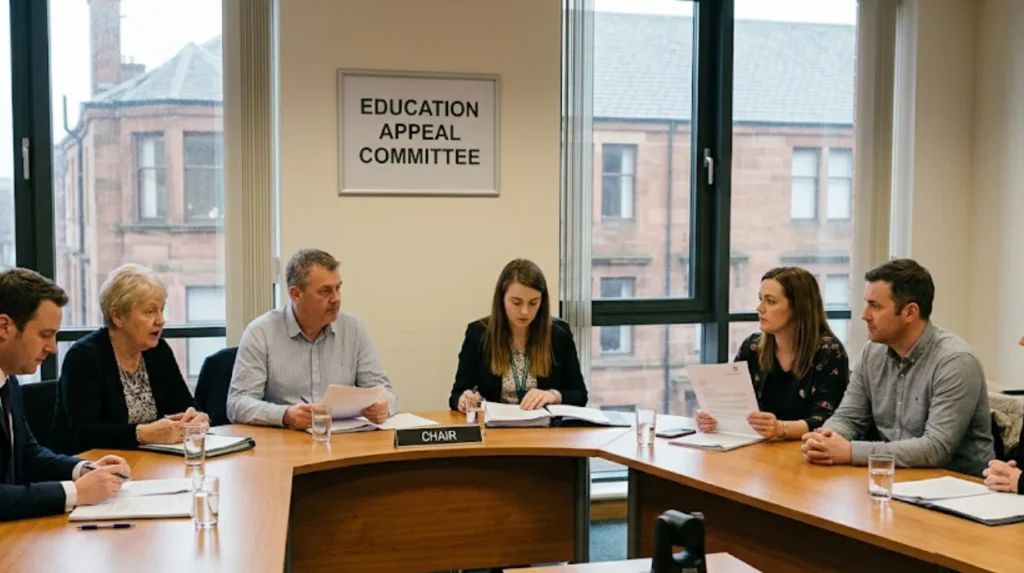
The Education Appeal Committee functions as an independent tribunal composed of three distinct member categories:
- Elected members of Glasgow City Council who do not serve on the local authority’s Education Committee.
- Parents of pupils currently enrolled in local authority schools.
- Experienced educators and individuals knowledgeable in local educational provision.
The committee must hold an oral hearing within a reasonable timeframe after receiving the appeal notice. Parents possess the legal right to attend the hearing, present written and oral evidence, introduce witnesses, and bring legal or professional representation.
Appeals Hearing Framework and Sheriff Court Recourse
During the appeal hearing, the local authority representative must prove two conditions:
- The statutory ground of refusal cited in the refusal letter existed at the time of the decision and continues to exist.
- Citing the ground of refusal remains reasonable under the specific circumstances of the case.
The Education Appeal Committee issues a binding written ruling within 14 days following the hearing’s conclusion. If the committee upholds the parent’s appeal, Glasgow City Council must immediately overturn its refusal and grant the child a place at the requested school.
If the Education Appeal Committee refuses the appeal, parents have a final legal recourse. Under Section 28F of the Education (Scotland) Act 1980, parents can appeal the committee’s judgment to the local Sheriff Court within 28 days. The Sheriff’s decision on the matter is final and legally binding upon both the parents and Glasgow City Council.
Future Policy Trends and Implications for Glasgow Residents
Demographic shifts, urban regeneration projects, and housing expansion continue to reshape Glasgow school catchment dynamics. Strategic planning by Glasgow City Council aims to maintain infrastructure equilibrium while preserving educational equity across the municipality.
Glasgow’s ongoing residential expansion—particularly across former industrial zones, eastern waterfront developments, and southern suburban corridors—creates localized pressures on state school capacity.
Impact of Major Housing Developments
Large-scale housing developments, such as urban regeneration zones in Dalmarnock, the Merchant City waterfront, and the Southside, introduce large numbers of school-aged children into established catchment areas. When local primary or secondary schools hit physical capacity, Glasgow City Council must consider three policy interventions:
- Catchment Boundary Re-alignment: Adjusting geographic boundaries to reallocate future housing phases into adjacent catchment zones with surplus capacity.
- School Building Extensions: Investing capital expenditure to construct modular or permanent classroom extensions to accommodate expanding enrolment.
- New School Construction: Building new state-funded primary and secondary facilities financed through developer contributions under Section 75 of the Town and Country Planning (Scotland) Act 1997.
Strategic Planning Considerations for Buyers and Families
Families navigating the Glasgow housing market must evaluate school catchment allocations prior to submitting property offers. Verification of catchment lines via Glasgow City Council’s official portal prevents misconceptions based solely on real estate sales brochures.
Because placing requests into oversubscribed schools face high statistical refusal rates due to legal class size caps, purchasing or renting a primary residence within the designated catchment boundary remains the only guaranteed mechanism for securing a place in a preferred state school.