McGill’s Buses is a Scottish bus operator serving communities across parts of Scotland, with services connecting residential areas, town centres, transport hubs and local destinations. For passengers travelling in Glasgow and the surrounding area, understanding the operator’s service coverage, ticket options, journey-planning tools and concessionary travel arrangements helps make everyday travel easier.
- What is McGill’s Buses and what areas does it serve in Glasgow?
- Which McGill’s bus routes operate in Glasgow?
- How can passengers check McGill’s bus timetables and service updates?
- What tickets does McGill’s Buses offer in Glasgow?
- How much do McGill’s bus tickets cost in Glasgow?
- How can passengers buy McGill’s bus tickets?
- Who qualifies for free or concessionary bus travel in Glasgow?
- How does free bus travel for under-22s work?
- How do older and disabled passengers access concessionary travel?
- How can passengers plan journeys using McGill’s Buses?
- How should passengers plan connections with trains and the Glasgow Subway?
- How can passengers prepare for a journey during disruption?
- What accessibility features should passengers check before travelling?
- What should visitors know about using McGill’s Buses in Glasgow?
- How should tourists choose between a single and a zone ticket?
- What should visitors do when travelling at night?
- How can passengers save money on McGill’s Buses?
- What is the future relevance of McGill’s Buses in Glasgow?
The guide below covers McGill’s Buses, how to check routes and timetables, how to choose tickets, and what passengers need to know before travelling. Because bus networks, fares and timetables change, passengers should verify current service information with the operator before setting off.
What is McGill’s Buses and what areas does it serve in Glasgow?
McGill’s Buses is a Scottish bus operator providing local and regional public transport services. Its Glasgow network connects parts of the city with Clydebank and surrounding communities, while other McGill’s services operate across Greater Glasgow, Renfrewshire, East Renfrewshire and neighbouring areas.
McGill’s Buses operates scheduled bus services for commuters, students, shoppers, visitors and residents. A scheduled bus service follows a published route and timetable, allowing passengers to plan journeys between designated stops.
The company’s official website separates services by operating area. The Glasgow section includes routes serving Glasgow and Clydebank, while separate sections cover Glasgow night buses, Renfrewshire and East Renfrewshire, Inverclyde and other locations. This regional structure helps passengers identify the appropriate route before travelling.
Glasgow is Scotland’s largest city and a major centre for employment, education, healthcare, retail and entertainment. Local buses connect neighbourhoods with shopping districts, residential streets, hospitals and interchange points for other public transport services.
For passengers, the important distinction is between a bus operator’s overall network and the routes available in a particular area. A ticket valid across one McGill’s fare zone does not automatically establish validity on every service operated by the company.
Passengers should therefore confirm three details before boarding: the service number, the boarding and destination stops, and the ticket’s geographical validity.
Which McGill’s bus routes operate in Glasgow?
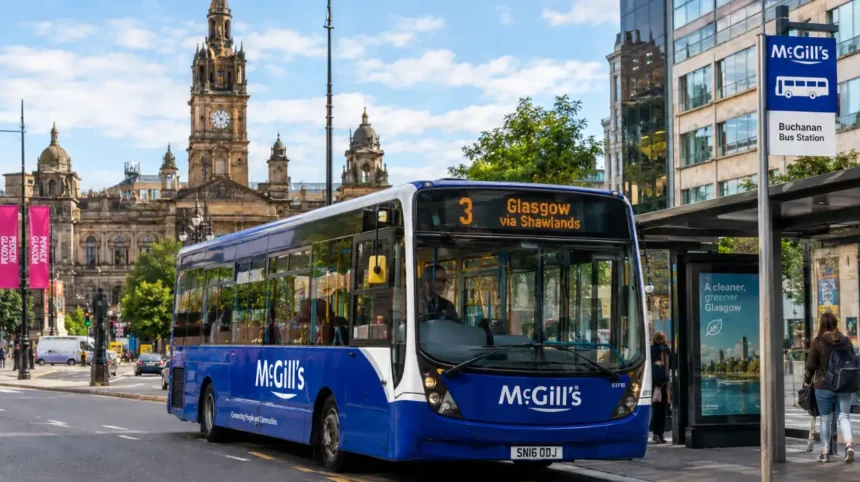
McGill’s publishes Glasgow-area routes through its official timetable and map directory. Listed examples include service 3 between Neilston and Glasgow, night services N3 and N4, service 6 and 6A between Silverburn and Paisley, and N6 between Glasgow city centre and Clydebank.
The Glasgow network contains services for different travel needs. Some connect outer neighbourhoods with central Glasgow, while others provide links between residential districts, suburban shopping destinations and neighbouring towns.
Examples from the operator’s published Glasgow route listings include the following:
- Service 3: Connects Neilston with Glasgow via Barrhead, Auchenback, Silverburn and Shawlands.
- N3: Connects Glasgow city centre with Pollok via Shawlands, Thornliebank and Nitshill.
- N4: Connects Glasgow city centre with Newton Mearns via Shawlands and Giffnock.
- Services 6 and 6A: Connect Silverburn with Paisley via Nitshill, Hurlet and Lonend.
- N6: Connects Glasgow city centre with Clydebank via Hillhead, Anniesland and Scotstoun West.
- X7: Provides a connection between Greenock, Kilmacolm and Linwood and Glasgow’s Buchanan Bus
These examples illustrate the network’s coverage rather than providing a complete or permanent route list. Operators revise services to respond to passenger demand, roadworks, timetable changes and operational requirements.
Passengers should check the official Glasgow routes and timetables before relying on a particular service. The route page identifies individual services and displays relevant disruption notices.
How can passengers choose the correct route?
Start with the exact boarding stop and destination rather than relying only on the route number. Two services travelling through the same neighbourhood can follow different roads or terminate at different locations.
Check the direction of travel, intermediate stops and final destination. If a journey involves a change of bus, confirm the transfer point and allow sufficient time between services.
For example, a passenger travelling from Neilston to central Glasgow can investigate service 3. Someone travelling from Glasgow city centre to Clydebank can check N6 and compare its stops with the intended destination.
Route numbers alone do not establish that a service operates at every hour. Daytime services and night buses can have different operating periods and stopping patterns.
How can passengers check McGill’s bus timetables and service updates?
Passengers can check McGill’s published timetables, route maps and service notices through the official website. These resources identify scheduled departures, route coverage and reported disruptions, helping travellers check their journey before leaving home or work.
A bus timetable lists scheduled departure or arrival times at designated stops. The exact information provided depends on the service and timetable format.
McGill’s maintains a dedicated Timetables and Maps page, where passengers can search by route or location and select the relevant operating area.
Use the following process to plan a journey:
- Open the operator’s timetable directory.
- Select Glasgow or the relevant surrounding area.
- Find the service number or search for a location.
- Open the current timetable and check the direction of travel.
- Confirm the departure time, operating days and destination stop.
- Review any service updates or planned changes affecting the journey.
A weekday timetable does not necessarily apply on Saturdays, Sundays or public holidays. Early-morning and late-night journeys also require separate checks because the number of departures often differs from daytime frequencies.
Why do service updates matter?
Service updates identify operational changes that affect a published route or timetable. Examples include road closures, temporary stop relocations, diversions and disruptions caused by local events.
A route can remain in operation while individual stops become temporarily unavailable. Passengers who rely exclusively on an old timetable risk waiting at a stop that the service is not currently using.
McGill’s publishes disruption notices alongside its route information. Travellers should check these notices on the day of travel, particularly when attending an appointment, catching a train or travelling to an unfamiliar destination.
For time-sensitive journeys, allow extra time for traffic and transfers. A published departure represents the scheduled time, not a guarantee that the bus will arrive at that exact minute.
What tickets does McGill’s Buses offer in Glasgow?
McGill’s offers ticket options for different journey patterns, including single journeys, network or zone tickets, student tickets and concessionary travel arrangements. The appropriate product depends on the route, passenger eligibility, travel frequency and geographical area covered by the ticket.
McGill’s groups its fares and ticket information by product and operating area. Its published options include Greater Glasgow tickets, Greater Glasgow Plus tickets, Clydeside Zone tickets, CitySaver tickets and discounted student travel.
The main consideration is how often a passenger travels and how much of the network they need to use.
What is a single bus ticket?
A single ticket covers one eligible journey under the ticket’s conditions. It is generally suitable for a passenger making an occasional trip, such as travelling from a residential area to a shopping centre or taking a one-way journey into Glasgow city centre.
The fare depends on the applicable service, journey and current pricing rules. Passengers should confirm the destination with the driver or use the operator’s journey planner to establish the correct fare.
What are McGill’s zone tickets?
Zone tickets cover travel within defined geographical areas of the operator’s network. McGill’s lists Greater Glasgow, Greater Glasgow Plus and Clydeside Zone products, alongside Inverclyde-area options.
A zone ticket is relevant to commuters who regularly travel between locations within its coverage. However, the names of ticket zones do not establish that every route, journey or additional operator is included.
Before purchasing, check the geographical coverage, validity period, permitted services and any restrictions on travel beyond the selected zone.
What are CitySaver and student tickets?
McGill’s lists CitySaver tickets for specified services connecting Braehead, Queen Elizabeth University Hospital, Paisley town centre, Paisley Road West and Glasgow. It also advertises discounted student travel for eligible passengers with a valid matriculation card.
These products serve more specific passenger needs than a general network ticket. CitySaver is associated with a defined group of corridors, while student tickets depend on the operator’s eligibility requirements.
Students should verify the current discount, required identification, validity period and participating services before buying a ticket.
How much do McGill’s bus tickets cost in Glasgow?
McGill’s fares depend on the journey, ticket type and applicable fare zone. The operator provides a journey planner and dedicated fares page to help passengers identify suitable products. Check the live fare before travelling because ticket prices and promotional conditions can change.
There is no single price that accurately describes every McGill’s journey across Glasgow and the surrounding region. A short local trip and a longer journey across a wider operating area can have different fares.
Passengers can check the to explore available products and use the journey planner.
The process is straightforward: enter the starting point, destination and intended departure time. Review the suggested journey and fare information, then check whether a single, zone or other ticket product better matches the trip.
Does the £2 bus fare cap apply to McGill’s services?
Scotland’s £2 Bus Fare Cap scheme covers eligible single adult and child journeys on participating services in designated areas, including Strathclyde. Under the scheme rules, an eligible single journey costs no more than £2. The operator and journey must qualify.
The scheme is relevant to Glasgow-area passengers, but the £2 maximum should not be assumed to apply to every bus service or ticket product. Passengers should check whether the particular McGill’s service participates and whether the journey meets the scheme’s conditions.
The fare cap applies to eligible single journeys. It does not mean every weekly, monthly, student or multi-journey ticket automatically costs £2.
How can passengers compare ticket value?
Compare the cost of the tickets available for the journeys you actually make. An occasional traveller generally needs a different product from someone who commutes five days each week.
For example, a passenger making one trip to Glasgow city centre can compare the single fare with any eligible alternative. A commuter travelling repeatedly between the same neighbourhoods should compare the total cost of individual fares with a zone ticket that covers those journeys.
Always check the ticket’s validity rules before comparing prices. A cheaper ticket is not useful if it excludes the route or destination you need.

How can passengers buy McGill’s bus tickets?
Passengers should use McGill’s official fares information to confirm the available purchase methods for their selected service. Ticket options and payment arrangements depend on the product, so travellers should check whether a ticket is purchased online, through an approved digital method or directly when boarding.
McGill’s provides a dedicated section explaining its payment methods and ticket products. The correct purchasing method depends on the ticket selected and the service on which it will be used.
Passengers should follow these steps before buying:
- Check the current fare and ticket conditions.
- Confirm the route and geographical coverage.
- Review the available purchase methods.
- Check whether a digital ticket needs to be activated before boarding.
- Keep the ticket or eligible travel card ready when boarding.
Can passengers buy tickets online?
Online ticket purchasing is useful when the operator offers the required product through its website or an approved booking channel. It allows passengers to review the available options before travelling.
However, not every ticket type necessarily has the same online availability. Passengers should confirm whether their chosen product can be purchased in advance and whether any activation or collection requirements apply.
The McGill’s fares and tickets page is the appropriate starting point for checking available products and payment information.
Can passengers pay by card or contactless?
Passengers should check McGill’s current payment guidance to confirm the payment methods accepted on their intended service. The availability of a particular payment method should not be assumed from the practices of another Scottish bus operator.
Before boarding, prepare an accepted payment method and establish the correct fare. If a journey requires a particular ticket or advance booking, follow the operator’s instructions rather than relying on payment at the driver’s cab.
Who qualifies for free or concessionary bus travel in Glasgow?
Eligible passengers can use Scotland’s National Entitlement Card to access concessionary bus travel on qualifying services. The national schemes include free bus travel for eligible residents aged 60 and over, qualifying disabled people, and Scottish residents aged 5 to 21 under the Young Persons’ Free Bus Travel Scheme.
The National Entitlement Card, commonly called the NEC, is a smartcard used to access eligible concessionary travel benefits. Transport Scotland administers the national policy, while local authorities and Strathclyde Partnership for Transport (SPT) support relevant application and delivery arrangements.
Eligible passengers should apply through the appropriate official channel and check that their card is valid before travelling.
How does free bus travel for under-22s work?
Scottish residents aged 5 to 21 can apply for a National Entitlement Card or Young Scot NEC to access free travel on eligible bus services. Children under five generally travel free on commercial bus services without needing this card.
When boarding, eligible young passengers should tell the driver their destination and tap their card on the electronic reader. The card records the journey so the scheme can reimburse participating operators.
The entitlement is subject to the scheme’s rules. Premium-fare night buses, tours, excursions and certain other services are among the exclusions identified by Transport Scotland. Passengers should confirm acceptance with the operator if they intend to use a service with special conditions.
How do older and disabled passengers access concessionary travel?
Eligible people aged 60 and over and qualifying disabled passengers can apply for concessionary travel through the National Entitlement Card scheme. Eligibility criteria and application arrangements are available through Transport Scotland and the relevant local authority or SPT.
Passengers should carry their own valid card and present it according to the instructions provided. The card cannot be transferred to another person.
Eligible disabled cardholders who require a companion should check whether their entitlement includes companion travel. The national scheme provides companion benefits for qualifying disabled people who meet the applicable conditions.
If a card is lost, damaged or no longer works, passengers should contact the issuing authority to arrange a replacement. A passenger who cannot present a working card can be required to pay the normal fare.
How can passengers plan journeys using McGill’s Buses?
Passengers can plan McGill’s journeys by identifying the origin and destination, selecting a suitable service, checking the timetable and confirming the fare. Reviewing service notices and transfer points before departure helps travellers avoid incorrect stops, missed connections and unsuitable tickets.
Journey planning starts with the exact location rather than a broad neighbourhood name. A large destination, such as a hospital, university or shopping centre, can have several entrances and nearby bus stops.
A reliable planning process involves five checks.
First, identify the nearest suitable boarding stop. Second, search for the destination and compare available services. Third, inspect the timetable for the intended day. Fourth, check the fare and ticket validity. Finally, review any disruption notices before leaving.
How should passengers plan connections with trains and the Glasgow Subway?
Glasgow’s public transport network includes buses, suburban and regional trains, and the Glasgow Subway. These modes serve different routes and interchange locations.
A passenger travelling from a residential district to a railway station can use a bus for the first part of the journey and continue by train. Another passenger can use a bus to reach a Subway station before travelling towards central Glasgow or the West End.
The most important consideration is the transfer time. Allow enough time to walk between stops or platforms, particularly at unfamiliar interchanges or during busy periods.
Passengers should also check ticket compatibility. A McGill’s bus ticket does not automatically include train or Subway travel. Transport Scotland identifies integrated ticketing and smartcard products, but the applicable terms depend on the particular product.
How can passengers prepare for a journey during disruption?
Check the latest operator notice before travelling and identify an alternative stop or route if the usual service is diverted. For essential appointments, allow extra time and confirm the destination stop remains accessible.
Roadworks, temporary closures and special events can change where passengers board. A familiar route can therefore require a different boarding point on a particular day.
Passengers should rely on current operator information rather than an old screenshot, saved timetable or an unverified journey description.
What accessibility features should passengers check before travelling?
Passengers who require accessible travel should confirm the facilities available on their specific McGill’s service and at the stops they intend to use. Checking boarding arrangements, wheelchair space, mobility requirements and any relevant assistance information before departure helps passengers plan with greater confidence.
Accessibility depends on both the vehicle and the boarding location. A bus can have accessible boarding equipment while a particular stop remains difficult to reach because of pavement conditions, roadworks or temporary obstructions.
Passengers with mobility requirements should check the operator’s accessibility guidance and contact customer services if they need clarification about a particular route.
Wheelchair users should confirm the arrangements for wheelchair spaces and boarding. Passengers travelling with assistance dogs or requiring other forms of support should also check the relevant conditions.
Older passengers, parents travelling with pushchairs and people carrying luggage benefit from knowing the boarding arrangements in advance. These requirements can affect which service or stop is most suitable.
Accessibility information should be checked for the specific journey rather than assumed to be identical across every vehicle or route.
What should visitors know about using McGill’s Buses in Glasgow?
Visitors can use McGill’s services to reach selected Glasgow neighbourhoods and surrounding destinations, provided the relevant route operates on their travel date. Checking the route map, ticket coverage, stop location and service timetable before departure helps visitors navigate the network.
Glasgow attracts visitors for its museums, architecture, shopping areas, cultural venues, universities and sporting events. Local buses can provide practical connections between accommodation, neighbourhood destinations and transport interchanges.
Visitors should identify the exact entrance or street address of the destination before selecting a bus. A route passing through a neighbourhood does not necessarily stop directly outside every attraction.
How should tourists choose between a single and a zone ticket?
Tourists making one or two local journeys should compare the relevant single fares. Visitors planning repeated travel across several areas should examine the geographical coverage and validity of suitable zone products.
For example, someone making a single journey from a Glasgow neighbourhood to the city centre can check the individual fare. Someone travelling repeatedly between Glasgow and destinations in surrounding areas should investigate whether a Greater Glasgow or Greater Glasgow Plus ticket meets their needs.
The correct choice depends on the planned route, the number of journeys and the ticket conditions. Visitors should avoid buying a wider-area ticket unless its coverage matches their itinerary.
What should visitors do when travelling at night?
McGill’s publishes a dedicated Glasgow night-bus category, including services such as N3, N4 and N6. These services connect selected destinations during their designated operating periods.
Night travel requires particular attention to departure times and stopping patterns. A daytime service number does not guarantee that a corresponding bus operates late at night.
Visitors should confirm the last suitable departure, identify the correct stop and check whether the service accepts their intended ticket or concessionary card. They should also plan for the possibility of a longer wait between night services.
Explore More Area Guide
First Bus Glasgow: Routes, Tickets and Timetables Guide
Glasgow Bus Prices and Tickets: 2026 Fare Guide
How can passengers save money on McGill’s Buses?
Passengers can manage bus travel costs by comparing single fares with suitable zone tickets, checking eligibility for concessionary travel and reviewing participating-service fare caps. The best option depends on journey frequency, route coverage, passenger eligibility and the current ticket conditions.
Regular passengers should calculate their expected travel costs over a typical week or month. This approach helps identify whether a multi-journey or zone product offers better value than buying individual tickets.
For example, a commuter making repeated journeys between the same residential area and workplace should compare the total single fares with the cost of a suitable zone ticket. A passenger travelling occasionally should compare the cost of individual journeys with the products available for that particular route.
Eligible passengers should also check national concessionary schemes before purchasing a standard ticket. Scotland provides free bus travel for qualifying young people, older people and disabled passengers under the relevant eligibility rules.
Which mistakes should passengers avoid?
Common ticketing mistakes include purchasing a ticket that does not cover the destination, overlooking a timetable change and assuming that a concessionary card is valid on every transport service.
Passengers should avoid relying on outdated fare information. They should also check whether a ticket covers the return journey, how long it remains valid and whether it can be used on the intended service.
Checking these details before boarding reduces the risk of paying an unexpected fare or needing an alternative journey.
What is the future relevance of McGill’s Buses in Glasgow?
McGill’s remains relevant to Glasgow’s public transport network because local bus services connect residential communities with employment, education, healthcare and retail destinations. Reliable route information, appropriate ticketing and accessible services support passengers who depend on buses for everyday travel.
Bus services form an important part of regional transport because not every neighbourhood has a railway or Subway station within convenient walking distance. Local buses help connect those neighbourhoods with wider transport networks and essential services.
Digital timetable information and electronic concessionary ticketing also help passengers plan journeys and record eligible travel. Scotland’s National Entitlement Card schemes demonstrate how public transport policy supports access to bus services for qualifying groups.
For passengers, the practical priority remains the same: identify the correct route, confirm the timetable, select an eligible ticket and check service updates before departure.
McGill’s official route directory and fares page provide the main starting points for these checks. As the network changes, consulting the latest information is the most dependable way to plan a journey across Glasgow and its surrounding communities.
What areas do McGill’s Buses serve in Glasgow?
McGill’s Buses serves Glasgow and selected surrounding communities, including Clydebank and destinations across Renfrewshire and East Renfrewshire. Check the official route directory to confirm services for your location.