Key Points
- Protesters gathered at Buchanan Steps in Glasgow city centre to demonstrate over an ongoing dispute regarding the Garvaghy Road parade in Portadown, Northern Ireland.
- The dispute emerged after Northern Ireland’s Parades Commission permitted the unionist Orange Order—backed by the DUP and TUV—to march down Garvaghy Road for the first time in 28 to 30 years.
- Republican groups, including Cairde na hÉireann (Friends of Ireland), staged a rally in solidarity with Garvaghy Road residents, displaying pro-Palestine flags and anti-imperialism banners.
- Loyalist groups organized a counter-demonstration at the same location to show support for the Portadown District Orange Lodge, carrying signs concerning immigration and housing.
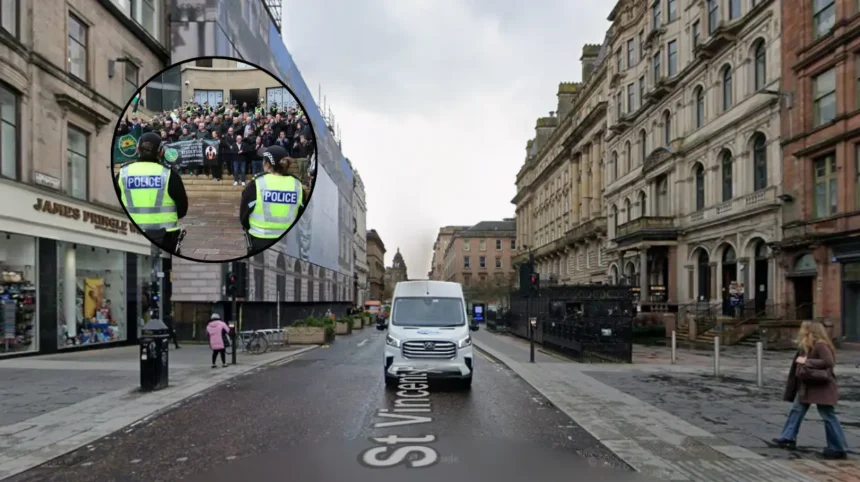
- Police Scotland formed a separation line between the rival factions at the city centre location; authorities confirmed that no arrests were made and no major incidents or violence were reported.
Glasgow (Glasgow Express) October 5, 2026 — Demonstrators gathered in Glasgow city centre on Sunday afternoon following intense controversy over the unionist Orange Order parade along Garvaghy Road in Portadown. The high-profile flashpoint unfolded at the Buchanan Steps, where competing republican and loyalist demonstrations converged. As reported by staff journalists at The National, scores of people assembled to voice solidarity with the residents of Garvaghy Road. The underlying dispute developed after Northern Ireland’s Parades Commission granted approval for the Orange Order—which receives backing from the Democratic Unionist Party (DUP) and the Traditional Unionist Voice (TUV)—to march through the nationalist area for the first time in nearly three decades.
As detailed in coverage by reporters from the Glasgow Times, the demonstration drew multiple factions into the heart of the Scottish city. Members of republican organisations, including Cairde na hÉireann, gathered on the stairs outside the Buchanan Galleries carrying placards reading, “Republicans in Scotland stand with the residents of Garvaghy Road” and “From Glasgow to Gaza to Garvaghy Road, resist occupation and fascism”. At the same time, as noted by PA news agency correspondents, a separate group of Scottish loyalists organized a counter-demonstration to support the Portadown District Orange Lodge under the banner of “Hands Across the Water”. The loyalist gathering featured participants holding signs focused on domestic housing priorities and immigration control.
To maintain public order, Police Scotland officers established a physical barrier separating the opposing crowds. According to updates provided by Police Scotland spokespersons to local media outlets, the demonstrations remained largely orderly. Authorities confirmed that no arrests were made, no physical altercations or violent clashes took place, and officers observed no significant intimidation or aggressive chanting between the rival groups.
Background of the Particular Development
The demonstrations in Glasgow reflect deep-seated historical tensions rooted in decades of community conflict surrounding Orange Order parades in Northern Ireland. The controversy centres heavily on the historic stand-offs at Drumcree and the passage of parades through the predominantly nationalist Garvaghy Road area in Portadown. Throughout the 1990s, the dispute generated intense political friction, severe public disorder, and major security operations. Local residents, supported by nationalist political parties such as Sinn Féin and the SDLP, have historically opposed the marches due to the perceived sectarian nature of routing through nationalist residential zones without community consent.
The recent escalation occurred after an appeals court ruling and a subsequent decision by the Parades Commission allowed the Orange Order to march the route for the first time in approximately 28 to 30 years. This decision immediately re-ignited community opposition, physical blockades on the ground in Portadown, and widespread political debate across the United Kingdom. Because diaspora communities and political solidarity networks maintain active ties to Northern Irish politics, the reverberations of these localized disputes frequently manifest in sympathetic rallies and counter-protests in urban centres like Glasgow.
Prediction
This ongoing development and its spillover into mainland UK cities carry significant implications for community relations and political stability within both Northern Ireland and Scotland. For the local communities and residents along Garvaghy Road, the re-authorization of the parade threatens to entrench polarization, risking prolonged public order operations and renewed friction between nationalist residents and unionist marchers.
For the broader public, including diaspora groups and political activists in cities like Glasgow, these events demonstrate how overseas constitutional and cultural disputes can rapidly mobilize polarized domestic factions. If legal and regulatory bodies continue to navigate these high-stakes parading permissions without securing broader local consensus, public demonstrations are likely to persist. This dynamic risks hardening ideological divides and increasing demands on law enforcement agencies tasked with policing contentious proxy demonstrations across British urban centres.