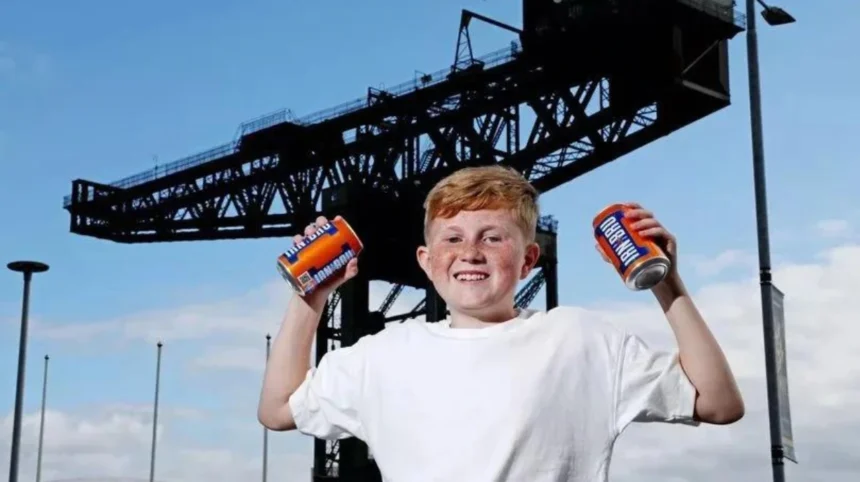
Irn-Bru culture describes the social, commercial and cultural importance of Barr’s Irn-Bru in Glasgow and wider Scotland. The drink connects local manufacturing history, Scottish advertising, everyday consumption, humour, sport and national identity. Its Glasgow roots and long presence helped make it a recognisable Scottish cultural symbol.
- How did Irn-Bru become connected with Glasgow?
- When was Iron Brew renamed Irn-Bru?
- What is Irn-Bru made from?
- Why is Irn-Bru associated with Scottish identity?
- Why does Irn-Bru have such a strong connection with Glasgow humour?
- What role did the “Made in Scotland from Girders” campaign play?
- How important is Irn-Bru in Scottish soft-drink consumption?
- Why did the 2018 recipe change become such a major cultural issue?
- What is the difference between regular IRN-BRU, IRN-BRU Zero and IRN-BRU 1901?
- How is Irn-Bru connected with Scottish sport?
- Why is Irn-Bru sometimes called Scotland’s other national drink?
- How does Irn-Bru culture appear in everyday Glasgow life?
- Is Irn-Bru culture uniquely Glaswegian?
- How has Irn-Bru culture changed in the modern era?
- What does Irn-Bru culture tell us about Glasgow?
How did Irn-Bru become connected with Glasgow?
Irn-Bru became connected with Glasgow through A.G. Barr’s 1887 Glasgow business, the 1901 launch of Iron Brew, decades of local advertising and the brand’s continuing Scottish production history. Glasgow therefore sits within the commercial and cultural history that transformed Irn-Bru into a Scottish icon.
A.G. Barr’s Glasgow connection predates Irn-Bru by several decades. Robert F. Barr established a soft-drinks business on Great Eastern Road in Glasgow, later renamed Gallowgate, in 1887. His brother Andrew G. Barr subsequently took control of the Glasgow operation.
The modern drink began as IRON BREW. A.G. Barr records that Robert Barr’s Falkirk business and A.G. Barr & Co. in Glasgow jointly launched the original recipe on 15 April 1901. The launch occurred when carbonated soft drinks were already developing into a major consumer industry in Britain.
Glasgow also became important because the city was a major industrial and commercial centre. Barr’s own account connects the drink with workers rebuilding Glasgow Central Station, although this specific origin story is part of the company’s brand history rather than an independently established explanation for the entire drink’s development.
Academic research provides a broader historical perspective. David Leishman’s research into Irn-Bru argues that the drink’s deeper history is more complicated than a purely Scottish origin story. Earlier Iron Brew products existed outside Scotland, including an 1890s Jamaican product using an imported American flavouring essence. Barr’s achievement was therefore the development, protection and marketing of its own product into a distinctive Scottish brand.
That distinction is important. Irn-Bru culture is not simply about where a recipe originated. It is about how a product became embedded in everyday Scottish consumption and how advertising connected the brand with Scottish identity.
When was Iron Brew renamed Irn-Bru?
Barr’s original Iron Brew was launched in 1901 and the modern IRN-BRU trademark was registered on 18 July 1946. The phonetic spelling became associated with the post-war product relaunch, with IRN-BRU appearing commercially as the familiar brand name from 1947.
The name change is one of the most important stages in Irn-Bru history.
During the 1940s, proposed food-labelling regulations created concerns about the name IRON BREW. Barr’s drink contained iron but was not literally brewed. Barr therefore developed the phonetic spelling IRN-BRU.
The new trademark was registered in July 1946. Barr states that the name appeared on the market around 1947 after wartime controls on the soft-drinks industry ended.
The unusual spelling became commercially valuable. It immediately differentiated the drink from conventional soft-drink names and gave the brand a distinctive visual identity.
Academic research also identifies the spelling as an important part of the brand’s cultural development. Leishman argues that the transformation from “Iron Brew” to “Irn-Bru” helped establish a product identity increasingly associated with Scottishness during the second half of the twentieth century.
The name is therefore more than a shortened version of the original. It became part of the recognisable visual and linguistic identity of the product.
What is Irn-Bru made from?
IRN-BRU is a carbonated flavoured soft drink made from carbonated water, sugar, acids, flavourings, sweeteners, preservatives and colourings. A.G. Barr describes the modern drink as using a secret recipe containing 32 flavours, making its precise flavour composition commercially protected.
A.G. Barr identifies the principal ingredients in regular IRN-BRU as carbonated water, sugar, citric acid, flavourings, sweeteners, preservative E211 and colourings. The listed flavourings include caffeine, ammonium ferric citrate and quinine.
The company describes the recipe as containing 32 flavours. The complete flavour formulation remains a trade secret.
The UK Intellectual Property Office has used IRN-BRU as an example of trade-secret protection. Trade secrets differ from patents because they do not require the protected information to be publicly disclosed and have no fixed expiry date while confidentiality is maintained.
This secrecy contributes to the drink’s distinct product identity. Consumers recognise the flavour without being given a conventional ingredient-by-ingredient flavour description.
The drink also has a strong visual identity. Its orange colour, blue-and-orange branding, distinctive name and recurring Scottish references make the product easy to identify in shops, restaurants, sporting venues and other public spaces.
Why is Irn-Bru associated with Scottish identity?
Irn-Bru became associated with Scottish identity because Barr repeatedly connected the drink with Scottish places, humour, strength, sport and national imagery. Academic research identifies the brand as an important example of commercial culture becoming embedded in everyday expressions of Scottish identity.
The connection between Irn-Bru and Scotland developed through sustained marketing rather than a single campaign.
Barr used athletes and sporting figures in early advertising. Its historical record identifies endorsements from prominent sports personalities, including Glaswegian boxer Benny Lynch, who became world flyweight champion in 1935.
Sport provided an effective cultural setting because Scottish sporting identity was already strongly associated with public events, local communities and national representation.
Advertising later became even more important. Barr’s campaigns increasingly presented Irn-Bru as a recognisably Scottish product.
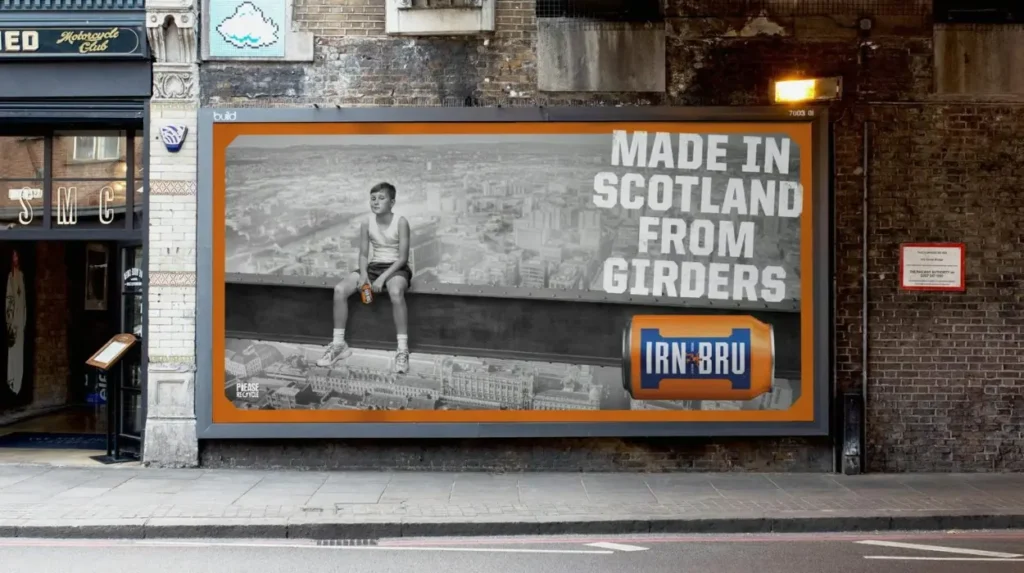
The slogan “Made in Scotland from girders” became particularly influential. The campaign linked the drink with toughness, industrial Scotland and humour. Barr states that the campaign ran from the mid-1970s into the early 1990s and received a Scottish Advertising Award in 2007 for the best advertising strapline of the previous 21 years.
Academic research treats this process as an example of consumer nationalism. Consumer nationalism describes the relationship between everyday purchasing practices, commercial branding and perceptions of national belonging.
This does not mean every Scottish person identifies with the brand in the same way. It means that the brand has become one recognisable commercial symbol through which Scottish identity is represented.
Why does Irn-Bru have such a strong connection with Glasgow humour?
Irn-Bru’s connection with Glasgow humour comes from decades of advertising that used irreverence, local cultural references, exaggerated situations and distinctive Scottish language. The advertising created a recognisable brand personality that became closely associated with Scottish popular culture.
Humour is central to the cultural meaning of Irn-Bru.
Barr’s advertising history identifies the 1995 Scottish poster campaign as an important development. The company describes the campaign as establishing an irreverent tone of voice that became closely associated with the brand.
This approach fits Glasgow’s wider advertising and comedy culture, where local language and social observation frequently provide material for popular entertainment.
The relationship also works through recognition. Scottish consumers who understand local expressions, accents and cultural references can interpret an advertisement differently from an international audience.
The brand’s humour therefore performs a cultural function as well as a commercial one.
It communicates that the product is Scottish without relying exclusively on traditional national symbols such as castles, tartan or bagpipes.
This is particularly relevant to Glasgow. The city has a strong popular-culture tradition involving comedy, music, advertising, football and distinctive spoken language. Irn-Bru’s advertising frequently operates within those same cultural environments.
What role did the “Made in Scotland from Girders” campaign play?
“Made in Scotland from girders” became one of Irn-Bru’s defining advertising messages by combining industrial imagery, Scottish identity and comic exaggeration. The campaign helped position Irn-Bru as a distinctly Scottish soft drink rather than simply another carbonated beverage.
The campaign emerged during a period when Scotland’s industrial heritage remained highly visible in public life.
The word “girders” referenced structural steel and industrial production. The slogan therefore connected the drink with strength and manufacturing.
The advertising did not present Irn-Bru as an ordinary fruit-flavoured or cola-style drink. It created a separate category around the brand’s unusual flavour and personality.
Academic analysis identifies this period as important in the construction of Irn-Bru’s Scottish cultural meaning. Leishman describes the brand’s advertising as linking the product with ideas of Scottish authenticity and strength.
The slogan also became memorable because it used humour rather than conventional claims about refreshment.
This approach helped create a distinctive identity that remained recognisable long after individual advertisements disappeared from television.
How important is Irn-Bru in Scottish soft-drink consumption?
Irn-Bru has maintained a major position in Scotland’s carbonated-soft-drinks market for decades. Historical market data recorded more than 20% value share of total carbonates in Scotland in 2004, while later company reports continue to identify IRN-BRU as a major core brand.
A.G. Barr reported that IRN-BRU exceeded 20% market share by value of total carbonated soft drinks in Scotland in 2004, based on Nielsen Scantrack data.
That figure demonstrates the scale of the brand’s Scottish presence during the period.
The market has changed substantially since then. Consumers now have access to a much wider selection of soft drinks, energy drinks, bottled water and zero-sugar products.
IRN-BRU has continued to adapt to those changes.
A.G. Barr’s 2025 annual report stated that IRN-BRU volume grew ahead of the market and sales revenue increased by 6.4% in the reporting year. The company also reported particularly strong growth in England.
This matters for understanding modern Irn-Bru culture. The brand is no longer consumed only in Scotland. Its Scottish cultural meaning exists alongside national and international distribution.
Glasgow remains important because the brand’s historical development and cultural associations are deeply connected to Scotland’s largest city and the surrounding central-belt consumer market.
Why did the 2018 recipe change become such a major cultural issue?
The 2018 recipe change became culturally significant because A.G. Barr reduced regular IRN-BRU’s sugar from 10.3g to 4.7g per 100ml. The reformulation followed changing consumer preferences and the introduction of the UK Soft Drinks Industry Levy.
The UK Soft Drinks Industry Levy came into effect in April 2018.
Under the original system, drinks containing at least 5g of sugar per 100ml entered the levy structure, with higher rates applying at 8g or more. The policy encouraged manufacturers to reduce sugar content through reformulation.
A.G. Barr announced in October 2017 that regular IRN-BRU would contain approximately 50% less sugar from January 2018.
The sugar level fell from 10.3g to 4.7g per 100ml. The reformulated drink used low-calorie sweeteners, including aspartame and acesulfame K.
The change generated substantial public attention because consumers had developed long-term familiarity with the original formulation.
The response demonstrates how a soft drink can become more than a packaged product. When a product has been consumed across generations, changes to its formulation become part of cultural discussion.
The episode also demonstrates that Irn-Bru culture is not frozen in the past. The brand has continued to change in response to regulation, consumer preferences and commercial conditions.
What is the difference between regular IRN-BRU, IRN-BRU Zero and IRN-BRU 1901?
Modern IRN-BRU products include the regular carbonated drink, zero-sugar alternatives and IRN-BRU 1901. The 1901 version is based on Barr’s archived recipe, uses sugar rather than modern sweetener blends and contains no caffeine.
The modern product range demonstrates how Barr combines heritage with contemporary soft-drink preferences.
Regular IRN-BRU uses the current formulation and includes sugar and sweeteners.
IRN-BRU Zero provides a zero-sugar option.
Diet IRN-BRU was renamed IRN-BRU Sugar Free in January 2011. Barr stated that the name change did not alter the recipe at that time.
IRN-BRU 1901 represents a different approach.
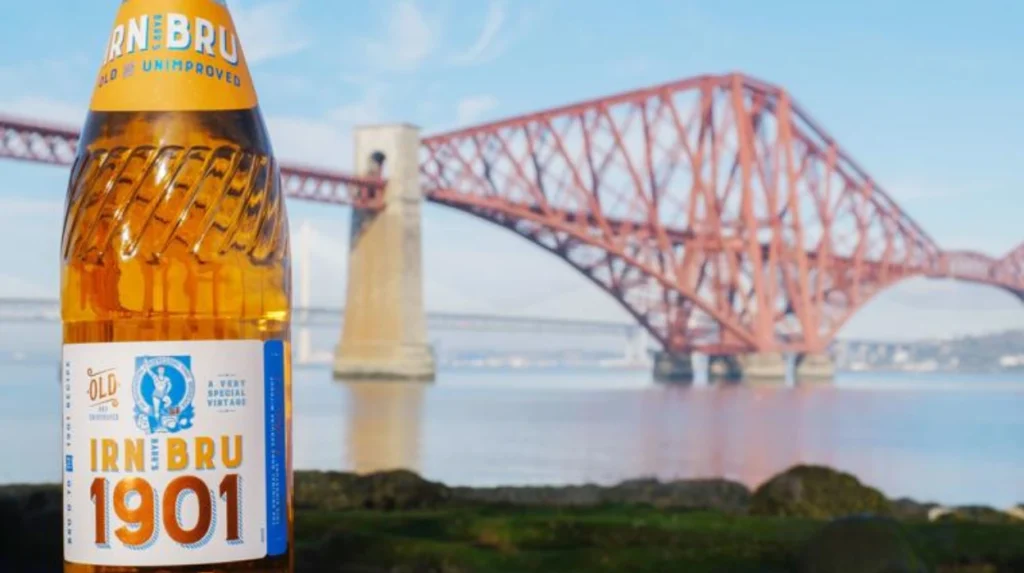
Barr recreated the original 1901 formulation from a handwritten recipe book preserved in the company’s archives for more than a century. The 1901 recipe contains no caffeine, uses sugar as the sweetener and uses quillaia to create its characteristic frothy head.
The product was initially released as a limited edition in 2019 and returned as a permanent addition to the range in March 2021.
This gives modern consumers access to different stages of the brand’s history.
How is Irn-Bru connected with Scottish sport?
Irn-Bru has maintained a long relationship with Scottish sport through athlete endorsements, football sponsorship, national sporting campaigns and major-event marketing. These activities repeatedly placed the brand inside public conversations about Scottish teams, sporting identity and national representation.
Sport has been part of the brand’s marketing from its earliest years.
Barr used sporting figures in promotional campaigns, including athletes associated with Highland Games and boxing. Benny Lynch provided an especially strong Glasgow connection because the world champion was born in the city.
The brand later developed relationships with Scottish football.
In 2016, the Scottish Challenge Cup was renamed the IRN-BRU Cup under a three-year sponsorship agreement. Barr described the partnership as a continuation of its long association with Scottish football.
The brand also became visible during the 2014 Commonwealth Games in Glasgow.
Academic research identifies the 2014 event as an example of Irn-Bru being used within a wider representation of Scottish identity. A can-based replica of the Forth Rail Bridge featured in the Commonwealth Games opening ceremony, while A.G. Barr was an event sponsor.
These examples demonstrate the commercial mechanism behind Irn-Bru culture: repeated exposure connects the product with institutions, events and activities that already carry cultural significance.
Why is Irn-Bru sometimes called Scotland’s other national drink?
Irn-Bru became known as Scotland’s “other national drink” through long-running advertising that positioned the soft drink alongside established symbols of Scottish culture. The phrase is commercial rather than an official national designation, but it became an influential part of the brand’s identity.
Scotland has no official legal designation making Irn-Bru a national drink.
The phrase comes from marketing.
Barr’s historical record identifies “Your other national drink” as one of the brand’s memorable advertising positions. It followed earlier campaigns that emphasised Scottish strength, humour and identity.
The phrase worked because it used an established concept of national drinks while maintaining the brand’s humorous tone.
The result was a commercial identity that became familiar outside advertising itself.
People began using the phrase when discussing the drink’s place in Scottish life, helping transform a marketing message into a wider cultural reference.
This process is central to understanding why Irn-Bru has cultural significance. The drink’s Scottishness is not a legal status. It is a cultural association reinforced through production, consumption, advertising and public recognition.
How does Irn-Bru culture appear in everyday Glasgow life?
Irn-Bru culture appears through ordinary consumption in shops, cafés, restaurants, takeaways, workplaces, sporting venues and homes. Its cultural importance comes from repeated everyday exposure rather than a single ceremony, festival or institution, making the brand part of ordinary Scottish consumer life.
Everyday availability is one of the strongest mechanisms behind cultural familiarity.
A product that appears regularly in supermarkets, convenience shops, vending machines, cafés and food outlets becomes part of normal purchasing behaviour.
Academic research describes Irn-Bru as an ingrained element of everyday Scottish consumption. The research connects its cultural role to ordinary consumer habits rather than treating it solely as an advertising phenomenon.
Glasgow provides a particularly relevant setting because the city is closely connected with the history of A.G. Barr and Scottish popular culture.
The drink also appears in combinations with food. It is commonly associated with takeaway meals and casual eating, creating another everyday context for consumption.
The significance is cumulative.
A person encounters the product at home, in shops, during sporting events, in advertising and in social settings. These repeated encounters strengthen recognition across generations.
That process helps explain why Irn-Bru remains culturally visible even as tastes and the soft-drinks market change.
Is Irn-Bru culture uniquely Glaswegian?
Irn-Bru culture is strongly connected with Glasgow but is not exclusively Glaswegian. The brand is Scottish in its modern cultural identity, while its commercial history includes Glasgow, Falkirk and national distribution. Glasgow provides one important centre of its cultural significance rather than its sole geographical identity.
The distinction between Glasgow culture and Scottish culture matters.
A.G. Barr’s history includes major locations in both Glasgow and Falkirk. The original 1901 launch involved both the Glasgow and Falkirk businesses.
The brand subsequently expanded across Scotland and the rest of Britain.
Academic research similarly describes Irn-Bru as a Scottish cultural symbol rather than exclusively a Glasgow symbol.
Glasgow nevertheless has a special place in the story.
The city hosted A.G. Barr’s Glasgow operation from the late nineteenth century. It also became a major setting for advertising, sport, public events and popular culture associated with the brand.
The distinction is therefore straightforward: Irn-Bru is strongly Scottish in cultural identity, with Glasgow forming a particularly important part of its history and cultural environment.
Explore More Area Guide
Why Glaswegians Are Known as the UK’s Friendliest People
Famous Glaswegian Slang Words and Their Meanings
How has Irn-Bru culture changed in the modern era?
Modern Irn-Bru culture combines heritage with product innovation, sugar reduction, zero-sugar alternatives, limited editions, digital marketing and wider UK distribution. The brand continues to use its Scottish identity while adapting to changing consumer preferences and regulatory requirements.
The brand’s modern history includes several important developments.
Diet IRN-BRU became a distinct brand and was later renamed IRN-BRU Sugar Free.
IRN-BRU Energy introduced the brand into the energy-drink category.
IRN-BRU 1901 returned to an earlier recipe and packaging format.
Limited-edition flavours have expanded the range while retaining the core IRN-BRU identity. A.G. Barr’s 2025 annual report specifically identified Raspberry Ripple and Wild Berry Slush as limited-edition IRN-BRU XTRA flavours aimed at attracting younger shoppers.
The brand has therefore developed in two directions.
One direction preserves heritage through archive recipes, historic packaging and Scottish cultural references.
The other direction introduces new products and marketing formats to reach contemporary consumers.
This balance explains why Irn-Bru culture remains relevant. Heritage provides recognition, while innovation keeps the product connected with changing consumption patterns.
What does Irn-Bru culture tell us about Glasgow?
Irn-Bru culture shows how an everyday commercial product can become embedded in Glasgow’s wider cultural environment through local history, repeated consumption, humour, sport, advertising and national identity. Its importance comes from the interaction between brand strategy and consumer culture over more than a century.
Irn-Bru’s Glasgow significance is therefore historical as well as commercial.
The brand’s story began with a nineteenth-century Barr business in Glasgow and developed through the 1901 launch of Iron Brew.
Its later advertising created a recognisable Scottish personality based on humour, strength and local cultural references.
Its sporting partnerships placed the drink alongside important Scottish events.
Its everyday availability made the product familiar across generations.
Its 2018 sugar reformulation demonstrated the strength of consumer attachment by turning a technical product change into a major public cultural discussion.
Academic research provides the clearest explanation for this broader significance. Irn-Bru has been studied as an example of how commercial branding becomes involved in the construction and expression of national identity.
For Glasgow, the story is particularly relevant because the city sits inside the brand’s commercial history and its wider popular-culture environment.
Irn-Bru culture is therefore not simply about liking a fizzy drink. It describes the accumulated relationship between A.G. Barr, Glasgow, Scottish advertising, everyday consumption, humour, sport and identity.
That relationship has lasted from the launch of Iron Brew in 1901 through the IRN-BRU relaunch in the 1940s, the major advertising campaigns of the late twentieth century, the 2018 reformulation and the product innovations of the 2020s.
The result is one of Scotland’s most recognisable consumer brands and one of the clearest examples of how a commercial product can acquire cultural meaning through everyday life.
What is Irn-Bru culture?
Irn-Bru culture refers to the drink’s connection with Scottish everyday life, humour, advertising, sport and national identity. Glasgow has a particularly strong connection because A.G. Barr operated there from 1887.