
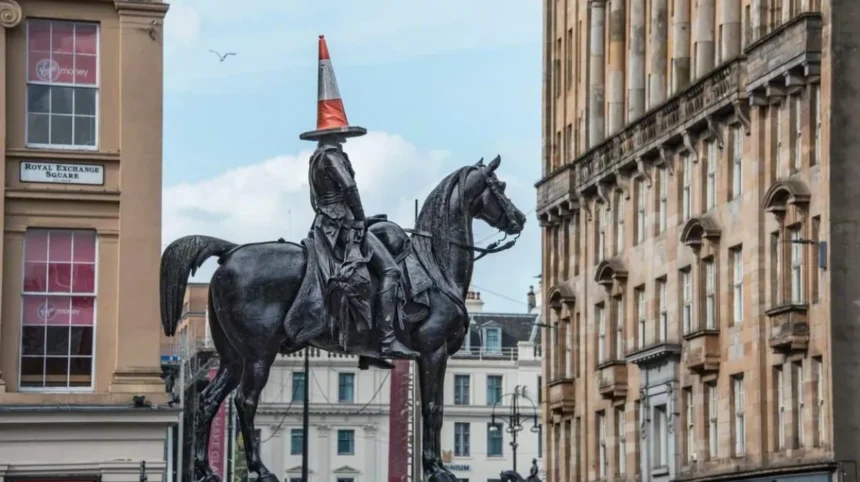
The Duke of Wellington statue in Glasgow is one of the city’s most recognisable public monuments. The bronze equestrian statue stands outside the Gallery of Modern Art (GoMA) at Royal Exchange Square, beside Queen Street and close to Glasgow city centre.
- Why does the Duke of Wellington statue have a traffic cone on its head?
- Who was the Duke of Wellington shown on the Glasgow statue?
- When was the Duke of Wellington statue in Glasgow built?
- What does the Duke of Wellington statue actually depict?
- When did the traffic cone tradition begin?
- Why did Glasgow City Council try to stop people putting cones on the statue?
- Is the traffic cone officially part of the Duke of Wellington statue?
- Why has the traffic cone become a symbol of Glasgow?
- How does the cone tradition relate to the Gallery of Modern Art?
- Has the Duke of Wellington statue always had a cone?
- What happened during the 2013 “cone” controversy?
- Does the cone damage the statue?
- Why is the Duke of Wellington statue still important to Glasgow today?
- What should visitors know before seeing the Duke of Wellington statue?
- What does the traffic cone tell us about Glasgow’s cultural identity?
The statue depicts Arthur Wellesley, 1st Duke of Wellington, the British military commander and statesman who defeated Napoleon Bonaparte at the Battle of Waterloo in 1815. Sculptor Carlo Marochetti created the Glasgow monument, which was unveiled in 1844. Historic Environment Scotland lists it as a Category A listed building, recognising its national architectural and historic importance.
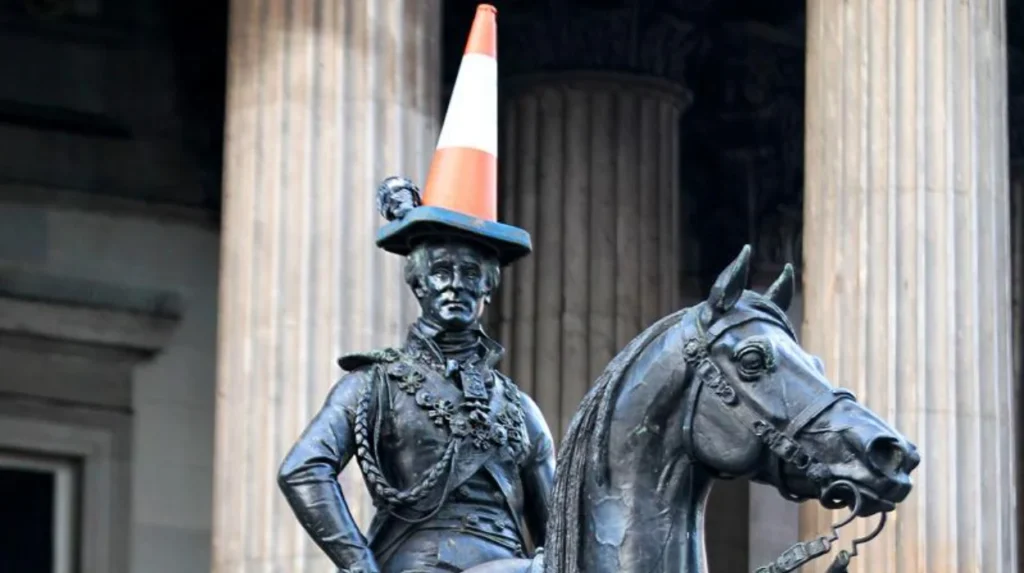
Its unusual modern identity comes from something that was never part of Marochetti’s design: an orange traffic cone placed on Wellington’s head. The cone has become a long-running feature of the monument and a widely recognised symbol of Glasgow’s humour and street culture. Glasgow Life itself describes the statue as having a “self-perpetuating traffic cone hat”.
The exact individual who first put a cone on the statue has not been established. Historical accounts generally place the beginning of the tradition in the 1980s. The practice continued for decades despite attempts to discourage it because climbing the monument creates safety risks and repeated interference causes maintenance concerns.
Why does the Duke of Wellington statue have a traffic cone on its head?
The traffic cone became a Glasgow tradition after members of the public began placing cones on the Duke of Wellington statue, with the practice established by at least the 1980s. Repeated replacement transformed a prank into a recognisable part of Glasgow’s cultural identity.
The cone is not part of the original monument. It is placed there by members of the public. The practice became associated with the statue because Wellington’s raised position and accessible surroundings made the monument a conspicuous target for urban pranks.
The tradition has lasted because removing one cone does not end the practice. Another cone appears after removal, creating a recurring cycle. Glasgow Life’s own museum material refers directly to the question of why Wellington “always” wears a traffic cone.
The tradition also became visually distinctive. The orange cone contrasts strongly with the dark bronze statue and the pale stone architecture of Royal Exchange Square. This makes the monument immediately recognisable in photographs.
The cone therefore functions as a contemporary layer added to a nineteenth-century monument. The statue retains its historical subject, sculptor, material and architectural setting, while the cone represents a much more recent element of Glasgow’s public culture.
There is no authoritative record identifying the first person responsible. Accounts consistently connect the custom with Glasgow’s public and student culture during the late twentieth century, but the precise starting event remains undocumented.

Who was the Duke of Wellington shown on the Glasgow statue?
Arthur Wellesley, 1st Duke of Wellington, was a British military commander and politician who became famous for leading Allied forces against Napoleon at Waterloo in 1815. He later served as British prime minister and remained a major nineteenth-century public figure.
Arthur Wellesley was born in Dublin in 1769. He entered the British Army in 1787 and served in several military campaigns before becoming a senior commander.
His career included military service in India and the Peninsular War against French forces in Spain and Portugal. His successes established his reputation before his most famous campaign against Napoleon.
Wellington commanded the Allied Army at the Battle of Waterloo on 18 June 1815. Prussian forces under Gebhard Leberecht von Blücher joined the fighting, and Napoleon’s army was defeated. The battle ended Napoleon’s final attempt to regain control of Europe.
Wellington then continued his political career. He served as Prime Minister of the United Kingdom from 1828 to 1830, with a further short period in office in 1834. His public career therefore extended beyond military history.
The Glasgow monument reflects this nineteenth-century view of Wellington as a national military hero. Its later association with a traffic cone created a very different layer of meaning around the original commemorative purpose.
When was the Duke of Wellington statue in Glasgow built?
The Duke of Wellington statue was erected in 1844 and unveiled on 8 October that year. Italian-born French sculptor Carlo Marochetti created the bronze equestrian monument, which stands on a Peterhead granite pedestal in Royal Exchange Square.
The idea for a Glasgow Wellington monument emerged after Wellington’s military achievements became part of British public memory. A public meeting proposed the statue in 1840, and funding was raised through public subscription.
Historical accounts record around 10,000 contributors to the fundraising effort. The scale of the subscription demonstrates the importance given to the proposed monument during the nineteenth century.
Marochetti received the commission. He was born in Turin in 1805 and developed his career in France before receiving major European commissions. His Glasgow Wellington became one of his significant public monuments.
The statue was unveiled on 8 October 1844 before a large crowd. Contemporary accounts describe military participation and Waterloo veterans attending the ceremony.
The monument is constructed from bronze with a granite pedestal. The pedestal includes bronze relief panels connected with Wellington’s military career.
This original design is important because it shows that the traffic cone represents a later cultural intervention rather than an element of the statue itself.
What does the Duke of Wellington statue actually depict?
The Glasgow monument depicts Wellington mounted on his horse Copenhagen in military uniform. The bronze composition includes military insignia and relief panels representing battles and Wellington’s relationship with war and peace. Its Category A listing confirms its historic importance.
Wellington is shown on horseback rather than standing or sitting in a conventional portrait pose. His horse, Copenhagen, was one of the best-known horses associated with Wellington.
The monument therefore belongs to the tradition of equestrian public sculpture. Such monuments presented military and political leaders in prominent urban settings.
The bronze reliefs on the pedestal include representations of the Battle of Assaye and the Battle of Waterloo. Other reliefs depict a soldier leaving for war and returning to civilian life.
The use of Waterloo imagery connects the monument directly to Wellington’s most famous military achievement.
The statue is also formally protected. Historic Environment Scotland records the Queen Street Duke of Wellington Statue as Category A, with the designation added on 15 December 1970. The official description identifies the monument as a 1844 bronze equestrian statue by Baron Marochetti.
This protection is significant when considering the traffic cone tradition. The statue is not an ordinary street decoration. It is a protected historic monument.
When did the traffic cone tradition begin?
The exact beginning of Glasgow’s Wellington cone tradition is undocumented, but reliable historical accounts place it at least in the 1980s. The custom continued through subsequent decades, becoming sufficiently established to attract national and international attention.
There is no verified date for the first cone.
The commonly cited starting period is the 1980s. This places the tradition roughly 140 years after the statue was unveiled in 1844.
The distinction between documented history and local tradition is important. The statue’s construction, sculptor, unveiling date and listed status are documented through heritage records. The precise origin of the first cone is not documented with the same certainty.
The custom became persistent rather than occasional. Cones appeared repeatedly, and the public began to associate the statue itself with its unusual headwear.
The tradition also survived changes in the surrounding area. The former Royal Exchange eventually became the Gallery of Modern Art, which opened in 1996. The statue therefore moved into a new cultural context without losing its connection to the square.
By the twenty-first century, photographs of the statue commonly showed the cone as part of the landmark’s visual identity.
Why did Glasgow City Council try to stop people putting cones on the statue?
Glasgow City Council attempted to discourage cone placement because climbing the statue created safety and maintenance concerns. In 2013, a proposal to raise the plinth by about £65,000 triggered strong public opposition and was subsequently withdrawn.
The issue became particularly prominent in 2013.
The council considered altering the statue’s setting by raising its plinth. The proposal was reported as costing approximately £65,000 and was intended to make it more difficult for people to reach the Duke’s head.
The debate involved two different considerations.
The first was conservation and public safety. People climbing onto or around a protected monument create risks to themselves and to the historic structure.
The second was cultural recognition. By 2013, the cone had become strongly associated with Glasgow itself.
An online petition opposing the proposed changes attracted more than 10,000 signatures. The proposal was withdrawn after the public reaction.
The 2013 episode is one of the clearest demonstrations of how the cone had moved beyond a temporary prank. It had become part of a public debate about the relationship between historic monuments, civic management and contemporary culture.
Is the traffic cone officially part of the Duke of Wellington statue?
No. The traffic cone is not an original or formally designed component of the Duke of Wellington monument. The protected monument dates from 1844, while the cone tradition emerged more than a century later through repeated public intervention.
Historic Environment Scotland’s official listing describes the monument as a bronze equestrian statue by Marochetti on a stone pedestal. It does not identify a traffic cone as part of the monument’s design.
This distinction matters because the statue has legal heritage protection.
The cone is an informal addition. Its presence does not alter the documented artistic authorship of the monument.
At the same time, the cone has become inseparable from the way many people recognise the statue today. Glasgow Life describes the coned statue as an iconic city view and uses the image in its own museum communications.
The difference between official status and cultural significance explains why the cone can be unofficial while still being historically interesting.
It is best understood as a recurring public custom associated with a protected monument.
Why has the traffic cone become a symbol of Glasgow?
The cone became a Glasgow symbol because a repeated local prank developed into a recognisable urban tradition. Its persistence, visibility beside GoMA and frequent appearance in photographs turned the coned statue into an internationally recognisable representation of Glasgow.
Glasgow has a strong tradition of public humour and informal urban culture. The Wellington cone became one of the most visible examples because it is positioned in a major city-centre location.
The statue stands directly outside GoMA, one of Glasgow’s major cultural institutions. GoMA opened in 1996 and occupies the former Royal Exchange building in Royal Exchange Square.
The location creates constant visibility.
Visitors entering the square encounter the statue and the gallery together. Photographers can capture the monument against GoMA’s prominent neoclassical façade.
Glasgow Life describes the coned statue as a landmark that helps tourists navigate the city and notes its appearance in millions of photographs.
The cone has also entered Glasgow’s commercial and cultural imagery. Glasgow Life’s own museum shop sells products inspired by the statue and its famous cone, demonstrating that the image has become part of the city’s contemporary cultural branding.
How does the cone tradition relate to the Gallery of Modern Art?
The Duke of Wellington statue stands directly outside Glasgow’s Gallery of Modern Art, creating a striking relationship between nineteenth-century public sculpture and a modern cultural institution. GoMA opened in 1996 and occupies the former Royal Exchange building in Royal Exchange Square.
GoMA is one of Glasgow’s major museums.
The building has a much older history than the gallery. The structure began as the townhouse of William Cunninghame of Lainshaw in the late eighteenth century. It was later associated with the Royal Exchange and other civic uses.
The Royal Exchange was developed in the nineteenth century, around the same period when the Wellington statue was installed outside.
The building and statue therefore share a substantial historical setting.
GoMA opened in 1996 as Glasgow’s main gallery for modern and contemporary art. Its collections include paintings, sculpture, photography, prints, video and installation works.
The combination of contemporary art, historic architecture and the coned Wellington statue creates a distinctive city-centre cultural environment.
Glasgow Life’s own publications regularly use the statue as an identifying visual reference for the gallery and its surroundings.
Has the Duke of Wellington statue always had a cone?
No. The statue stood without its famous traffic-cone headwear for more than a century after its 1844 unveiling. Historical photographs from earlier periods show Wellington without the modern cone tradition, which emerged during the late twentieth century.
The timeline is clear.
The monument was unveiled in 1844.
The cone tradition is generally dated to at least the 1980s.
That means the statue existed for roughly 140 years before the modern tradition became established.
Photographic records help demonstrate this difference. Historical images of Royal Exchange Square show the Wellington monument without its familiar orange headwear. The traffic cone belongs to the later cultural history of the statue.
This long chronology explains why descriptions of the monument often separate its nineteenth-century history from its twentieth- and twenty-first-century popular identity.
The original monument commemorated Wellington.
The modern cone represents the later history of how Glasgow residents and visitors interact with the monument.
Both histories now form part of the landmark’s public identity.
What happened during the 2013 “cone” controversy?
The 2013 controversy began when Glasgow City Council proposed raising the statue’s plinth to discourage people from placing traffic cones on Wellington’s head. More than 10,000 people signed a petition, and the council withdrew the proposal.
The controversy attracted national attention because the proposed physical alteration was directly connected to the cone tradition.
The proposed work would have raised the statue’s position to make access more difficult. Reports put the project cost at approximately £65,000.
Public reaction was rapid.
A petition organised in November 2013 attracted more than 10,000 signatures. The campaign argued that the cone had become part of Glasgow’s heritage and public identity.
The council subsequently withdrew the planning application.
This episode remains important because it documents the transition from an informal joke to a recognised cultural issue.
It also demonstrates a recurring challenge in heritage management: historic monuments have an original purpose, legal protections and conservation requirements, but they also acquire new meanings through public use.
The Wellington statue provides a particularly visible example because the public addition is impossible to miss.
Does the cone damage the statue?
Placing objects on a protected statue creates conservation and safety concerns, particularly when people climb the monument to reach the head. Glasgow authorities have previously cited minor damage and injury risks when discouraging cone placement.
The main issue is not the symbolic presence of an orange cone.
The practical problem is how the cone gets there.
A person must reach the statue’s head, creating a risk of falling. Climbing also creates opportunities for physical contact with the bronze sculpture and its pedestal.
Historical reporting records concerns from Glasgow City Council and Strathclyde Police about potential damage and injuries associated with placing cones on the monument.
The statue’s Category A listed status adds another consideration. Historic Environment Scotland explains that listed buildings receive statutory protection because of their special architectural or historic interest.
This does not make the cone itself part of the legal monument.
Instead, it means that physical changes to protected historic fabric require careful management.
The practical distinction is important for visitors. Photographing the statue is different from attempting to climb it or physically interfere with the monument.
Why is the Duke of Wellington statue still important to Glasgow today?
The Duke of Wellington statue remains important because it combines documented nineteenth-century sculpture, Glasgow’s military and civic history, Royal Exchange Square, GoMA and a long-running traffic-cone tradition that has become part of the city’s contemporary visual identity.
The monument represents several historical periods at once.
Its first layer is the 1844 memorial to Wellington.
Its second layer is the history of Royal Exchange Square and Glasgow’s nineteenth-century commercial development.
Its third layer is the twentieth-century transformation of the surrounding building and city centre.
Its fourth layer is the modern cone tradition that emerged during the 1980s and became internationally recognisable.
This layered history explains the statue’s continuing relevance.
The National Army Museum documents Wellington’s role in the Napoleonic Wars and the Battle of Waterloo. Historic Environment Scotland documents the monument’s architectural and historic significance. Glasgow Life documents the statue’s modern relationship with the city and its traffic cone.
The statue therefore connects military history, public art, architecture, heritage conservation and contemporary urban culture in one location.
Explore More Area Guide
Irn-Bru Culture: Why Glasgow Loves Scotland’s Icon
Why Glaswegians Are Known as the UK’s Friendliest People
What should visitors know before seeing the Duke of Wellington statue?
Visitors can find the Duke of Wellington statue outside GoMA in Royal Exchange Square, close to Queen Street, Buchanan Street and Glasgow city centre. The statue is publicly visible, while GoMA provides the surrounding cultural and historical context.
The statue stands at the Queen Street side of Royal Exchange Square.
GoMA is located at Royal Exchange Square, Glasgow, G1 3AH. Glasgow Life states that the gallery is a short walk from Glasgow Queen Street and Glasgow Central stations, with Buchanan Street the nearest Subway station.
The location makes the statue easy to include in a Glasgow city-centre walking route.
Visitors can also explore the architectural relationship between the monument, Royal Exchange Square and GoMA.
The most important point is that the traffic cone is a public tradition rather than an official feature of the artwork.
Visitors should not attempt to climb the statue or place objects on it. The monument is a protected historic structure, and climbing creates avoidable safety and conservation risks.
The best way to experience the landmark is from the surrounding public space, where its sculpture, architecture and modern cultural identity can be seen together.
What does the traffic cone tell us about Glasgow’s cultural identity?
The Wellington traffic cone shows how a historic monument can acquire a new cultural identity through repeated public interaction. Glasgow’s cone tradition transformed a nineteenth-century military memorial into a modern city landmark recognised for both heritage and contemporary street culture.
The original purpose of the statue was commemorative.
The modern public meaning is broader.
The cone became associated with Glasgow because it was repeatedly placed on a prominent monument in a highly visible city-centre location. Over time, repetition created recognition.
That recognition is now institutional as well as informal. Glasgow Life uses the coned statue in museum content, merchandise and cultural communications. Its museum material even gives the tradition a dedicated identity through the term “Coneheid.”
The story therefore extends beyond a simple explanation of why an object sits on a statue.
It is a documented example of how urban traditions develop. A nineteenth-century monument acquired a late twentieth-century practice, the practice survived official attempts to discourage it, and the resulting image became part of Glasgow’s contemporary cultural vocabulary.
The traffic cone does not replace Wellington’s historical significance. It adds another layer to the way the monument is understood.
That combination explains why the Duke of Wellington statue remains one of Glasgow’s most recognisable landmarks.
The key facts behind Glasgow’s famous cone
The Duke of Wellington statue was unveiled in 1844, created by Carlo Marochetti and dedicated to Arthur Wellesley, 1st Duke of Wellington. The monument is Category A listed and stands outside GoMA in Royal Exchange Square.
The traffic cone is a much later addition. The tradition is generally traced to at least the 1980s, although the identity of the first person to place one on Wellington’s head is not established.
The tradition became especially notable during the 2013 council controversy, when a proposed £65,000 alteration intended to deter cone placement was withdrawn following significant public opposition.
Today, the cone is an unofficial but widely recognised part of the statue’s popular identity. Glasgow Life describes the coned monument as an iconic Glasgow landmark, while the museum’s own cultural material continues to feature the image.
The simplest answer to the question is therefore straightforward: the Duke of Wellington has a traffic cone because Glasgow residents have repeatedly placed one there for decades, turning a late twentieth-century prank into one of the city’s best-known urban traditions.
Why is there a traffic cone on the Duke of Wellington statue in Glasgow?
A traffic cone is repeatedly placed on the Duke of Wellington statue by members of the public. The tradition dates back to at least the 1980s and has become a famous part of Glasgow’s cultural identity.