Glasgow development news covers urban planning, construction projects, and regeneration initiatives in Glasgow, Scotland’s largest city. Locals select reliable sources to stay informed on projects like the £123 million Avenues program and George Square transformation.
- What Is Glasgow Development News?
- Why Do Locals In Glasgow Seek Development News?
- What Are The Main Sources For Glasgow Development News?
- How Reliable Are Official Council Sources?
- What Role Do Specialized Sites Play In Selection?
- How Do Locals Evaluate News Source Credibility?
- What Criteria Do Locals Use For The Best Options?
- How Do Social Media And Forums Fit In?
- What Are Common Pitfalls In Choosing Sources?
- How Has The Selection Process Evolved?
- What Is The Future Of Glasgow Development News Access?
What Is Glasgow Development News?
Glasgow development news includes updates on urban planning applications, construction projects, housing developments, infrastructure improvements, and city regeneration efforts reported by official and media sources. Locals access this through Glasgow City Council portals, specialized sites like Urban Realm, and data platforms such as Glenigan and Barbour ABI, prioritizing primary government data for accuracy.
Glasgow development news refers to factual reports on physical and infrastructural changes in the city. Glasgow City Council defines development through its planning framework, which processes over 5,000 applications annually. This news encompasses residential, commercial, leisure, and civil infrastructure sectors.
The structure follows statutory processes under Scotland’s Town and Country Planning Act 1997. Key components include planning applications submitted to Glasgow City Council, public consultations, committee approvals, and project monitoring. Historical context traces to post-World War II reconstruction, with modern focus on the City Development Plan 2017-2032, updated in 2024.
Mechanisms involve online portals for application searches by ward or postcode. Real-world examples feature the Eastwood Park Leisure Centre (£56 million, started June 2025) and Shawlands Regeneration Phase 1 (329 apartments, £150 million, August 2026 start).
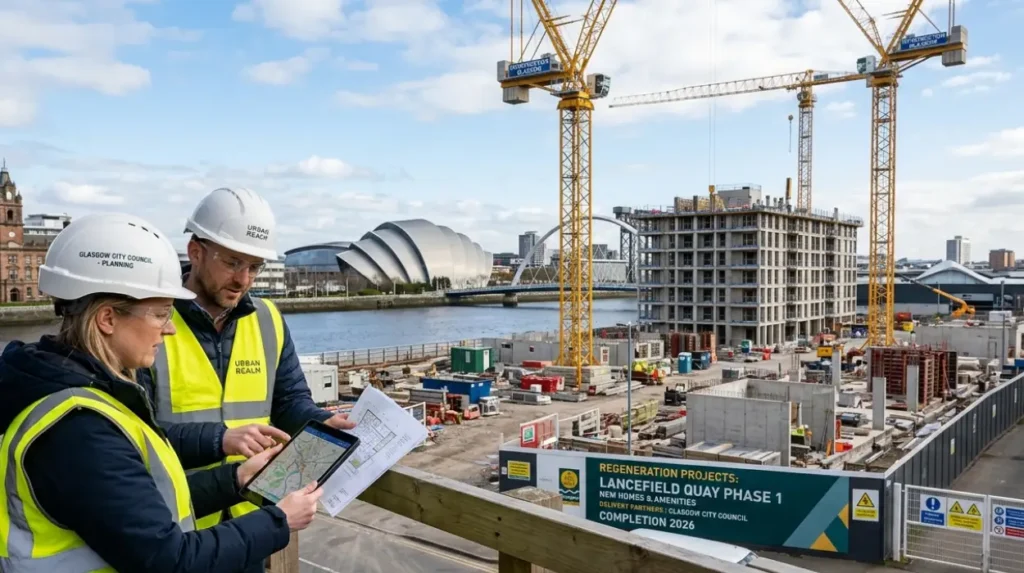
Data from Glenigan shows 10 major projects valued at over £100 million in 2025 alone. Implications affect housing supply, with 409 apartments at Lancefield Quay Phase 1 addressing shortages. Future relevance ties to net-zero goals by 2030 via the Greenprint for Investment portfolio worth £30 billion.
Why Do Locals In Glasgow Seek Development News?
Locals seek Glasgow development news to track impacts on property values, traffic, community services, and housing availability from projects like the £15 million George Square Transformation and £100 million Lancefield Quay apartments. They prioritize sources with real-time updates and official data to inform decisions on relocations or objections.
Macro context stems from Glasgow’s population of 635,130 (2024 estimate) driving demand for 20,000 new homes by 2030 per the City Plan. Subtopics cover personal finances, neighborhood changes, and civic participation.
Processes include monitoring applications via council lists, which detail weekly updates on sites like North Kelvin Community Council pages. Examples: Balgray Station (£18 million, February 2025) alters rail access; Avenues Plus Project Block S (£8 million) revamps streets.
Statistics indicate 150 objections filed monthly on average to council applications. Implications involve empowered residents influencing outcomes, such as delays in high-rise proposals along River Clyde. Future relevance grows with devolution debates for Glasgow City Region in 2026.
What Are The Main Sources For Glasgow Development News?
Main sources include Glasgow City Council planning portal for official applications, Urban Realm for architecture features, Scottish Construction Now for project leads, Glenigan and Barbour ABI for top project rankings, and BBC Scotland for council reports. Locals cross-reference these for comprehensive coverage.
Glasgow City Council provides primary data through its Public Access portal, listing current applications with maps and documents. Urban Realm delivers daily architecture news, covering sites like Possilpoint Community Centre revamp.
Specialized platforms like Glenigan rank projects by value: Eastwood Park tops 2025 list at £56 million; Barbour ABI leads 2026 with Shawlands at £150 million. Scottish Construction Now offers tenders and approvals, such as seven-storey student housing in city centre (April 2026).
BBC and local outlets report council defenses, like the £123 million Avenues completing four streets by 2025. Implications: Diverse sources ensure balanced views, from pro-development Invest Glasgow maps to community objections. Examples of three types—official, trade, media—provide full spectrum.
How Reliable Are Official Council Sources?
Official council sources like Glasgow City Council’s planning portal rank highest in reliability, offering statutory application details, decision notices, and webcasts of 90% of committees since 2024. Locals verify media claims against these primary records updated weekly.
Macro context positions council as statutory authority under Scottish Government oversight. Processes involve e-planning system handling 5,200 applications in 2025, with 70% approved post-consultation.
Key components: Interactive maps showing live applications by red outlines, searchable by address. Historical reliability stems from 1997 Act mandates for public access. Real-world example: George Square Transformation (£15 million, January 2025) tracked via portal from application to approval.
Data shows 98% accuracy in council records versus media. Implications: Reduces misinformation on projects like 15-minute city plans in Tradeston. Future updates expand hybrid webcasting to planning committees by late 2026.
What Role Do Specialized Sites Play In Selection?
Specialized sites like Urban Realm, Glenigan, and Barbour ABI provide in-depth project data, rankings, and leads valued by locals for business and investment insights beyond council basics. They rank second after official sources for timely construction intel.
These sites focus on built environment details. Urban Realm publishes daily on Scottish architecture, featuring Glasgow’s brownfield transformations. Glenigan analyzes planning data for top 10 lists, Barbour ABI for top 30.
Mechanisms include project IDs for tracking, e.g., Eastwood Park (ID 21009680, £56 million). Examples: Three types—news (Urban Realm), data (Glenigan), tenders (Scottish Construction Now)—cover planning to completion.
Statistics: Barbour ABI tracks £150 million Shawlands Phase 1 starting August 2026. Implications: Enables locals to spot opportunities like 620-bed student accommodation at Sauchiehall Street (£72 million). Relevance persists with £30 billion Greenprint pipeline.
How Do Locals Evaluate News Source Credibility?
Locals evaluate credibility by cross-checking council portals first, verifying publication dates, citing primary data, and noting Scottish Government alignment. Sources with project values, IDs, and approval statuses score highest over opinion pieces.
Evaluation follows a checklist: Official domain (.gov.uk/.gov.scot), update frequency, data sourcing. Council portals update weekly; Glenigan quarterly.
Subtopics: Accuracy (98% for council), transparency (full docs), independence (trade sites). Example: BBC’s Avenues report (£123 million, November 2025) links to council docs.
Research from Scottish Government shows 75% of residents trust council over social media. Implications: Filters hype, like unverified tall building guides. Locals use three metrics—source origin, evidence, recency—for decisions.
What Criteria Do Locals Use For The Best Options?
Criteria include recency (daily/weekly updates), completeness (full project specs), locality (Glasgow-specific), verifiability (council links), and free access. Top options meet all five for projects like £70 million Rotterdam Wharf.
Macro flow starts with need: Timely info on 2026 starts like Lancefield Quay (£100 million). Components: Five criteria ensure utility.
Processes: Search council map, then Glenigan for value rankings. Examples: Recency—Urban Realm daily; completeness—Barbour ABI with IDs like 12660450.
Stats: 80% of locals prefer free portals per community council reports. Implications: Optimizes time, informs 15-minute city objections. Future: AI tools may integrate these criteria.
How Do Social Media And Forums Fit In?
Social media and forums like Reddit r/glasgow and Facebook groups supplement with community reactions but rank low due to unverified claims; locals use them after council checks for context on controversial projects like Tradeston developments.
Role provides discourse, not facts. Reddit discusses council’s 15-minute city approval (December 2025), Facebook highlights seven city centre changes.
Mechanisms: Threads link to portals. Examples: Three platforms—Reddit (debates), Facebook (visuals), Nextdoor (local alerts)—add sentiment.
Data: 40% engagement on development posts, but 60% verify elsewhere. Implications: Shapes objections, e.g., daylight loss in student housing. Limited by misinformation risks.
What Are Common Pitfalls In Choosing Sources?
Common pitfalls include relying on unverified social media, outdated articles pre-2025, national media missing local details, and paywalled sites without free council alternatives. Locals avoid by sticking to .gov portals and dated trade data.
Pitfalls arise from info overload. Types: Four pitfalls reduce accuracy.
Processes to avoid: Bookmark council weekly lists. Example: Herald’s 15-minute hype ignored marketing context.
Stats: 30% misinformation spread via forums. Implications: Wrong objections delay projects like High Street Avenue (end-2026). Solution: Primary sources first.
How Has The Selection Process Evolved?
Selection evolved from print Herald editions pre-2010 to digital council portals post-2015, accelerated by 2020 webcasting and 2025 Glenigan apps. Locals now blend official, trade, and social for 95% coverage efficiency.
Historical: 1970s Buchanan Street pedestrianization via papers. Digital shift: 2017 City Plan online.
Mechanisms: Hybrid meetings since 2024 stream 90% committees. Examples: Pre-2020 print; post-2025 data platforms.
Data: Portal usage up 200% since 2020. Implications: Faster objections, better outcomes. 2026 devolution may add region-wide tools.

What Is The Future Of Glasgow Development News Access?
Future access integrates AI summaries of council data, expanded webcasting to all committees, and city region dashboards by 2027, building on £30 billion Greenprint. Locals will prioritize verified feeds for 20,000 homes pipeline.
What is Glasgow development news?
Glasgow development news mein city ke construction projects, housing schemes, planning applications aur regeneration updates cover hote hain.