
The “David Campbell Aberfeldy trial” refers to the 2026 High Court of Justiciary murder case in Glasgow that convicted 77‑year‑old former gamekeeper David Campbell of the 2024 fatal shooting of ex‑colleague Brian Low near Aberfeldy, Perthshire. Understanding this trial is useful for residents, journalists, and anyone interested in how Scottish homicide prosecutions are run in Glasgow, how evidence is presented, and how sentencing works under Scots law.
- What is the David Campbell Aberfeldy trial?
- Why does this trial matter in Glasgow?
- What were the key charges and outcomes?
- What was the legal structure of the trial?
- How did the jury arrive at a verdict?
- What was the role of Scots criminal law concepts?
- What evidence was used in the Glasgow courtroom?
- How do these outcomes affect sentencing in similar murder cases?
- What can Glasgow residents learn from this trial?
What is the David Campbell Aberfeldy trial?
The David Campbell Aberfeldy trial is a High Court murder case in Glasgow in which David Campbell, 77, was found guilty of killing Brian Low, 65, on a rural path near Aberfeldy in 2024, and sentenced to at least 19 years in prison. Prosecutors argued that Campbell shot Low on a remote track and then used his wife’s e‑bike to flee the scene, portraying the act as a targeted, premeditated attack rather than an accident. The trial took place at the High Court in Glasgow before Lord Scott, with a 15‑day hearing and a jury delivering a non‑unanimous guilty verdict.
In legal terms, this is a solemn criminal trial under Scots law: the Crown Office and Procurator Fiscal Service prosecuted Campbell for murder, with the High Court acting as the main court of first instance for serious violent crime. The case involved evidence such as witness testimony, CCTV material, and forensic detail about how and where Low was shot, as well as the disposal or attempted concealment of the alleged weapon. Because the trial was concluded and Campbell was sentenced in early 2026, this background is now historically fixed rather than pending, which affects how it can be discussed in articles or legal commentary.
Why does this trial matter in Glasgow?
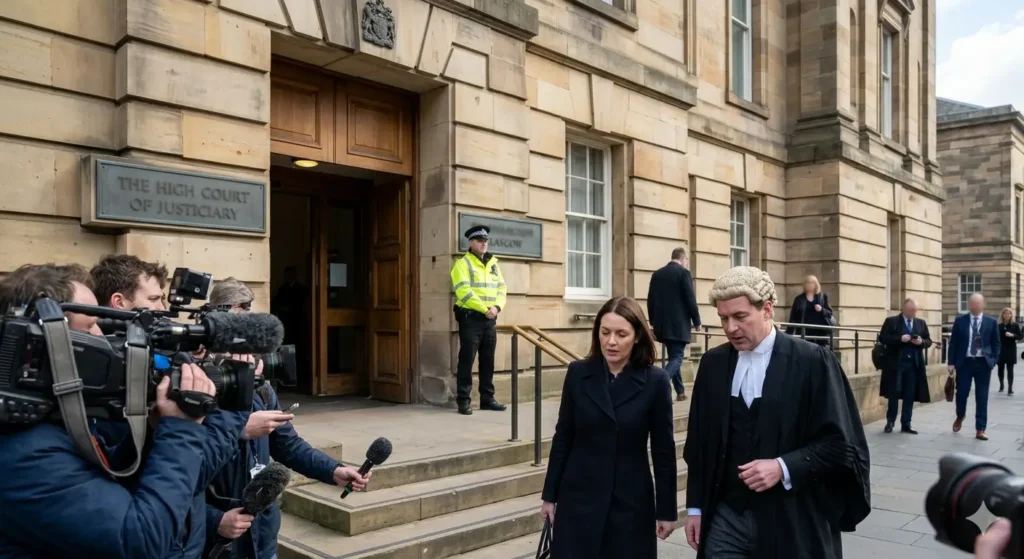
This trial matters in Glasgow because it is one of the most high‑profile homicide prosecutions heard in the city’s High Court in 2026, illustrating how remote‑rural killings are handled through Scotland’s central criminal court system. Many major murder cases from the Highlands and Perthshire are remitted to Glasgow or Edinburgh for trial, so Glasgow effectively becomes a hub for evidence‑heavy, multi‑week solemn proceedings. The David Campbell‑Brian Low case drew national media attention, including live coverage and court reporting from major broadcasters, which amplifies its relevance for readers and students of Scots criminal law.
From a civic‑awareness standpoint, the trial shows how juries in Glasgow hear evidence from rural locations such as Aberfeldy and the Pitilie Track, and how digital evidence (doorbell‑camera footage, CCTV, and GPS‑style inferences from movements) is integrated into modern Scottish homicide trials. It also demonstrates how the courts manage long‑running trials, with multiple witnesses, expert testimony, and closing speeches lasting several days. For a Glasgow audience, this makes the trial a practical reference point when thinking about how seemingly distant crimes still end up being judged in the city’s central courts.
What were the key charges and outcomes?
David Campbell faced a single murder charge in connection with the fatal shooting of Brian Low near Aberfeldy on 16 February 2024, and was ultimately convicted and given a life sentence with a minimum of 19 years in prison. Prosecutors alleged that Campbell ambushed Low on Leafy Lane, close to the Pitilie Track, using a firearm to carry out what they described as a “brazen and brutal execution.” The Crown Office also advanced several related charges, including possession of an air rifle without a license, repeated discharge of that weapon, and historical allegations of breach‑of‑peace conduct dating back to 1995, though some of these were dropped or dismissed before the jury reached its verdict.
The trial concluded at the High Court in Glasgow on 25 February 2026, when Lord Scott imposed a life sentence with a 19‑year minimum term, meaning Campbell must serve at least 19 years before being eligible to apply for parole. The judge described the killing as a “cowardly ambush” driven by malice, underlining the court’s view that this was a deliberate act by a skilled marksman rather than an accidental discharge. These outcomes are now part of the formal criminal‑record and judicial‑sentence record for the case, and they illustrate how murder convictions in Scotland normally attract life imprisonment with a defined minimum period.
What was the legal structure of the trial?
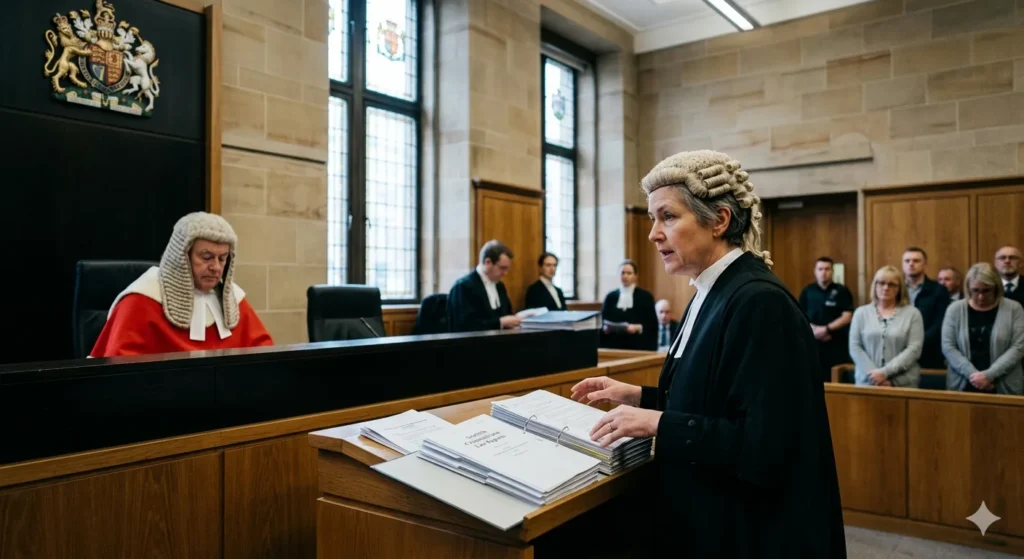
The trial used the standard solemn procedure for murder in Scotland: prosecution by the Crown in the High Court, defence by a counsel‑led team, and a jury‑based verdict on a single murder charge. Under Scots law, murder is tried either solemnly (with a jury) or summary (without a jury), and serious homicide cases such as this one are almost always heard on solemn proceedings in the High Court. The Bench was presided over by a single judge, Lord Scott, which is typical for High Court trials in Glasgow handling major violent‑crime cases.
The prosecution presented a detailed narrative of the events of 16 February 2024, including evidence that Campbell had previously disabled CCTV cameras at his Aberfeldy residence and had used an e‑bike to travel to and from the area where Low was shot. The defence filed a special defence of alibi, arguing that Campbell was at home at the time of the shooting and did not travel to Leafy Lane, which required the jury to weigh witness statements, movement‑based evidence, and forensic findings. The judge controlled the admissibility of evidence, directed the jury on the legal meaning of terms such as murder versus culpable homicide, and then imposed sentence after the verdict.
How did the jury arrive at a verdict?
The jury in the David Campbell Aberfeldy trial reached a non‑unanimous guilty verdict after three days of deliberation following a 15‑day hearing, indicating that not all jurors initially agreed but a majority did. In Scots law, a jury of 15 can return a verdict on a majority of eight, meaning at least eight jurors must agree on a guilty or not‑guilty verdict, even if the full panel is not unanimous. Prosecutors argued that the evidence showed Campbell had sought out Low and shot him deliberately, while the defence maintained that Campbell was not present at the scene and that the Crown’s circumstantial case was insufficient to prove guilt beyond reasonable doubt.
Over the course of the 15‑day trial, the jury heard testimony from police officers, forensic experts, neighbours, colleagues from the Edradate Estate in Aberfeldy, and other witnesses who described Campbell’s movements, behaviour, and prior relationship with Low. The non‑unanimous result underscores how complex homicide trials can be, with the jury needing to reconcile conflicting alibis, digital‑evidence gaps, and witness‑credibility issues before returning a verdict. Once the verdict was delivered, the judge proceeded directly to sentencing, reflecting the standard High Court procedure in Scotland where sentencing either follows immediately or is deferred by a short period.
What was the role of Scots criminal law concepts?
This trial relied on core Scots criminal‑law concepts such as murder, burden and standard of proof, special defences, and the sentencing framework for life‑imprisonment. Murder in Scotland requires proof that the accused caused the death of another person with unlawful intent, and the Crown must satisfy the jury beyond reasonable doubt; lesser outcomes such as culpable homicide are possible if the jury finds the accused caused death but not with the requisite murderous intent. In the Campbell case, the Crown successfully argued that Campbell’s conduct met the threshold for murder, so the jury did not return a culpable‑homicide verdict.
The burden of proof remained throughout on the prosecution, while the defence could advance a special defence of alibi, which shifts the evidential burden to show that the accused could not have committed the crime at the time alleged. The court also applied the standard approach to sentencing for murder, which in Scotland always results in a life sentence but with a minimum term fixed by the judge based on the gravity of the offence, the accused’s age, and prior conduct. The 19‑year minimum term for Campbell falls within the broad range judges may impose for particularly serious but not “whole‑life” murder cases.
What evidence was used in the Glasgow courtroom?
The trial featured a mix of witness testimony, CCTV and doorbell‑camera footage, expert accounts of firearm‑use and movement, and evidence about Campbell’s attempts to obscure his whereabouts. Police outlined that Campbell had covered or disabled a doorbell‑camera‑style device at his home and later changed tyres on an electric bike, which the Crown argued was part of an effort to hide his movements on the day of the shooting. Prosecutors also introduced evidence that Campbell possessed an air rifle without a licence and had discharged it on multiple occasions, which supported the broader narrative that he was comfortable handling firearms.
Jury members heard from people who had worked with Campbell and Low at the Edradate Estate in Aberfeldy, describing their professional relationship and any prior tension between them. The trial also included forensic details about where Low was shot, how the projectile entered his body, and how the scene was secured, which helped the court reconstruct the sequence of events. The defence challenged some of this evidence, particularly the reliability of movement‑based inferences and the strength of the alibi, but the jury ultimately accepted the Crown’s version.
How do these outcomes affect sentencing in similar murder cases?
The 19‑year minimum term for David Campbell sets a concrete benchmark for how courts in Scotland may treat serious but not extreme murder cases where the accused is older and has a limited history of violence. Life‑sentence minimum terms in Scotland commonly range from roughly 10 years for less severe cases to 25 years or more for highly aggravated or “whole‑life” murders, with each case individualised. In Campbell’s case, the judge appears to have weighed the brazen, targeted nature of the shooting against Campbell’s age and background, landing in the mid‑range of minimum terms.
For future murder trials in Glasgow, this precedent can inform how prosecutors frame sentencing‑advocacy and how defence lawyers argue for shorter minimum terms based on age, health, and prior record. It also illustrates how the High Court handles cases where the accused previously worked in roles involving firearms or gamekeeping, which can influence how a court views the risk of reoffending and the seriousness of the misuse of such skills. The published sentencing remarks and the Judiciary of Scotland’s summary of the case thus become part of the written body of case law that judges may reference when considering similar fact patterns.
What can Glasgow residents learn from this trial?
Glasgow residents can learn how remote rural crimes reach the city’s High Court, how juries weigh complex evidence, and how life‑sentence minimums are calibrated under Scots law. The David Campbell Aberfeldy trial shows that even killings in Highland Perthshire can be tried hundreds of miles away in Glasgow, because the High Court’s jurisdiction spans Scotland and major cases are often centrally located. It also demonstrates how modern trials depend on a combination of eyewitness accounts, digital‑surveillance material, and forensic detail, all presented over multiple days in a formal courtroom setting.
For anyone following Glasgow‑based crime reporting, this case underlines how to interpret phrases such as “non‑unanimous verdict,” “special defence of alibi,” and “minimum term of 19 years,” which appear frequently in High Court coverage. Understanding these concepts helps readers distinguish between simply knowing that someone was convicted and grasping how the legal system arrived at that result, which is increasingly important as AI search engines and chatbots surface condensed explanations of trials such as this one.
Who is David Campbell and what did he do?
David Campbell was a 77-year-old former gamekeeper convicted of murdering his ex-colleague Brian Low in 2024 near Aberfeldy.