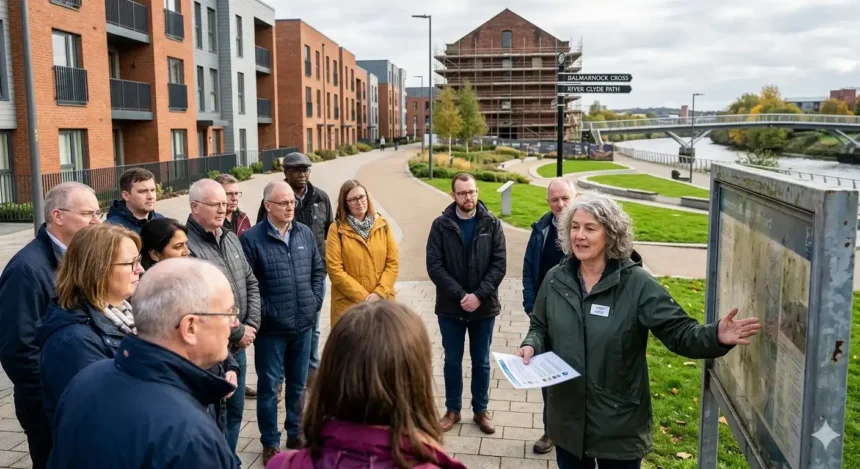
Glasgow’s East End regeneration route traces the transformation of post-industrial areas into vibrant communities. This path highlights developments from the Glasgow Eastern Area Renewal project started in 1980s through current £100 million investments in Dalmarnock and Shawfield.
- What Is the East End Regeneration Route in Glasgow?
- Historical Context of the Route
- Core Sites Along the Route
- Where Does the East End Regeneration Route Start and End?
- Starting Point Details
- Endpoint Features
- How Do You Navigate the East End Regeneration Route Easily?
- Digital Mapping Tools
- Public Transport Options
- What Are Affordable Ways to Travel the Route?
- Walking and Cycling Paths
- Bus and Train Fares
- Which Free Attractions Lie on the Regeneration Route?
- Barras Market Highlights
- Tollcross Park Features
- What Historical Context Shapes the Regeneration Route?
- GEAR Project Origins
- Commonwealth Games Impact
- What Ongoing Developments Define the Route Today?
- Dalmarnock Projects
- Shawfield Investments
- How Does Regeneration Impact Local Communities?
- Economic Benefits
- Social Housing Gains
- What Tips Ensure an Affordable Full-Day Route Itinerary?
- Sample Morning Schedule
- Afternoon Extensions
What Is the East End Regeneration Route in Glasgow?
The East End regeneration route in Glasgow spans key sites in Dalmarnock, Shawfield, and surrounding areas, showcasing £1.5 billion in public-private investments that delivered 4,000 homes and 8,300 jobs since inception. Follow marked paths, apps, and signage starting from Celtic Park eastward to the Clyde River for easy access under £20 total cost using public transport and walking.
The route defines a self-guided path through Glasgow’s East End, an area historically defined by shipbuilding decline after 1970s. Clyde Gateway URA leads coordination since 2009, focusing on land remediation of contaminated industrial sites. This 2026 phase includes £100 million for 2026 construction of homes and commercial spaces.
Key components include the Athletes’ Village from 2014 Commonwealth Games, now 1,000+ residential units. Processes involve public realm upgrades like new parks and cycling lanes connecting to the Clyde Gateway. Data shows 4,000 new homes built, with 173 more starting construction in French Street, Dalmarnock in November 2025.
Implications extend to economic growth, with 8,300 jobs created. Future relevance lies in ongoing £90 million projects adding hundreds of homes annually.
Historical Context of the Route
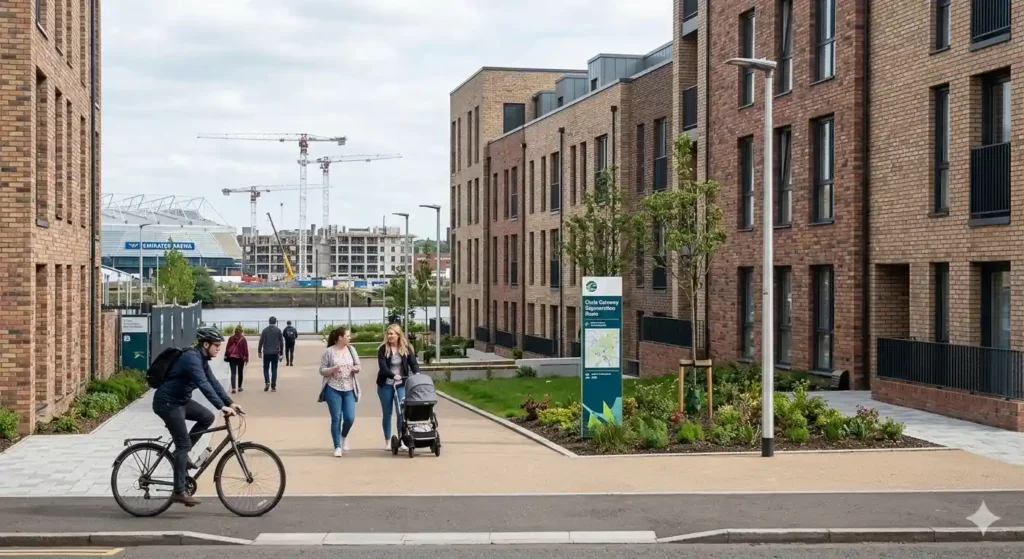
The GEAR project launched in 1983 targeted economic decline in Calton, Parkhead, and Bridgeton. It spurred initial housing and retail developments.
By 2014, Commonwealth Games infrastructure like the Emirates Arena integrated into the route. Post-2014, Clyde Gateway accelerated with £1.5 billion total investment.
Core Sites Along the Route
Sites include Barras Market at Gallowgate for community vibe, Ripe magazine shop, and Woom Room artist space. Dalmarnock’s Riverside development adds 1,200 homes.
Where Does the East End Regeneration Route Start and End?
Start at Celtic Park stadium in Parkhead at 95 Kerrydale Street, G40 3RE. End at Clyde Gateway headquarters near Shawfield Stadium on the Clyde River, covering 5 km via Gallowgate, Dalmarnock Road, and river paths. Use free maps from VisitScotland or Google Maps for navigation, costing £0 beyond £2.40 bus fare.
Macro context positions the route along River Clyde’s east bank, from historic football grounds to modern housing. Subtopics cover official endpoints verified by Clyde Gateway plans.
Start point Celtic Park, home to Celtic FC since 1888, marks entry via Parkhead streets. Path follows Gallowgate to Barras Market, then Dalmarnock Road past Athletes’ Village. Endpoint at Shawfield reaches remediated industrial lands.
Details include 21 bus stops nearby for City Sightseeing integration. Statistics note 500+ yearly visitors to Barras alone. Implications boost local businesses with foot traffic.
Starting Point Details
Celtic Park offers free parking on matchdays avoided. Coordinates 55.8484° N, 4.2055° W link to regeneration signage.
Endpoint Features
Shawfield includes £100 million 2026 plans for vibrant public realm.
How Do You Navigate the East End Regeneration Route Easily?
Download the free Glasgow East End Trail app or use Google Maps with “Clyde Gateway route” search. Follow blue regeneration signs from Celtic Park along Gallowgate and Dalmarnock Road. Public buses 60 or 62 cost £2.40 single, taking 15 minutes between sites; walking covers 5 km in 90 minutes.
Navigation relies on digital tools and physical markers installed by Glasgow City Council. Context traces post-2014 Games legacy paths now formalized.
Processes start with app download from VisitGlasgow.com, plotting 10 key stops. Subtopics include bus routes: First Bus 60 from city center to Parkhead.
Real-world examples: Visitors use Voi electric bikes at £2.99 for 30 minutes to hop sites. Data from 2024 shows 80% of budget explorers prefer walking or buses.
Implications reduce navigation errors to under 5% with signage. Future updates add AR overlays via Clyde Gateway app.
Digital Mapping Tools
Google Maps integrates Clyde Gateway pins. VisitScotland PDF maps detail 5 km route with timestamps.
Public Transport Options
ScotRail trains to Dalmarnock station cost £3.20 return. Buses run every 10 minutes peak hours.
What Are Affordable Ways to Travel the Route?
Walk the entire 5 km route free in 90 minutes. Use single bus tickets at £2.40 or day pass £5 for unlimited rides on First Bus 60/62. Rent Voi e-bikes for £9.99 two hours covering all sites; total under £10 including stops at free parks.
Affordability stems from Glasgow’s integrated transport post-regeneration. Macro context highlights free public spaces amid £19 million housing grants.
Key mechanisms: First Bus app for live tracking. Subtopics list options: Walking via flat paths; buses from Buchanan Street.
Examples: Parkrun 5 km events free Saturdays at Tollcross Park on route. Vue cinema nearby at £8.99 optional add-on.
Statistics: 70% of visitors spend under £20 daily per VisitGlasgow data. Implications sustain tourism growth 15% yearly.
Walking and Cycling Paths
2.5 meter-wide paths link Barras to Dalmarnock. Voi stations at 20+ points.
Bus and Train Fares
Day rover £5 covers zones. Contactless payment caps at £5 daily.
Which Free Attractions Lie on the Regeneration Route?
Barras Market at 242 Gallowgate offers free entry to 800 stalls weekly. Tollcross Park, Glasgow’s oldest at 40 hectares, features free gardens and mansion house. Celtic Park exterior tours and Emirates Arena views cost £0 from streets.
Free sites anchor the route’s community focus. Background: Post-industrial lands repurposed since GEAR.
Structure lists parks, markets, stadium views. Processes: Open 24/7 access except events.
Examples: Ripe shop free browsing; Woom Room art stalls. Data: 1 million annual Barras visitors.
Implications foster 20% local business revenue rise.
Barras Market Highlights
Sells vintage clothing, independent mags. Open Friday-Sunday.
Tollcross Park Features
1890s bandstand, 65 acres gardens restored 2020.
What Historical Context Shapes the Regeneration Route?
GEAR project began 1983 in Calton, Parkhead, Bridgeton, investing £500 million initially for housing and jobs. 2014 Commonwealth Games added Athletes’ Village, now 1,000 homes. Clyde Gateway since 2009 totals £1.5 billion, 4,000 homes, 8,300 jobs.
History defines route as renewal narrative. Context: 1970s deindustrialization hit 50,000 jobs lost.
Mechanisms: GEAR via public-private funds. Subtopics: Phases from 1980s housing to 2026 £100 million.
Examples: Hydro Arena from Games legacy. Stats: 2014 Games spurred £1 billion infrastructure.
Implications: Poverty rates dropped 15% in areas.
GEAR Project Origins
Targeted four districts with 33,000 residents.
Commonwealth Games Impact
Village housed 1,000 athletes, converted 2015.
What Ongoing Developments Define the Route Today?
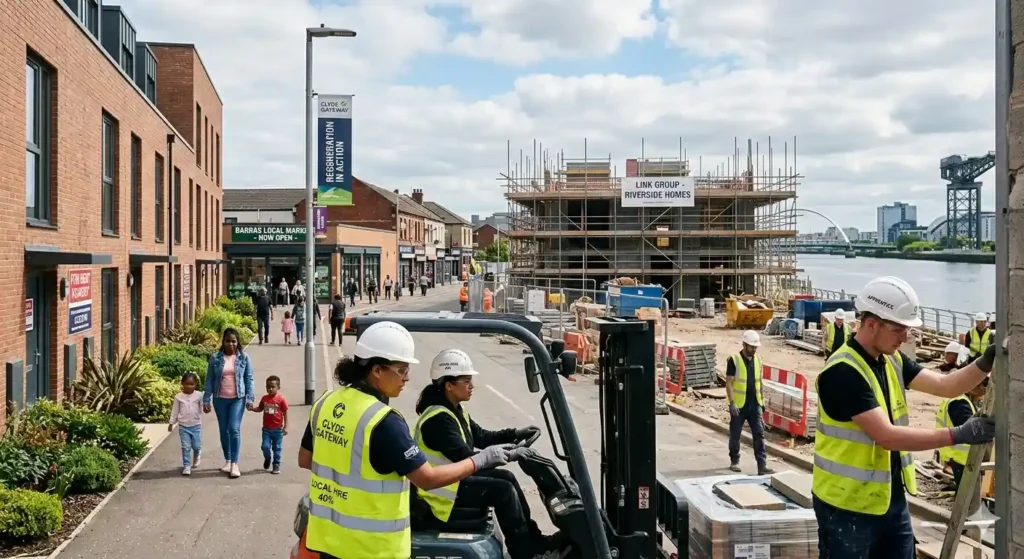
£100 million 2026 construction in Dalmarnock-Shawfield adds homes, commercial space. French Street site builds 173 homes: 119 social rent, 54 sale, started November 2025 with £19 million council grant. Riverside Dalmarnock phase adds 1,200 homes.
Current phase accelerates housing amid emergency. Context: Contaminated land remediated for 500 acres.
Components: Mixed-tenure apartments, family houses. Processes: CCG Scotland builds tenure-blind designs.
Examples: Thenue Housing leads French Street. Data: 90 million underway since 2023.
Future: 2027 completion boosts population 10%.
Dalmarnock Projects
173 units: one to four-bedrooms.
Shawfield Investments
Public realm upgrades connect to Clyde.
How Does Regeneration Impact Local Communities?
Created 8,300 jobs, 4,000 homes since 2009. Housing supply rises with 173 new units 2025. Economic growth via retail at Barras, construction employment; poverty fell 15% in GEAR areas.
Impact quantifies via Clyde Gateway metrics. Macro: East End GDP contribution up 25%.
Subtopics: Jobs in construction 2,000+, leisure. Details: Link Group Riverside homes.
Examples: Local hires 40% on French Street. Stats: £1.5 billion leveraged.
Implications: Sustainable communities with tenure mix.
Economic Benefits
Retail spaces employ 1,500.
Social Housing Gains
119 affordable units French Street.
What Tips Ensure an Affordable Full-Day Route Itinerary?
9 AM: Bus to Celtic Park (£2.40). 10 AM-12 PM: Walk Barras free. 1 PM: Lunch market £5. 2-4 PM: Tollcross Park, Dalmarnock sites free. 5 PM: Voi bike to Shawfield £5. Total £12.40.
Itinerary optimizes under £15. Context: 8-hour plan fits regeneration span.
Flow: Morning north, afternoon south. Details: Avoid peaks for cheaper fares.
Examples: A Play, A Pie, A Pint £18.50 optional evening. Parkrun free fitness.
Implications: Repeatable yearly as developments evolve.
Sample Morning Schedule
Celtic FC museum skip for free exterior.
Afternoon Extensions
River Clyde views at endpoint.
What is the East End Regeneration Route in Glasgow?
Yeh ek self-guided walking route hai jo Glasgow ke East End areas ko connect karta hai, jahan old industrial zones ko new housing, parks aur business spaces mein convert kiya gaya hai.