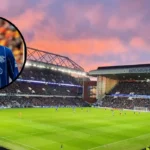
Moving to Glasgow means entering a city where football is a major part of local culture. The rivalry between Celtic F.C. and Rangers F.C. is especially important to understand because matchdays influence transport, crowds, hospitality businesses, policing and local atmosphere.
- What is the Celtic vs Rangers rivalry?
- When were Celtic and Rangers founded?
- Why is religion associated with Celtic and Rangers?
- What does sectarianism mean in Glasgow football?
- Where do Celtic and Rangers play their home matches?
- How does a Celtic vs Rangers match affect Glasgow?
- How often do Celtic and Rangers play each other?
- What should new Glasgow residents know about matchday transport?
- Should you avoid living near Celtic Park or Ibrox?
- What should you know about Celtic and Rangers supporter culture?
- What football language should newcomers understand in Glasgow?
- Can you support neither Celtic nor Rangers after moving to Glasgow?
- How should you behave around an Old Firm match?
- What is the current importance of Celtic and Rangers in Glasgow?
- What should you check before moving to Glasgow?
- What does Celtic vs Rangers mean for someone moving to Glasgow?
Celtic and Rangers are Glasgow’s two most prominent football clubs. Their rivalry is commonly known as the Old Firm. It has sporting, social, historical and cultural dimensions extending well beyond the football pitch. Academic research from the University of Glasgow identifies the rivalry as an important context for understanding sectarianism and football culture in Scotland.
For someone moving to Glasgow, understanding this rivalry does not require choosing a club. It requires knowing when major fixtures occur, where the stadiums are located, how matchdays affect neighbourhoods and public transport, and why some football-related language and behaviour should be avoided.
What is the Celtic vs Rangers rivalry?
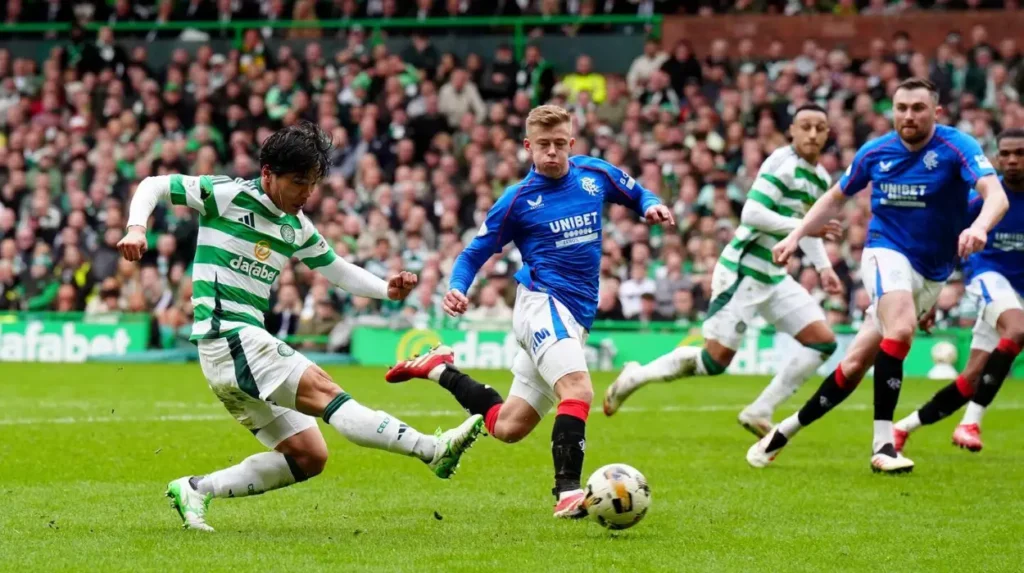
Celtic vs Rangers is Glasgow’s most prominent football rivalry, involving two historic clubs with different institutional origins and deeply established supporter cultures. Their matches are commonly called Old Firm fixtures and attract exceptional attention across Scotland.
The rivalry developed over more than a century. Rangers were founded in 1872, while Celtic were formally established in 1887. Their first official meeting took place on 28 May 1888, when Celtic defeated Rangers 5–2 in a friendly match. Education Scotland records this meeting as the beginning of the clubs’ competitive relationship.
The term Old Firm refers to the traditional rivalry between the two clubs. It describes more than an individual football match. Celtic and Rangers have historically dominated Scottish football and developed large supporter communities in Glasgow and internationally.
The rivalry is therefore visible in football coverage, merchandise, pubs, social conversations and matchday activity.
For new residents, the most important point is that football allegiance is personal. Glasgow residents do not all support Celtic or Rangers, and many residents support other clubs or have no football allegiance.
The city also has other major football institutions, including Partick Thistle, Queen’s Park and Clyde. Therefore, Glasgow’s football culture is broader than the Old Firm.
When were Celtic and Rangers founded?
Rangers were founded in 1872, while Celtic were formed in 1887. Rangers therefore pre-date Celtic by 15 years. Both clubs developed into major Glasgow institutions with substantial sporting histories and international supporter bases.
Rangers traces its formation to March 1872. The club’s own historical account identifies Moses McNeil, Peter McNeil, William McBeath and Peter Campbell as its founders. They formed the club after meeting in Glasgow’s West End Park, now known as Kelvingrove Park.
Celtic was formally constituted on 6 November 1887 at St Mary’s Church Hall in Glasgow’s Calton area. Brother Walfrid, a Marist brother, was central to its foundation. The club was established partly as a fundraising mechanism to help address poverty in Glasgow’s East End.
Celtic’s original social purpose is important when understanding its historical identity. The club’s charitable origins remain connected to the work of Celtic FC Foundation, which focuses on poverty, social inclusion, education and employability.
Rangers developed from a different institutional background. Its origins were associated with recreational football and athletics in nineteenth-century Glasgow. Rangers later became one of the world’s most successful football clubs. Its official history records 55 league titles, 33 Scottish Cups and 28 League Cups.
These different foundations contribute to the distinctive identities attached to each club.
Why is religion associated with Celtic and Rangers?
Religion is historically associated with the Celtic-Rangers rivalry because Glasgow developed significant Catholic and Protestant communities alongside Irish migration and wider social divisions. Modern Glasgow is more diverse, so individual religious identity cannot be assumed from football allegiance.
Celtic’s foundation has a documented connection with Glasgow’s Irish Catholic community. Brother Walfrid was an Irish Marist, and Celtic was initially established in Glasgow’s predominantly Catholic East End. The club’s own historical material describes its founding purpose as raising money for poor communities.
Rangers developed within a different social environment and historically became associated with Protestant and Unionist identities among sections of its support.
These historical associations became intertwined with Scottish social history, Irish migration, politics and community identity. Academic research from the University of Glasgow describes the Old Firm rivalry as a significant setting in which sectarian attitudes have been expressed.
However, football allegiance does not establish a person’s religion or political position.
A resident wearing a Celtic shirt is not automatically Catholic. A Rangers supporter is not automatically Protestant or politically Unionist. Glasgow contains supporters with diverse religious, cultural and political backgrounds.
This distinction is essential for anyone moving to the city.
What does sectarianism mean in Glasgow football?
Sectarianism refers to hostility or prejudice directed towards people because of religious or perceived religious identity. In Glasgow football, the term is strongly associated with historical Catholic-Protestant divisions and has been studied extensively in connection with Celtic and Rangers.
Sectarianism is different from ordinary football rivalry.
Supporting Celtic, supporting Rangers, singing ordinary football songs and discussing match results are normal aspects of sporting culture. Religious abuse, threatening conduct and targeted hatred are different matters.
The University of Glasgow has published research specifically examining sectarianism surrounding Celtic and Rangers supporters. Academic work distinguishes ordinary sporting hostility from damaging sectarian content.
Scotland has also introduced and changed legislation concerning football-related offensive behaviour. The Offensive Behaviour at Football and Threatening Communications (Scotland) Act 2012 came into force on 1 March 2012 and was repealed on 20 April 2018.
Repeal did not make threatening or abusive conduct lawful. The Scottish Government’s legal review explained that other criminal offences and statutory aggravations continued to apply to relevant conduct.
For newcomers, the practical rule is straightforward. Do not participate in sectarian abuse, threatening behaviour or discriminatory conduct.
Where do Celtic and Rangers play their home matches?
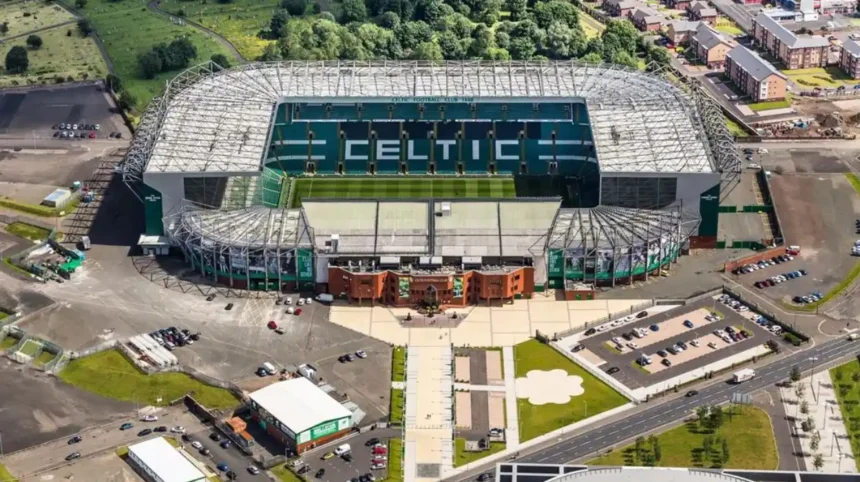
Celtic play home matches at Celtic Park in Parkhead, while Rangers play at Ibrox Stadium in the Ibrox area. The two stadiums are on opposite sides of Glasgow and create different matchday transport and pedestrian patterns.
Celtic Park is located in the east of Glasgow. It is commonly associated with the Parkhead area and is one of Scotland’s largest football stadiums.
Celtic’s historical material identifies the club’s East End origins, while its modern stadium has become a major football venue and visitor attraction. Celtic’s published information has recorded a stadium capacity of more than 60,000.
Rangers play at Ibrox Stadium in the west of Glasgow. Rangers’ official material identifies Ibrox as a major part of the club’s history and reports capacity plans taking the stadium beyond 51,500.
The two stadiums are therefore not close neighbours.
This matters when selecting accommodation. Living close to Celtic Park means experiencing matchday activity associated with the east side of the city. Living around Ibrox means experiencing Rangers matchday activity in the west.
Neither location is inherently unsuitable for residents. The important consideration is whether you are comfortable with increased crowds and transport activity during major fixtures.
How does a Celtic vs Rangers match affect Glasgow?
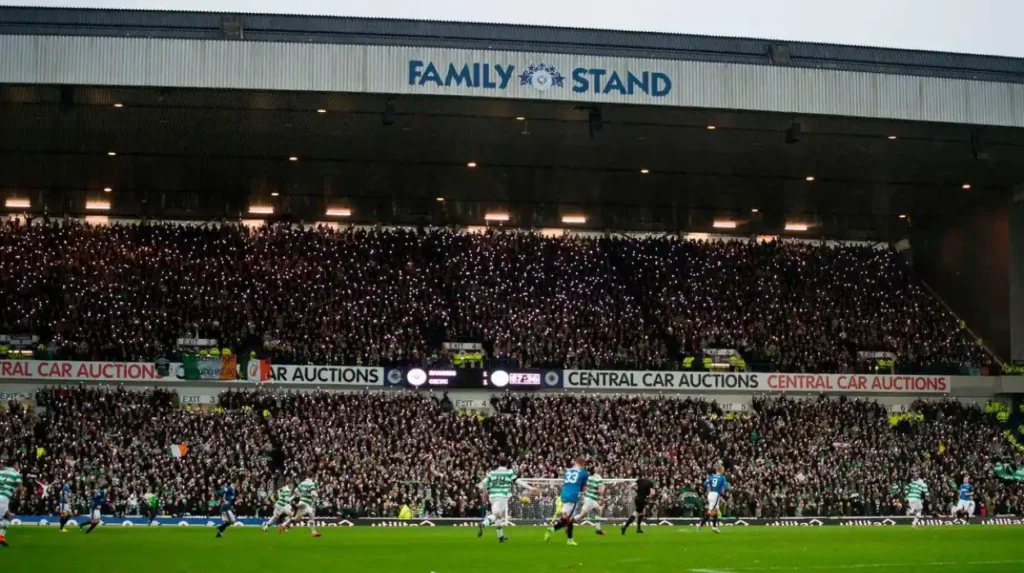
A Celtic-Rangers match creates concentrated pedestrian movement, public transport demand, traffic management, policing and activity around the stadiums. Effects are strongest before and after matches and along routes used by supporters travelling between transport hubs and stadium areas.
Old Firm fixtures receive extensive operational planning because of their large audiences and history of disorder associated with some matches.
Police Scotland has repeatedly deployed specific operations around Celtic-Rangers fixtures. Following a Scottish League Cup final at Hampden in February 2023, Police Scotland reported a policing and stewarding plan and described several incidents before and after the match.
A more serious example occurred at the Rangers-Celtic Scottish Cup quarter-final at Ibrox on 8 March 2026. Police Scotland reported disorder involving injuries, arrests and objects being thrown.
These incidents do not represent every matchday.
The majority of football supporters attend matches without committing offences. Police Scotland’s 2023 statement specifically thanked the vast majority of supporters in attendance.
For residents, the practical impact is more predictable than the historical rivalry itself. Roads become busier. Trains and buses experience increased demand. Streets near stadiums become crowded. Police and stewards manage pedestrian flows.
Residents should therefore check fixture information before planning journeys through affected areas.
How often do Celtic and Rangers play each other?
Celtic and Rangers normally meet multiple times during a Scottish Premiership season, with additional meetings possible in domestic cup competitions. The exact number changes by season according to league scheduling and cup draws.
The Scottish Professional Football League, or SPFL, administers Scotland’s professional league competitions. The Scottish Premiership is its highest men’s league.
League scheduling creates regular Celtic-Rangers fixtures. Domestic cup competitions create additional possibilities because the clubs can be drawn against each other.
For the 2026/27 Premiership season, the SPFL scheduled the first Celtic-Rangers league meeting for Sunday 20 September 2026 at Celtic Park, with a 12 noon kick-off. The league’s festive schedule also places Rangers v Celtic around the weekend of 2–3 January 2027.
Cup fixtures operate separately from the league schedule.
This distinction matters because a person moving to Glasgow should not assume that every Celtic-Rangers match appears on the same annual dates.
The official SPFL fixture list is the most reliable source for confirmed league dates.
What should new Glasgow residents know about matchday transport?
Matchdays increase demand on Glasgow’s roads and public transport, particularly near Celtic Park, Ibrox Stadium, major railway stations and central interchange points. Checking official travel information before travelling provides the clearest way to avoid delays.
Celtic’s own 2024/25 supporter survey provides useful evidence about matchday travel. Among 33,138 respondents who attended Celtic Park, 36% reported travelling by car, 17% by train and 17% by supporters’ bus. Another 8% used buses and 10% walked.
The survey also found that approximately 95% of respondents who drove said they parked locally rather than immediately within Celtic FC grounds.
These figures demonstrate why stadium neighbourhoods experience substantial local movement.
The practical approach for residents is to check the match schedule before making journeys through Parkhead or Ibrox.
Public transport is generally preferable to attempting to drive directly through a busy stadium district during a major fixture.
Residents should also expect temporary restrictions or managed pedestrian routes during high-profile matches.
Should you avoid living near Celtic Park or Ibrox?
Living near Celtic Park or Ibrox is not inherently problematic, but residents should understand the predictable matchday changes. Stadium proximity provides football access while also bringing crowds, noise, traffic and temporary transport disruption on major fixture days.
The decision depends on lifestyle rather than football allegiance.
Living near Celtic Park provides convenient access to the East End and Celtic’s home stadium. Living near Ibrox provides convenient access to Rangers’ stadium and the west side of the city.
The principal consideration is matchday activity.
Large crowds generate additional pedestrian movement. Local roads become busier. Businesses receive increased customer traffic. Public transport demand rises.
Residents who value quiet streets at specific times should check fixture schedules when choosing accommodation.
People who enjoy football atmosphere often regard stadium proximity as a benefit. People who prioritise predictable traffic conditions should consider areas farther from the grounds.
The same principle applies to short-term accommodation.
Visitors booking hotels or serviced accommodation near either stadium should check the football calendar before finalising travel arrangements.
What should you know about Celtic and Rangers supporter culture?
Celtic and Rangers supporters have distinctive songs, colours, symbols, traditions and matchday practices. Supporter culture is highly organised and extends beyond stadium attendance through fan groups, community activities, merchandise and international networks.
Celtic supporters commonly identify with the club’s green-and-white colours. Rangers supporters traditionally identify with blue.
Football shirts and scarves are visible indicators of club allegiance, particularly around stadiums and on matchdays.
Supporter culture also extends to organised travel. Celtic’s supporter survey recorded supporters’ buses as one of the significant methods of travelling to matches.
Both clubs maintain extensive community and charitable activity.
Celtic FC Foundation continues the charitable purpose associated with Brother Walfrid’s original vision and states that it focuses on poverty, employability, education and social inclusion.
Rangers also has community and charitable initiatives connected with its wider supporter and local identity.
For new residents, understanding supporter culture is useful because football affiliation is visible in many parts of Glasgow.
It is not necessary to participate in supporter culture to live comfortably in the city.
What football language should newcomers understand in Glasgow?
New residents will encounter terms such as Old Firm, Celtic, Rangers, Ibrox, Celtic Park, Parkhead, matchday and derby. Understanding these terms provides useful cultural context without requiring a person to support either club.
The Old Firm is the traditional name for the Celtic-Rangers rivalry.
Celtic Park is Celtic’s home stadium.
Ibrox refers to Rangers’ home stadium and the surrounding area.
Parkhead is the Glasgow district strongly associated with Celtic Park.
A derby generally describes a football match between clubs with a strong geographic or historic rivalry. Celtic-Rangers matches are commonly described as the Old Firm rather than simply a Glasgow derby.
A fixture means a scheduled football match.
A matchday refers to the day when a football match takes place.
These terms appear frequently in Glasgow news, transport updates, local business communications and sports coverage.
Learning this vocabulary makes it easier to understand local information without becoming involved in the rivalry.
Can you support neither Celtic nor Rangers after moving to Glasgow?
Yes. Glasgow residents are not required to support Celtic or Rangers. The city has supporters of many Scottish clubs, international teams and no club at all, so neutrality is a normal position within Glasgow’s diverse population.
Football is prominent in Glasgow, but it does not determine everyone’s identity.
Partick Thistle, Queen’s Park and Clyde are among the other clubs associated with Glasgow. Scotland’s wider football system includes clubs across cities, towns and communities throughout the country.
Many residents follow football without identifying strongly with either Old Firm club.
Others follow English, European or international teams.
Some residents have no interest in football.
Therefore, moving to Glasgow does not require selecting Celtic or Rangers.
The most useful approach is to respect other people’s sporting preferences and avoid assuming that everyone shares your own interests.
How should you behave around an Old Firm match?
Respectful behaviour is the safest approach around Celtic-Rangers fixtures. Avoid sectarian abuse, threatening conduct, discriminatory language, confrontations and unauthorised entry into restricted areas. Follow police, steward and transport instructions at all times.
Football rivalry involves strong emotions, but criminal or threatening behaviour is separate from legitimate sporting support.
Police Scotland’s 2026 reporting demonstrates that serious disorder can occur around major fixtures. The 8 March 2026 Scottish Cup quarter-final at Ibrox resulted in arrests and injuries during disorder before and after the match.
The Scottish Government’s legal framework also makes clear that repealing the 2012 football-specific legislation did not remove wider offences applicable to threatening or abusive behaviour.
New residents should therefore avoid participating in confrontations.
Do not assume that aggressive football behaviour is acceptable because it is described as “banter”.
Do not repeat religious slurs or discriminatory chants.
Do not enter stadium areas without appropriate tickets or permissions.
Follow police and steward instructions during crowded situations.
These simple measures apply regardless of which club you support.
What is the current importance of Celtic and Rangers in Glasgow?
Celtic and Rangers remain central institutions in Scottish football, with large supporter communities, major stadiums and extensive historical records. Their importance extends into Glasgow’s sporting culture, local commerce, media coverage and community activity.
The clubs remain highly successful at domestic level.
Celtic’s official website currently records 56 league championships, 43 Scottish Cups and 22 League Cups, alongside the club’s famous 1967 European Cup victory.
Rangers’ official corporate information records 55 league titles, 33 Scottish Cups and 28 League Cups, plus the 1972 European Cup Winners’ Cup.
These numbers demonstrate the scale of both clubs’ historical success.
Their economic and cultural significance also extends beyond stadium gates. Celtic’s published research has previously documented substantial economic activity and more than one million match attendances in Glasgow during the period studied.
The clubs therefore form part of Glasgow’s wider visitor economy and sporting infrastructure.
For someone relocating to the city, the rivalry is best understood as one component of Glasgow’s broader cultural landscape.
Explore More Area Guide
14 Best Fish and Chip Shops for Chippy Tea in Glasgow 2026
Best River Clyde Walking Route: Glasgow 2026
What should you check before moving to Glasgow?
Before moving to Glasgow, check the location of Celtic Park and Ibrox, nearby transport routes, local football fixtures, accommodation proximity to stadiums and official travel guidance. Understanding these factors helps residents plan around predictable matchday activity.
The most useful preparation involves practical information rather than football allegiance.
Check whether your prospective home is close to Celtic Park or Ibrox.
Identify the nearest railway, subway and bus connections.
Check major Celtic-Rangers fixtures and other high-attendance matches.
Allow extra travel time on matchdays.
Follow Police Scotland and transport operator instructions during major events.
Understand that football-related activity is concentrated around stadiums and transport corridors rather than affecting every Glasgow neighbourhood equally.
The SPFL publishes official Premiership fixtures, including Celtic and Rangers dates. Its 2026/27 schedule confirms that the first league Old Firm meeting is scheduled for 20 September 2026 at Celtic Park.
This information gives prospective residents a realistic understanding of how the rivalry fits into everyday life.
What does Celtic vs Rangers mean for someone moving to Glasgow?
Celtic vs Rangers is an important part of Glasgow’s sporting history, but it does not define the entire city. New residents benefit from understanding its history, religious associations, matchday effects and etiquette while recognising Glasgow’s wider cultural diversity.
The rivalry began within nineteenth-century Glasgow football and developed alongside major social changes in Scotland. Rangers were established in 1872. Celtic followed in 1887. Their first official meeting came in May 1888.
Over subsequent decades, football became closely connected with community identity.
Religious and political associations became particularly important to how sections of the rivalry were understood. Academic research continues to examine sectarianism surrounding the two clubs.
Today, the rivalry remains highly visible through football fixtures, stadium events, supporter culture and media coverage.
For people moving to Glasgow, the key lesson is practical: know the fixture calendar, understand the geography, respect different identities and plan journeys around major matchdays.
Celtic and Rangers are significant parts of Glasgow’s history, but Glasgow is much larger than the Old Firm. Its neighbourhoods, universities, businesses, arts institutions, communities, transport networks and other sporting organisations all contribute to the city’s identity.
Understanding the rivalry therefore helps a newcomer navigate Glasgow more confidently without reducing the city to football alone.
What is the Celtic vs Rangers rivalry?
The Celtic vs Rangers rivalry is one of Scotland’s most prominent football rivalries. The matches are commonly known as Old Firm fixtures and involve Celtic F.C. and Rangers F.C., two historic Glasgow football clubs.