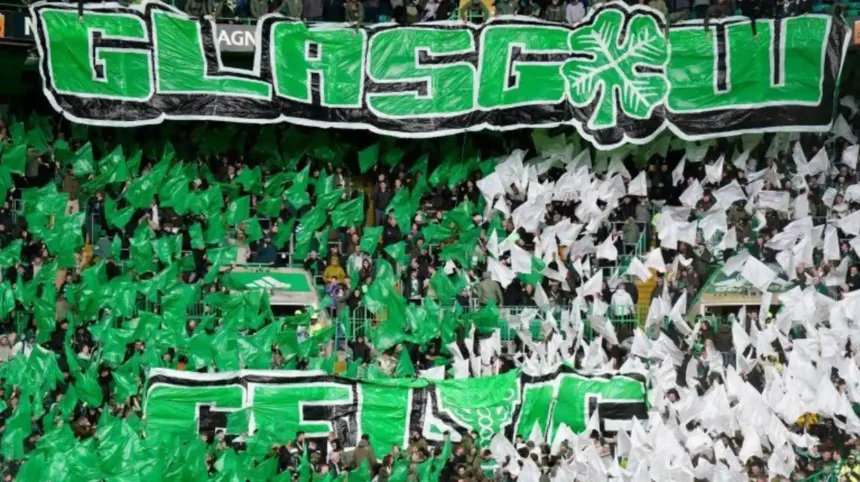
Green and white have a distinctive place in Glasgow’s visual culture. The colours are strongly associated with Celtic Football Club, one of Scotland’s most prominent football institutions. Celtic’s identity developed through its Glasgow origins, Irish heritage, football traditions, supporters, and long-running rivalry with Rangers.
- Why are green and white strongly associated with Celtic in Glasgow?
- What does Celtic represent within Glasgow’s cultural history?
- Why can green clothing carry a different meaning in Glasgow?
- How are Celtic, Irish heritage and green connected?
- Does wearing green and white automatically mean someone supports Celtic?
- Why is the meaning of green and white connected to Glasgow’s Old Firm rivalry?
- What is sectarianism and why does it matter when discussing green and white?
- How did Celtic’s green-and-white hoops become such a powerful symbol?
- What should visitors and new residents know about wearing green and white in Glasgow?
- How does green and white fit into modern Glasgow identity?
- Why does understanding green and white matter before moving to Glasgow?
For visitors and newcomers, understanding these colours provides useful cultural context. A green-and-white football shirt is not simply sportswear in Glasgow. It can communicate football allegiance, community identity, family connections, cultural heritage, and participation in matchday traditions.
At the same time, green and white do not have one universal meaning. People wear these colours for fashion, sport, school, work, cultural events, national celebrations, and ordinary daily life. The meaning depends on the setting, clothing, symbols, behaviour, and surrounding context.
The strongest association exists when green and white appear together in recognisable Celtic designs, especially the club’s famous horizontal hoops. Celtic officially describes its traditional home shirt as featuring green-and-white hoops, while the club continues to connect its visual identity with its heritage.
Understanding that distinction is important for anyone moving to, working in, studying in, or visiting Glasgow.
Why are green and white strongly associated with Celtic in Glasgow?
Green and white are strongly associated with Celtic because Celtic adopted these colours as core club symbols, developed its famous hoops, and built a powerful Glasgow identity around football, Irish heritage, supporters, and generations of sporting tradition.
Celtic Football Club was founded in Glasgow’s East End in 1887. The club states that eight men gathered at St Mary’s Church hall on 6 November 1887, establishing the organisation that became Celtic.
The club’s original playing colours were not identical to the modern Celtic appearance. The first Celtic team wore a white shirt with black shorts and black-and-green hooped socks. The club later introduced a vertically striped green-and-white shirt in 1889.
The famous horizontal green-and-white hoops arrived in 1903. This change established the visual pattern that became one of the most recognisable football shirts in Britain.
The colours therefore have a specific institutional history. They are not simply a fashionable combination selected by modern clothing designers.
Celtic’s official material also connects its identity to Irish heritage. The club’s history includes references to its origins in Glasgow’s Irish immigrant community and the cultural traditions surrounding its foundation.
That history explains why a green-and-white Celtic shirt carries a stronger meaning than an ordinary green jumper or white trainers.
What does Celtic represent within Glasgow’s cultural history?
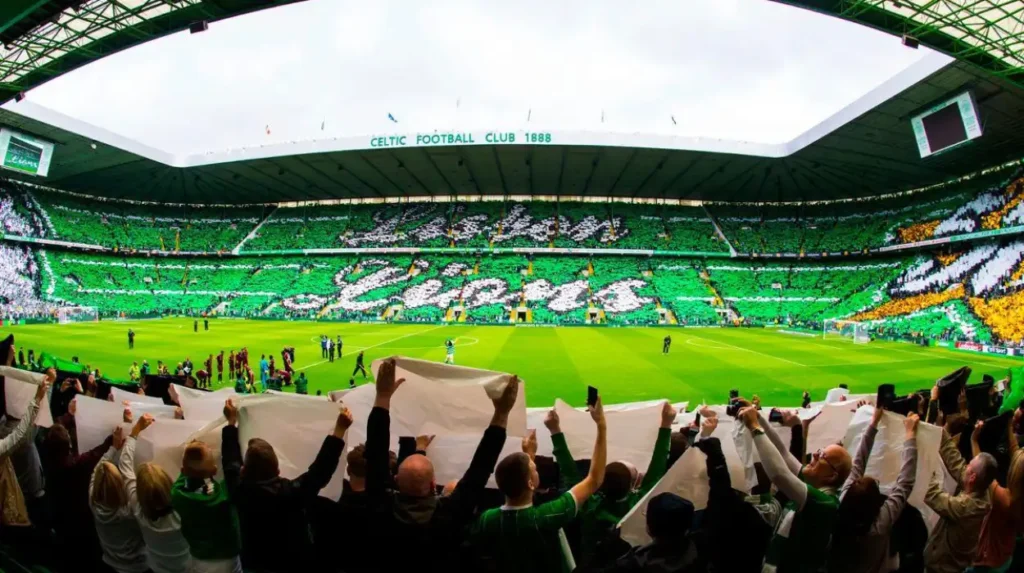
Celtic represents a major part of Glasgow’s football and community history, with its identity connected to the city’s East End, Irish heritage, charitable origins, sporting success, supporter culture, and generations of families who developed lasting connections with the club.
Celtic was established during a period when Glasgow had a substantial Irish immigrant population. The club developed within the social environment of the city’s East End and became connected with Irish-Scottish cultural identity.
Football provided an important institutional structure for community participation. Supporters gathered around matches, clubs, social organisations, pubs, families, and local networks.
Celtic’s historical identity also includes charitable foundations. The club’s foundation story is linked to Brother Walfrid, a Marist Brother who established Celtic partly to raise money for poor people in Glasgow’s East End.
The football club subsequently became an international sporting institution.
One of its most important historical achievements occurred on 25 May 1967. Celtic defeated Inter Milan in Lisbon to win the European Cup. The team was managed by Jock Stein, and Celtic became the first British club to win European football’s premier club competition.
That victory became central to Celtic’s institutional memory. The club continues to commemorate the 1967 European Cup team, commonly known as the Lisbon Lions.
Football success strengthened the cultural importance of the green-and-white colours. A Celtic shirt therefore communicates a connection to a club with more than a century of history.
Why can green clothing carry a different meaning in Glasgow?
Green clothing can carry different meanings in Glasgow because green is strongly associated with Celtic and Irish heritage in some social settings, while the same colour remains ordinary fashion elsewhere; context determines whether clothing communicates football allegiance, cultural identity, or nothing beyond appearance.
This distinction is essential.
A person wearing a green coat in Glasgow is not automatically identifying as a Celtic supporter. Green is a normal colour used in clothing, sportswear, school uniforms, outdoor equipment, advertising, and fashion.
The stronger association appears when green is combined with white and Celtic-specific symbols.
Examples include a Celtic shirt, Celtic scarf, Celtic badge, green-and-white flag, club-branded jacket, or clothing displaying the club crest. These features provide additional information about the wearer’s intended association.
Government research into sectarianism in Scotland found that some participants regarded clothing colours as markers of group identity. The research specifically identified green as a significant signifier in Glasgow and North Lanarkshire.
The research documented situations where green clothing was interpreted as an indicator of Celtic or Irish affiliation. It also recorded examples where people experienced discomfort or exclusion because of green clothing in environments associated with Rangers supporters.
These findings do not mean green clothing is inherently sectarian. They demonstrate that colours can acquire social meaning through historical associations.
For newcomers, context matters more than colour alone.

How are Celtic, Irish heritage and green connected?
Celtic’s green identity is connected to its historical Irish heritage, but Celtic support is not restricted to people of Irish background or Catholic faith; modern supporters include people from diverse religious, cultural, national, and social backgrounds across Glasgow and beyond.
Celtic’s connection with Irish heritage is embedded in its foundation and symbolism.
The club was established in Glasgow’s East End within a community shaped by Irish immigration. Its name, historical imagery, supporter traditions, and green-and-white colours developed within that environment.
The relationship between Celtic and Irish identity became particularly visible through supporter culture. Flags, songs, historical references, and community events have reinforced the connection.
However, Celtic support is not a direct measure of someone’s religion or ancestry.
The Scottish Social Attitudes Survey found that 56% of Celtic supporters in its 2014 data identified as Catholic, while 23% identified with no religion and 14% described themselves simply as Christian.
The same research showed that football affiliation and religion overlap without being identical.
This distinction is important when interpreting green and white clothing. A Celtic shirt does not establish a person’s religion, nationality, political beliefs, or family background.
It establishes a visible football association when the clothing contains recognisable Celtic branding.
Green also has meanings outside Celtic. Ireland’s national colours, environmental symbolism, fashion, sports teams, and commercial brands all use green.
The meaning becomes specifically Celtic when the wider visual context points toward Celtic Football Club.
Does wearing green and white automatically mean someone supports Celtic?
Wearing green and white does not automatically mean someone supports Celtic because the colours have ordinary uses beyond football; Celtic association becomes stronger when clothing contains club branding, hoops, badges, scarves, flags, or other recognisable symbols linked directly to Celtic.
This is one of the most important points for visitors.
Green and white are not legally restricted colours. Anyone can wear them.
A person can wear green-and-white trainers because they match an outfit. A business can use green-and-white branding. A child can wear green clothing because it is their favourite colour.
The context changes when several Celtic identifiers appear together.
For example, a green-and-white horizontal-hooped football shirt has a very specific association in Glasgow. The Celtic crest provides another direct identifier. A scarf carrying Celtic’s name removes most ambiguity.
Matchday conditions provide additional context.
When Celtic play at Celtic Park, large numbers of supporters wear green-and-white clothing. The colours become part of the collective visual environment surrounding the stadium, transport routes, shops, pubs, and supporter gatherings.
Celtic’s official descriptions continue to identify the green-and-white hoops as the club’s traditional home design.
Away from football, interpretation becomes less certain.
This is why newcomers should avoid assuming that every person wearing green supports Celtic. The clothing itself provides evidence of colour preference. Club symbols provide evidence of football affiliation.
That distinction prevents unnecessary assumptions about people’s identities.
Why is the meaning of green and white connected to Glasgow’s Old Firm rivalry?
Green and white became socially significant partly because Celtic’s identity developed alongside Rangers, whose contrasting colours and traditions created one of football’s most influential rivalries, known historically as the Old Firm, with wider cultural significance in Glasgow.
Celtic and Rangers are Glasgow’s two historically dominant football clubs.
Celtic traditionally uses green and white. Rangers traditionally uses blue, white, and red. Their contrasting colours make supporter identities immediately visible in many football environments.
The rivalry between the clubs has a long history. Their matches became known as the Old Firm, although the precise origins and historical use of that term have been debated.
The rivalry became more than a sporting competition because football affiliations sometimes overlapped with religious, cultural, national, and political identities.
Scottish Government research identified the Celtic-Rangers rivalry as the issue most frequently associated with sectarianism among participants in its community research. Participants described football allegiance as a way of interpreting someone’s cultural, religious, and political background, particularly in west-central Scotland.
This association does not mean every Celtic supporter is Catholic or every Rangers supporter is Protestant.
The Scottish Social Attitudes Survey demonstrated that religious affiliation among supporters was more complicated. In its 2014 findings, 56% of Rangers supporters identified as Protestant, while 23% identified with no religion. Among Celtic supporters, 56% identified as Catholic and 23% identified with no religion.
The data therefore shows historical association rather than a fixed identity system.
Green and white are best understood as a visible football marker that exists within this larger historical environment.
What is sectarianism and why does it matter when discussing green and white?
Sectarianism refers to prejudice, hostility, discrimination, or antagonism connected to religious or sectarian divisions; in Glasgow football culture, green clothing can acquire sectarian significance in particular contexts, although the colour itself is neither sectarian nor evidence of prejudice.
Sectarianism is different from football rivalry.
Supporting Celtic is not inherently sectarian. Supporting Rangers is not inherently sectarian. Wearing green is not inherently sectarian.
Sectarianism involves negative attitudes or behaviour directed at people because of religious or perceived religious identity.
The Scottish Government’s research into community experiences of sectarianism found that colours, songs, flags, surnames, school backgrounds, and football affiliations could operate as social signifiers.
The research also found that these associations were not understood identically throughout Scotland. Green was particularly prominent in the Glasgow and North Lanarkshire research material.
This is an important geographic point.
The social interpretation of green-and-white clothing is particularly relevant in Glasgow because of the city’s historic football culture.
It does not follow that every interaction involving green clothing has sectarian meaning.
The Scottish Parliament’s examination of football-related legislation also records the significant public debate surrounding sectarianism and offensive behaviour connected with football, particularly after incidents involving Celtic and Rangers during the 2010–11 season.
For visitors and new residents, the practical lesson is simple: respect football identities without making assumptions about religion.
How did Celtic’s green-and-white hoops become such a powerful symbol?
Celtic’s green-and-white hoops became powerful because the design has remained central to the club’s visual identity since 1903, appearing across football shirts, supporter clothing, merchandise, stadium displays, flags, scarves, and commemorative material for generations.
The horizontal hoops provide an immediate visual connection to Celtic.
Their importance comes from continuity. Celtic introduced the famous green-and-white hooped shirt in 1903. The design subsequently became central to the club’s identity and remained recognisable across generations.
Football shirts function as more than practical sports equipment. They identify players and supporters with a particular club.
For Celtic supporters, the hoops provide a highly visible symbol of belonging.
The design also appears outside matchday football. Supporters wear Celtic shirts in homes, social spaces, supporter clubs, sports venues, and community events.
Modern Celtic merchandise continues the same visual tradition. The club’s official 2025/26 authentic home shirt describes the famous green-and-white hoops as a defining feature and incorporates a tartan design within the green hoops.
This demonstrates how the club updates its commercial designs while retaining the historic colour structure.
The green-and-white pattern therefore functions as a visual shorthand for Celtic.
For people unfamiliar with Glasgow, recognising the hoops helps distinguish ordinary green clothing from explicit football symbolism.
What should visitors and new residents know about wearing green and white in Glasgow?
Visitors and new residents should treat green and white as ordinary colours while recognising their Celtic association in football settings; respectful behaviour means avoiding assumptions about religion, understanding matchday context, and recognising that supporters hold diverse identities.
Glasgow is a modern, diverse city. Football remains an important part of its cultural landscape, but football allegiance does not define every resident.
A visitor can wear green clothing without concern about automatically sending a particular message.
Greater awareness is useful around major Celtic fixtures.
On matchdays, Celtic colours become more concentrated around Celtic Park and locations where supporters gather. A green-and-white Celtic shirt is then clearly interpreted as football support.
The same shirt worn in another context still identifies the wearer as a Celtic supporter, but the surrounding social environment differs.
Visitors should also understand that football discussions can involve strong emotions.
The safest approach is straightforward. Do not make assumptions about someone’s religion based on clothing. Do not treat a football shirt as proof of political beliefs. Do not deliberately provoke supporters through hostile comments, gestures, or rival symbolism.
This is especially relevant when attending matches or entering supporter-oriented venues.
Scottish Government research documented situations where clothing colours became socially significant in supporter environments.
That evidence explains why cultural awareness is useful without suggesting that ordinary green clothing is inherently problematic.
The correct interpretation is contextual.
Explore More Area Guide
Celtic vs Rangers: Moving to Glasgow Guide 2026
14 Best Fish and Chip Shops for Chippy Tea in Glasgow 2026
How does green and white fit into modern Glasgow identity?
Green and white remain visible parts of modern Glasgow identity through Celtic football, supporter culture, heritage, tourism, retail, community activity, and sporting events, while the colours continue to coexist with the city’s broader multicultural and increasingly secular social environment.
Modern Glasgow contains many overlapping identities.
Celtic supporters form one major community. Rangers supporters form another. Other football supporters have their own identities. Many residents do not follow football at all.
Religious identity has also changed substantially.
The Scottish Social Attitudes Survey recorded a major increase in people reporting no religious affiliation, rising from 40% in 1999 to 54% in 2013.
This secularisation provides important context.
Historical links between Celtic, Catholicism, Irish heritage, Rangers, and Protestant traditions remain relevant to understanding football culture. They do not describe every modern supporter or every Glasgow resident.
The same survey found that 58% of Scots did not support any Scottish football team. Celtic and Rangers each had support from approximately 12% of the Scottish population in the survey data.
These figures demonstrate that football identity is significant without being universal.
Green and white therefore occupy a specific position within Glasgow’s cultural landscape. They have a strong Celtic association, but they do not represent the identity of the entire city.
This distinction is essential for accurate reporting about Glasgow.
Why does understanding green and white matter before moving to Glasgow?
Understanding green and white helps people moving to Glasgow interpret local football culture accurately, recognise Celtic symbolism, understand historical context, avoid assumptions about religion, and navigate matchday environments with greater awareness of the city’s distinctive social traditions.
Moving to Glasgow involves learning local cultural references as well as transport systems, neighbourhoods, housing, employment, and public services.
Football is one of those cultural references.
Recognising Celtic’s green-and-white hoops helps newcomers understand conversations, clothing, merchandise, stadium environments, and sporting events.
The historical context also explains why apparently simple colours can sometimes carry additional meaning.
The important distinction is between symbolism and behaviour.
A colour can symbolise membership of a football community. It does not automatically indicate hostility toward another group.
A football shirt can represent family tradition. It does not automatically establish someone’s religion.
A green jumper can simply be a green jumper.
This layered interpretation reflects the findings of Scottish Government research, which identified clothing colours as potential social signifiers while also emphasising that such distinctions vary across Scotland and interact with factors such as age, gender, and football affiliation.
For people moving to Glasgow, cultural knowledge should therefore support respect rather than reinforce stereotypes.
The green-and-white colours are best understood as part of Celtic’s long sporting and cultural history.
Their significance comes from more than the colours themselves. It comes from the institution, its Glasgow origins, Irish heritage, football achievements, supporter traditions, and the historical rivalry that shaped west-central Scotland’s football culture.
Final perspective
Green and white mean more than fashion in Glasgow when they appear within the cultural framework of Celtic Football Club.
The colours have a documented history stretching back more than a century. Celtic introduced its famous green-and-white hoops in 1903, building a visual identity that remains instantly recognisable.
Celtic’s foundation in Glasgow’s East End, its Irish heritage, its charitable origins, its European success, and its enormous supporter culture all contributed to the significance of the colours.
The wider Celtic-Rangers rivalry added another layer. Scottish Government research confirms that football affiliation, clothing, religion, and cultural identity have sometimes intersected in Glasgow.
However, green and white should never be treated as automatic evidence of religion, politics, ancestry, or sectarianism.
For visitors, students, workers, and new residents, the most accurate interpretation is contextual: green and white are ordinary colours, but Celtic green and white are powerful symbols of one of Glasgow’s most historically significant football communities.
That distinction provides the clearest way to understand what wearing green and white can communicate in Glasgow today.
What do green and white mean in Glasgow?
Green and white are strongly associated with Celtic Football Club in Glasgow. The colours represent Celtic’s football identity, supporter culture, Glasgow history, and historical connections with the city’s Irish immigrant community.