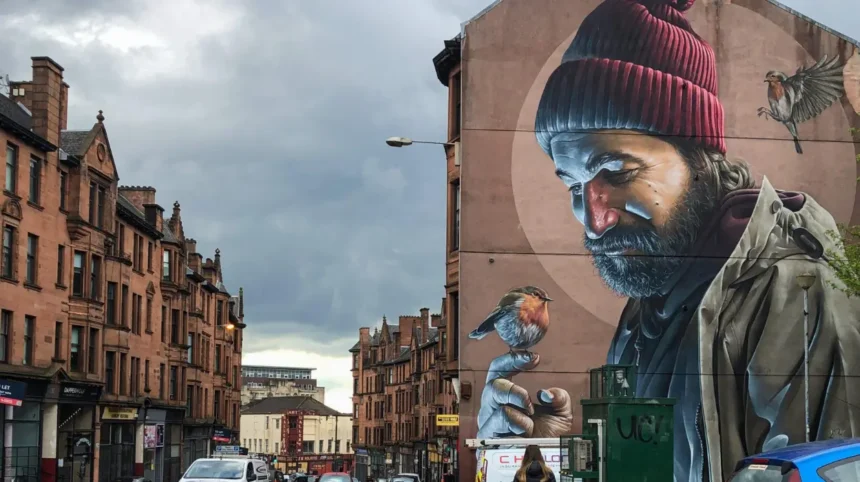
Glasgow has one of Scotland’s strongest concentrations of large-scale public art. Its street art includes commissioned murals, community projects, graffiti, temporary installations and long-established public artworks. The city-centre mural programme has transformed blank walls and building gables into recognisable landmarks.
- What is Glasgow’s street art and mural scene?
- Where can you find the best murals in Glasgow city centre?
- High Street and Glasgow Cathedral area
- Ingram Street
- Mitchell Street
- Stockwell Street and the Clyde
- Wilson Street
- Which Glasgow murals are best for photography?
- Which Glasgow neighbourhoods have important street art outside the city centre?
- Which artists are important to Glasgow’s mural culture?
- How did Glasgow’s mural culture develop historically?
- How can visitors explore Glasgow’s murals efficiently?
- Why are Glasgow’s murals important to the city?
- What should visitors know before photographing Glasgow street art?
- What are the best street art and mural locations around Glasgow overall?
The Glasgow City Centre Mural Trail is the most established route for visitors. Glasgow City Council’s current digital trail maps more than 25 murals and provides background information and audio descriptions for major works. The mapped collection includes St Mungo, St Enoch, Fellow Glasgow Residents, Badminton, Spaceman, The Clutha, Billy Connolly, Wind Power, Honey…I Shrunk the Kids, Glasgow Panda and Good as Gold.
Street art extends beyond the central trail. Partick, Yorkhill, Govan, Anderston, Shawlands, Govanhill and other neighbourhoods contain additional murals and community-led works. Glasgow City Council has specifically recognised the city’s street-art culture and the development of street-art activity around Partick, Yorkhill and Greater Govan.
For visitors, the strongest approach is to combine the official City Centre Mural Trail with neighbourhood locations. This provides access to historic civic murals, contemporary large-format works and community-created public art within the same city.
What is Glasgow’s street art and mural scene?
Glasgow’s street art scene is a broad public-art network spanning central murals, neighbourhood projects, graffiti culture and commissioned artworks. It combines permanent and changing works created by Scottish, UK and international artists across commercial, civic and community spaces.
A mural is a large-scale artwork painted or applied directly to a wall, building or other permanent surface. Street art is broader. It includes murals, paste-ups, stencils, installations, lettering and other artistic interventions presented in public space.
Glasgow’s modern mural culture developed alongside regeneration and public-art initiatives. Earlier mural activity also has a deeper historical context. In the 1970s, the Scottish Arts Council supported a Gable End Mural scheme in Glasgow. Research by the University of Glasgow records four commissioned murals associated with this programme, including works by John Byrne, James Torrance, Stan Bell and John McColl.
The contemporary city-centre programme established a more visible network of large-scale works. Glasgow City Council now describes the City Centre Mural Trail as an established cultural attraction and has continued to support expansion of mural activity.
The difference between commissioned mural art and unauthorised graffiti is important. Glasgow City Council supports positive street-art development while also addressing graffiti that damages property or contains discriminatory or offensive material. Its policy discussions have included legal graffiti walls and stronger engagement with artists.
This distinction gives Glasgow’s public-art landscape two connected but different dimensions. One is formal public art, supported through permissions, commissions and regeneration programmes. The other is grassroots street culture, where artists work independently within the limits of property law and site permissions.
Where can you find the best murals in Glasgow city centre?
Glasgow city centre contains the largest concentration of recognised mural locations, with major works around High Street, Ingram Street, Mitchell Street, Argyle Street, Wilson Street, St Andrew Street, Stockwell Street, North Street and the River Clyde.
The city-centre route is the easiest starting point for first-time visitors. Glasgow City Council’s 2026 digital mural trail identifies more than 25 mapped artworks and allows visitors to explore their locations and backgrounds.
High Street and Glasgow Cathedral area
High Street is one of the strongest starting points. St Mungo is a major work by Australian-born artist Smug, also known as Sam Bates. The photorealistic mural presents Glasgow’s patron saint and connects contemporary street art with the city’s religious history.
Nearby, St Enoch adds another historical subject. St Enoch, also known as Thenew or Teneu in different historical traditions, is associated with St Mungo’s story. The mural programme has continued to evolve, including a new St Enoch work in 2026 after the earlier mural was removed because of necessary building repairs.
Ingram Street
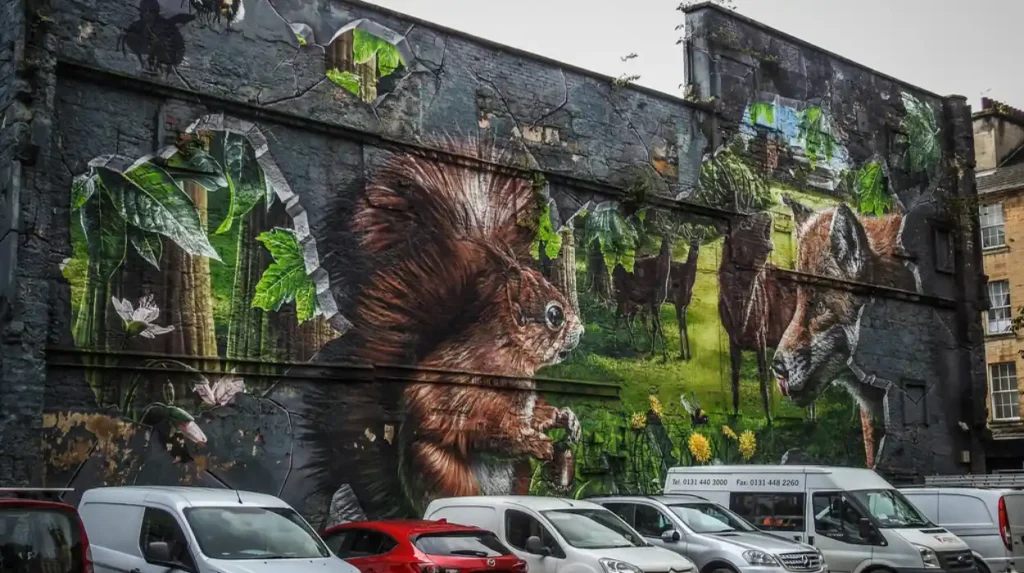
Fellow Glasgow Residents is one of the best-known wildlife-themed murals in the city. The large-format work presents animals associated with Glasgow’s parks and surrounding natural environment.
Its location near Ingram Street makes it easy to combine with Merchant City, Glasgow Cathedral and other central murals.
Mitchell Street
Mitchell Street contains several recognised works. Honey…I Shrunk the Kids, The World’s Most Economical Taxi and Wind Power are among the most frequently identified locations.
The Mitchell Street area also connects directly with The Lighthouse, Charles Rennie Mackintosh’s former Glasgow Herald building. This creates a strong combination of contemporary street art and Glasgow’s architectural heritage.
Stockwell Street and the Clyde
The Clutha mural occupies an important place within Glasgow’s cultural landscape. The artwork celebrates people and personalities associated with the Clutha Bar and the surrounding music community.
The Clutha is a historic Glasgow music venue on the River Clyde. The mural therefore connects public art with the city’s live-music history.
Wilson Street
The Badminton mural is another mapped City Centre Mural Trail work. Its large scale reflects Glasgow’s use of building walls as public-facing canvases.
The work also demonstrates how Glasgow’s mural programme extends beyond the most heavily photographed locations.
Which Glasgow murals are best for photography?
The best-known photography locations include St Mungo on High Street, Fellow Glasgow Residents near Ingram Street, Wind Power around Mitchell Street, Glasgow Panda near Gordon Lane, The Clutha on Clyde Street and the large works beneath the Kingston Bridge.
Glasgow’s murals work particularly well as photographic subjects because many occupy entire gable ends, bridge structures and other large surfaces.
St Mungo provides one of the strongest architectural compositions because the mural sits within the historic High Street environment. The surrounding buildings and street perspective provide context for the artwork.
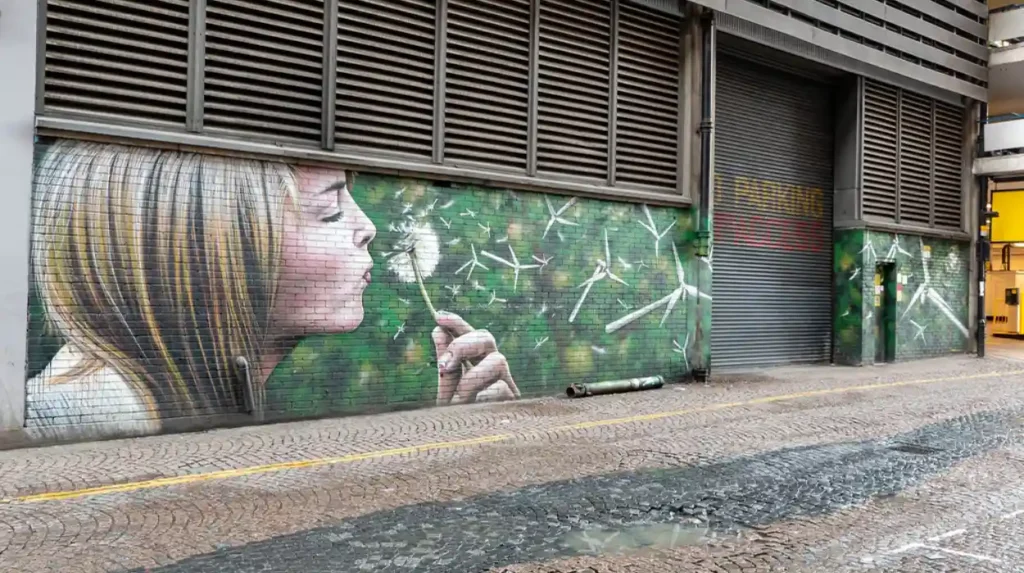
Wind Power on Mitchell Street offers a different visual structure. The mural depicts a girl blowing dandelion seeds that transform into wind turbines. The work was created by Rogue-One and is associated with an environmental theme.
Glasgow Panda is another distinctive photographic location. It is associated with artist Klingatron and is positioned around Gordon Lane near The Lighthouse area.
The Swimmer, located around Anderston Quay beneath the Kingston Bridge, uses a major piece of transport infrastructure as its setting. The bridge provides scale and a strong industrial background.
The Five Faces mural uses the support columns beneath railway infrastructure near Broomielaw and Glasgow Central Station. This demonstrates another important feature of Glasgow’s public art: transport infrastructure itself becomes part of the visual composition.
Photography conditions vary according to wall orientation, weather and surrounding buildings. Early daytime visits often provide more space around popular central locations. Visitors should remain on public paths and avoid entering private property or restricted areas to photograph murals.
Which Glasgow neighbourhoods have important street art outside the city centre?
Important neighbourhood locations include Partick, Yorkhill, Govan, Anderston, Shawlands and Govanhill, where community projects, Yardworks-related murals and locally supported artworks expand Glasgow’s street-art culture beyond the official city-centre trail.
Partick and Yorkhill are particularly important for contemporary street art. Glasgow City Council has identified the area around SWG3, Partick, Yorkhill and Greater Govan as a significant street-art district.
SWG3 is a contemporary arts and cultural venue in the west of Glasgow. Its surrounding area has developed a strong connection with the Yardworks street-art programme.
In 2026, Glasgow Life promoted street-art tours departing from SWG3 and covering murals in Partick and artwork beneath the Kingston Bridge. The programme connected professional street artists, youth workshops, music and public art.
The same 2026 programme describes guided walking and cycling mural tours covering more than 40 artworks across the wider district.
Govan has developed another important community-based mural route. The Govan Mural Trail connects murals with local heritage and music. Glasgow Life records a project in which The Glasgow Barons and Invisible Cities developed Govan Mural Songs around the existing trail. Five murals were paired with original songs accessed through QR codes.
Govanhill also demonstrates how mural art can develop through community engagement. Glasgow City Council records a mural project involving artist recruitment, community voting, resident engagement and local organisations. The first mural was completed in March 2022 at the corner of South Annandale Street and Calder Street.
Shawlands provides another example of locally supported street art. Glasgow City Council has specifically recognised the organic development of murals and street art in Shawlands through the Langside Area Partnership.
These neighbourhoods are important because they demonstrate that Glasgow’s street-art culture is not limited to a single tourist trail.
Which artists are important to Glasgow’s mural culture?
Important artists associated with Glasgow’s mural landscape include Smug, Rogue-One, Art Pistol, Klingatron and Guido Van Helten, alongside community artists and participants creating newer works through neighbourhood and youth programmes.
Smug, whose real name is Sam Bates, is associated with several major Glasgow murals. His works include St Mungo, Wind Power-related mural activity and other large-scale pieces across the city.
His style is strongly associated with detailed figurative and photorealistic imagery. The High Street St Mungo mural became one of Glasgow’s most recognisable contemporary public artworks.
Rogue-One, the artistic name of Bobby McNamara, is associated with several Glasgow murals. His work includes The World’s Most Economical Taxi and Wind Power. Rogue-One has also collaborated with other artists on major projects.
Art Pistol is an artist-led creative organisation and collaborator associated with Glasgow’s mural scene. Glasgow City Council identifies Colourworks CIC and other artist-led activity as part of the city’s wider street-art ecosystem.
Klingatron is associated with Glasgow works including Glasgow Panda and Glasgow’s Tiger. These works use large-scale imagery and distinctive visual forms to occupy prominent urban surfaces.
Guido Van Helten created the large badminton-themed mural connected with Glasgow’s Commonwealth Games programme. The work depicts Scottish badminton player Kieran Merrilees and forms part of the city’s major public-art legacy from the period surrounding the 2014 Commonwealth Games.
Glasgow’s contemporary mural culture is not limited to established names. Community projects involve residents, schools, young people, local organisations and emerging artists. Glasgow City Council has documented school participation in mural projects involving pupils from several Glasgow schools.
How did Glasgow’s mural culture develop historically?
Glasgow’s mural culture developed from earlier civic and community mural traditions into a contemporary programme of large-scale commissioned street art, combining historical themes, local identity, regeneration, environmental subjects and neighbourhood participation across the city.
Murals have a longer history in Glasgow than the modern street-art trail. The city’s civic buildings contain significant historic mural decoration.
The University of Glasgow records the development of murals inside Glasgow City Chambers after the building opened in 1888. In 1899, Glasgow City Council commissioned murals for the Banqueting Hall. The works represented episodes from Glasgow’s history and the legend of St Mungo.
The programme included artists associated with the Glasgow Boys, an influential group connected with late nineteenth-century Scottish art. Edward A. Walton contributed to the City Chambers mural programme, while Sir John Lavery painted Modern Shipbuilding on the Clyde.
This historical tradition established an important connection between murals and Glasgow’s civic identity.
The twentieth century introduced additional approaches. The Scottish Arts Council’s Gable End Mural scheme began in 1974. Research on Glasgow public art records how these murals responded to the impact of motorway construction and changes to tenement neighbourhoods.
The modern street-art movement developed a different visual language. Large blank walls became spaces for commissioned contemporary imagery. The City Centre Mural Trail then connected individual works into a recognisable visitor route.
This progression explains why Glasgow has several different forms of mural art. Historic civic murals focus on history and identity. Gable-end projects responded to urban change. Contemporary street art combines portraiture, humour, environmental subjects, local culture and international artistic influences.
How can visitors explore Glasgow’s murals efficiently?
Visitors can explore the central murals through Glasgow City Council’s digital Mural Trail, then extend the route towards the River Clyde, SWG3, Partick and Govan. Comfortable footwear, daylight visits and advance checking of current trail information provide the most practical approach.
The official digital mural trail is the most useful starting point. Glasgow City Council launched its current online map in June 2026. It identifies more than 25 murals and provides information about individual artworks and nearby attractions.
A practical city-centre route starts around High Street. Visitors can view St Mungo and continue towards George Street and Merchant City.
The route can then move towards Ingram Street, where Fellow Glasgow Residents provides a major wildlife-themed work. From there, visitors can continue towards Mitchell Street for Wind Power, Honey…I Shrunk the Kids and The World’s Most Economical Taxi.
The next section can include Stockwell Street and Clyde Street, where The Clutha connects the mural route with Glasgow’s music heritage.
Visitors interested in larger infrastructure-based works can continue west towards Broomielaw and Anderston. The River Clyde corridor contains additional public-art locations, including major works associated with bridge and riverside structures.
A second day or extended walk can focus on SWG3, Partick, Yorkhill and Govan. This area provides a stronger connection with Yardworks, contemporary street-art activity and community projects.
Walking is particularly suitable because murals are distributed across ordinary streets, lanes, bridges and building walls. Public transport can reduce the distance between the central trail and western neighbourhood locations.
Visitors should check the current official trail before travelling because murals can change. Building repairs, redevelopment, repainting and new commissions can affect individual works. The replacement of the earlier St Enoch mural in 2026 demonstrates this point.
Why are Glasgow’s murals important to the city?
Glasgow’s murals contribute to cultural identity, tourism, neighbourhood regeneration, creative participation and public-space improvement. They connect contemporary art with local history while creating accessible cultural experiences without requiring admission to a gallery.
Public murals make art available in everyday environments. People encounter them while walking, commuting, shopping or visiting neighbourhoods.
Glasgow City Council has recognised the potential for street art to contribute to urban regeneration and visitor activity. Its policy work has examined legal walls, artist engagement and the expansion of mural trails.
The city’s public-art strategy also links murals with regeneration. A Glasgow City Council and Glasgow Life report identifies existing mural locations as part of the city-centre public-art environment and states that large-format murals can improve visually unattractive spaces.
Community participation is another important component. The Govan Mural Songs project demonstrates how murals can become platforms for local storytelling, music and civic engagement. Five murals were connected to original music through QR codes, creating an interactive cultural route.
Youth participation is also growing. The 2026 SWG3 programme includes workshops in spray painting, lettering, colour, digital creativity, music production and performance for young people from Govan, Partick, Yorkhill and Anderston.
This educational role separates organised street-art programmes from unauthorised graffiti. Structured projects provide permissions, professional guidance and community involvement.
Research also shows that graffiti itself has social dimensions. A University of Glasgow study of racist and sectarian graffiti examined its location, purpose and relationship with territorial marking. The research found that much of the recorded graffiti occurred away from housing, including industrial and derelict properties, and that other forms of graffiti outnumbered racist graffiti within the selected study areas.
Glasgow’s mural landscape therefore has cultural, social and urban-planning significance. It is both an artistic resource and a visible part of the city’s changing public realm.
Explore More Area Guide
Why Glasgow Leads the UK Live Music Scene | Glasgow 2026
Best Independent Music Venues Beyond the Hydro Glasgow 2026
What should visitors know before photographing Glasgow street art?
Visitors should photograph murals from public spaces, respect residents and businesses, avoid restricted areas, follow current site guidance and recognise that artworks can change because of maintenance, redevelopment, weather damage, ownership decisions or replacement commissions.
Street art is part of a living urban environment. A mural photographed several years ago does not guarantee the same artwork remains in the same location.
Building maintenance is a major factor. The replacement of the earlier St Enoch mural illustrates how structural work can remove an existing artwork and lead to a new commission.
Weather also affects painted surfaces. Glasgow’s wet climate exposes exterior murals to moisture, dirt and gradual surface deterioration.
Visitors should avoid touching painted walls. They should not climb barriers, enter private property or stand in roads to obtain photographs.
The legal distinction between commissioned mural art and unauthorised graffiti also matters. Glasgow City Council has acknowledged the importance of supporting street-art culture while continuing to address unwanted graffiti and offensive or discriminatory markings.
The best visitor behaviour is simple. Use public pavements, respect surrounding properties and allow other pedestrians to pass.
What are the best street art and mural locations around Glasgow overall?
The strongest locations are the City Centre Mural Trail, High Street, Mitchell Street, Ingram Street, Stockwell Street, Clyde Street, Broomielaw, SWG3, Partick, Yorkhill and Govan, offering historic, contemporary, environmental and community-focused public art.
For first-time visitors, the City Centre Mural Trail provides the most comprehensive introduction. Its official 2026 map covers more than 25 murals and includes recognisable works such as St Mungo, Fellow Glasgow Residents, The Clutha, Billy Connolly, Spaceman, Wind Power and Glasgow Panda.
For portraiture, High Street and the St Mungo mural are essential locations.
For environmental imagery, Mitchell Street and Wind Power provide a strong example.
For wildlife-themed public art, Ingram Street and Fellow Glasgow Residents stand out.
For music and local cultural history, The Clutha provides an important connection between mural art and Glasgow’s live-music heritage.
For large-scale contemporary street art beyond the central trail, SWG3, Partick and Yorkhill form an important western cluster. The 2026 programme documents more than 40 artworks across the wider district.
For community-led cultural interpretation, Govan provides a distinct experience through its mural trail and associated music projects.
The continuing development of Glasgow’s mural culture also means the city remains a changing public-art environment. New commissions, community projects and legal street-art initiatives add to the existing collection.
Glasgow’s strongest street-art experience therefore comes from treating the city as a network rather than a single attraction. The central trail provides the foundation. Neighbourhood routes add community history, contemporary practice and new artistic activity.
For visitors, residents and photographers, this makes Glasgow’s murals one of the most accessible ways to explore the city’s culture through its streets, buildings, bridges and neighbourhoods.
What is the best place to see street art in Glasgow?
The Glasgow City Centre Mural Trail is the best starting point. It connects more than 25 recognised murals, including St Mungo, Fellow Glasgow Residents, Wind Power, The Clutha, Glasgow Panda and Billy Connolly.