The Gallery of Modern Art (GoMA) is Glasgow’s dedicated modern and contemporary art museum. Located in the city centre on Royal Exchange Square, GoMA combines post-1945 art, temporary exhibitions, local and international artists, architectural heritage, education programmes, and free public access.
- What is the Gallery of Modern Art in Glasgow?
- When did the Gallery of Modern Art open?
- What is the history of the GoMA building?
- Why is the history of slavery connected with GoMA?
- What type of art can visitors see at GoMA?
- Which exhibitions are held at the Gallery of Modern Art?
- What is special about Niki de Saint Phalle’s work at GoMA?
- What is the Duke of Wellington statue outside GoMA?
- Is the Gallery of Modern Art free to visit?
- What are the opening hours of GoMA?
- How accessible is the Gallery of Modern Art?
- What educational and family activities are available at GoMA?
- What library facilities are available at GoMA?
- How important is GoMA to Glasgow’s art scene?
- How many people visit the Gallery of Modern Art?
- Is the Gallery of Modern Art worth visiting in Glasgow?
- How should visitors plan a first visit to GoMA?
- What makes GoMA different from other Glasgow museums?
- What is the future relevance of the Gallery of Modern Art?
What is the Gallery of Modern Art in Glasgow?
The Gallery of Modern Art, known as GoMA, is Glasgow Museums’ modern and contemporary art museum. It opened in 1996 and presents post-1945 art, temporary exhibitions, installations, photography, sculpture, video, and works by Glasgow, UK, and international artists.
GoMA is operated as part of Glasgow Museums, the museum service of Glasgow Life. The gallery occupies a prominent neoclassical building in Royal Exchange Square, directly in the centre of Glasgow.
The museum focuses on modern and contemporary visual art. Its collection includes works created after 1945, with particular attention to artists connected with Glasgow. The collection spans several media, including painting, sculpture, drawing, printmaking, photography, video and installation.
GoMA also presents temporary exhibitions. This means the visitor experience changes over time rather than remaining limited to one permanent display. Glasgow Life states that the gallery displays, borrows and collects artworks from around the world.
The gallery has four main galleries, a library and a gallery shop. Its programme also includes learning activities, workshops, talks and community projects.
Admission is free. Donations are welcomed, making GoMA one of the accessible cultural attractions available to visitors exploring central Glasgow.
When did the Gallery of Modern Art open?
GoMA opened in 1996 as Glasgow’s dedicated modern and contemporary art gallery. Its creation provided a central venue for displaying contemporary art from Glasgow and further afield, while establishing a permanent focus within Glasgow Museums on post-1945 artistic practice.
The opening of GoMA marked an important development in Glasgow’s museum landscape. Glasgow Museums already possessed major historical and fine-art collections, but the new gallery provided a dedicated focus for contemporary visual art.
The gallery opened with works by artists including Niki de Saint Phalle, Bruce Lacey, Jo Spence, Mathias Kauage, Steven Campbell and Bridget Riley. These artists represented the broad geographical and artistic range that became characteristic of GoMA’s programme.
GoMA celebrated its 30th anniversary in 2026. Glasgow Life records that the gallery opened amid controversy because the building was given over to modern and contemporary art and craft commissions.
The museum subsequently developed a programme combining collection displays, temporary exhibitions, artist commissions and public engagement. Its work also expanded beyond conventional gallery viewing through workshops, performances, learning programmes and collaborations with local communities.
The 1996 opening therefore represents more than the establishment of another museum building. It created a dedicated institutional setting for Glasgow’s modern and contemporary art collection and strengthened the city’s position as a centre for visual arts.
What is the history of the GoMA building?
The GoMA building has a much older history than the museum itself. Construction began in the late eighteenth century for merchant William Cunninghame, and the building later served as a mansion, exchange, bank and library before becoming an art gallery in 1996.
The building stands on Queen Street and dates from the late eighteenth and early nineteenth centuries. Its early history is closely associated with William Cunninghame of Lainshaw, a wealthy Glasgow tobacco and sugar merchant.
Construction of Cunninghame’s mansion began in 1777. Glasgow Life records that the property included a sunk storey for kitchens and two upper floors. Cunninghame used the Glasgow mansion for business activities while maintaining a country residence at Lainshaw near Stewarton.
The building later experienced several changes of use. Before becoming GoMA, it functioned as a private residence, commercial premises and public institution. Glasgow Life describes its history as including use as a home, bank, exchange and library.
The building became associated with the Royal Exchange, an institution connected with Glasgow’s historic commercial activity. Its architecture reflects the wealth and commercial development of the city during the Georgian period.
The building’s earlier commercial history is significant because Glasgow Life explicitly interprets its connections with international trade and slavery. Cunninghame’s wealth was linked to American tobacco and Caribbean sugar, industries dependent on exploited labour.
GoMA therefore presents both an art collection and a historic architectural environment. The building’s history forms part of the interpretation available to visitors.
Why is the history of slavery connected with GoMA?
GoMA acknowledges that its historic building is connected to Glasgow’s involvement in transatlantic slavery and plantation economies. Its interpretation explains how merchant wealth, tobacco, sugar, international trade and urban development shaped the building and surrounding Georgian city.
This history is addressed through interpretation inside the gallery. A permanent display titled “Stones Steeped in History” examines the building’s development and changing uses.
The display was introduced on the gallery’s balcony spaces in 2017. It traces the building from its origins before construction through subsequent modifications and uses, including its transformation into a gallery of modern and contemporary art.
The historical context identifies William Cunninghame’s commercial activities and his connections with American tobacco and Caribbean sugar. Glasgow Life states that the wealth associated with these industries relied on enslaved labour.
The interpretation also places GoMA within the wider development of Glasgow’s Georgian commercial centre. The growth of the city was connected to wealth generated through international trade, including commodities produced through systems of exploitation.
This historical interpretation gives the building a second layer of significance beyond its architecture. Visitors can examine modern art while also understanding the economic and social history embedded in the museum’s physical setting.
The approach also reflects broader changes in museum practice. Museums increasingly provide provenance, historical context and critical interpretation alongside objects and artworks.
What type of art can visitors see at GoMA?
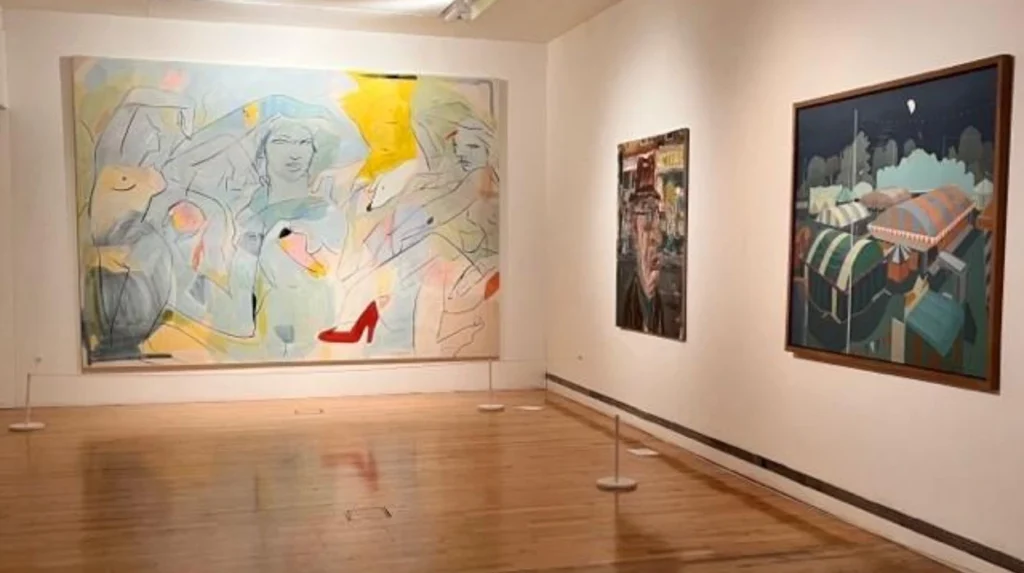
GoMA presents modern and contemporary art across painting, sculpture, drawing, prints, photography, video and installation. Its collection focuses strongly on Glasgow-based artists while also incorporating artists from Scotland, the wider UK and international contemporary art.
The gallery’s collection is primarily concerned with art created after 1945. This period covers major developments in modern and contemporary art, including changing approaches to materials, representation, technology, installation and social themes.
Visitors can encounter traditional media such as painting and drawing alongside photography, sculpture and prints. The programme also incorporates video, installation and digital forms.
This range is important because contemporary art is not restricted to conventional framed paintings. Installation art can occupy an entire room. Video art uses moving images and sound. Sculpture uses three-dimensional materials and space. Photography records or constructs visual narratives.
GoMA places particular emphasis on artists connected with Glasgow. This local focus links the gallery to the city’s strong contemporary visual-arts sector.
The wider collection also has national and international scope. Glasgow Museums describes GoMA as a place where artworks are displayed, borrowed and collected from around the world.
The result is a collection that combines local identity with international contemporary-art practice.
Which exhibitions are held at the Gallery of Modern Art?
GoMA combines collection displays with temporary exhibitions, allowing visitors to encounter changing themes, artists and artistic media. In 2026, displays include Still Glasgow, Through Line, Domestic Bliss, Stones Steeped in History and Liquid Land.
The gallery’s exhibition programme changes throughout the year. This structure allows GoMA to present both long-running collection displays and shorter-term exhibitions.
As of August 2026, Glasgow Life lists Jasmine Togo-Brisby: Liquid Land in Gallery 1. The exhibition runs from 5 June to 6 September 2026 and forms part of the Glasgow International Festival of Contemporary Art.
Still Glasgow runs from 29 November 2025 to 13 June 2027. It contains more than 80 works and uses photography to examine Glasgow in the past and present. The display includes photographs from Glasgow Life Museums’ collection and works that explore photography and the city.
Through Line: Connecting the Collection is an ongoing display. Domestic Bliss is also listed as an ongoing display. The balcony galleries contain Stones Steeped in History, which examines the building’s historical development.
This programme means the exact selection of works changes. Visitors planning a specific trip should check the official exhibition programme before travelling.
What is special about Niki de Saint Phalle’s work at GoMA?
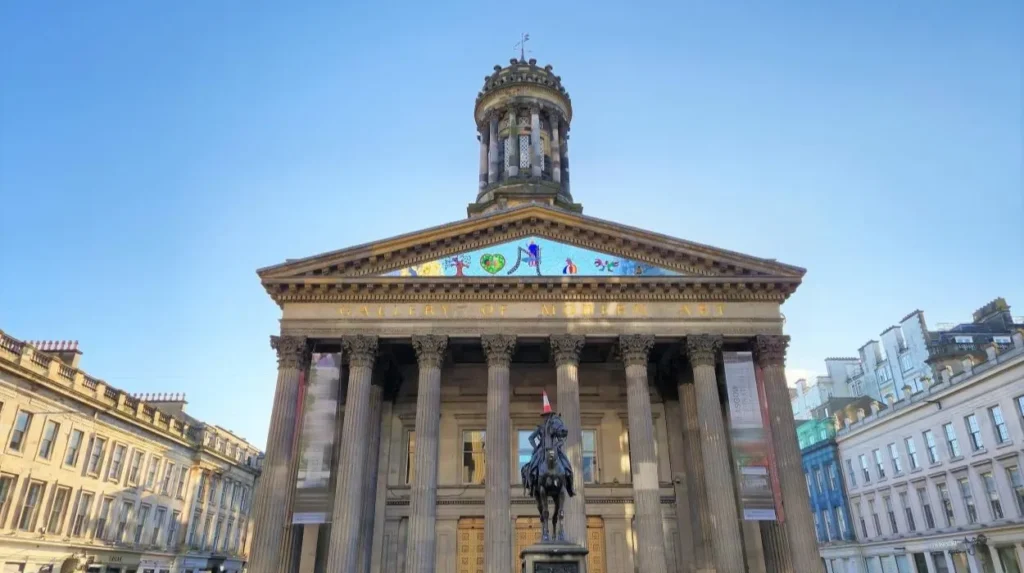
Niki de Saint Phalle’s work forms part of GoMA’s artistic history, including the commissioned 1996 exterior work Tympanum. The triangular mirror mosaic sits above the entrance and was created specifically for the Gallery of Modern Art.
Niki de Saint Phalle was a French-American artist known for large-scale sculpture, colourful forms and experimental visual practices. She already had a connection with Glasgow before GoMA opened.
Glasgow Life records that de Saint Phalle held a solo exhibition at Glasgow’s McLellan Galleries in 1993. Her work was subsequently represented in major public and private collections internationally.
For GoMA, she created Tympanum, a triangular mirror mosaic positioned above the entrance. The work was commissioned in 1996, the year the gallery opened.
The exterior artwork forms part of the visitor experience before entering the museum. It also demonstrates how GoMA incorporates contemporary art into its historic architecture.
Visitors therefore encounter modern art not only inside exhibition galleries but also as part of the building’s exterior and architectural setting.
What is the Duke of Wellington statue outside GoMA?
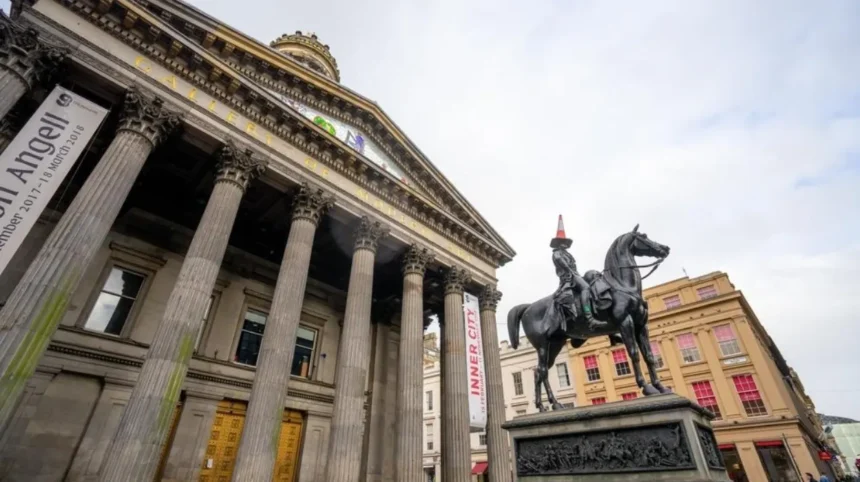
The Duke of Wellington equestrian statue stands outside GoMA on Royal Exchange Square. The statue is a nineteenth-century monument and became internationally recognisable because people repeatedly placed traffic cones on Wellington’s head.
The Duke of Wellington statue is located directly outside GoMA. It depicts Arthur Wellesley, the Duke of Wellington, on horseback.
The monument predates the gallery. Its position creates a strong visual relationship between the historic sculpture, the neoclassical museum building and the modern art programme inside GoMA.
The traffic-cone tradition became closely associated with the statue. The cone placed on Wellington’s head became a widely recognised feature of Glasgow’s public-space culture.
GoMA itself has incorporated this local visual phenomenon into its public identity. Glasgow Life’s GoMA material frequently shows the statue outside the building with a traffic cone positioned on Wellington’s head.
The statue therefore adds a significant public-art and urban-history element to a visit. Visitors can view the monument before entering the gallery and then explore modern and contemporary art inside.
Is the Gallery of Modern Art free to visit?
GoMA has free admission, with donations welcomed. Free entry applies to the gallery’s exhibitions and provides visitors with access to a major central Glasgow cultural attraction without a general admission ticket or standard museum entrance charge.
Glasgow Life confirms that admission to GoMA is free. Donations are welcomed at the venue or online.
The gallery’s exhibition listings also state that exhibitions and displays are free to visit during opening hours.
Free admission is significant for visitors exploring Glasgow on a budget. It also supports repeat visits because the financial barrier to returning for a new exhibition is low.
The free-access model applies to the museum’s normal exhibitions. Individual special events can have separate booking arrangements, so visitors should check the event listing before attending a particular programme.
What are the opening hours of GoMA?
GoMA currently opens from 10am to 5pm on Monday through Thursday and Saturday, from 11am to 5pm on Friday and Sunday. Visitors should check Glasgow Life before travelling because event schedules and holiday arrangements can change.
Glasgow Life currently lists these regular opening hours:
Monday: 10am–5pm
Tuesday: 10am–5pm
Wednesday: 10am–5pm
Thursday: 10am–5pm
Friday: 11am–5pm
Saturday: 10am–5pm
Sunday: 11am–5pm.
The official visitor information should remain the primary reference for planning a visit because exhibition schedules, public holidays, special events and temporary arrangements can affect access.
The gallery’s central location also supports flexible sightseeing. Visitors can combine GoMA with other attractions, shops, restaurants, public squares and transport connections in central Glasgow.
How accessible is the Gallery of Modern Art?
GoMA provides accessibility facilities including accessible toilets, assistance-dog access, hearing-loop provision and accessibility information. The gallery also runs quieter sessions designed to reduce noise, lighting effects and crowd levels for visitors needing calmer conditions.
Glasgow Life provides accessibility information for GoMA through AccessAble and Euan’s Guide. The venue has an accessible toilet on the lower-ground floor. Guide and assistance dogs are welcome, and water bowls can be provided.
A hearing loop is available, and Glasgow Life provides a British Sign Language introduction to GoMA.
The museum also runs specific accessibility-focused programming. In August 2026, an autism-friendly early opening provided a calmer environment with reduced noise, flashing lights and crowds. Sensory bags containing items such as ear defenders were also available.
These provisions demonstrate that accessibility is incorporated into GoMA’s visitor programming rather than being limited to physical access.
Visitors with specific access requirements should consult the current accessibility information before travelling.
What educational and family activities are available at GoMA?
GoMA provides educational and family programmes alongside exhibitions. Activities include workshops, art clubs, baby sessions and community projects, giving children, families and adults structured opportunities to engage with contemporary art through practical and participatory activities.
GoMA operates a learning programme alongside its exhibition programme. Activities use drawing, painting, sculpture, printing, collage and other creative techniques.
The Saturday Art Club runs during 2026 for families with children aged approximately 5–12. The programme takes inspiration from works displayed at GoMA and uses different materials and artistic processes.
GoMA also hosts Art for Baby sessions for babies aged from birth to walking and their carers. These sessions provide a relaxed environment for exploring contemporary art and creative activities.
The gallery’s programmes extend beyond family activities. Glasgow Life describes workshops, talks, events and community projects as part of GoMA’s wider role.
These programmes make the museum relevant to visitors who want participation rather than exhibition viewing alone.
What library facilities are available at GoMA?
The Library at GoMA is located within the museum and provides free access to thousands of books alongside classes, events and library services. It adds a research and learning dimension to the gallery’s exhibition and educational programme.
The Library at GoMA operates inside the Gallery of Modern Art on Royal Exchange Square.
Glasgow Life states that the library contains thousands of books and provides weekly classes and events. The service is free to access.
The library complements GoMA’s visual-art collections by providing additional resources for research, learning and general engagement with culture.
Its presence also reinforces the building’s historical connection with library use. The library previously occupied the building before moving elsewhere and returning to the GoMA basement in 2002.
Visitors interested in contemporary art can therefore combine exhibition viewing with access to supporting reading and learning resources.
How important is GoMA to Glasgow’s art scene?
GoMA provides a central institutional platform for Glasgow-based artists while connecting local contemporary art with national and international practice. Its collection, exhibitions, commissions and community programmes contribute to Glasgow’s established reputation as an important centre for visual arts.
Glasgow has developed a significant contemporary-art reputation, and GoMA provides a major public institution within that ecosystem.
Glasgow Museums’ collection documentation states that the opening of GoMA in 1996 provided a focus for contemporary-art display and collection. It also identifies Glasgow as an international centre for contemporary visual arts.
The collection includes important works by artists who later achieved international recognition, including Turner Prize winners.
GoMA’s importance therefore extends beyond tourism. It provides a public platform for artists, researchers, families, students and communities.
The gallery also participates in Glasgow’s wider festival and cultural programme. Its 2026 exhibition Liquid Land forms part of the Glasgow International Festival of Contemporary Art, connecting the museum with a major city-wide contemporary-art event.
How many people visit the Gallery of Modern Art?
GoMA has historically attracted around 600,000 visitors annually, according to Glasgow Life’s museum management information. The figure demonstrates the gallery’s substantial public reach and places it among Scotland’s most visited modern-art institutions.
Glasgow Life reported that GoMA welcomed approximately 600,000 visitors per year in its historical visitor information and described it as Scotland’s most visited modern art gallery.
Visitor numbers demonstrate the gallery’s broad appeal. Its central location, free admission, changing exhibitions and accessible programmes support a large audience.
The historical figure should not be treated as a current annual attendance count for 2026. Visitor numbers change according to exhibition schedules, tourism levels, cultural events, operating conditions and wider patterns of museum attendance.
The figure remains useful as an indicator of GoMA’s established public importance within Scotland’s cultural landscape.
Is the Gallery of Modern Art worth visiting in Glasgow?
GoMA is worth including in a Glasgow itinerary for visitors seeking free contemporary art, historic architecture, changing exhibitions and central-city cultural experiences. Its collection, temporary displays, public programmes and architectural history provide several distinct reasons to visit.
GoMA offers several clear visitor benefits.
First, admission is free. This makes it suitable for visitors managing a limited travel budget.
Second, the gallery occupies a historically significant building. The site connects eighteenth-century merchant history, Glasgow’s commercial development and contemporary museum practice.
Third, the exhibitions cover multiple artistic media. Visitors encounter painting, sculpture, photography, video, installation, drawing and prints rather than a single art form.
Fourth, the programme changes. Displays such as Still Glasgow, Liquid Land, Domestic Bliss and Through Line: Connecting the Collection provide different experiences across the exhibition calendar.
Fifth, the gallery provides learning and family activities. Saturday Art Club, Art for Baby and other programmes extend the museum beyond conventional exhibition viewing.
Finally, GoMA is located in central Glasgow. The building, Royal Exchange Square and the Duke of Wellington statue create a concentrated cultural experience that fits easily into a wider city-centre itinerary.
For visitors interested in modern and contemporary art, Glasgow history, architecture, photography or free cultural attractions, GoMA provides a substantial museum experience without an admission charge.
How should visitors plan a first visit to GoMA?
First-time visitors should check the official exhibition programme, confirm opening hours, allow time for multiple galleries, and explore the historic building and Royal Exchange Square. Free admission makes GoMA suitable for both short visits and longer cultural itineraries.
A practical first visit begins by checking the current exhibitions on the official Glasgow Life website. Temporary displays change, so the programme determines what visitors will see.
Allowing sufficient time is important because GoMA contains four galleries, a library and additional public spaces.
Visitors should also look beyond the main exhibition rooms. The building itself has historical significance, while Stones Steeped in History provides additional context about the site’s commercial and architectural past.
The exterior should also be included. Royal Exchange Square provides the setting for the building and the Duke of Wellington monument.
Photography-focused visitors can pay particular attention to displays such as Still Glasgow, while visitors interested in international contemporary art can check the current temporary programme.
Families should check the learning calendar because GoMA runs dedicated workshops and activities throughout the year.
Accessibility requirements should also be reviewed before travelling. Glasgow Life provides dedicated access information and details of facilities and quieter programming.
Explore More Area Guide
Hidden Lane Finnieston: Creative Gem in Glasgow 2026
Is Kelvingrove Art Gallery Worth Visiting Regularly? Glasgow 2026
What makes GoMA different from other Glasgow museums?
GoMA differs from Glasgow’s broader museum network because its primary institutional focus is modern and contemporary art. Its programme combines post-1945 collections, changing exhibitions, local artists, international practice, historic architecture and contemporary cultural debate.
Glasgow has several major museums covering art, transport, history, religion, natural history and other subjects. GoMA has a more specific focus on modern and contemporary visual art.
Its collection emphasis begins largely with art created after 1945. Its displays include Glasgow artists while also presenting national and international practices.
The building creates another distinction. GoMA places contemporary art inside a historic structure with direct connections to Glasgow’s eighteenth- and nineteenth-century commercial history.
The museum also combines collection-based displays with temporary exhibitions. This creates a changing programme rather than a single fixed presentation.
Its free admission further increases accessibility. Visitors can experience a major contemporary-art institution without paying a general entrance fee.
The combination of modern art, contemporary art, Glasgow history, architecture, public programmes and free admission defines GoMA’s role within Glasgow’s cultural landscape.
What is the future relevance of the Gallery of Modern Art?
GoMA’s future relevance rests on its changing contemporary-art programme, Glasgow-focused collection, international partnerships, community engagement and interpretation of complex histories. Its 30th anniversary in 2026 demonstrates the institution’s established role in Glasgow’s cultural infrastructure.
GoMA reached its 30th anniversary in 2026, marking three decades since its opening in 1996.
Its future programme remains connected to contemporary artistic practice and changing social questions. The 2026 exhibition Liquid Land, for example, examines histories of enslavement and domestic labour through sculpture, photography, installation and video.
The museum also continues to examine the history of its own building. This approach connects contemporary art with Glasgow’s economic, architectural and social history.
Community participation remains another important area. GoMA has worked with families, schools, students, charities and marginalised communities through workshops, performances and activities.
This combination gives GoMA continuing relevance within Glasgow’s cultural infrastructure. The museum is not simply a repository for historic modern art. It remains an active venue for contemporary exhibitions, learning, research, public engagement and artistic debate.
For visitors planning a Glasgow cultural itinerary, GoMA therefore provides an accessible and historically informed introduction to the city’s modern and contemporary art scene.
What is the Gallery of Modern Art in Glasgow?
The Gallery of Modern Art (GoMA) is Glasgow’s main museum dedicated to modern and contemporary art. It opened in 1996 and features paintings, sculpture, photography, installations, video and works by Glasgow, UK and international artists.