Glasgow is Scotland’s largest city and has a long-established LGBTQ+ community, dedicated venues, community organisations, cultural events and equality initiatives. Its LGBTQ+ scene is particularly visible in the city centre, while inclusive businesses, social spaces and community activity extend across the West End, Southside and other neighbourhoods.
- Is Glasgow an LGBTQ-friendly city?
- What makes Glasgow welcoming to LGBTQ+ people?
- How has Glasgow’s LGBTQ+ history developed?
- Which Glasgow area has the strongest LGBTQ+ scene?
- Is Glasgow West End LGBTQ-friendly?
- Is Glasgow Southside LGBTQ-friendly?
- Is Glasgow city centre LGBTQ-friendly outside Merchant City?
- What LGBTQ+ venues are associated with Glasgow?
- How does Glasgow support LGBTQ+ young people?
- What legal protections apply to LGBTQ+ people in Glasgow?
- What should LGBTQ+ visitors know about safety in Glasgow?
- What LGBTQ+ events take place in Glasgow?
- Which Glasgow area should LGBTQ+ visitors choose for accommodation?
- Does Glasgow’s LGBTQ+ scene extend beyond gay bars and clubs?
- What is the overall LGBTQ+ geography of Glasgow?
- How is Glasgow’s LGBTQ+ environment developing?
The city’s LGBTQ+ identity combines nightlife with broader community infrastructure. Glasgow has LGBTQ+ bars and clubs, queer cultural events, LGBTQ+ sports groups, youth organisations, specialist booksellers, community projects and services supporting sexual orientation and gender identity.
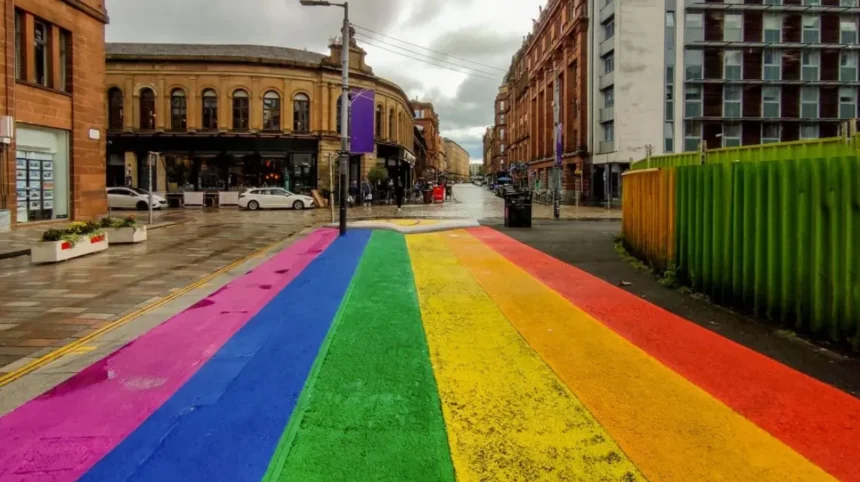
Visit Glasgow identifies Merchant City as the city’s LGBTQ+ district and describes it as the heart of Glasgow’s LGBTQ+ scene. Its official LGBTQ+ guide also highlights activities and venues in Merchant City, the Southside and central Glasgow.
Scotland provides the wider legal framework. Same-sex sexual activity between men was decriminalised in Scotland in 1980, the age of consent was equalised in 2001, civil partnerships became available in 2005 and same-sex marriage was introduced in 2014.
Glasgow’s current LGBTQ+ environment therefore reflects both national legal change and local community development. The city has also retained a visible distinction between its established LGBTQ+ nightlife district and wider neighbourhoods where inclusion is expressed through cultural, social and community activity.
Is Glasgow an LGBTQ-friendly city?
Glasgow has an established LGBTQ+ community, visible venues, dedicated organisations and citywide equality activity. Merchant City contains the strongest concentration of LGBTQ+ nightlife, while the West End, Southside and central districts provide additional inclusive cultural, social and hospitality spaces.
Visit Glasgow describes Glasgow as a welcoming and inclusive city and promotes it as an LGBTQ+ destination. Its dedicated LGBTQ+ guide covers nightlife, accommodation, cultural attractions, community events, food and drink, demonstrating that LGBTQ+ activity extends beyond a single type of venue.
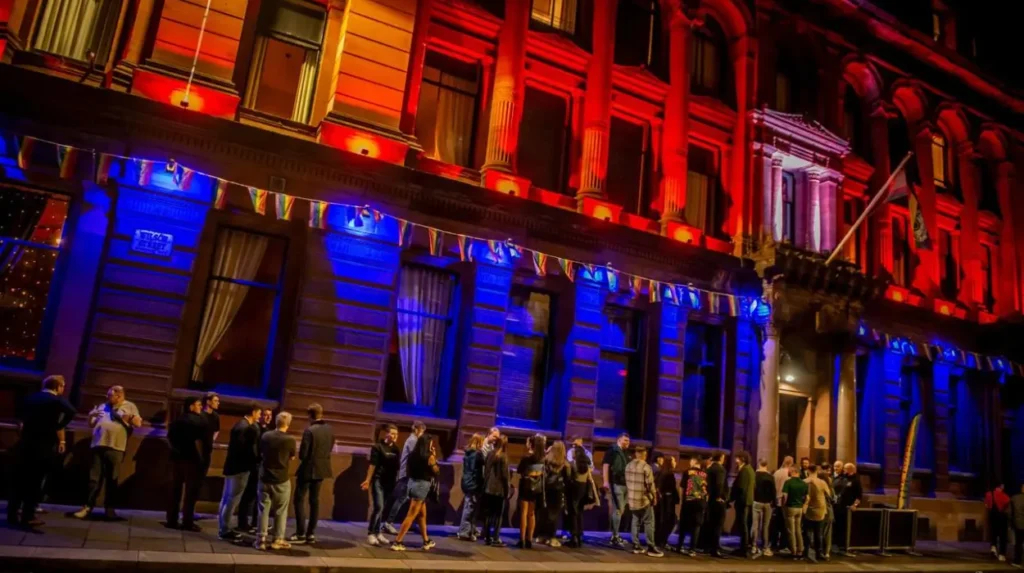
The city’s LGBTQ+ visibility is particularly strong around Merchant City. The district contains several long-established venues, including Delmonica’s, Polo Lounge and the Riding Room. Visit Glasgow identifies Merchant City as the heart of the city’s LGBTQ+ scene.
Glasgow also has organisations focused on LGBTQ+ community support. LGBT Youth Scotland is Scotland’s national charity for LGBTQ+ young people aged 13 to 25. Its Glasgow office is located on Bell Street, close to the city centre, and the organisation provides youth work, groups and individual support.
The city’s inclusive environment also appears in local cultural activity. The Scottish Queer International Film Festival, LGBTQ+ tours at The Burrell Collection, Glasgow Zine Library activities and Glasgow Frontrunners are examples of LGBTQ+-related activity beyond conventional nightlife.
Being an LGBTQ-friendly city does not mean that every individual experience is identical. Scotland continues to record hate crime involving sexual-orientation and transgender-identity aggravators. In 2024-25, Police Scotland recorded 8,538 hate crimes nationally, with 24% containing a sexual-orientation aggravator and 2% containing a transgender-identity aggravator.
The available evidence therefore supports a factual description of Glasgow as a city with substantial LGBTQ+ infrastructure and visibility, alongside continuing equality and safety challenges.
What makes Glasgow welcoming to LGBTQ+ people?
Glasgow’s LGBTQ+ welcome is supported by community organisations, dedicated venues, cultural programming, equality policies and established social networks. These features create different forms of LGBTQ+ participation, including nightlife, youth support, sport, arts, education, hospitality, community events and social activities.
Community infrastructure is an important part of Glasgow’s LGBTQ+ environment. LGBT Youth Scotland operates from Glasgow and provides support for LGBTQ+ young people. Its services include youth groups, one-to-one support, online support and community-based activities.
The organisation also operates Trans Youth Glasgow for trans, non-binary and questioning young people aged 16 to 25. The group meets in Glasgow and provides a dedicated youth environment with accessible facilities and a quiet space.
Cultural infrastructure adds another layer. Glasgow has queer-focused film programming, LGBTQ+ bookshops, women’s history collections, inclusive music events and LGBTQ+-related museum programming.
Category Is Books is an independent LGBTQ+ bookshop in Glasgow selling queer books, magazines, graphic novels, comics, zines and badges. The Glasgow Women’s Library also holds lesbian archival material as part of its wider collections.
Sport provides another community route. Glasgow Frontrunners is described by Visit Glasgow as Scotland’s largest LGBTQIA+ sports club and operates as a community running group for different ability levels.
These examples show that Glasgow’s LGBTQ+ community is not limited to bars and clubs. It includes education, youth work, culture, sport, books, heritage and social activities.
How has Glasgow’s LGBTQ+ history developed?
Glasgow’s LGBTQ+ environment developed alongside major changes in Scottish law and community activism. Decriminalisation in 1980, equalisation of the age of consent in 2001, civil partnerships in 2005 and same-sex marriage in 2014 transformed the legal context.
The historical background is important because modern LGBTQ+ visibility in Glasgow developed after a period when same-sex relationships faced direct legal discrimination.
Consensual sexual activity between men remained criminalised in Scotland until 1980. The Scottish Government states that same-sex sexual activity between men was a criminal offence in all circumstances as late as 1980. The age of consent was not equalised until January 2001.
Civil partnership represented another legal change. The Civil Partnership Act 2004 introduced civil partnerships for same-sex couples, with the arrangements taking effect in December 2005.
Scotland then introduced same-sex marriage through the Marriage and Civil Partnership (Scotland) Act 2014. The first same-sex marriage ceremonies took place in Scotland on 31 December 2014.
Historical legal reform also included recognition of previous discrimination. The Historical Sexual Offences (Pardons and Disregards) (Scotland) Act 2018 provided pardons for men previously convicted under obsolete laws relating to same-sex sexual activity.
These developments form the legal background to Glasgow’s contemporary LGBTQ+ environment. They also explain why LGBTQ+ history remains an important part of Scottish community organisations, archives, museums and cultural programming.
Which Glasgow area has the strongest LGBTQ+ scene?
Merchant City has Glasgow’s most concentrated LGBTQ+ nightlife and is the city’s recognised LGBTQ+ district. The area around Virginia Street, Wilson Street and nearby central streets contains established LGBTQ+ venues, restaurants, bars, entertainment spaces and accommodation.
Merchant City is the clearest answer for visitors specifically seeking concentrated LGBTQ+ nightlife. Visit Glasgow directly describes the district as Glasgow’s LGBTQ+ district and identifies it as the location of most LGBTQ+ bars and clubs.
The area contains several established venues. Delmonica’s opened in 1991 and remains a prominent LGBTQ+ venue on Virginia Street. Polo Lounge has operated in Glasgow since 1995 and describes itself as a safe and inclusive venue.
The Riding Room provides cabaret and entertainment, while Katie’s Bar operates in the Merchant City with LGBTQ+ community connections dating back to 2013. The Underground provides another LGBTQ+ nightlife setting in the district.
Merchant City also offers non-nightlife facilities. The district contains restaurants, cafés, shops, cultural venues, galleries, historic buildings and public spaces. This makes LGBTQ+ activity visible within a wider mixed-use urban neighbourhood rather than a separate enclave.
Pride activity also connects Merchant City with wider Glasgow. Visit Glasgow notes that Glasgow Pride passes through the area and can coincide with the Merchant City Festival.
For visitors whose primary objective is access to established LGBTQ+ bars and clubs, Merchant City provides the greatest concentration within Glasgow.
Is Glasgow West End LGBTQ-friendly?
Glasgow’s West End has a broad inclusive cultural environment, with independent cafés, restaurants, arts venues, universities, nightlife and community spaces. It has fewer concentrated LGBTQ+ venues than Merchant City but provides a substantial wider social environment for LGBTQ+ visitors and residents.
The West End includes neighbourhoods such as Hillhead, Partick and Kelvinbridge and is one of Glasgow’s major cultural and residential districts.
Visit Glasgow describes the West End as leafy, relaxed and known for food, independent businesses, cultural attractions and distinctive lanes.
Its LGBTQ+ relevance comes primarily from the broader cultural environment rather than a concentrated gay nightlife district. Visitors can move between cafés, restaurants, arts venues and entertainment spaces without relying exclusively on specialist LGBTQ+ businesses.
The West End also has strong connections to Glasgow’s university population. The University of Glasgow and nearby student communities contribute to a diverse social environment and a large population of younger adults.
Finnieston, positioned between the city centre and West End, adds another hospitality-focused area. It contains restaurants, bars and entertainment venues and forms part of the wider central-west Glasgow visitor circuit.
For travellers seeking daytime activities, food, culture and independent businesses alongside LGBTQ+ nightlife elsewhere in the city, the West End provides a practical base.
Is Glasgow Southside LGBTQ-friendly?
Glasgow’s Southside has an established inclusive cultural and community environment, particularly around Queen’s Park and nearby neighbourhoods. LGBTQ+ activity includes cafés, creative spaces, community events, cultural organisations and attractions rather than the concentrated nightclub pattern found in Merchant City.
The Southside includes areas such as Shawlands, Pollokshields, Strathbungo, Battlefield and the neighbourhoods around Queen’s Park.
Visit Glasgow describes the Southside as lively and welcoming, with traditional tenements, parks, cafés, creativity and local culture.
The area also appears in Glasgow’s LGBTQ+ visitor information. Transylvania Shop and Cafe near Queen’s Park celebrates Pride, while Fulton’s operates as a Southside café and is run by a married couple.
Cultural activity is another feature. The Burrell Collection in Pollok Country Park has hosted LGBTQ+-focused tours examining the history and meaning of objects within its collections.
Glasgow Zine Library is also highlighted by Visit Glasgow for its LGBTQ+-inclusive events and growing collection. The library has more than 3,500 zines and hosts cultural programming in the Southside.
The Southside therefore provides a different form of LGBTQ+ welcome from Merchant City. It is particularly relevant to visitors interested in cafés, parks, culture, independent businesses and community activities.
Is Glasgow city centre LGBTQ-friendly outside Merchant City?
Central Glasgow outside Merchant City also contains inclusive nightlife, hospitality, shopping, entertainment and cultural venues. Sauchiehall Street and nearby central districts connect the established LGBTQ+ scene with the wider city centre, creating a broader network of accessible social spaces.
Glasgow city centre contains the main transport connections, major shopping streets, hotels, theatres, restaurants and nightlife venues.
Sauchiehall Street forms one of the central entertainment corridors. Visit Glasgow describes the area as a place where creativity, nightlife and history come together.
The central location also makes movement between neighbourhoods straightforward. Visitors staying near Glasgow Central Station, Queen Street Station or central hotels can reach Merchant City, the West End and Southside using public transport and walking routes.
LGBTQ+ visitors therefore do not need to remain inside a single designated district. The city centre functions as a connection point between Glasgow’s different cultural and social areas.
The distinction is useful when planning a visit. Merchant City provides concentrated LGBTQ+ nightlife, while the wider city centre provides access to mainstream hospitality, entertainment and transport.
What LGBTQ+ venues are associated with Glasgow?
Glasgow has a long-established network of LGBTQ+ bars, clubs and entertainment venues, with the highest concentration in Merchant City. Examples include Delmonica’s, Polo Lounge, Katie’s Bar, The Underground, Riding Room and The Waterloo, alongside newer and mixed LGBTQ+-inclusive spaces.
Delmonica’s is one of Glasgow’s longest-established LGBTQ+ venues. Visit Glasgow records its opening in 1991 and identifies it as a fixture of the city’s queer community.
Polo Lounge dates from 1995 and operates as a multi-room venue on Wilson Street. Its wider venue includes the Riding Room, which focuses on entertainment and cabaret.
Katie’s Bar has served the LGBTQ+ community since 2013 and offers entertainment including karaoke, bingo and live music. The Underground provides another LGBTQ+ venue within Merchant City.
The Waterloo is described by Visit Glasgow as one of the oldest gay pubs in Scotland. Its long history reflects the development of Glasgow’s established LGBTQ+ nightlife infrastructure.
Venue information changes over time. Opening hours, events, ownership and programming require checking directly before visiting. The established geographic pattern, however, remains clear: Merchant City is the main concentration of LGBTQ+ nightlife.
How does Glasgow support LGBTQ+ young people?
Glasgow has dedicated LGBTQ+ youth infrastructure through organisations including LGBT Youth Scotland. Services include youth groups, one-to-one support, digital support and specialist groups for trans, non-binary and questioning young people aged 16 to 25.
LGBT Youth Scotland is Scotland’s national charity for LGBTQ+ young people aged 13 to 25. Its Glasgow office is located on Bell Street.
The organisation provides different forms of support. These include one-to-one youth work, local groups, online support and opportunities for young people to connect with peers.
Trans Youth Glasgow is specifically designed for trans, non-binary and questioning young people aged 16 to 25. The group meets weekly and provides a dedicated youth environment.
Glasgow City Council has also documented work involving LGBTQ+ equality in education. Council records describe engagement with LGBT Youth Scotland and the Time for Inclusive Education campaign, including initiatives addressing homophobic and transphobic bullying in schools.
This youth infrastructure is significant because an LGBTQ-friendly city requires more than nightlife. Support services, education and community networks provide additional forms of inclusion for younger residents.
What legal protections apply to LGBTQ+ people in Glasgow?
LGBTQ+ people in Glasgow are covered by UK and Scottish equality law, including protections relating to sexual orientation and gender reassignment. Scotland also recognises same-sex marriage, civil partnerships and other legal rights established through national equality legislation.
The Equality Act 2010 identifies sexual orientation as a protected characteristic. The legal definition covers attraction to people of the same sex, opposite sex or either sex. Gender reassignment is a separate protected characteristic.
Scottish legislation has also developed specific LGBTQ+ protections. The Scottish Government identifies same-sex marriage, adoption rights for same-sex couples, reforms to sexual offences law and historical pardons among major legal developments.
Same-sex marriage became available in Scotland in December 2014. Civil partnership became available to same-sex couples in 2005.
These protections apply across Glasgow rather than only within LGBTQ+ neighbourhoods.
Legal protection and lived experience are separate issues. The existence of legal rights does not eliminate every form of prejudice or hate crime. Scotland continues to publish hate crime statistics involving sexual orientation and transgender identity.
What should LGBTQ+ visitors know about safety in Glasgow?
Glasgow has established LGBTQ+ venues and community infrastructure, but visitors should use the same practical safety measures expected in any large city. Stay aware in nightlife areas, use reputable transport, protect personal belongings and report hate crime or harassment when necessary.
The Scottish Government recorded 8,538 police-recorded hate crimes in Scotland in 2024-25. Glasgow City had the highest recorded hate-crime rate among Scottish local authorities at 32 crimes per 10,000 population, compared with 25 per 10,000 in Edinburgh.
These figures require careful interpretation. Glasgow is a large urban centre and hosts major events and demonstrations. The Scottish Government specifically notes that Glasgow and Edinburgh are frequently used for large-scale events, which affects recorded hate-crime patterns.
In 2024-25, 24% of Scottish police-recorded hate crimes included a sexual-orientation aggravator. A transgender-identity aggravator appeared in 2%. Individual crimes can contain more than one aggravator, so these percentages are not mutually exclusive categories.
For visitors, practical precautions include travelling with friends at night, using licensed or reputable transport, keeping valuables secure and remaining aware of surroundings after leaving nightlife venues.
The existence of an LGBTQ+ district does not remove normal urban safety considerations.
What LGBTQ+ events take place in Glasgow?
Glasgow’s LGBTQ+ calendar includes Pride, queer film, cultural events, community groups, sporting activities and nightlife programming. Major examples include Pride Glasgow, the Scottish Queer International Film Festival and LGBTQ+-focused activities at cultural institutions.
Pride Glasgow provides one of the city’s largest LGBTQ+ public events. VisitBritain lists Glasgow Pride as a summer event featuring a city parade and activities around Glasgow Green.
The Scottish Queer International Film Festival, commonly abbreviated as SQIFF, takes place in Glasgow each autumn and focuses on LGBTQIA+ film and queer community building.
Cultural programming also appears in museums and libraries. The Burrell Collection has offered LGBTQ+-focused tours, while Glasgow Women’s Library provides access to women’s histories and lesbian archival material.
Sport creates another route into the community. Glasgow Frontrunners provides LGBTQIA+ running activities and is identified by Visit Glasgow as Scotland’s largest LGBTQIA+ sports club.
These events demonstrate that Glasgow’s LGBTQ+ culture operates throughout the year rather than only during Pride season.
Which Glasgow area should LGBTQ+ visitors choose for accommodation?
Merchant City suits visitors prioritising LGBTQ+ nightlife and central venues. The West End suits visitors prioritising restaurants, cafés, culture and neighbourhood atmosphere. Southside suits visitors seeking parks, independent businesses and cultural attractions with access to central Glasgow.
Merchant City provides the most direct access to Glasgow’s established LGBTQ+ nightlife. Hotels and accommodation in or near the district reduce the need for late-night travel between venues.
The West End provides a different accommodation environment. It has restaurants, cafés, cultural attractions, university activity and access to public transport. It also provides convenient connections towards central Glasgow.
Southside accommodation works well for visitors whose interests include Queen’s Park, Pollok Country Park, The Burrell Collection and independent cafés. The area has a strong local identity and cultural scene.
Central Glasgow provides another practical option because it connects these districts. The main railway stations and city-centre transport routes make it straightforward to reach different parts of the city.
Accommodation choice therefore depends on the type of LGBTQ+ experience a visitor wants. Merchant City is the principal choice for concentrated nightlife, while the West End and Southside provide broader neighbourhood experiences.
Does Glasgow’s LGBTQ+ scene extend beyond gay bars and clubs?
Glasgow’s LGBTQ+ scene extends well beyond nightlife through youth services, cultural institutions, books, sport, film, cafés, museums, community groups and inclusive hospitality. These activities create daytime and evening opportunities across several parts of the city.
The breadth of Glasgow’s LGBTQ+ environment is one of its defining structural features.
A visitor can explore queer literature at Category Is Books, attend an LGBTQ+-related museum tour, join a sporting group, visit an inclusive café, attend a film festival or participate in community activities without entering a nightclub.
LGBT Youth Scotland provides another example. Its services focus on youth development, social connection and support rather than nightlife.
Glasgow’s cultural organisations also preserve LGBTQ+ history. The Glasgow Women’s Library and other cultural spaces contribute to the preservation and presentation of LGBTQ+-related histories and experiences.
This broader infrastructure makes the city relevant to different LGBTQ+ audiences, including young people, families, cultural visitors, sports participants, solo travellers and people interested in Scottish social history.
Explore More Area Guide
Strathclyde Enters UK Top 10 Universities in Glasgow 2026
Best Expat Communities and Social Groups in Glasgow
What is the overall LGBTQ+ geography of Glasgow?
Glasgow’s LGBTQ+ geography has a concentrated centre and a wider network. Merchant City is the principal LGBTQ+ nightlife district, while the city centre, West End, Finnieston and Southside contain additional inclusive venues, cultural activities, community organisations and hospitality spaces.
The geography is best understood as a network rather than a single neighbourhood.
Merchant City is the main concentration of LGBTQ+ bars and clubs. Central Glasgow provides transport, hotels, shopping and entertainment. The West End contributes cafés, culture, universities and independent businesses. Southside adds parks, creative activity, cafés and LGBTQ+-related cultural attractions.
This distribution is useful for visitors planning different types of trips.
A nightlife-focused visit naturally centres on Merchant City. A cultural itinerary can connect Merchant City with the West End and Southside. A longer stay can incorporate all three areas while using Glasgow’s central transport network as the connecting point.
Glasgow therefore has both a defined LGBTQ+ district and a wider inclusive urban environment.
How is Glasgow’s LGBTQ+ environment developing?
Glasgow’s LGBTQ+ environment continues to combine established nightlife with community services, equality programmes and cultural activity. Current priorities include improving equality, reporting hate crime, supporting LGBTQ+ communities and strengthening inclusive practices across public services.
The Scottish Government continues to maintain an LGBTQI+ equality policy covering sexual orientation, gender identity, conversion practices, gender recognition and community funding.
Glasgow City Council has also maintained equality structures involving LGBTQ+ communities. Council equality documentation identifies an LGBTQ+ Forum among its community forums and records engagement with protected-characteristic communities.
The council’s equality framework has included objectives connected to improving confidence in reporting hate crime among LGBTI+ people and working with partners to prevent hate crime and improve responses to victims.
At the same time, national statistics demonstrate that hate crime remains a continuing issue. The 2024-25 Scottish data provides the most recent full-year national picture and cannot be directly compared with all earlier periods because the Hate Crime and Public Order (Scotland) Act 2021 introduced new categories and recording arrangements.
Glasgow’s LGBTQ+ environment is therefore defined by both substantial community infrastructure and continuing equality work.
For visitors, the practical geographic pattern is clear. Merchant City is the established centre of LGBTQ+ nightlife; the West End offers a broad cultural and social environment; and the Southside provides additional LGBTQ+-inclusive cultural and community activity. Together, these areas form a wider LGBTQ+ network across Glasgow rather than a single isolated district.
Is Glasgow an LGBTQ-friendly city?
Yes. Glasgow has an established LGBTQ+ community, dedicated venues, cultural events, youth organisations and equality initiatives. Merchant City is the main LGBTQ+ nightlife district, while the West End, Southside and wider city centre also provide inclusive social and cultural spaces.