Key Points
- The University of Strathclyde climbed two places to secure ninth position in The Times and Sunday Times UK University Rankings.
- The rise places the Glasgow-based institution ahead of several renowned universities, including University College London (14th), the University of Glasgow (15th), and the University of Edinburgh (17th).
- Professor Stephen McArthur, principal and vice-chancellor of the University of Strathclyde, attributed the milestone to quality education, research, and innovation.
- The institution extended its dominance across individual subject tables, securing the top spot in five areas: accounting and finance, communication and media studies, creative writing, pharmacology and pharmacy, and social work.
- Elsewhere in the rankings, St Andrews claimed the top position from the London School of Economics and Political Science, while Glasgow Caledonian University dropped seven places to 43rd.
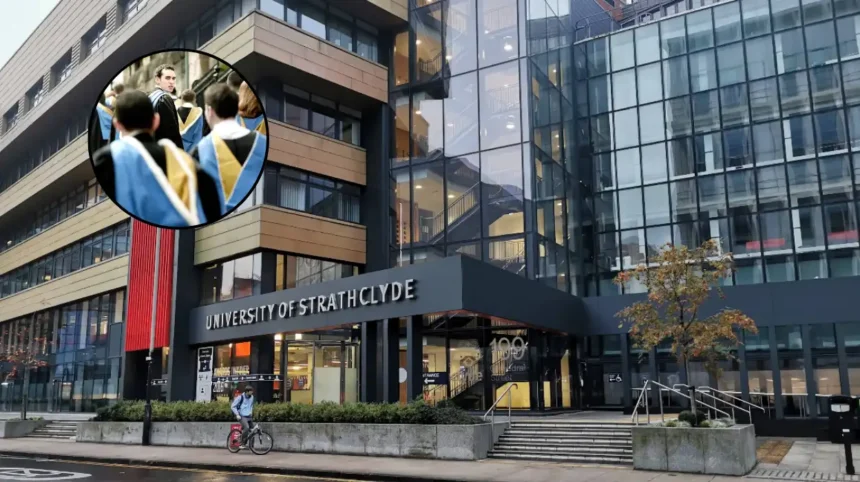
Glasgow (Glasgow Express) September 18, 2026 — A prominent Glasgow institution has achieved a historic milestone by breaking into the upper echelon of British higher education. The University of Strathclyde, situated in the heart of Glasgow’s city centre, climbed two positions to secure ninth place in the latest national league table compiled by The Times. This upward movement allows the academy to surpass several long-established and elite institutions across the United Kingdom, outperforming University College London, which landed in 14th place, alongside the University of Glasgow at 15th and the University of Edinburgh at 17th.
- Key Points
- What did university leadership say about the milestone achievement?
- Which individual subjects drove the success in the national rankings?
- How did other Scottish and UK institutions fare in the same league table?
- Background of the particular development
- Prediction on how this development can affect prospective students, current undergraduates, and the local academic community
The advancement highlights a significant shift in the domestic academic landscape, rewarding the institution’s sustained focus on modern educational frameworks and practical research output.
What did university leadership say about the milestone achievement?
Responding to the new league table positions, leadership at the institution emphasized that the recognition spans multiple operational pillars. As reported by institutional communications for the University of Strathclyde, Professor Stephen McArthur, principal and vice-chancellor of the university, stated that:
“This is a tremendous achievement and recognition of the quality of Strathclyde’s education, research and innovation.”
Professor McArthur further added that:
“The results reflect excellence across the breadth of the University and provide further evidence of the strength of our distinctive approach.”
Elaborating on the broader climate within the sector, he noted that:
“At a time of significant change and challenge across higher education, these results are a welcome recognition of the quality, ambition and collective effort found throughout Strathclyde.”
Which individual subjects drove the success in the national rankings?
Beyond its overall ascension into the top ten, the academy strengthened its competitive standing across specific academic disciplines. The latest subject tables highlight that the University of Strathclyde secured the number one ranking nationwide in five distinct fields:
- Accounting and finance
- Communication and media studies
- Creative writing
- Pharmacology and pharmacy
- Social work
Furthermore, the institution placed inside the top ten nationally for 18 additional subjects, including high-performing areas such as politics and international relations, physics and astronomy, bioengineering, business management, and law. Observers note that these subject-specific triumphs contributed heavily to the institution’s overall score trajectory.
How did other Scottish and UK institutions fare in the same league table?
While Strathclyde celebrated its historic entry into the top tier, other notable shifts occurred across the national tables. The University of St Andrews captured the overall top spot, climbing one place to replace the London School of Economics and Political Science at the summit.
Conversely, other regional institutions experienced downward adjustments. Glasgow Caledonian University fell seven places in the same reporting period, landing at 43rd position. These contrasting movements underscore a highly dynamic competitive environment among UK tertiary education providers, where continuous adjustments in student satisfaction, research intensity, and graduate prospects frequently reshape institutional standings.
Background of the particular development
The recent elevation of the University of Strathclyde within the UK university league tables is the culmination of a multi-year strategic focus on technological innovation, practical learning models, and targeted campus investments. Founded originally in 1796 as a place of “useful learning,” the institution has historically positioned itself differently from traditional research-heavy or collegiate-style universities, leaning instead into engineering, applied sciences, and business enterprise.
Over the past decade, the university accelerated this trajectory through major capital projects, most notably the establishment of the Technology and Innovation Centre (TIC). This facility was designed to foster close collaboration between academic researchers, industry partners, and public sector bodies. By aligning its course offerings and research outputs with contemporary economic demands—such as advanced manufacturing, renewable energy systems, and digital health—the university systematically improved metrics concerning graduate employability, research quality, and institutional sustainability. These cumulative efforts laid the groundwork for its steady climb in national league tables, culminating in its breakthrough into the top ten.
Prediction on how this development can affect prospective students, current undergraduates, and the local academic community
The ascent of the University of Strathclyde into the UK’s top ten is poised to create a ripple effect across multiple segments of the academic ecosystem. For prospective students, particularly those residing in Scotland and across the wider United Kingdom, the enhanced ranking elevates the institution’s profile as a premier destination for higher education, potentially driving up application volumes and increasing admissions selectivity in forthcoming recruitment cycles.
For current undergraduates and recent graduates, holding a degree from a top-ten ranked UK university can enhance résumé visibility with corporate employers, engineering firms, and financial institutions both domestically and internationally. The heightened prestige may also stimulate increased research funding and commercial partnerships for faculty members, strengthening the institution’s capacity to attract global talent.
At the local level, Strathclyde’s success intensifies academic competition within Glasgow itself, prompting neighboring institutions like the University of Glasgow and Glasgow Caledonian University to recalibrate their strategic priorities to maintain market share. Ultimately, this institutional rivalry fosters a higher standard of academic delivery and student support across the city’s broader educational landscape.