


Finding a flat in Glasgow through Facebook starts with choosing active accommodation and flatshare communities, checking listings carefully, and verifying landlords before paying money. Useful searches include Glasgow Housing and Flatshare, Glasgow student accommodation groups, university communities, and area-specific groups.
- Which Facebook groups are best for finding flats in Glasgow?
- Glasgow Housing and Flatshare
- Glasgow student accommodation groups
- University-specific Facebook communities
- West End and neighbourhood-based groups
- How should you search Facebook for Glasgow flats?
- What types of Glasgow accommodation appear in Facebook groups?
- How can you tell whether a Glasgow Facebook flat listing is genuine?
- What should you check before viewing a Glasgow flat?
- How much deposit can a Glasgow landlord legally request?
- What should you never pay for a Glasgow Facebook flat?
- How do Facebook groups compare with official Glasgow rental platforms?
- Which Glasgow areas are commonly useful for Facebook flatshare searches?
- How should students use Facebook groups to find Glasgow accommodation?
- How should international renters use Glasgow Facebook groups safely?
- What Scottish rental rights apply after finding a flat through Facebook?
- How can you make a Facebook flat search more efficient?
- What is the safest strategy for finding flats through Facebook in Glasgow?
Facebook has become a practical supplementary channel for Glasgow’s private rental market. Students, graduates, professionals, international residents, and existing tenants use groups to advertise spare rooms, replacement tenants, flatshares, and complete properties. University accommodation guidance also recognises Facebook groups as a useful route for finding shared accommodation.
The important distinction is that Facebook is an advertising and networking platform, not a regulated rental marketplace. A Facebook listing does not prove that a property, landlord, letting agent, or tenancy is legitimate. Glasgow renters therefore need to combine social-media searches with official checks.
Scotland has operated the Private Residential Tenancy system for most new private tenancies since 1 December 2017. The system provides open-ended tenancy arrangements and statutory protections for tenants.
Which Facebook groups are best for finding flats in Glasgow?
The most useful Facebook communities include Glasgow Housing and Flatshare, Glasgow student accommodation groups, University of Glasgow communities, Strathclyde student groups, and neighbourhood-based housing groups. Search these names and related terms because group availability and activity change.
Glasgow Housing and Flatshare
Glasgow Housing and Flatshare is one of the most directly relevant Facebook communities for people searching for rooms and shared flats. A discussion about Glasgow accommodation specifically identifies this page as having thousands of members and frequent listings.
This type of group is particularly relevant to people looking for one room rather than an entire property. Existing tenants often advertise when a flatmate leaves, while prospective tenants can publish a “room wanted” post.
Search Facebook for:
Glasgow Housing and Flatshare
Also search variations such as:
Glasgow Housing & Flatshare
Glasgow Flatshare
Glasgow Rooms to Rent
The exact group name, membership size, moderation policy, and activity level should be checked directly on Facebook before relying on a group.
Glasgow student accommodation groups
Student-focused Facebook groups are useful for University of Glasgow, Glasgow Caledonian University, University of Strathclyde, Glasgow School of Art, and Royal Conservatoire of Scotland students.
A University of Glasgow visiting-student resource confirms that Facebook groups have been used to connect students seeking flatmates and shared accommodation.
Search terms include:
Glasgow University Student Accommodation
Glasgow Flatshare Students
UofG Housing
University of Glasgow Accommodation
Glasgow Student Accommodation
These searches work particularly well during periods when students move between university accommodation and private flats.
University-specific Facebook communities
University communities often provide a more targeted audience. Students already enrolled in Glasgow can use course groups, freshers groups, international student communities, and accommodation communities to find replacement tenants.
The Royal Conservatoire of Scotland states that its Facebook freshers community can help students find people to share accommodation with.
Strath Union also states that students use Facebook pages and groups to advertise flats and find people to move in with. Its housing guidance specifically points students towards university-related Facebook communities.
These communities are most useful when the search involves a specific university, campus, student year, or course.
West End and neighbourhood-based groups
Area-specific Facebook communities are useful when the renter already knows the preferred part of Glasgow. Search combinations such as:
West End Glasgow flats
Partick rooms to rent
Kelvinbridge flatshare
Dennistoun rooms
Shawlands flatshare
Southside Glasgow accommodation
Finnieston flats
Neighbourhood groups often reach existing residents who know about rooms becoming available. They also provide local context about transport, shops, amenities, and nearby services.

How should you search Facebook for Glasgow flats?
Use several precise search phrases instead of relying on one Facebook group. Combine Glasgow with terms such as flatshare, room, accommodation, tenant, replacement tenant, sublet, student housing, and specific neighbourhoods to increase relevant results.
Facebook search works best when the query matches the type of accommodation required.
Someone looking for an entire one-bedroom property should search Glasgow one bedroom flat, Glasgow private rent, and Glasgow flat to rent.
Someone seeking a room should search Glasgow room to rent, Glasgow flatshare, and Glasgow replacement tenant.
Students should add their institution. Examples include University of Glasgow accommodation, Strathclyde flatshare, and GCU student accommodation.
International students can also search nationality, language, or international-student communities connected with Glasgow. Experiences from international students show that community Facebook groups have been used to locate accommodation and flatmates.
The search should also include the desired moving date. A post saying “room available from September” has greater relevance for students starting the academic year than a listing available immediately.
What types of Glasgow accommodation appear in Facebook groups?
Facebook accommodation groups commonly contain spare rooms, shared flats, replacement-tenant listings, entire flats, short-term rooms, student accommodation transfers, and flatmate requests. Each listing type requires different checks before a tenant commits to a tenancy or payment.
Spare rooms
A spare room is a bedroom available inside an existing household. The tenant normally shares facilities such as the kitchen, bathroom, hallway, and living space.
This option suits people who want to join an established flatshare rather than rent an entire property.
Replacement tenants
A replacement-tenant listing appears when an existing tenant is leaving before the other occupants. The new occupant takes the departing tenant’s place subject to the landlord’s tenancy arrangements.
The incoming tenant should confirm whether the arrangement involves a new tenancy, a change of joint tenant, or another legally permitted arrangement.
Complete flats
Some Facebook posts advertise complete flats. These listings require the same landlord, property, tenancy, deposit, and safety checks that apply to properties advertised elsewhere.
Facebook itself does not provide the legal protection associated with Scottish tenancy legislation.
Student flatshares
Student flatshares involve multiple students sharing a rented property. University communities are particularly useful for this category because prospective flatmates often share similar academic schedules and moving dates.
Glasgow university accommodation guidance has long directed students towards flatshare resources and Facebook communities.
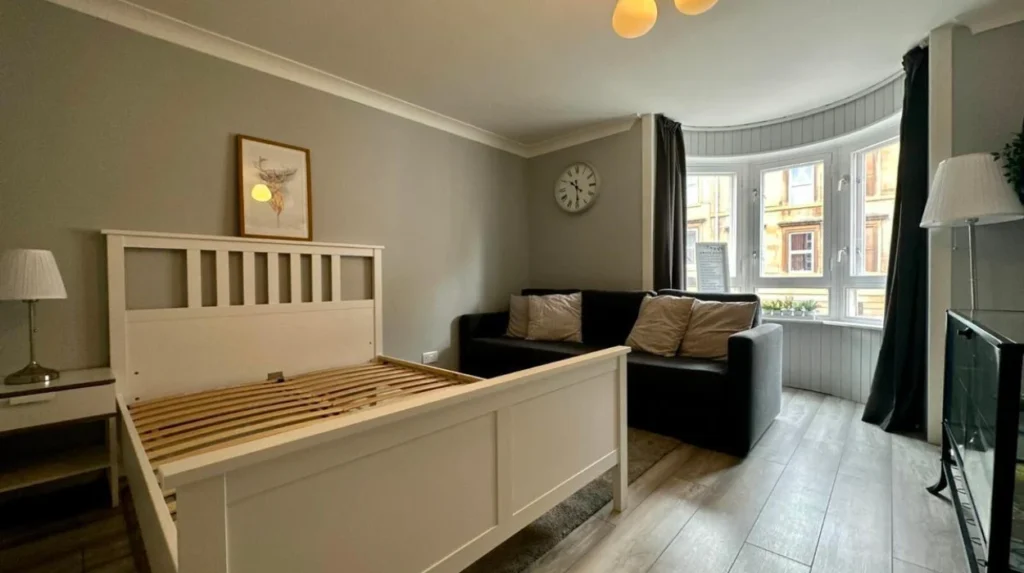
How can you tell whether a Glasgow Facebook flat listing is genuine?
A genuine Glasgow rental listing should provide a verifiable property, identifiable landlord or registered letting agent, realistic rental terms, and a proper tenancy process. Never treat Facebook membership, photographs, or profile activity as proof of legitimacy.
Start with the property address. Check whether the building exists and whether the photographs correspond with the location.
Next, establish who is advertising the property. If the person claims to be the landlord, check the Scottish Landlord Register. Mygov.scot states that landlords must register before renting out property unless an exemption applies, and renting without registration is a criminal offence.
If a letting agent is involved, check the Scottish Letting Agent Register. Mygov.scot states that letting agents must be registered and that operating as an unregistered letting agent is a criminal offence.
The listing should also make sense financially. A property advertised significantly below comparable Glasgow rents deserves additional scrutiny.
A request for money before a viewing is another major warning sign. Glasgow accommodation discussions contain examples of suspicious Facebook listings involving requests for payment before a viewing.
What should you check before viewing a Glasgow flat?
Before viewing a Glasgow flat, verify the address, advertiser, rental amount, availability date, tenancy type, property condition, and expected deposit. Keep all communication and documents so the proposed arrangement can be checked before money changes hands.
The first check is the exact address.
The second check is the identity of the landlord or agent.
The third check is the expected rent and deposit.
The fourth check is whether the property is intended as the tenant’s main home.
The fifth check is whether the landlord or agent will provide written tenancy terms.
For most new private tenancies beginning after 1 December 2017, the relevant arrangement is a Private Residential Tenancy, or PRT. The Scottish Government states that a PRT is generally open-ended and does not simply end because a fixed period has expired.
A landlord must provide written tenancy terms. This requirement applies even when the property was originally discovered through social media.
How much deposit can a Glasgow landlord legally request?
A private landlord in Glasgow can generally request a tenancy deposit of no more than two months’ rent. The deposit must normally be protected in an approved Scottish tenancy deposit scheme within 30 working days of the tenancy starting.
Scotland has specific statutory rules governing tenancy deposits.
The deposit cannot exceed two months’ rent. Mygov.scot confirms this maximum and states that landlords normally must protect deposits through an approved tenancy deposit scheme.
There are three government-approved tenancy deposit schemes in Scotland:
Letting Protection Service Scotland
mydeposits Scotland
SafeDeposits Scotland
The deposit normally has to be protected within 30 working days of the tenancy starting.
The landlord must also provide prescribed information about the deposit.
This distinction is important when using Facebook. A person asking for a large “reservation fee”, “security payment”, or unexplained administration charge is not following the normal Scottish private-renting framework.
Mygov.scot also states that landlords cannot charge certain additional fees for starting or renewing a tenancy, including key money, credit-check fees, administration fees, and non-refundable holding deposits.
What should you never pay for a Glasgow Facebook flat?
Do not pay a landlord or advertiser simply to arrange a viewing, reserve an unseen property, obtain keys, or secure a supposed position on a waiting list. Verify the property and tenancy first, then use the lawful payment process.
The most important rule is simple: do not transfer money because an online listing creates urgency.
Scammers often use limited availability, attractive photographs, low rent, relocation stories, or pressure to make a decision immediately. Facebook’s social environment does not eliminate these risks.
A legitimate landlord can still require lawful payments associated with a tenancy. The issue is whether the payment is legally permitted and whether the person requesting it is genuinely connected to the property.
The Scottish Government states that tenants cannot be charged additional premiums as a condition of granting, renewing, or continuing a tenancy.
The safest process is to verify the property, verify the landlord or agent, inspect the accommodation, receive written tenancy terms, and understand the deposit arrangements before making a commitment.
How do Facebook groups compare with official Glasgow rental platforms?
Facebook groups provide direct access to flatmates, replacement tenants, students, and local communities, while established property platforms provide structured listings and search tools. The strongest Glasgow rental search combines Facebook discovery with official registers and established accommodation services.
Facebook is strongest for informal connections.
SpareRoom is particularly useful for rooms and flatshares. Its Glasgow service provides searches for rooms, flatmates, and shared accommodation.
The University of Glasgow Students’ Representative Council also operates a flatshare service where students can list flats, find accommodation, and advertise themselves as potential flatmates.
Strathclyde’s housing guidance identifies established websites such as Rightmove, Zoopla, Gumtree, Citylets, S1 Homes, and Lettingweb for property searches, alongside SpareRoom and other services for rooms and flatmates.
The practical strategy is therefore not to choose Facebook instead of every other service. Use Facebook to discover opportunities and communities, then use official checks to validate the opportunity.
Which Glasgow areas are commonly useful for Facebook flatshare searches?
Glasgow Facebook searches become more effective when they include a specific neighbourhood, university, or transport corridor. Useful examples include the West End, Partick, Finnieston, City Centre, Dennistoun, Shawlands, and other established residential areas.
The West End is particularly relevant to students and University of Glasgow renters. Facebook searches can combine terms such as Byres Road, Hillhead, Kelvinbridge, Partick, Kelvinside, and Kelvingrove.
The City Centre attracts students, young professionals, and people seeking convenient access to central employment and education.
Dennistoun is useful for renters seeking east-side accommodation and transport connections.
Shawlands and the wider Southside provide another strong search category for flatshares and private rentals.
Finnieston and Kelvingrove are relevant to renters seeking proximity to the city centre and West End.
These area terms should be added to Facebook searches rather than used as evidence that a particular listing is legitimate.
How should students use Facebook groups to find Glasgow accommodation?
Students should join university communities early, search for flatmates and replacement tenants, compare listings with official accommodation services, and verify landlords before signing agreements. University-specific communities are particularly useful around academic-year moving periods.
University accommodation demand follows strong seasonal patterns. Students frequently search for rooms before the beginning of an academic year and when existing tenants leave shared flats.
The University of Glasgow’s visiting-student guidance documents the use of Facebook to find flatmates and shared accommodation.
The Royal Conservatoire of Scotland also identifies its Facebook freshers community as a useful route for students seeking roommates.
Students should also use university housing advice. Strath Union provides guidance on finding housing, tenancy rights, deposit disputes, property legitimacy, and rental scams.
The University of Glasgow SRC provides a dedicated flatshare service. This creates an additional channel beyond Facebook.
International students should prepare identity, proof-of-income or funding evidence, references, and other legitimate documents that a landlord can lawfully request.
How should international renters use Glasgow Facebook groups safely?
International renters should use university communities and local housing groups to identify opportunities while independently checking every landlord, property, tenancy document, and payment request. Facebook connections do not replace Scottish rental regulations or official verification.
International students often face additional challenges because they arrive without established local networks.
Facebook groups help create those networks. International-student communities can connect newcomers with existing tenants, flatmates, and people leaving properties.
However, international renters should avoid assuming that a person from the same university, country, language community, or student group is automatically trustworthy.
A Glasgow accommodation experience documented by GLOCAL shows international students using Facebook communities alongside SpareRoom to find housing.
The same verification standards apply to every renter.
Check the landlord.
Check the property.
Check the tenancy.
Check the deposit.
Check the payment request.
Keep documentary evidence.
What Scottish rental rights apply after finding a flat through Facebook?
Finding a property through Facebook does not reduce statutory tenant protections. Eligible private renters in Scotland generally receive Private Residential Tenancy protections, including written tenancy terms, regulated deposit arrangements, and legal procedures for ending a tenancy.
The Private Housing (Tenancies) (Scotland) Act 2016 introduced the Private Residential Tenancy on 1 December 2017.
The Scottish Government states that almost all new private tenancies in Scotland since that date are PRTs.
A PRT is open-ended. A landlord cannot simply require a tenant to leave because an agreed fixed term has ended. The landlord must rely on a statutory ground for repossession and follow the relevant process.
Rent increases also follow statutory requirements. Current Scottish Government guidance states that a landlord must give at least three months’ written notice before increasing rent under the applicable rules.
These protections apply based on the legal nature of the tenancy, not the website or social-media platform used to find the property.
Explore More Area Guide
Glasgow Expat Communities & Social Groups Guide
Making Friends in Glasgow As an Outsider: Complete Guide
How can you make a Facebook flat search more efficient?
An efficient Glasgow Facebook search combines several relevant groups, daily keyword searches, immediate responses to suitable listings, organised documents, and independent verification. Speed helps identify opportunities, while verification prevents rushed decisions based on incomplete information.
Start by joining relevant accommodation groups.
Use separate searches for whole flats, rooms, student accommodation, and neighbourhoods.
Set notifications where Facebook provides them.
Prepare a short introduction containing your intended move date, preferred area, approximate budget, occupation, and room requirement.
When a suitable listing appears, request the full address and tenancy details.
Do not send sensitive identity documents to an unverified advertiser.
Do not transfer money solely because another person claims that multiple applicants are waiting.
Once the property and advertiser are verified, arrange a viewing or an appropriate verified viewing process.
After selecting a property, obtain written tenancy terms and understand the deposit process.
What is the safest strategy for finding flats through Facebook in Glasgow?
The safest strategy is to use Facebook groups for discovery, university communities for networking, established rental services for comparison, and Scottish Government registers for verification. Treat every social-media listing as unverified until the landlord, property, tenancy, and payment process are confirmed.
The best Facebook group is not necessarily the group with the largest membership. The most useful community is the one containing relevant, recent listings that match the renter’s property type, location, budget, and moving date.
For general flatshares, Glasgow Housing and Flatshare is a strong search starting point based on documented community use.
For students, searches for Glasgow University Student Accommodation, Glasgow Flatshare Students, UofG Housing, and university-specific communities provide targeted results. These search terms are also reflected in accommodation guidance and current housing discussions.
For neighbourhood searches, combine Glasgow flatshare with areas such as West End, Partick, Finnieston, Dennistoun, Shawlands, and City Centre.
For additional verification and comparison, use the University of Glasgow SRC flatshare service, university accommodation advice, SpareRoom, and established rental websites.
The final safeguard is legal verification. Check the landlord registration, check the letting-agent registration where relevant, understand the Private Residential Tenancy, confirm deposit protection, and reject unexplained or unlawful charges. Scottish Government guidance confirms that landlords must generally be registered and that tenancy deposits normally require protection in an approved scheme.
Facebook therefore works best as a property-discovery and flatmate-networking tool, not as proof that a rental opportunity is legitimate. A disciplined search combines social communities with official Scottish rental protections and independent verification. That approach remains relevant as Facebook groups, rental platforms, university communities, and Glasgow neighbourhoods continue to change.
What are the best Facebook groups for finding flats in Glasgow?
The most useful searches include Glasgow Housing and Flatshare, Glasgow Flatshare, Glasgow Rooms to Rent, Glasgow Student Accommodation, and university-specific housing groups. Group activity changes, so check recent posts, membership activity, and moderation before relying on a group.