
Gout is a painful form of inflammatory arthritis caused by the crystallization of uric acid within the joints. Managing this metabolic condition effectively in Glasgow requires an understanding of NHS Scotland clinical pathways, local specialist availability, and dietary adjustments suited to Scottish regional health profiles. Navigating medical care for gout in the NHS Greater Glasgow and Clyde region involves specific diagnostic protocols, preventative medication regimens, and lifestyle modifications necessary to prevent permanent joint damage.
- What Is Gout and How Does It Affect the Body?
- What Is the History of Gout Diagnostics and Care in Scotland?
- How Do You Get a Gout Diagnosis in Glasgow?
- What Gout Treatments Are Available in Glasgow?
- How Does Glasgow’s Healthcare System Manage Gout?
- What Dietary and Lifestyle Adjustments Matter for Glasgow Residents?
- What Are the Health Implications of Untreated Gout?
- How Can You Access Gout Support and Resources in Glasgow?
What Is Gout and How Does It Affect the Body?
Gout is a metabolic disease characterized by painful joint inflammation caused by the deposition of monosodium urate crystals. It occurs when excess uric acid builds up in the bloodstream, leading to severe pain, swelling, warmth, and redness in affected joints.
Uric acid is a normal waste product created when the body breaks down purines, which are natural chemical compounds found in human cells and specific foods. Under normal physiological conditions, the kidneys filter uric acid from the blood and excrete it through urine. When the liver produces too much uric acid, or the kidneys excrete too little, the concentration of uric acid in the blood rises above normal thresholds. This medical state is known as hyperuricemia, defined clinically as serum urate levels exceeding 408 micromoles per litre ($\mu\text{mol/L}$) or 6.8 milligrams per deciliter ($\text{mg/dL}$).
When saturation points are breached, the excess uric acid precipitates out of the blood plasma. It forms sharp, needle-like monosodium urate crystals in tissues with lower core temperatures, particularly peripheral joints. The immune system identifies these crystalline deposits as foreign invaders, deploying white blood cells to the site. This deployment triggers an acute inflammatory cascade, causing intense localized pain, visible swelling, hyperthermia, and erythema (redness).
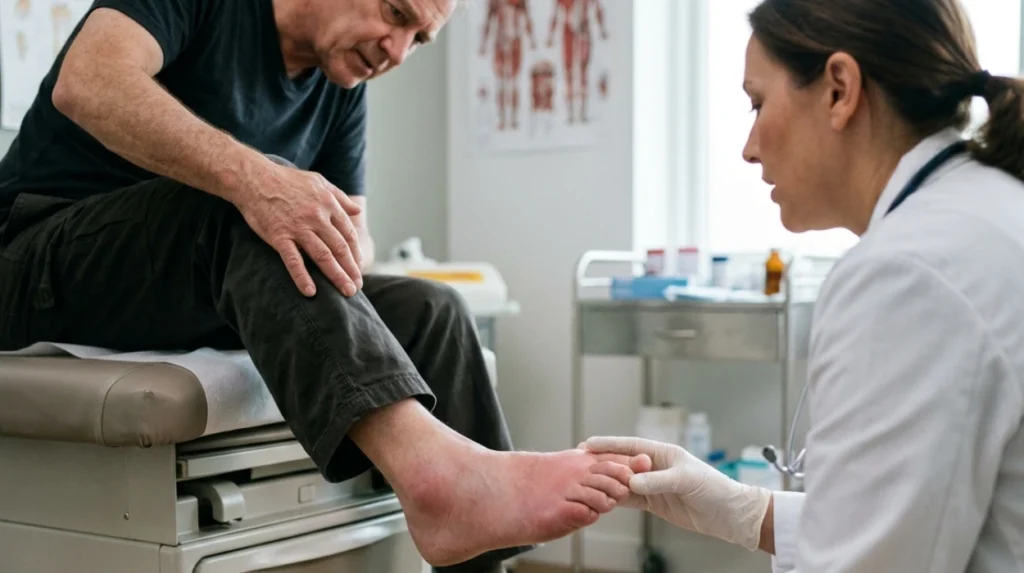
The primary site for a first gout attack is the metatarsophalangeal joint at the base of the big toe, a clinical condition historically termed podagra. Gout also frequently targets other peripheral joints. Examples include the ankles, knees, wrists, elbows, and small joints of the fingers.
Left untreated, the condition progresses from intermittent acute flares to chronic tophaceous gout. In this advanced stage, permanent clusters of urate crystals, called tophi, form under the skin and within joint structures. Tophi cause visible nodules, erode bone tissue, destroy cartilage, and lead to permanent joint deformities and functional disability.
What Is the History of Gout Diagnostics and Care in Scotland?
Scotland has a long history of clinical research into gout and metabolic disorders, dating back to the Scottish Enlightenment. Early Scottish physicians identified the link between affluent diets and joint inflammation, laying the groundwork for modern rheumatology and targeted uric-acid-lowering therapies.
During the 18th and 19th centuries, Edinburgh and Glasgow emerged as international centers for medical education and clinical research. Early faculty members at the University of Glasgow Medical School, established in 1751, documented the clinical presentation of gout among the city’s merchant classes. These early physicians noted a correlation between high consumption of imported fortified wines, heavy meat diets, and sudden-onset joint inflammation. They lacked modern chemical assays but correctly classified the disease as a metabolic ailment rather than a simple injury.
The transition to modern scientific understanding accelerated in the mid-19th century when British physician Sir Alfred Baring Garrod developed the thread test. This diagnostic method used a linen thread to catch and visualize uric acid crystals from the blood plasma of patients. This test confirmed hyperuricemia as the underlying cause of gout.
Following this breakthrough, Scottish infirmaries, including the Glasgow Royal Infirmary (founded in 1794) and the Glasgow Western Infirmary (opened in 1874), standardized diagnostic approaches based on identifying these chemical changes in blood and joint fluid.
In the 20th century, the introduction of polarized light microscopy in 1961 revolutionized diagnostic accuracy. It allowed clinicians to positively identify negatively birefringent needle-shaped urate crystals in synovial fluid.
Scottish researchers also contributed to clinical trials evaluating modern pharmacology. Examples include allopurinol, approved for medical use in 1966, and febuxostat, introduced later to lower uric acid production. These discoveries shifted the medical perception of gout in Scotland from an incurable lifestyle affliction to a highly controllable chronic condition.
How Do You Get a Gout Diagnosis in Glasgow?
To get a gout diagnosis in Glasgow, you must undergo a clinical assessment through an NHS Greater Glasgow and Clyde General Practitioner or a private rheumatologist. Diagnosis requires a physical examination, blood serum urate tests, or synovial fluid analysis via needle aspiration.
The diagnostic pathway in Glasgow begins with a primary care consultation at a local general practice. The General Practitioner evaluates the patient’s medical history, focusing on the speed of symptom onset, the specific joints involved, and the presence of localized inflammation. A typical acute gout flare reaches maximum intensity within 8 to 24 hours of onset, presenting with severe pain that makes bearing weight or touching the joint impossible.
The doctor will order a serum urate blood test to measure the concentration of uric acid. NHS Greater Glasgow and Clyde laboratories analyze these samples using standardized enzymatic assays.
A key clinical challenge is that serum urate levels can drop during an acute flare because uric acid moves out of the blood and deposits into the joint tissue. Consequently, guidelines from the British Society for Rheumatology recommend repeating the blood test four to six weeks after the acute attack subsides to establish an accurate baseline reading.
For ambiguous cases, a definitive diagnosis requires synovial fluid aspiration. A physician inserts a sterile needle into the inflamed joint to extract a small sample of fluid. This sample is sent to pathology labs at hospitals like the Queen Elizabeth University Hospital or the Glasgow Royal Infirmary.
Technicians use compensated polarized light microscopy to inspect the fluid. Detecting needle-shaped, negatively birefringent monosodium urate crystals provides an absolute confirmation of gout, distinguishing it from conditions like septic arthritis or pseudogout (calcium pyrophosphate deposition).
What Gout Treatments Are Available in Glasgow?
Gout treatments in Glasgow include acute symptom management medications like non-steroidal anti-inflammatory drugs, colchicine, and corticosteroids. Long-term management relies on Urate-Lowering Therapies, primarily allopurinol and febuxostat, which dissolve existing crystal deposits and prevent future inflammatory flares.
Acute Treatment Options
First-line treatment focuses on reducing pain and inflammation during an acute flare. Doctors frequently prescribe non-steroidal anti-inflammatory drugs. Examples include naproxen or etoricoxib, taken at high doses for the first few days of an attack.
If these drugs are unsuitable due to patient contraindications, such as chronic kidney disease or peptic ulcers, clinicians prescribe colchicine. Colchicine is an oral medication derived from the autumn crocus plant that stops white blood cells from responding to urate crystals. It must be administered early in the flare cycle at low doses to prevent gastrointestinal side effects like diarrhea.
Corticosteroids, such as oral prednisolone or direct intra-articular steroid injections, serve as effective alternatives for severe or multi-joint attacks.
Long-Term Preventative Strategies
Once the acute inflammation resolves, long-term management switches to Urate-Lowering Therapies to address the root cause of hyperuricemia. Allopurinol is the most common first-line preventive medication prescribed by doctors in Glasgow. It is a xanthine oxidase inhibitor that blocks the chemical pathway the liver uses to convert purines into uric acid.
Treatment begins at a low dose, typically 100 milligrams daily, and is uptitrated every few weeks based on follow-up blood tests. The goal is to lower and keep serum urate levels below $300\mu\text{mol/L}$ ($5.0\text{mg/dL}$), which is the target threshold for dissolving existing crystal deposits.
For patients who cannot tolerate allopurinol or who have advanced kidney disease, doctors prescribe febuxostat as an alternative xanthine oxidase inhibitor. When starting these long-term therapies, patients take a low-dose anti-inflammatory medication concurrently for up to six months. This prevents breakthrough flares caused by the shifting and dissolving of crystal structures within the joints.
How Does Glasgow’s Healthcare System Manage Gout?
The Glasgow healthcare system manages gout using integrated care pathways shared between NHS primary care clinics and hospital rheumatology departments. General Practitioners handle standard diagnostic testing and medication adjustment, while complex or treatment-resistant cases are referred to regional hospital clinics.
The NHS Greater Glasgow and Clyde health board provides medical care for approximately 1.2 million residents. Under this framework, primary care general practices serve as the main access point for gout management. GPs follow local clinical guidelines that align with Quality Outcomes Framework standards. These standards emphasize treating patients to a specific target serum urate level and conducting annual reviews to check kidney function and cardiovascular health.
When a patient exhibits complex symptoms, primary care doctors refer them to secondary care specialists. Conditions prompting a specialist referral include:
- Severe chronic tophaceous gout causing joint destruction.
- Frequent flares despite taking maximum tolerated doses of allopurinol.
- Gout complicated by advanced stage 4 or stage 5 chronic kidney disease.
Secondary rheumatology services operate out of major hospital centers across the city. Examples include the Queen Elizabeth University Hospital in the south, the Glasgow Royal Infirmary in the city center, Stobhill Hospital in the north, and the New Victoria Hospital on the south side.
In these specialist clinics, consultant rheumatologists, clinical nurse specialists, and specialized pharmacists work together to manage complex cases. They have access to advanced diagnostic imaging tools, such as dual-energy computed tomography scans, which can detect and measure urate crystal deposits that are invisible on standard X-rays.
Explore More Area Guide
Where to Find Current Live Status Updates for Glasgow Central Station
How Glasgow Locals Choose the Best Shooting Locations Today
What Dietary and Lifestyle Adjustments Matter for Glasgow Residents?
Dietary and lifestyle adjustments for Glasgow residents require modifying regional nutritional habits that elevate purine levels, such as high consumption of alcohol, red meat, and sugary drinks. Increasing hydration and managing body weight effectively support medical treatments by reducing the overall metabolic strain on the kidneys.
While genetic factors account for approximately 60% to 70% of a person’s risk for hyperuricemia, dietary choices play a major role in triggering acute flares and raising baseline uric acid levels. Traditional dietary patterns in the West of Scotland often include high amounts of purine-dense foods.
To manage gout effectively, patients need to limit or avoid specific foods that break down into uric acid. Examples include game meats, beef, pork, lamb, and seafoods like sardines, mackerel, mussels, and crabs. Organ meats, such as liver and kidneys, contain exceptionally high purine concentrations and should be entirely eliminated from the diet.
| Dietary Component | Impact on Gout | Local Recommendations / Alternatives |
| High-Purine Meats (Beef, pork, lamb, venison, offal) | High Risk: Greatly increases uric acid production. | Substitute with poultry, eggs, and plant-based proteins like tofu or legumes. |
| Seafood (Sardines, mackerel, mussels, scallops) | High Risk: Contains dense purine concentrations that trigger acute joint inflammation. | Limit portion sizes; opt for white fish varieties in moderation. |
| Alcohol (Beer, stouts, ale, spirits) | High Risk: Beer introduces purines; all alcohol dehydrates and slows kidney excretion. | Significantly reduce intake; substitute with water, herbal teas, or low-fat milk. |
| Fructose-Sweetened Drinks (Sugary sodas, high-fructose corn syrup beverages) | High Risk: Fructose accelerates cellular ATP breakdown, raising uric acid production. | Eliminate sugary sodas; choose water or sugar-free alternatives. |
Alcohol consumption is another significant lifestyle factor for gout patients. Beer, ale, and stout pose a double risk: they are rich in purines from the brewing yeast and contain ethanol, which stimulates uric acid production in the liver while reducing its excretion through the kidneys. Spirits also increase the risk of hyperuricemia, whereas moderate consumption of wine shows a lower correlation with flares.
Fructose-sweetened beverages and snacks also contribute to hyperuricemia. When the liver processes fructose, it accelerates the breakdown of cellular adenosine triphosphate, releasing purine precursors that raise uric acid levels in the blood.
Conversely, specific dietary inclusions provide protective benefits against gout flares. Increased consumption of low-fat dairy products, such as skimmed milk and low-fat yogurt, correlates with lower serum urate levels because dairy proteins promote uric acid excretion in urine.
Staying well-hydrated by drinking more than two litres of water daily assists the kidneys in clearing uric acid from the bloodstream. Gradual weight loss achieved through regular exercise also lowers baseline uric acid levels and reduces structural strain on weight-bearing joints like the knees and ankles.
What Are the Health Implications of Untreated Gout?
The health implications of untreated gout include progressive bone erosion, permanent joint deformities, chronic kidney damage, and an increased risk of cardiovascular diseases. Failing to manage hyperuricemia allows urate crystals to accumulate throughout the body, causing systemic inflammation.
Ignoring gout or relying only on short-term pain relief for flares leads to serious, long-term health complications. As monosodium urate crystals continually accumulate in joint spaces, they destroy the surrounding cartilage and subchondral bone. This structural damage results in a chronic state of secondary osteoarthritis, leaving the patient with persistent joint pain, stiffness, and a restricted range of motion even between acute flares.
The kidneys are particularly vulnerable to chronic hyperuricemia. Excess uric acid filtering through the renal system can precipitate within the microscopic collecting ducts, causing a condition known as chronic urate nephropathy. This crystalline obstruction triggers interstitial inflammation and progressive fibrosis, which accelerates the decline of kidney function and can contribute to chronic kidney disease. Furthermore, high concentrations of uric acid in the urine promote the formation of nephrolithiasis, or uric acid kidney stones, which cause severe renal colic and can obstruct the urinary tract.
Research also links chronic hyperuricemia with an elevated risk of cardiovascular diseases. Examples include hypertension, ischemic heart disease, and stroke.
Urate crystals can deposit within the endothelial linings of blood vessels, triggering low-grade vascular inflammation, reducing nitric oxide production, and accelerating atherosclerosis (the hardening of the arteries). Managing gout by lowering uric acid levels to target thresholds is essential not only for joint health, but also for protecting the kidneys and cardiovascular system.
How Can You Access Gout Support and Resources in Glasgow?
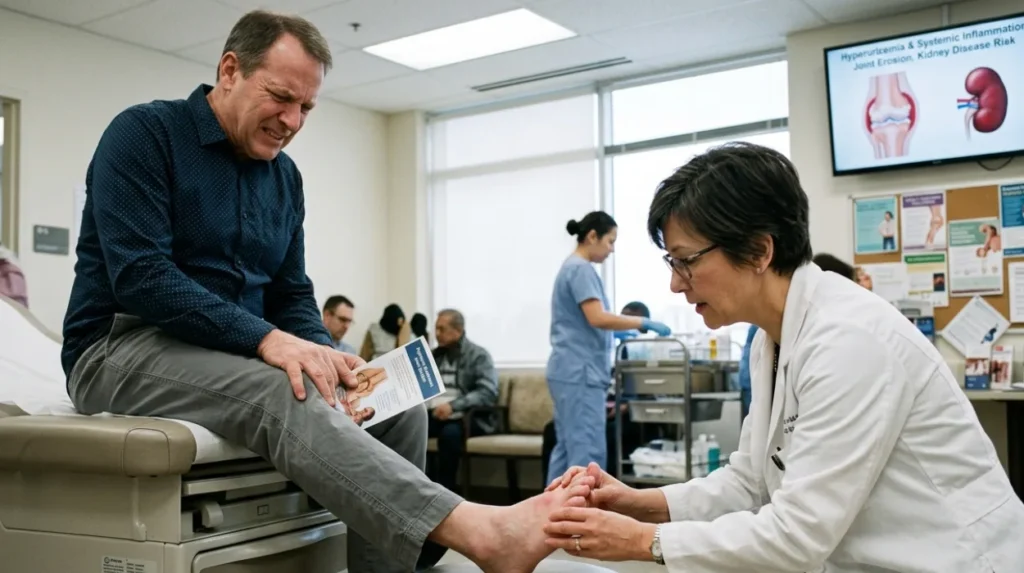
You can access gout support and resources in Glasgow through NHS primary care services, national charities like Versus Arthritis, and local community pharmacies. These networks provide educational materials, peer-support groups, and medication management programs to help patients control their condition long term.
Managing gout successfully relies on consistent patient education and adherence to long-term therapies. Versus Arthritis is a major national charity operating throughout Scotland and the wider United Kingdom. It provides extensive resources tailored for individuals diagnosed with inflammatory arthritis.
The organization runs dedicated helplines, publishes evidence-based booklets detailing treatment pathways, and coordinates local peer-support networks in the Greater Glasgow region. These groups allow patients to share experiences regarding dietary changes, lifestyle adjustments, and navigating long-term medication use.
The NHS Pharmacy First Scotland service enables community pharmacies across Glasgow to offer accessible health advice and medication support. Located in neighborhood shopping districts and health centers, pharmacists can conduct comprehensive reviews of allopurinol adherence, explain potential drug interactions, and provide advice on managing mild side effects.
These local pharmacies work alongside primary care practices to ensure patients receive regular blood tests, helping them safely and effectively manage their gout treatment over the long term.
What is gout and why is it so painful?
Gout is a type of inflammatory arthritis caused by uric acid crystals forming inside joints. The pain happens because the immune system attacks these sharp crystals, causing sudden swelling, redness, heat, and severe inflammation.