Glasgow residents can arrange a bulky waste collection through Glasgow City Council when household items are too large to fit inside standard household bins. The service provides a formal way to dispose of unwanted furniture, electrical appliances and other large domestic items.
- What Is Glasgow’s Bulky Waste Collection Service?
- How Does Glasgow Bulky Waste Collection Work?
- Step 1: Identify the Items for Collection
- Step 2: Submit a Collection Request
- Step 3: Check the Collection Charges
- Step 4: Receive Collection Instructions
- Step 5: Prepare Items for Collection
- Step 6: Complete the Collection
- How Much Does Glasgow Bulky Waste Collection Cost?
- Which Items Can Glasgow City Council Collect?
- Household Furniture
- Mattresses and Bedroom Furniture
- Large Electrical Appliances
- Other Oversized Household Objects
- Which Items Are Not Accepted for Glasgow Bulky Waste Collection?
- Construction and DIY Waste
- Hazardous Waste
- Vehicle and Specialist Waste
- Waterlogged Furniture and Textiles
- How Should Residents Prepare Bulky Waste for Collection?
- Prepare Items Before Collection Day
- Keep Communal Areas Clear
- Avoid Putting Items Out Too Early
- Check Upholstered Furniture
- How Does Bulky Waste Collection Work for Glasgow Flats and Tenement Properties?
- What Happens If Residents Miss Their Glasgow Bulky Waste Collection?
- Where Can Glasgow Residents Take Bulky Waste Instead?
- What Is the Difference Between Bulky Waste Collection and Fly-Tipping?
- Examples of Fly-Tipping in Glasgow
- Why Is Fly-Tipping a Problem?
- How Can Residents Report Fly-Tipping?
- Why Is Responsible Bulky Waste Disposal Important in Glasgow?
- Scotland’s Household Waste Statistics
- The Role of Furniture Reuse
- Recycling Electrical Appliances
- Supporting Scotland’s Circular Economy
- How Can Glasgow Households Reduce Bulky Waste?
- Repair Furniture Before Replacing It
- Donate Reusable Household Items
- Plan Large Purchases Carefully
- Separate Recyclable Materials
- What Should Residents Know Before Booking a Bulky Waste Collection?
- What Is the Future of Bulky Waste Management in Glasgow?
The council operates a request-based collection system. Residents must submit a booking, identify the items they want removed, pay the applicable charges and follow the instructions for presenting waste. Leaving unwanted furniture or appliances on pavements, streets or back lanes without an authorised collection arrangement can constitute fly-tipping.
Understanding the booking process, collection charges, accepted items and recycling alternatives helps Glasgow households manage bulky waste responsibly.
What Is Glasgow’s Bulky Waste Collection Service?
Glasgow’s bulky waste collection service is a council-managed household waste removal service for large items that do not fit inside standard wheeled bins. It allows residents to arrange authorised collection of unwanted furniture, appliances and other eligible domestic items.
Glasgow City Council manages household waste services across the city. Its bulky waste service provides an alternative to transporting large items to a household waste recycling centre.
Bulky waste refers to household objects that are too large or unsuitable for ordinary bin collections. These items require separate handling because of their dimensions, weight, materials or electrical components.
Common examples include:
- Sofas and armchairs, including two-seater and three-seater furniture.
- Beds and mattresses, including single, double and king-size mattresses.
- Wardrobes and cupboards, including freestanding bedroom furniture.
- Washing machines and dishwashers, including large domestic appliances.
- Refrigerators and freezers, including household cooling equipment.
- Tables and desks, including dining tables and office furniture.
The service operates through advance requests rather than unrestricted street collections. Residents must provide information about the waste and follow the collection arrangements confirmed by the council.
This distinction is important for Glasgow households. Placing unwanted furniture beside a communal bin store or on a public pavement does not automatically arrange a collection.
Why Does Glasgow Need a Separate Bulky Waste Service?
Large household items create different collection requirements from ordinary domestic rubbish. A standard refuse vehicle and wheeled-bin system are designed for regular household waste rather than heavy furniture and electrical appliances.
A separate collection arrangement helps the council organise appropriate vehicles, collection crews and handling procedures.
It also supports responsible waste management. Furniture, metal appliances and reusable household goods contain materials that can enter recycling or reuse systems instead of being abandoned.
Glasgow’s service is particularly relevant to residents moving house, replacing furniture, renovating domestic interiors or clearing unwanted household possessions.
How Does Glasgow Bulky Waste Collection Work?
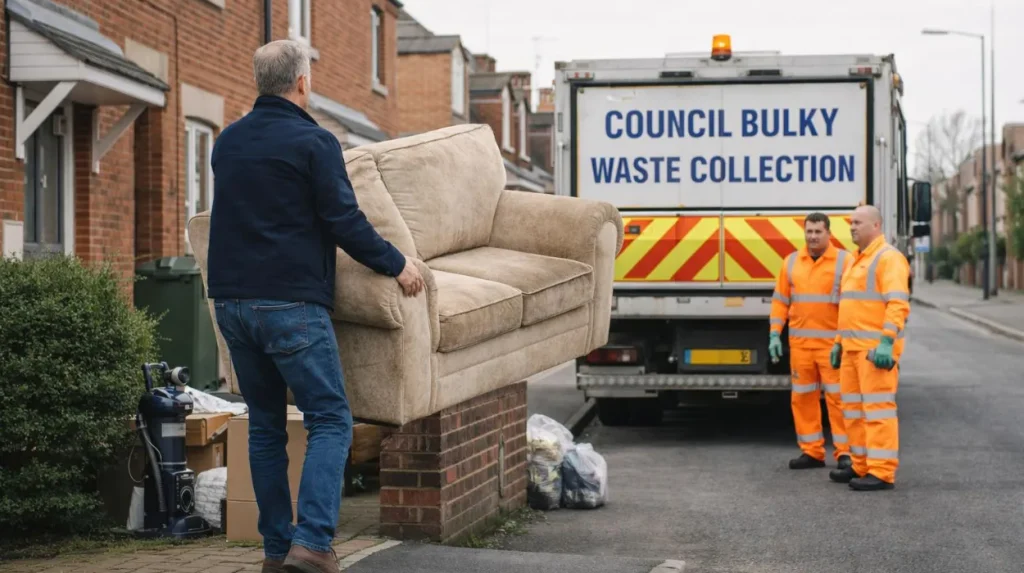
Glasgow residents arrange bulky waste collection by submitting a request to Glasgow City Council, identifying the household items, checking applicable charges and following the confirmed collection instructions. The council provides collection arrangements after processing the request.
The booking process requires residents to identify what they want removed and provide accurate information about the collection location.
Glasgow operates a request-based system. Residents cannot assume that a scheduled communal bulk collection will remove every item placed outside a property.
The process generally follows these stages.
Step 1: Identify the Items for Collection
Residents should first establish which household items need removal.
An accurate inventory helps prevent confusion during booking. For example, a household disposing of a sofa, mattress and washing machine should identify each object separately.
The item descriptions should match the council’s available categories. Electrical appliances and upholstered furniture can have different charging arrangements.
Step 2: Submit a Collection Request
Residents can use the council’s online bulky waste service to arrange an uplift.
Residents should provide the requested property information, item descriptions and other booking details.
The council also provides customer service assistance through its main contact number, 0141 287 9700.
Step 3: Check the Collection Charges
The council applies charges according to the type of item being collected.
Residents should review the price displayed during booking before completing payment. White goods and upholstered domestic seating have separate charging arrangements.
Step 4: Receive Collection Instructions
After submitting a request, residents should check the confirmation information.
This information establishes the collection date and the approved presentation arrangements. Residents should retain their booking reference and any confirmation emails.
Step 5: Prepare Items for Collection
Households must prepare their items according to the council’s instructions.
This includes using the designated collection location and ensuring that the waste does not obstruct communal access, pedestrian routes or other household facilities.
Step 6: Complete the Collection
The council’s collection team removes the booked items in accordance with the service arrangements.
Residents should check that the items presented match the booking. Additional or unlisted objects should not be assumed to form part of the authorised collection.
How Much Does Glasgow Bulky Waste Collection Cost?
Glasgow City Council charges residents for bulky waste collection, with prices varying according to the type of household item. Published 2026 guidance identifies £25 per white goods item and £5 per upholstered seating item. Other items follow their applicable booking categories.
Glasgow introduced charges for bulky waste collection in July 2021. Before the change, the council provided free collection for most eligible household items.
The charging system helps distinguish between different waste categories and their handling requirements.
The following figures are reported in 2026 service guidance:
- White goods: £25 per item, including refrigerators, freezers, washing machines and dishwashers.
- Waste Upholstered Domestic Seating (WUDS): £5 per sofa or armchair.
- Other standard bulky items: Charges depend on the applicable item category. Published guidance gives an example of four standard bulk items costing £35.
White goods are electrical household appliances used for major domestic functions. Their collection requires appropriate handling because of their electrical components and materials.
WUDS is a waste classification covering upholstered domestic seating. Examples include sofas and armchairs containing cushioning, fabric or other upholstery materials.
The distinction between these categories is important when calculating the total cost of a household clearance.
How Can Residents Calculate Their Collection Costs?
Residents should identify every item and check its category before paying.
For example, a household disposing of one refrigerator and one sofa should account for the separate white goods and upholstered seating charges.
Based on the published figures:
- One refrigerator: £25.
- One sofa: £5.
- Combined indicative charge: £30.
A household disposing of four standard bulky items should also check the council’s published example of £35.
These figures provide a useful guide, but the live council booking system should determine the final amount. Residents should confirm the applicable charges before submitting payment because fees and categories can change.
Why Did Glasgow Introduce Bulky Waste Charges?
The introduction of charges in July 2021 changed bulky waste collection from a predominantly free service to a chargeable, request-based arrangement.
The change also reinforced the importance of booking collections rather than leaving unwanted items at communal collection points without authorisation.
Residents now need to account for collection costs when planning furniture replacement, house moves and property clearances.
Which Items Can Glasgow City Council Collect?
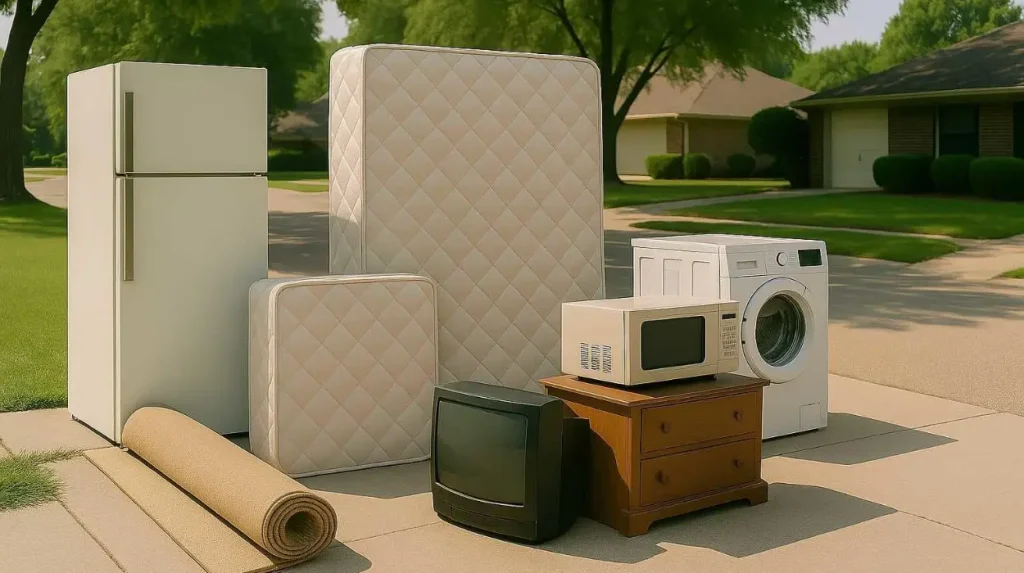
Glasgow’s bulky waste service covers eligible household furniture, large electrical appliances and other oversized domestic objects. Examples include sofas, mattresses, wardrobes, washing machines and refrigerators. Residents must check individual item categories and restrictions before booking.
The council’s service is designed for household waste rather than unrestricted commercial, construction or industrial disposal.
Understanding the main categories helps residents identify suitable items.
Household Furniture
Furniture is one of the main categories of bulky domestic waste.
Examples include:
- Sofas and armchairs, including upholstered seating.
- Beds and bed frames, including wooden and metal structures.
- Wardrobes and cupboards, including freestanding storage units.
- Dining tables and chairs, including household dining furniture.
- Desks and bookcases, including domestic office furniture.
Residents should describe each item accurately during booking. Large furniture should also be prepared according to the council’s collection instructions.
Mattresses and Bedroom Furniture
Mattresses and bedroom furniture often become bulky waste when households replace beds or renovate bedrooms.
Examples include single mattresses, double mattresses, bed frames and bedroom storage furniture.
Mattresses require suitable handling and should remain dry. Waterlogged textile items can create handling and hygiene problems and are identified as restricted in published Glasgow service guidance.
Large Electrical Appliances
Large electrical appliances require separate consideration because they contain electrical components and materials that need appropriate treatment.
Examples include:
- Washing machines, used for domestic laundry.
- Dishwashers, used for washing household dishes.
- Refrigerators, used for food storage.
- Freezers, used for frozen food storage.
- Other large domestic electrical equipment.
Refrigerators and freezers should be emptied of food before collection.
Electrical appliances should not be dismantled or placed in ordinary household bins. Their materials require suitable electrical waste management.
Other Oversized Household Objects
Some households also need to dispose of large domestic equipment that does not fit into standard refuse bins.
Examples include large storage units, household furniture and eligible oversized electrical equipment.
The exact eligibility of an object depends on the council’s booking categories. Residents should not assume that every large object qualifies simply because it is difficult to place inside a bin.
Which Items Are Not Accepted for Glasgow Bulky Waste Collection?
Glasgow’s bulky waste collection service does not accept every type of unwanted material. Building waste, hazardous substances, soil, rubble and tyres are among the restricted categories. Residents must use appropriate disposal facilities for excluded materials.
The service is intended for eligible domestic bulky waste. It is not a general clearance service for every material produced during building work, gardening or commercial activity.
Residents should distinguish household furniture and appliances from specialist waste.
Construction and DIY Waste
Construction and DIY waste is generally unsuitable for the standard bulky household collection service.
Examples include:
- Bricks and rubble, including broken masonry.
- Soil and excavated material, including garden excavation waste.
- Building debris, including plaster and construction offcuts.
- Renovation waste, including mixed materials from building projects.
Households undertaking renovation work should arrange suitable disposal through an authorised waste facility or waste contractor.
Hazardous Waste
Hazardous waste requires specialist handling because it can present risks to people and the environment.
Examples include chemicals, certain paints, solvents and other substances requiring controlled disposal.
Residents should contact the relevant waste facility for instructions rather than placing hazardous materials alongside booked furniture.
Vehicle and Specialist Waste
Tyres and other specialist vehicle-related waste do not belong in ordinary bulky household collections.
Examples include car tyres and materials associated with vehicle maintenance.
These items require suitable specialist disposal arrangements.
Waterlogged Furniture and Textiles
Furniture and textiles affected by water can create additional handling and hygiene difficulties.
Examples include soaked mattresses, wet carpets and heavily water-damaged upholstered furniture.
Published Glasgow service guidance identifies waterlogged textile items as restricted. Residents should check with the council before including damaged items in a booking.
How Should Residents Prepare Bulky Waste for Collection?
Residents should prepare booked bulky waste according to the council’s collection instructions, using the designated collection location and keeping access routes clear. Items must match the booking, remain accessible and be presented at the instructed time.
Correct preparation reduces the risk of unsuccessful collections and unnecessary waste left in communal areas.
The collection location depends on the property type and the arrangements confirmed by the council.
Prepare Items Before Collection Day
Residents should identify the booked objects and separate them from ordinary household rubbish.
Furniture should be positioned so that collection crews can access it safely. Smaller loose materials should not be added unless included in the booking.
Households should also ensure that large appliances are ready for collection. Refrigerators and freezers should be emptied before uplift.
Keep Communal Areas Clear
Glasgow has many tenement buildings and shared residential spaces.
Communal areas include closes, stairwells, backcourts and shared bin storage areas. Poorly positioned bulky waste can obstruct residents, visitors and emergency access.
Items should never block:
- Building entrances, including shared front doors.
- Staircases and corridors, including communal escape routes.
- Bin stores, including access for refuse collection.
- Pavements and pedestrian routes, including public walking areas.
Residents should follow the collection location specified in their confirmation rather than choosing an alternative location.
Avoid Putting Items Out Too Early
Residents should only present booked items within the instructed collection window.
Leaving furniture outside for several days increases the risk of unauthorised dumping, damage, obstruction and removal by other people.
A confirmed booking does not give permission to leave waste anywhere in the surrounding neighbourhood.
Check Upholstered Furniture
Sofas and armchairs should be kept in suitable condition for collection.
Residents should protect these objects from rain where required and avoid presenting waterlogged upholstered furniture.
Correct preparation helps reduce handling difficulties and collection delays.
How Does Bulky Waste Collection Work for Glasgow Flats and Tenement Properties?
Glasgow residents living in flats and tenements must follow the collection arrangements applicable to their building. Housing associations, property factors and communal waste facilities can have additional procedures, while certain property types face council service restrictions.
Glasgow has a substantial number of tenement buildings, traditional flats and modern apartment developments.
These properties often share entrances, staircases, backcourts and bin storage facilities. Consequently, bulky waste collection requires coordination between residents and property managers.
Bulky Waste in Tenement Buildings
Tenement buildings commonly contain multiple households sharing communal facilities.
Residents should check whether their property has an individual council collection arrangement or a separate bulk waste procedure managed through a housing association or property factor.
Historically, some Glasgow tenement arrangements involved organised pull-out services. Under these arrangements, a housing association, factor or residents’ group coordinated the movement of bulky items from communal storage areas to an agreed collection point.
Such historical arrangements should not be confused with the current individual booking system.
Residents should confirm the procedure currently operating in their building before moving furniture into shared spaces.
Housing Association Responsibilities
Housing associations manage residential properties and communal facilities for their tenants.
Some housing associations publish their own waste disposal guidance and coordinate contractors for communal waste management.
For example, Glasgow West Housing Association has published guidance directing residents towards Glasgow City Council’s on-demand bulky waste arrangements.
Residents should contact their housing association when they are unsure whether an item requires an individual council booking or an approved communal arrangement.
What About High-Rise Flats?
High-rise properties have additional operational restrictions.
Published Glasgow bulky waste guidance identifies high-rise properties and buildings with internal bulk storage chambers among the restrictions affecting the service.
Residents living in these properties should contact their housing provider or Glasgow City Council to establish the available disposal arrangements.
They should not leave large items beside the entrance, in lifts, on staircases or in communal corridors without authorisation.
What Happens If Residents Miss Their Glasgow Bulky Waste Collection?
Residents who experience a missed bulky waste collection should check their booking confirmation and contact Glasgow City Council. They should provide their collection reference, property details and item descriptions so the council can investigate the missed uplift.
A missed collection can occur when booked items are inaccessible, incorrectly presented or affected by operational problems.
Residents should establish whether the collection team attended and whether the items met the booking requirements.
Check the Collection Confirmation
The booking confirmation provides the reference information needed to investigate a collection problem.
Residents should check the agreed collection date and presentation instructions before contacting the council.
They should also confirm that the correct items were placed at the approved location.
Contact Glasgow City Council
Residents can contact Glasgow City Council through its customer service number:
0141 287 9700
They should explain that the booked bulky waste collection has not taken place and provide the booking reference.
The council can advise residents about the appropriate next steps.
Avoid Rebooking Without Checking
Residents should establish the reason for the missed collection before submitting another request.
For example, an inaccessible item and an operational collection delay require different responses.
Keeping booking confirmations and payment information helps residents resolve collection problems more efficiently.
Where Can Glasgow Residents Take Bulky Waste Instead?
Glasgow residents have alternatives when council bulky waste collection is unsuitable. Household waste recycling centres, charitable reuse organisations and authorised private waste contractors provide different disposal options for unwanted furniture, appliances and other household materials.
These alternatives are particularly useful when residents have large quantities of waste, excluded materials or reusable household possessions.
Household Waste Recycling Centres
Household Waste Recycling Centres (HWRCs) are facilities where residents take eligible domestic waste for sorting, recycling and disposal.
Glasgow residents can use the council’s recycling centre information to identify suitable facilities and check current access requirements.
Examples of materials commonly handled through appropriate recycling facilities include:
- Electrical equipment, including household appliances.
- Scrap metal, including metal furniture components.
- Wood, including suitable timber products.
- Cardboard and paper, including packaging materials.
- Textiles, including eligible fabric waste.
- Garden waste, including suitable branches and plant material.
Residents should check individual centre rules before travelling. Accepted materials, vehicle restrictions and opening arrangements depend on the facility.
Charity Furniture Collections
Furniture that remains clean, safe and usable does not always need to become waste.
Charitable organisations and reuse services can provide alternative routes for unwanted household goods.
Examples include reusable sofas, dining tables, wardrobes and bedroom furniture.
Residents should check whether an organisation accepts the item, whether it offers a collection service and whether the furniture meets its safety requirements.
This approach supports reuse and keeps usable materials in circulation.
Private Waste Collection Companies
Private waste contractors provide another option for households that require additional collection arrangements.
Some businesses offer furniture removal, property clearance and appliance disposal.
Residents should verify that a contractor holds the appropriate waste carrier registration and provides suitable disposal documentation.
Using an authorised contractor helps reduce the risk of waste entering illegal dumping sites.
What Is the Difference Between Bulky Waste Collection and Fly-Tipping?
Bulky waste collection is an authorised process for removing large household items through an approved council or waste contractor arrangement. Fly-tipping is the illegal deposit of waste on land without permission, including unauthorised dumping on streets and communal areas.
The main difference is authorisation.
A resident who books a council collection and follows the presentation instructions uses an approved waste disposal service.
A resident who leaves an unwanted sofa on a pavement without arranging an authorised collection risks committing fly-tipping.
Examples of Fly-Tipping in Glasgow
Fly-tipping involves different types of illegally deposited waste.
Examples include:
- Abandoned sofas, including unwanted household seating.
- Discarded mattresses, including bedroom furniture waste.
- Dumped electrical appliances, including refrigerators and washing machines.
- Unauthorised building debris, including rubble and renovation materials.
- Bags of household rubbish, including mixed domestic waste.
These deposits can obstruct public spaces and create additional work for local environmental services.
Why Is Fly-Tipping a Problem?
Fly-tipping affects residential environments, public access and waste management.
Discarded furniture can block pavements and create hazards for pedestrians. Dumped appliances can also create environmental problems when their components are damaged or improperly handled.
Communal dumping creates additional difficulties in tenement backcourts and shared bin areas.
It can also lead to extra clearance costs for housing associations, property factors and local authorities.
How Can Residents Report Fly-Tipping?
Residents who discover illegally dumped waste should report it through Glasgow City Council’s environmental reporting services.
They should provide the location, a description of the waste and any relevant information about the incident.
Photographs can help identify the type and quantity of waste.
Residents should not move hazardous materials or attempt to handle dangerous discarded objects themselves.
Why Is Responsible Bulky Waste Disposal Important in Glasgow?
Responsible bulky waste disposal supports cleaner neighbourhoods, safer communal spaces and better resource management. Reusing furniture and recycling suitable materials reduces unnecessary disposal and supports Scotland’s wider circular economy objectives.
A circular economy is an economic system that keeps products and materials in use for as long as possible through repair, reuse and recycling.
This approach is relevant to Glasgow because household waste contains materials that retain value after their original use.
Scotland’s Household Waste Statistics
The Scottish Environment Protection Agency (SEPA) publishes official statistics on household waste generation and recycling.
According to SEPA’s 2025 statistical release covering 2024, Scottish households generated approximately 2.31 million tonnes of household waste.
The household recycling rate reached 44.3% in 2024. This means less than half of household waste was recycled during that reporting period. Scottish Environment Protection Agency+1
SEPA’s October 2026 release also reports that the Scottish household recycling rate fell to 42.8% in 2025. Households generated approximately 2.31 million tonnes of waste during that year. Scottish Environment Protection Agency+1
These figures demonstrate the continuing importance of waste reduction, reuse and recycling across Scotland.
They represent Scotland-wide household waste statistics rather than figures exclusively for Glasgow.
The Role of Furniture Reuse
Furniture reuse reduces the need to dispose of functional household objects.
Examples include donating a usable wardrobe, passing a dining table to another household or selling a working washing machine.
These actions extend product lifespans and reduce demand for replacement materials.
Residents should prioritise reuse when furniture remains safe and suitable for another household.
Recycling Electrical Appliances
Electrical appliances contain materials that can be recovered through appropriate recycling systems.
Examples include metals, plastics and other components found in washing machines, refrigerators and dishwashers.
Separating electrical equipment from ordinary household waste helps ensure that it enters an appropriate treatment process.
Residents should use approved collection services and recycling facilities rather than dismantling appliances themselves.
Supporting Scotland’s Circular Economy
The Scottish Government’s Circular Economy and Waste Route Map to 2030 identifies waste reduction, reuse and recycling as important priorities.
The strategy emphasises keeping materials in productive use and reducing dependence on disposal.
The government’s approach also recognises that household waste management requires participation from residents, local authorities and businesses. Scottish Government+1
Glasgow’s bulky waste collection arrangements contribute to this wider framework by providing an organised route for removing large household objects.
How Can Glasgow Households Reduce Bulky Waste?
Glasgow households can reduce bulky waste by repairing usable furniture, donating unwanted possessions, purchasing durable products and separating recyclable materials. Planning household replacements and using reuse services prevents unnecessary disposal and reduces pressure on collection facilities.
Preventing waste is generally preferable to disposing of unwanted objects after they become unusable.
Several practical approaches help households manage their possessions more efficiently.
Repair Furniture Before Replacing It
Furniture with minor damage does not always require disposal.
Examples include repairing loose chair joints, replacing damaged cupboard handles and fixing broken table legs.
These repairs extend furniture life and reduce the amount of bulky material entering waste streams.
Donate Reusable Household Items
Residents can offer suitable furniture to charitable organisations and local reuse networks.
Examples include working desks, clean mattresses accepted by the receiving organisation and usable storage furniture.
Acceptance policies differ between organisations, so residents should check their requirements before arranging a donation.
Plan Large Purchases Carefully
Households replacing furniture should consider how existing possessions will be reused or removed.
For example, someone purchasing a new sofa can arrange a donation or authorised collection for the old one before delivery.
This prevents unwanted furniture from accumulating in communal spaces.
Separate Recyclable Materials
Residents should identify materials that belong in appropriate recycling systems.
Examples include metal components, electrical equipment, cardboard packaging and suitable timber.
Correct separation helps recycling facilities manage materials more effectively.
Explore More Area Guide
Glasgow Recycling Guide: What Can and Can’t Be Recycled
How to Report a Missed Bin Collection in Glasgow
What Should Residents Know Before Booking a Bulky Waste Collection?
Residents should check item eligibility, collection charges, property restrictions and presentation instructions before booking. Accurate information helps prevent unsuccessful collections, unexpected costs and unauthorised waste deposits across Glasgow’s residential neighbourhoods.
A few checks make the process more straightforward.
Residents should:
- List every item requiring collection.
- Check the applicable price for each item.
- Confirm that the property qualifies for the service.
- Check the confirmed collection location.
- Empty refrigerators and freezers before collection.
- Keep upholstered furniture dry.
- Retain the booking confirmation and reference number.
- Follow the council’s instructions about when to present items.
Residents living in shared buildings should also consult their housing association or property factor when communal waste arrangements apply.
These steps help households arrange collection without obstructing shared spaces or creating unnecessary waste management problems.
What Is the Future of Bulky Waste Management in Glasgow?
Glasgow’s bulky waste management will remain connected to wider Scottish priorities for waste prevention, reuse and recycling. Household participation, suitable collection arrangements and responsible disposal will support cleaner neighbourhoods and more efficient resource management.
Scotland’s circular economy policies place increasing importance on reducing waste generation and retaining the value of materials.
This direction has implications for large household objects, particularly furniture, electrical appliances and reusable domestic equipment.
Future improvements in household waste management depend on several areas.
Greater Focus on Reuse
Reusable furniture offers opportunities to reduce disposal volumes.
Charitable collections, second-hand markets and furniture repair services help extend the useful life of household products.
Better Electrical Waste Management
Electrical equipment requires appropriate recycling and material recovery.
Household appliances contain materials that should enter authorised treatment systems rather than general waste disposal.
More Responsible Household Disposal
Residents play an important role in maintaining clean communal areas.
Booking collections, following disposal instructions and reporting fly-tipping help prevent unnecessary waste accumulation.
Progress Towards Circular Economy Targets
The Scottish Government’s waste strategy continues to emphasise resource efficiency, recycling and reduced waste generation.
Local authorities, housing providers and residents all contribute to these objectives.
For Glasgow, effective bulky waste management requires both accessible collection arrangements and responsible household participation.
Glasgow bulky waste collection provides residents with an organised way to dispose of large household items that do not fit into ordinary refuse bins. Glasgow City Council operates a request-based service with charges determined by item categories.
Residents should book collections in advance, check the latest prices, follow property-specific instructions and present items at the approved location.
Households also have alternatives, including recycling centres, charitable reuse services and authorised private waste contractors.
Responsible disposal prevents fly-tipping, protects communal spaces and supports Scotland’s wider recycling and circular economy objectives.
For residents across Glasgow, understanding how the bulky waste collection service works makes household clearances easier to organise and helps maintain cleaner neighbourhoods.
How do I book a bulky waste collection in Glasgow?
Residents can book a collection through the Glasgow City Council bulky waste service. They need to provide their property details, identify the items and pay the applicable charges.