Glasgow has recorded stronger long-term residential price growth than Scotland overall, but the latest annual figures show a more balanced picture. Registers of Scotland reports a 57% rise in Glasgow’s median residential price over ten years, compared with 41% across Scotland, while both Glasgow and Scotland recorded 4% growth in 2025-26.
- How have Glasgow property prices changed compared with Scotland?
- What are the latest Glasgow property prices in 2026?
- Has Glasgow actually risen faster than the rest of Scotland over the long term?
- Why has Glasgow experienced strong long-term property price growth?
- How does Glasgow compare with Edinburgh and other Scottish cities?
- Which Glasgow property types have seen the strongest growth?
- Is Glasgow more expensive than the Scottish average?
- How many properties are being sold in Glasgow?
- What does the latest Scottish housing data say about market momentum?
- What does this mean for people buying property in Glasgow?
- What does Glasgow’s long-term growth mean for the Scottish property market?
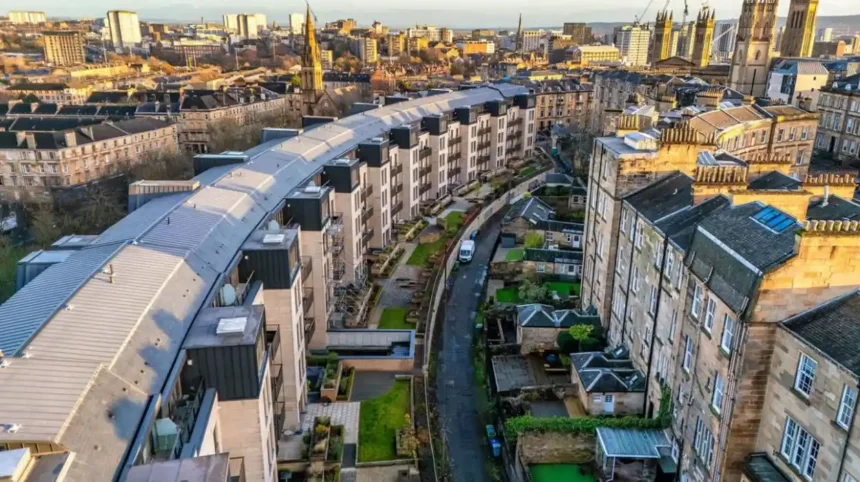
The comparison matters because Glasgow is one of Scotland’s largest housing markets. The city combines traditional tenement flats, modern apartments, terraced housing, semi-detached homes and detached properties across a wide range of neighbourhoods. Its market therefore provides a useful measure of how urban Scottish property has performed over time.
The latest evidence does not show Glasgow accelerating away from the whole of Scotland in the most recent annual period. It does show that Glasgow has delivered substantially stronger long-term price growth than the Scottish average and stronger growth than every other Scottish city except none: Glasgow recorded the highest 10-year increase among Scotland’s eight cities.
How have Glasgow property prices changed compared with Scotland?
Glasgow’s median residential property price increased 57% over the ten years to 2025-26, compared with 41% across Scotland. In 2025-26, both Glasgow and Scotland recorded 4% annual median-price growth, showing stronger long-term Glasgow growth but similar latest-year performance.
Registers of Scotland provides the clearest long-term comparison because its Property Market Report is based on completed residential sales rather than asking prices. The 2025-26 report covers transactions across Scotland and provides consistent historical data back to 2003-04.
The Scottish median residential property price reached £198,000 in 2025-26, up from £190,000 in 2024-25. That represented annual growth of 4%. Glasgow’s median price reached £185,000, also increasing by 4% during the year.
The longer comparison is more significant. Scotland’s median residential property price increased from £140,000 to £198,000 over the decade to 2025-26, equivalent to 41% growth. Glasgow recorded 57% growth over the same period.
This means Glasgow’s property market has risen faster than the Scottish market over the longer period, although the difference is not present in the latest one-year comparison.
The distinction between median price and average price is important. The median is the middle transaction when completed sales are ordered by price. It is less affected by a small number of exceptionally expensive properties than a simple arithmetic average.
Registers of Scotland uses completed sales because they provide evidence of actual transaction prices. Asking prices show seller expectations, while completed-sale statistics show prices recorded when transactions are registered.
What are the latest Glasgow property prices in 2026?
The latest UK House Price Index recorded an average Glasgow property price of £193,671 in June 2026, up 3.9% from £186,414 a year earlier. Scotland averaged £195,000, with annual growth of 2.3%, putting Glasgow slightly above the national growth rate.
The June 2026 UK House Price Index provides a more recent monthly comparison than the annual Registers of Scotland report.
For Glasgow, the average property price was £193,671 in June 2026, compared with £186,414 in June 2025. This produced annual growth of 3.9%.
Scotland’s average property price was £195,000 in June 2026, representing annual growth of 2.3%. The Glasgow annual growth rate was therefore higher than the Scottish rate in this particular month.
The June figures also show that Glasgow’s average price remained close to the Scottish average. Glasgow was not substantially more expensive than Scotland as a whole when all property types were combined.
The latest data must also be interpreted carefully because UK House Price Index figures for recent months are provisional. Later transaction information is incorporated into subsequent releases, so recent figures are subject to revision.
Registers of Scotland separately publishes monthly house price statistics. These statistics contain median and mean prices, sales volumes and total sales values, with data available by geography and property characteristics.
The two datasets have different methodologies, so the £185,000 Glasgow median for 2025-26 and the £193,671 Glasgow average for June 2026 should not be treated as contradictory figures. They measure different periods and use different statistical approaches.
Has Glasgow actually risen faster than the rest of Scotland over the long term?
Yes. Glasgow recorded 57% median residential price growth over the ten years to 2025-26, compared with 41% across Scotland and 44% across the rest of Scotland. Glasgow therefore had substantially stronger long-term growth than the wider Scottish market.
The Registers of Scotland city data provides a particularly useful comparison.
Over ten years to 2025-26:
- Glasgow recorded 57% growth.
- Scotland recorded 41% growth.
- The rest of Scotland recorded 44% growth.
- Edinburgh recorded 47% growth.
- Dunfermline recorded 39% growth.
- Stirling recorded 39% growth.
- Inverness recorded 32% growth.
- Dundee recorded 24% growth.
- Perth recorded 18% growth.
- Aberdeen recorded a 29% decline.
These figures establish Glasgow’s position within the Scottish city market without relying on forecasts or asking-price data.
Glasgow’s 57% growth also exceeded the 44% increase recorded across the rest of Scotland. That comparison directly addresses whether Glasgow has risen faster than areas outside the city.
The difference is substantial. Glasgow’s 57% increase was 13 percentage points higher than the rest-of-Scotland figure of 44%.
However, this does not mean every Glasgow neighbourhood experienced 57% growth. City-level statistics combine different housing markets, property types and locations. Individual streets and neighbourhoods have different transaction histories.
Why has Glasgow experienced strong long-term property price growth?
Glasgow’s long-term property growth reflects its scale as a major Scottish city, large transaction market, diverse employment base and broad housing stock. Its 11,305 residential sales in 2025-26 demonstrate substantial market activity and provide a large base of completed transactions.
Glasgow is Scotland’s largest city by population and a major centre for employment, education, healthcare, culture, retail and professional services. These functions support a large residential market.
The city also contains several major higher-education institutions, including the University of Glasgow, University of Strathclyde, Glasgow Caledonian University and Glasgow School of Art. Student accommodation, graduate housing and professional employment contribute to demand across different parts of the city.
Glasgow’s housing stock is also diverse. Traditional tenement flats are concentrated across many inner-city neighbourhoods. Suburban areas contain terraces, semi-detached houses and detached properties. Modern apartment developments add another category of housing.
This diversity creates multiple price segments within the same city.
Transaction volume is another important factor. Glasgow City recorded 11,305 residential sales in 2025-26, compared with 11,169 in the City of Edinburgh. Together, the two local authority areas accounted for 22% of all residential sales in Scotland.
A large transaction market provides substantial evidence for measuring price movements because the statistics contain many completed purchases across different property types.
Glasgow’s long-term growth also reflects its position relative to other Scottish cities. Edinburgh had a higher median price in 2025-26 at £275,000, but its ten-year growth rate of 47% remained below Glasgow’s 57%.
How does Glasgow compare with Edinburgh and other Scottish cities?
Glasgow had a median residential price of £185,000 in 2025-26, compared with £275,000 in Edinburgh. Glasgow recorded 57% ten-year growth, while Edinburgh recorded 47%, demonstrating stronger long-term percentage growth despite Edinburgh’s higher absolute price.
The Glasgow-Edinburgh comparison demonstrates why price level and price growth are separate measures.
Edinburgh was the most expensive of Scotland’s eight cities in 2025-26, with a median residential price of £275,000. Glasgow’s median was £185,000.
Despite the lower median price, Glasgow recorded higher ten-year growth.
Glasgow’s 57% increase compared with Edinburgh’s 47% increase over the same period. The difference shows that a lower current price level does not automatically mean weaker historical price appreciation.
The other Scottish cities also produced different results. Dundee recorded 24% ten-year growth, Inverness 32%, Perth 18%, Stirling 39% and Dunfermline 39%. Aberdeen was the only city with a decline, recording a 29% fall in median price over the decade.
These variations demonstrate the importance of location when interpreting Scottish property statistics.
A national Scottish growth rate therefore cannot be applied directly to every city. Likewise, Glasgow’s city-wide growth rate cannot be applied directly to every Glasgow neighbourhood.
Which Glasgow property types have seen the strongest growth?
Property type has a major effect on price growth. Across Scotland, semi-detached properties recorded about 50% median-price growth over ten years, while flats recorded 26%. Glasgow’s market contains substantial flat and tenement stock, making property type essential when assessing local price trends.
The Scottish data shows substantial differences between property types.
In 2025-26, detached properties had a median price of £324,995, while flats had a median price of £138,017. Semi-detached and terraced properties occupied intermediate positions.
Over ten years, flats recorded the slowest price growth at 26%. Semi-detached properties recorded the strongest growth at approximately 50%.
This matters particularly in Glasgow because flats form a significant part of the city’s traditional housing stock.
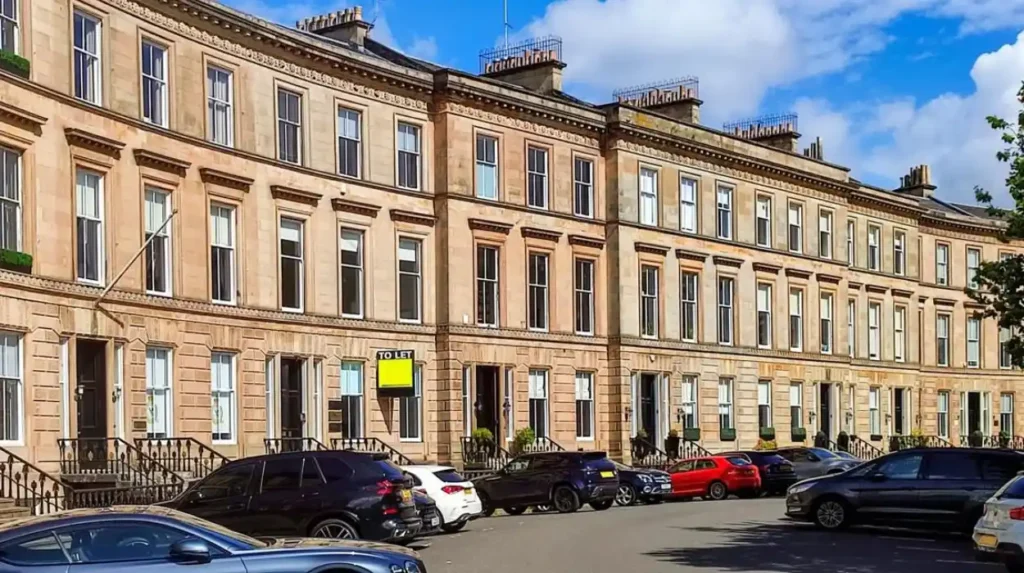
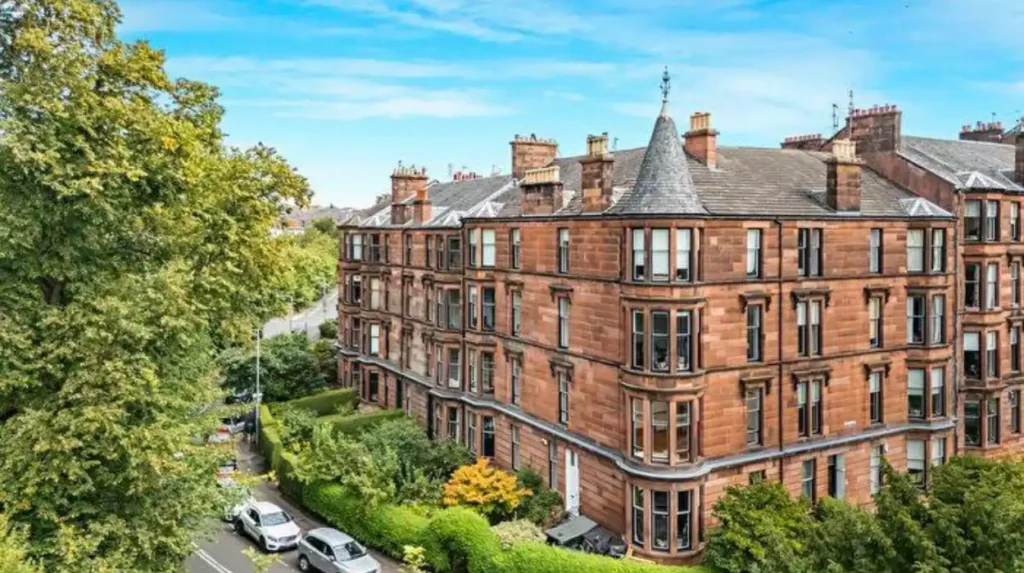
Glasgow contains extensive Victorian and Edwardian tenement housing. These buildings are concentrated in areas such as the West End, Southside and other established inner-city neighbourhoods.
The performance of an individual flat depends on factors including building condition, floor area, location, energy efficiency, communal repairs, factoring costs and local demand.
A city-wide property price therefore provides context rather than a valuation for an individual home.
New-build properties represent another important segment. Across Scotland, new-build median prices increased by 51% over ten years, compared with 41% for all residential sales. In 2025-26, new-build sales accounted for around 10% of Scottish residential transactions.
Is Glasgow more expensive than the Scottish average?
Glasgow’s price level depends on the statistical measure used. Its 2025-26 median residential price of £185,000 was below Scotland’s £198,000 median, while its June 2026 average price of £193,671 was close to Scotland’s £195,000 average.
The difference between Glasgow’s median and Scotland’s median is partly connected to the composition of each market.
Scotland includes expensive urban markets, accessible rural areas and high-value suburban authorities. In 2025-26, East Renfrewshire had the highest local-authority median at £305,200, while Inverclyde had the lowest at £123,000.
Scotland’s eight-city market also differs from the wider national market. In 2025-26, the combined median price for cities was £202,000, compared with £195,000 for the rest of Scotland.
Glasgow’s £185,000 city median therefore sat below both the Scotland-wide median and the combined city median.
The June 2026 UK HPI tells a slightly different story because it uses an average rather than the annual RoS median. Glasgow’s £193,671 average was close to Scotland’s £195,000 average.
This illustrates why property-market comparisons need consistent measures. Comparing a Glasgow average with a Scottish median produces an unreliable conclusion.
How many properties are being sold in Glasgow?
Glasgow City recorded 11,305 residential sales in 2025-26, the highest volume among Scotland’s local authority areas. Edinburgh recorded 11,169 sales, and the two areas together represented 22% of all Scottish residential transactions during the year.
Transaction volume provides important context for price movements.
Scotland recorded 104,408 residential sales in 2025-26, representing a 5% increase from the previous year. The total value of those transactions reached £24.3 billion, an increase of 7%.
Glasgow City accounted for 11,305 of those sales.
Edinburgh recorded 11,169 sales, placing the two largest urban markets close together in transaction volume. Together, Glasgow and Edinburgh accounted for approximately 22% of all residential sales across Scotland.
The size of Glasgow’s transaction market is relevant when considering its price statistics. A high volume of completed sales gives the market a substantial statistical base.
The wider Scottish market also became more active in 2025-26. Residential sales increased by 5%, while the national median price increased by 4%.
The combination of higher sales volume and higher median prices indicates increased transaction activity across the Scottish market rather than a Glasgow-only movement.
What does the latest Scottish housing data say about market momentum?
Scottish house-price growth slowed during early 2026, although prices remained above the previous year. The Scottish Government reported 3.3% annual growth across 2025-26, with quarterly growth slowing to 2.0% in Q1 2026, below the long-run 2.7% average.
The Scottish Housing Market Review provides additional context for interpreting the latest figures.
Using the UK House Price Index, the Scottish Government reported average Scottish house-price growth of 3.3% in 2025-26. The review also recorded a slowdown toward the end of that period.
Annual growth was 2.0% in Q1 2026, compared with 3.9% in Q4 2025. The Q1 figure was below the long-run Scottish annual average of 2.7% since 2010.
This indicates that the Scottish housing market entered 2026 with more moderate momentum than some earlier periods.
Glasgow’s June 2026 annual growth rate of 3.9% was above the Scottish rate of 2.3% for that month.
The figures therefore support two different conclusions depending on the timeframe.
Over ten years, Glasgow clearly outperformed Scotland. Over the latest year, the difference is smaller, with both markets showing 4% median-price growth in the 2025-26 RoS report. The June 2026 HPI showed Glasgow growing faster than Scotland in annual average-price terms.
Explore More Area Guide
How Much Deposit Do You Need to Buy a Glasgow Flat?
Glasgow Tenement Flat Value in the 2026 Property Market
What does this mean for people buying property in Glasgow?
Glasgow’s historical price growth provides important market context, but buyers need property-level evidence before making decisions. Current prices differ by neighbourhood, property type, condition, tenure, transport access, building quality and local supply.
The city-wide statistics provide a starting point rather than a valuation.
A buyer considering a tenement flat in the West End faces a different market from a buyer considering a detached property in the city’s suburban areas. Southside flats, city-centre apartments and family homes each have distinct transaction patterns.
The Scottish system also places importance on the Home Report, which contains information used by buyers and lenders when assessing residential properties. The report typically includes a single survey and valuation, a property questionnaire and an energy report.
Recent comparable sales provide additional evidence. Registers of Scotland records completed transactions and provides house price statistics by geography and property characteristics.
Buyers should therefore compare properties with similar characteristics rather than relying on a city-wide percentage.
A 4% annual Glasgow increase does not mean that every property increased by exactly 4%. Property-level changes vary according to location, type and individual characteristics.
What does Glasgow’s long-term growth mean for the Scottish property market?
Glasgow’s 57% ten-year growth establishes the city as one of Scotland’s strongest long-term urban housing markets, while the national 41% increase shows that property values also rose substantially across Scotland. The latest figures indicate continued growth rather than uniform acceleration.
The Scottish residential market reached a record £24.3 billion in total sales value in 2025-26, surpassing the previous £23.2 billion peak recorded in 2007-08.
The number of residential sales also increased to 104,408.
These figures show that Scotland’s property market remains substantially larger in nominal value than a decade earlier.
Glasgow has been a major contributor to this market. Its 11,305 residential transactions in 2025-26 made it the largest local-authority market by sales volume.
The long-term price difference is equally important. Scotland’s median price increased 41% over ten years, while Glasgow’s increased 57%. The rest of Scotland increased 44%.
The evidence therefore supports a precise answer to the central question.
Glasgow has risen faster than the rest of Scotland over the long term. Its 57% median-price increase exceeded the 44% increase recorded across the rest of Scotland between 2015-16 and 2025-26. However, the most recent annual RoS data shows Glasgow and Scotland both recording 4% median-price growth.
The June 2026 UK HPI adds a more current perspective, showing Glasgow average prices up 3.9% year on year compared with 2.3% across Scotland.
The overall picture is therefore one of stronger long-term Glasgow growth, moderate current annual growth and substantial variation between individual Scottish markets.
Future comparisons should use consistent measures, matching the same period, property type and statistical methodology. Registers of Scotland continues to publish monthly house price statistics and annual market reports, making it the primary source for monitoring completed Scottish property transactions.
Are Glasgow property prices rising faster than the rest of Scotland?
Over the ten years to 2025-26, Glasgow property prices rose faster than the Scottish average. Glasgow’s median residential property price increased by 57%, compared with 41% across Scotland and 44% across the rest of Scotland.