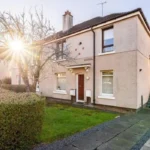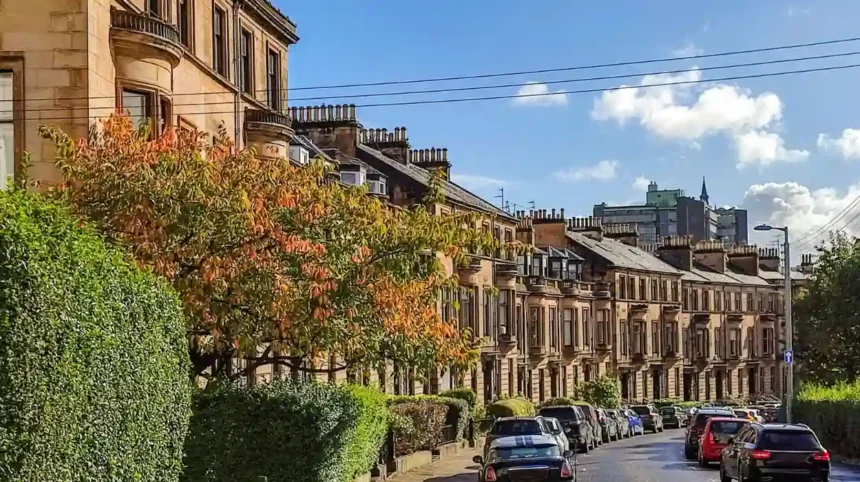
A Glasgow tenement flat is worth a highly location-dependent price in 2026. Glasgow’s average flat or maisonette price was £163,000 in June 2026, while traditional tenements in areas such as the West End, Southside and Dennistoun often achieve substantially different values.
- What is a Glasgow tenement flat?
- How much is a Glasgow tenement flat worth in 2026?
- Why do Glasgow tenement flat prices vary so much?
- Which Glasgow areas have the most expensive tenement flats?
- How much is a tenement flat worth in Dennistoun?
- How much is a Glasgow West End tenement flat worth?
- Does the floor of a Glasgow tenement flat affect its value?
- How much do size and bedrooms affect a tenement flat’s value?
- Does the condition of a tenement building affect its value?
- How do common repairs affect a Glasgow tenement flat’s value?
- How does Glasgow’s 2026 property market affect tenement values?
- How does the Scottish tenement housing stock influence Glasgow property values?
- How can a homeowner find the exact value of a Glasgow tenement flat?
- Is a Glasgow tenement flat still a valuable property in 2026?
A Glasgow tenement flat is a self-contained dwelling within a building containing multiple horizontally separated flats. Traditional Glasgow tenements are commonly sandstone buildings dating from the Victorian, Edwardian and early twentieth-century periods. Their value depends on location, floor, size, condition, period features, communal maintenance and buyer demand.
The 2026 market provides a useful benchmark. The Office for National Statistics recorded an average Glasgow property price of £194,000 in June 2026, up 3.9% from £186,000 a year earlier. Flats and maisonettes averaged £163,000, while terraced properties averaged £248,000.
The figure for all Glasgow flats does not represent the value of every traditional tenement. A large two-bedroom sandstone flat in Hyndland has a different market position from a smaller one-bedroom tenement in the East End. Recent sold-price evidence demonstrates this variation across the city.
What is a Glasgow tenement flat?
A Glasgow tenement flat is an individual residential property within a building containing two or more related flats divided horizontally. Traditional Glasgow tenements are typically sandstone buildings with shared entrances, stairs, roofs and other common structural elements.
The legal definition comes from the Tenement (Scotland) Act 2004. A tenement is a building comprising two or more related flats separated horizontally. The definition extends beyond traditional sandstone buildings and includes several other forms of multi-flat housing.
In everyday Glasgow property language, however, “tenement” usually refers to the traditional stone-built flats that form a distinctive part of the city’s architectural identity.
Many traditional buildings contain ground-floor, first-floor, second-floor and top-floor properties. Some have shops or commercial premises at street level. Others contain only residential accommodation.
The Scottish Government identifies traditional tenements as a particularly important category of Scottish housing. The 2024 Scottish House Condition Survey recorded approximately 177,000 occupied pre-1919 tenement dwellings, representing 7% of Scotland’s occupied housing stock.
Tenement flats therefore represent a significant part of Scotland’s housing market rather than a niche property category.
How much is a Glasgow tenement flat worth in 2026?
A typical Glasgow tenement flat sits within a broad 2026 market rather than one fixed value, with the city-wide flat average at £163,000. Individual traditional tenements range from lower-priced smaller flats to substantially higher values in premium neighbourhoods.
The most useful official benchmark is the Glasgow-wide average for flats and maisonettes. In June 2026, this stood at £163,000. The overall Glasgow average for all property types was £194,000.
This distinction is important because traditional tenements are concentrated in neighbourhoods with very different property markets.
For example, Rightmove’s latest sold-price data records an average flat price of £173,331 in Dennistoun over the preceding year. The overall Dennistoun property average was £177,616.
In Glasgow’s West End, the average price for flats sold over the preceding year was substantially higher at £275,338. The overall West End average was £306,674.
These figures demonstrate why a city-wide average cannot provide an exact valuation for an individual tenement.
A two-bedroom flat with original features, generous room sizes and a strong location can command a much higher price than a smaller flat requiring substantial repairs.
Why do Glasgow tenement flat prices vary so much?
Glasgow tenement values vary because buyers price location, floor position, internal size, condition, architectural features, energy performance, common repairs, transport access and local demand differently across individual properties and neighbourhoods.
Location is one of the strongest valuation factors. Tenements in established West End neighbourhoods such as Hyndland, Dowanhill and Partick occupy a different price segment from properties farther east or south.
The West End provides a clear example. Recent sold-price data shows an average flat price of £275,338, although individual transactions range much higher and lower.
Property size also affects value. A large three-bedroom traditional tenement can command considerably more than a compact one-bedroom flat within the same neighbourhood.
Condition creates another major difference. A fully refurbished property with a modern kitchen, upgraded bathroom, functioning heating system and well-maintained common areas generally occupies a different market segment from a flat requiring extensive work.
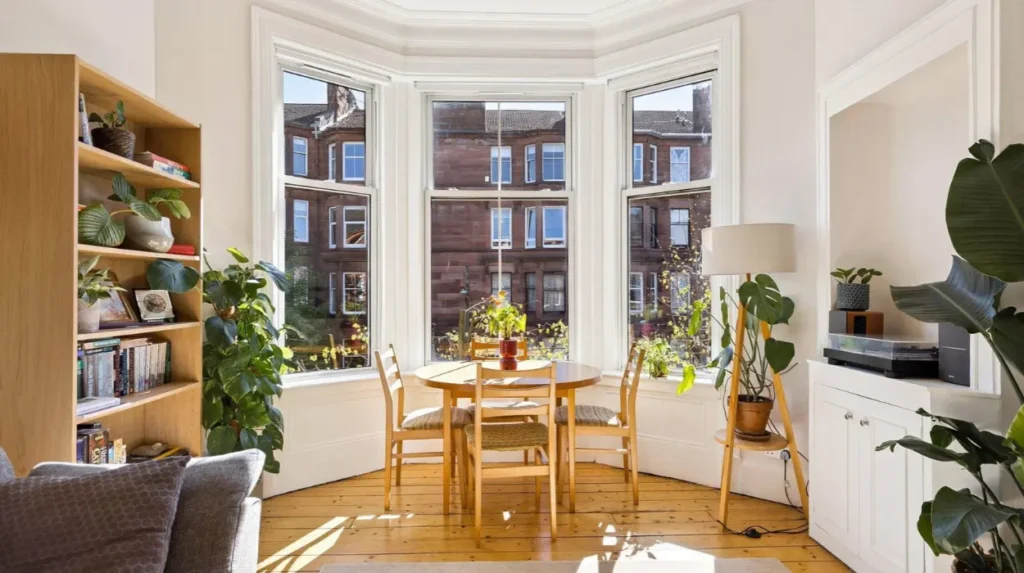
Original features can also influence buyer demand. High ceilings, cornicing, ceiling roses, fireplaces, bay windows, traditional doors and large communal staircases are characteristic features of many traditional Glasgow properties.
The condition of the wider building also matters. Owners share responsibility for certain common parts, meaning roof, stonework, gutters, stairs and other communal elements can influence a property’s financial position.
Which Glasgow areas have the most expensive tenement flats?
Glasgow’s West End contains some of the city’s highest-value traditional tenement flats, particularly around Hyndland, Dowanhill and neighbouring areas, while premium Southside streets also achieve strong prices because of architecture, location and established residential demand.
The West End is one of Glasgow’s strongest traditional tenement markets.
Recent sold-price data for West End Glasgow shows flats averaging £275,338 over the latest year. Individual transactions demonstrate the considerable range within the area.
For example, a flat on Great Western Road recorded a 2026 transaction at more than £575,000, while other flats in the wider West End sold for substantially less.
This variation reflects differences in size, street, specification and property quality.
Hyndland is particularly associated with large traditional sandstone tenements. Properties in this market frequently feature substantial floor areas, bay windows, period detailing and established communal arrangements.
Dowanhill and neighbouring areas also contain high-value traditional flats.
The Southside provides another major tenement market. Shawlands, Pollokshields, Langside, Battlefield and surrounding districts contain extensive sandstone housing stock.
Prices within the Southside vary considerably. A smaller tenement flat in one neighbourhood can be substantially cheaper than a larger property on a premium street.
The important point for valuation is therefore the exact address rather than simply the broad Glasgow district.
How much is a tenement flat worth in Dennistoun?
Dennistoun’s average flat sold price was £173,331 over the latest year of available sold-price data, making it a useful 2026 benchmark for East End tenement values, although individual properties vary substantially according to size, condition and exact location.
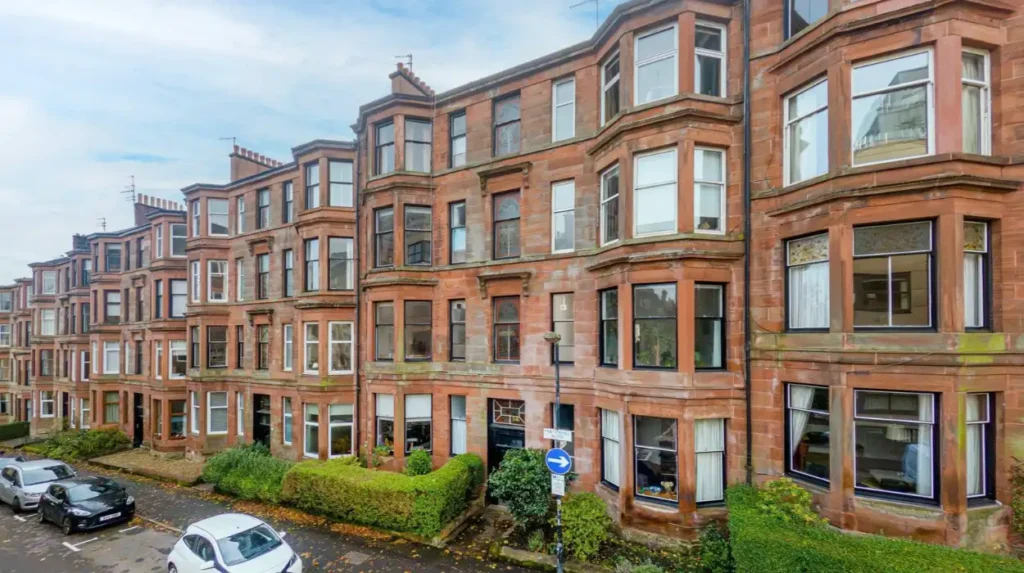
Dennistoun contains a large concentration of traditional sandstone tenements.
Rightmove’s latest sold-price information places the overall Dennistoun property average at £177,616, with flats averaging £173,331. Terraced properties averaged £342,562.
Individual 2026 transactions demonstrate the spread.
A two-bedroom flat on Reidvale Street sold for £165,000 in May 2026. A two-bedroom flat on Ingleby Drive sold for approximately £165,180 during the same period.
Current 2026 market listings also show substantial differences between individual tenement properties. A two-bedroom traditional second-floor sandstone tenement on Garthland Drive was marketed at £200,000, while another two-bedroom Dennistoun tenement on Roslea Drive was marketed at £170,000.
These examples show why asking prices should not be treated as confirmed market values. Completed sales provide stronger evidence for determining what buyers actually paid.
How much is a Glasgow West End tenement flat worth?
A Glasgow West End tenement flat is typically worth considerably more than the city’s overall flat average, with West End flats averaging £275,338 over the latest year of sold-price data and individual premium properties achieving substantially higher prices.
The West End represents one of Glasgow’s strongest property markets.
The latest available sold-price data records an overall West End average of £306,674 and a flat average of £275,338. Overall prices were 2% higher than the previous year and 7% above the 2023 peak recorded in the same dataset.
Individual transactions reveal the premium associated with exceptional properties.
A flat on Hughenden Road recorded a 2026 transaction at £505,000. A property on Athole Gardens recorded £472,000, while a flat on Hyndland Road recorded £460,000.
These transactions are not representative of every West End tenement. They demonstrate the upper end of the market.
More ordinary properties occupy lower price points. A two-bedroom flat on Kent Road was marketed at £240,000 in September 2026, showing that the West End market includes properties below its overall average.
The exact location, floor, size and presentation remain central to valuation.
Does the floor of a Glasgow tenement flat affect its value?
The floor affects a Glasgow tenement flat’s value because buyers consider natural light, views, accessibility, roof exposure, noise, heating requirements and stair access. Ground, middle and top-floor flats therefore attract different buyer preferences and valuation outcomes.
Traditional Glasgow tenements often contain several vertically arranged flats.
First-floor and second-floor properties frequently benefit from a balance between accessibility, privacy and natural light.
Top-floor flats can provide better views and increased privacy. They can also have direct exposure to the roof structure, which creates additional considerations for insulation, maintenance and energy performance.
The Scottish Government specifically identifies top-floor exposure as a factor affecting energy efficiency and living conditions in pre-1919 tenements.
Ground-floor properties offer easier access and can appeal to buyers who do not want communal stair climbing.
However, ground-floor homes have different considerations, including privacy, security, street-level noise and natural light.
There is no universal premium or discount for one floor. Valuation depends on the specific building, street and buyer market.
How much do size and bedrooms affect a tenement flat’s value?
Size and bedroom count strongly influence Glasgow tenement values because larger flats provide more accommodation and often contain larger traditional rooms, while one-bedroom properties occupy a lower overall price segment than two-bedroom and three-bedroom homes.
Traditional Glasgow tenements frequently contain generous room proportions.
A one-bedroom tenement can attract first-time buyers, investors and buyers seeking a lower entry price.
Two-bedroom flats represent an important part of the market because they provide additional accommodation while remaining accessible to a broad group of buyers.
Three-bedroom flats appeal to families and buyers requiring additional space. Large three-bedroom and four-bedroom properties in premium areas can reach substantially higher values.
Floor area also matters independently of bedroom count.
Two flats with two bedrooms can have very different values if one has a substantially larger living room, kitchen, hallway and bedrooms.
The layout also influences buyer perception. Traditional tenements often have long hallways, high ceilings and large front-facing rooms. These features contribute to the property’s overall accommodation and character.
A professional valuation therefore considers both the number of bedrooms and the total accommodation.
Does the condition of a tenement building affect its value?
The condition of the entire tenement block can materially affect a flat’s value because owners share responsibility for common elements, including roofs, external walls, stairs and other communal parts, creating potential repair liabilities alongside the flat’s internal condition.
Tenement ownership differs from owning an isolated house because multiple owners share parts of the building.
Common elements can include the roof, gutters, external walls, foundations, communal stairs and other structural or shared components.
The Scottish Government identifies common repair responsibility as a major issue in tenement management. Owners have responsibilities for maintaining common property, and unresolved building condition can create significant costs.
A buyer therefore needs to consider more than the appearance of the individual flat.
A recently refurbished kitchen does not eliminate the financial importance of a deteriorating roof or external stonework.
Factors such as previous common repairs, outstanding work, factoring arrangements and planned maintenance can affect buyer confidence.
The building’s repair position therefore forms an important part of a 2026 Glasgow tenement valuation.
How do common repairs affect a Glasgow tenement flat’s value?
Common repairs affect value because substantial roof, stonework, guttering, stair, masonry or structural works can create shared financial obligations for owners, while a well-maintained block provides stronger reassurance to buyers and mortgage lenders.
Common repairs are a distinctive feature of tenement ownership.
The Scottish Government’s tenement research identifies different arrangements for factoring, owner associations and building management. Some tenements have professional factors, while others operate through different owner-management arrangements.
A factor is an organisation or individual appointed to manage common property and related maintenance responsibilities.
The existence of a factor does not guarantee that a building is in perfect condition. Buyers still need to examine available documentation and repair history.
Major works can influence the effective cost of ownership.
A buyer considering a £180,000 flat must therefore examine whether the building has planned repairs that generate additional owner contributions.
The Home Report, title information, factoring documentation and solicitor’s enquiries provide important evidence during the purchase process.
How does Glasgow’s 2026 property market affect tenement values?
Glasgow’s 2026 property market shows continued annual price growth, with the average city property price reaching £194,000 in June and the average flat price reaching £163,000, providing a positive but moderate market context for tenement valuations.
The latest official data provides a clear picture of the wider market.
The average Glasgow property price reached £194,000 in June 2026, compared with £186,000 in June 2025. This represents annual growth of 3.9%.
Flat prices increased by 2.9% over the same annual period.
The wider Scottish market recorded an average property price of £195,000 in June 2026, with annual growth of 2.3%. Scottish flats and maisonettes averaged £137,000.
Glasgow therefore remains close to the Scottish average for all property types while maintaining a stronger price position for many urban flats.
Long-term data provides additional context. Registers of Scotland reported that Glasgow had the largest median residential property price increase among Scotland’s eight cities over the ten years to 2025-26, with median prices increasing by 57%.
This long-term increase provides important context for today’s tenement market.
How does the Scottish tenement housing stock influence Glasgow property values?
Scotland’s large tenement housing stock makes traditional flats an established part of the residential market, while differences in building age, repair condition, energy performance, size and location create substantial differences between individual Glasgow tenement properties.
Tenements form a significant component of Scotland’s housing stock.
The Scottish Government’s 2024 House Condition Survey records approximately 2.55 million occupied dwellings across Scotland. Around 177,000 were classified as old pre-1919 tenement flats, while another 185,000 were modern post-1982 tenements.
Earlier Scottish Government research estimated that approximately 40% of Scotland’s housing stock falls within the legal definition of a tenement.
This broad definition includes traditional buildings as well as other forms of multi-flat housing.
Glasgow’s historic development created a particularly strong concentration of traditional tenement housing.
The buildings remain important because they provide large numbers of centrally located homes close to employment, universities, transport infrastructure, shops and cultural facilities.
Their age also creates specific maintenance and energy-efficiency considerations.
Explore More Area Guide
Scottish Home Buying Process: Scotland vs England Explained
Best Glasgow Postcodes to Buy Property in 2026
How can a homeowner find the exact value of a Glasgow tenement flat?
The most reliable valuation combines recent completed sales of comparable flats, the property’s Home Report, condition, size, exact location, building maintenance position and current buyer demand rather than relying on a single Glasgow-wide average or online estimate.
The first reference point is the Home Report.
In Scotland, sellers generally provide a Home Report containing information about the property, including a valuation prepared by a qualified surveyor.
Recent completed transactions provide another important benchmark.
A comparable property should ideally match the subject flat in location, property type, size, bedroom count, floor, condition and building quality.
For example, comparing a small one-bedroom Dennistoun flat with a large three-bedroom Hyndland tenement produces a misleading valuation.
The valuation process should also consider common repair liabilities.
A property in a well-maintained block with recent roof and stonework repairs has a different risk profile from a similar-looking property within a building facing major common works.
Current asking prices provide useful market context but are not equivalent to completed sale prices.
Registers of Scotland publishes official Scottish house-price statistics covering median and mean prices, sales volumes and market values. The data is updated regularly and provides the strongest official foundation for wider market analysis.
Is a Glasgow tenement flat still a valuable property in 2026?
A Glasgow tenement flat remains an important residential asset in 2026, with values supported by established urban locations, strong demand for flats and Glasgow’s long-term price growth, although individual values depend heavily on property quality, neighbourhood and building condition.
The 2026 market demonstrates continued demand for Glasgow flats.
The city-wide average flat price of £163,000 provides a broad benchmark, while premium neighbourhoods such as the West End operate at substantially higher levels.
Dennistoun provides a mid-market example, with flats averaging £173,331 in the latest annual sold-price data.
The West End demonstrates the upper end of the traditional flat market, with flats averaging £275,338 and individual properties exceeding £400,000.
The market therefore cannot be reduced to one Glasgow tenement price.
The most accurate valuation comes from combining official city data with property-specific evidence.
For homeowners, the important factors are the exact postcode, floor, size, bedroom count, internal specification, original features, common repairs, factoring arrangements and recent comparable sales.
For buyers, the building’s condition is as important as the interior.
For sellers, realistic pricing should reflect completed transactions rather than relying solely on asking prices.
Glasgow’s 2026 property market provides a clear foundation for continued valuation analysis because official data is updated monthly and detailed sold-price information allows individual neighbourhoods to be compared.
A Glasgow tenement flat is therefore best understood as part of a localised property market. The city-wide £163,000 flat average establishes the broad benchmark, while the actual value of a traditional tenement depends on the specific building and location.
How much is an average Glasgow tenement flat worth in 2026?
A Glasgow tenement flat does not have one fixed value. The average Glasgow flat and maisonette price was £163,000 in June 2026, according to the Office for National Statistics. Traditional tenements in premium areas often sell for significantly more.