
Glasgow remains one of Scotland’s largest and most active residential property markets. In 2025–26, Glasgow City recorded 11,305 residential sales, the highest volume of any Scottish local authority. The latest Scottish Government data puts Glasgow’s average property price at £185,801 in Q1 2026, with prices 5.1% higher across the four quarters to Q1 2026.
- Why is Glasgow still attracting property buyers in 2026?
- Which Glasgow postcode is best for premium property?
- Is G11 a good postcode for buying property in Glasgow?
- Is G41 one of the best Southside postcodes to buy property?
- Why is G31 attractive for buyers seeking lower-priced Glasgow property?
- Is G20 a good postcode for property investment?
- Is G43 a good postcode for buying a family home?
- What makes G44 attractive for Glasgow property buyers?
- Should buyers consider G3 for city-centre property?
- How should buyers compare Glasgow postcodes before purchasing?
- What property types offer the strongest buying opportunities in Glasgow?
- What taxes and buying costs should Glasgow property buyers consider?
- Which Glasgow postcode offers the best balance between price and location?
- What is the outlook for Glasgow property prices?
- Which Glasgow postcodes are strongest for different types of buyers?
- What should buyers check before making an offer on Glasgow property?
The best Glasgow postcodes for property buyers depend on the purpose of the purchase. G12 and G11 provide established West End locations. G41 provides a strong Southside market around Shawlands and Strathbungo. G31 offers a lower entry price close to the city centre. G20 combines West End access with comparatively moderate prices. G43 and G44 provide larger housing choices across the Southside.
Postcode districts are useful for comparing Glasgow property markets, but they are not precise investment boundaries. A single postcode district contains streets with different property types, tenure patterns, transport access, conservation constraints and sale prices. Buyers therefore need to assess the individual street and property as well as the postcode.
Why is Glasgow still attracting property buyers in 2026?
Glasgow combines a large transaction market, rising long-term property values and a broad range of housing, from traditional tenement flats to detached homes. Its 2025–26 median Scottish market context supports continued demand across established neighbourhoods.
Glasgow is Scotland’s largest city by population and one of its principal economic, educational and cultural centres. The city contains the University of Glasgow, University of Strathclyde, Glasgow Caledonian University and Glasgow School of Art. These institutions support substantial housing demand in surrounding neighbourhoods.
The city also has a diversified employment base. Financial services, professional services, healthcare, education, tourism, retail, technology and creative industries contribute to the local economy.
Property transaction data provides a strong indicator of market depth. Registers of Scotland recorded 11,305 residential sales in Glasgow City during 2025–26. Glasgow and Edinburgh together represented 22% of all Scottish residential sales during the year.
Long-term price performance also supports Glasgow’s importance. Registers of Scotland reported that Glasgow had the largest increase in median residential property price among Scotland’s eight cities over the ten years to 2025–26, with a 57% increase.
The wider Scottish market remained active in 2025–26. Scotland recorded 104,408 residential sales, up 5% year on year. The national median residential sale price reached £198,000, up 4% from £190,000.
Glasgow therefore offers something important to buyers: market scale. A large number of transactions creates more comparable evidence when assessing a property, although individual postcode performance still varies considerably.
Which Glasgow postcode is best for premium property?
G12 is the strongest premium Glasgow postcode for buyers seeking established West End property, university proximity, historic architecture and high-value flats and houses. Its average sold price was £374,267 over the latest year recorded by Rightmove.
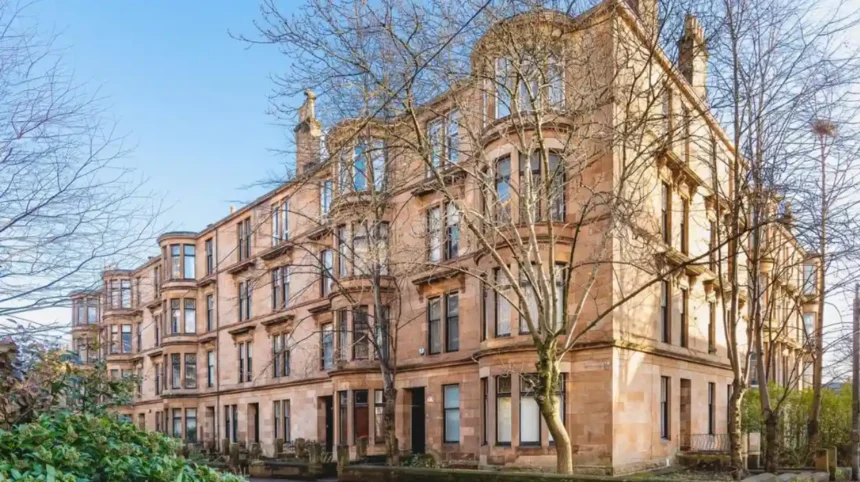
G12 covers important parts of Glasgow’s West End, including Hillhead, Dowanhill, Hyndland and surrounding areas. The district contains some of Glasgow’s most established residential streets.
Traditional sandstone tenements are a defining feature. These properties include large period flats with substantial room sizes, high ceilings and original architectural features. G12 also contains modern apartments and larger family properties.
The latest sold-price data shows the premium nature of the district. Rightmove reports an overall G12 average of £374,267 for the latest year. Flats averaged £352,613, while terraced properties averaged £665,939.
Individual streets can sit far above the district average. For example, recent recorded sales include properties on Great Western Road and Hughenden Road above £500,000.
G12 is particularly relevant for buyers prioritising location quality rather than low entry cost. The University of Glasgow, Kelvingrove Park, Byres Road and extensive public transport links are major location characteristics.
The district also contains premium micro-markets. Some individual G12 postcodes show substantially higher transaction values than the overall district average. This demonstrates why buyers should compare completed sales at street and property level rather than relying only on the postcode average.
Is G11 a good postcode for buying property in Glasgow?
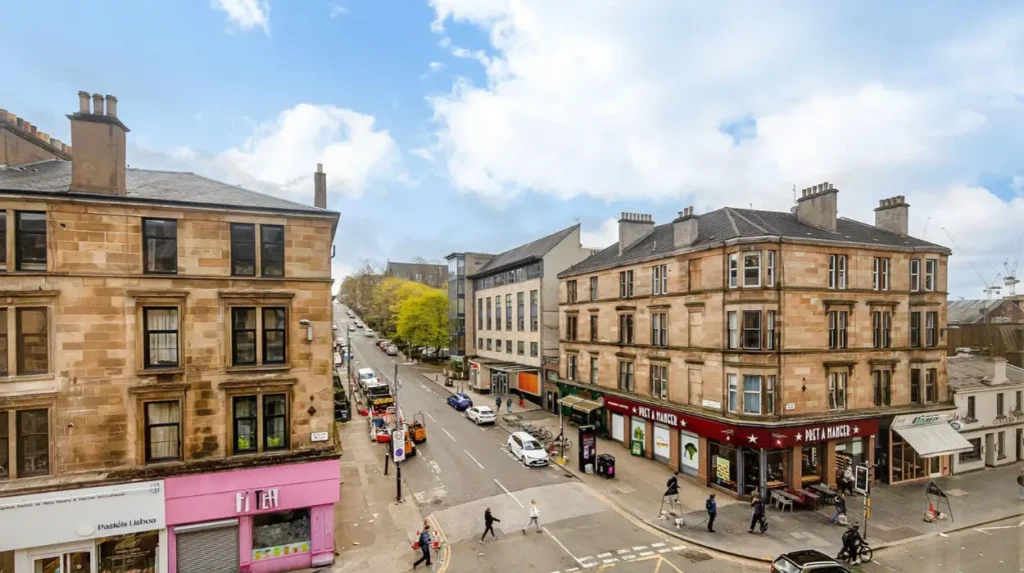
G11 is a strong West End buying area because it combines Partick, Kelvinhall, Yorkhill and Glasgow Harbour locations with comparatively lower prices than G12. Its latest overall average sold price was £251,319, with flats averaging £233,425.
G11 provides a useful alternative to the more expensive parts of G12. The district includes established residential streets around Partick and Hillhead, as well as newer waterfront development around Glasgow Harbour.
The latest Rightmove data records an overall G11 average of £251,319. Flats averaged £233,425, while terraced properties averaged £406,150 and detached properties £429,625.
Partick is particularly important because it provides strong public transport connectivity. The area has rail, Subway and bus services, making it practical for commuters travelling across Glasgow.
G11 also benefits from proximity to the West End. Buyers can access Byres Road, the University of Glasgow and West End amenities without paying the highest prices associated with some G12 streets.
Glasgow Harbour provides a different housing model. Modern apartment buildings create a substantial supply of contemporary flats, while older streets provide traditional tenement stock.
For buyers seeking a balance between West End location and purchase price, G11 offers a broader choice than the premium G12 market.
Is G41 one of the best Southside postcodes to buy property?
G41 is one of Glasgow’s strongest Southside property districts, covering Shawlands and nearby neighbourhoods with substantial traditional housing, independent businesses and transport connections. Its latest overall average was £273,739, with flats averaging £242,159.
G41 is closely associated with Shawlands, one of Glasgow’s best-known Southside neighbourhoods. The area contains traditional tenements, terraces, larger villas and modern apartments.
Shawlands has developed into a major residential and commercial centre. Its local shops, cafés, restaurants and services create a dense neighbourhood environment.
Rightmove records an overall G41 average sold price of £273,739 during the latest year. Flats averaged £242,159, while terraced properties averaged £350,861 and detached properties averaged £464,764.
The wider Shawlands market recorded an overall average of £254,053 over the same period. Flats averaged £223,839 and terraced properties £378,511. Shawlands prices were 5% higher than the previous year and 14% above the 2023 peak reported on that page.
G41 is also relevant to buyers seeking a property with multiple future-use options. A two-bedroom tenement can serve as a home, while larger properties provide family accommodation.
The area has established rail connections through Shawlands and nearby stations, while bus services connect the Southside with central Glasgow.
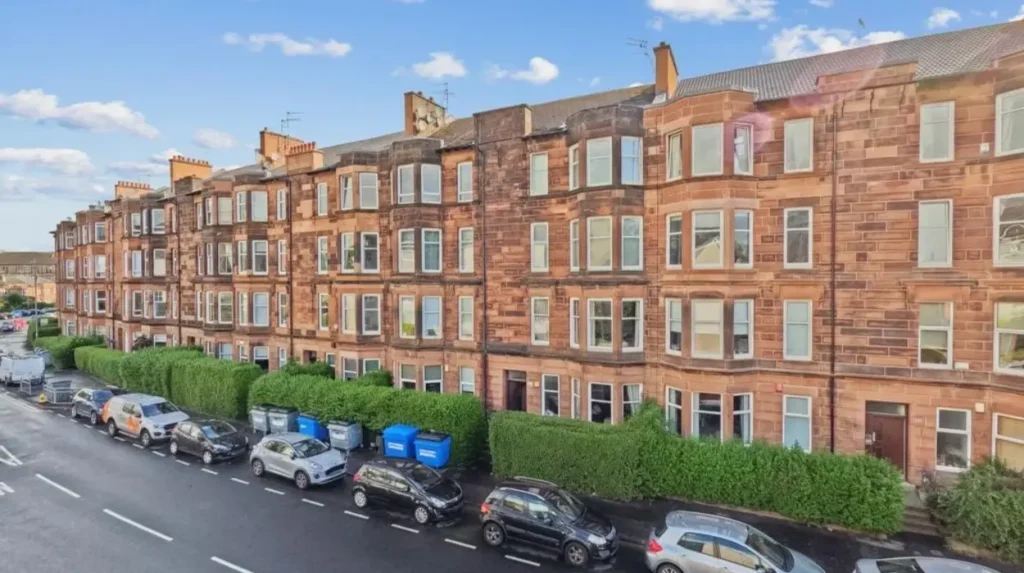
Why is G31 attractive for buyers seeking lower-priced Glasgow property?
G31 offers one of the more accessible entry points among established Glasgow postcode districts close to the city centre. Its latest overall average was £169,809, while flats averaged £162,175, supporting demand from budget-conscious buyers.
G31 covers areas including Dennistoun and parts of the city’s east side. Dennistoun has experienced significant residential attention because of its proximity to Glasgow city centre.
The latest G31 sold-price data records an overall average of £169,809. Flats averaged £162,175, while terraced properties averaged £265,347.
Dennistoun itself recorded an overall average of £177,616 during the latest year. Flats averaged £173,331 and terraced properties £342,562. Prices were 3% higher than the previous year.
This pricing structure makes G31 particularly relevant to buyers entering the Glasgow market with a smaller budget.
The district also has strong city-centre accessibility. Dennistoun sits close to Glasgow Queen Street, Glasgow city centre and major employment locations.
Property stock is dominated by flats, particularly traditional tenement properties. This makes condition assessment especially important. Buyers should inspect communal stairwells, roofs, stonework, windows, damp, factoring arrangements and planned maintenance.
G31 therefore provides affordability, but the individual building is central to the investment decision.
Is G20 a good postcode for property investment?
G20 provides a balance between West End access and comparatively moderate purchase prices. Its latest overall average was £233,279, with flats averaging £223,133 and terraced properties averaging £262,427.
G20 includes Maryhill, North Kelvinside and parts of the western inner city. The district sits close to the University of Glasgow and established West End neighbourhoods.
The latest data records an overall G20 average of £233,279. Flats averaged £223,133, terraced properties £262,427 and detached properties £275,012. Prices were 3% higher than the previous year.
G20 has a mixed property profile. Traditional flats sit alongside terraced houses and newer residential developments.
The district benefits from proximity to the West End while remaining below the overall G12 price level. This creates a different affordability profile for buyers who want access to West End employment, education and amenities.
Maryhill also has regeneration and transport considerations. Buyers should distinguish between individual streets because housing conditions and development activity differ across the postcode.
G20 is particularly relevant to buyers who want a central location without paying the premium associated with the most expensive West End streets.
Is G43 a good postcode for buying a family home?
G43 is a strong Southside option for buyers seeking a mixture of flats, terraces and larger houses. Its latest overall average was £274,429, while semi-detached properties averaged £478,569 and terraced properties £316,742.
G43 covers parts of the Southside including Pollokshields, Mansewood and surrounding residential areas. The postcode provides a broader property mix than many inner-city districts.
The latest sold-price data shows an overall G43 average of £274,429. Flats averaged £176,292, terraced properties £316,742 and semi-detached properties £478,569. Prices were 2% higher than the previous year.
The wide price gap between flats and houses demonstrates the importance of property type. A postcode-level average does not represent the price of every home.
G43 is useful for buyers moving from a flat into a larger property. It includes streets with family houses and properties with gardens.
Transport is another consideration. Buyers should compare walking distance to rail stations and bus routes because accessibility differs significantly between individual parts of the district.
G43 also connects buyers to established Southside amenities while providing access to larger green spaces.
What makes G44 attractive for Glasgow property buyers?
G44 offers a lower-cost Southside alternative with flats, terraces and semi-detached housing. Its latest overall average was £217,194, while flats averaged £155,069 and semi-detached homes averaged £377,234.
G44 covers areas around Mount Florida, Cathcart and Carmunnock Road. The district contains traditional tenements, flats, terraces and suburban housing.
The latest recorded overall average was £217,194. Flats averaged £155,069, terraced properties £400,384 and semi-detached properties £377,234.
The large difference between flat and house prices creates opportunities for different buyer budgets.
G44 also benefits from proximity to Hampden Park. Hampden Park is Scotland’s national football stadium and hosts major football fixtures and events.
Mount Florida provides rail connectivity to Glasgow city centre. This is important for commuters and buyers who prioritise public transport.
Cathcart offers a more suburban housing environment. The district therefore provides several property formats within one postcode.
Buyers should assess traffic, parking, garden maintenance and building condition alongside purchase price when comparing properties in G44.
Should buyers consider G3 for city-centre property?
G3 is relevant for buyers seeking central Glasgow apartments close to the city centre, Finnieston, the SEC and the River Clyde. It provides substantial modern apartment stock and strong access to employment, entertainment and transport.
G3 covers areas including Finnieston, Anderston and parts of the central-western city.
Its location places residents close to Glasgow city centre and the River Clyde. The district also contains the Scottish Event Campus, which includes the OVO Hydro and SEC venues.
Modern apartment development is a major characteristic of G3. The area therefore differs from G12, G41 and G44, where traditional tenements and houses form a larger share of the market.
G3 is particularly relevant for buyers prioritising central living. It is also important to assess communal management arrangements in apartment developments.
Factors include factoring fees, sinking funds, building insurance, maintenance programmes and planned major works. These costs affect the total cost of ownership.
The postcode also contains areas affected by ongoing urban development. Glasgow City Council continues to work on development planning, housing, transport and regeneration policies across the city.
How should buyers compare Glasgow postcodes before purchasing?
Buyers should compare completed sale prices, property condition, transport, local amenities, housing supply, planning activity and ownership costs. Postcode averages provide market context, but individual streets and buildings determine the practical value of a property.
The first measure is comparable sales. Registers of Scotland provides official property transaction statistics, including median and mean prices, sales volumes and total sales values. Its latest monthly house-price statistics were updated in 2026.
The second measure is property type. A postcode dominated by flats should not be compared directly with a postcode containing detached houses.
The third measure is location within the postcode. A property five minutes from a railway station has a different accessibility profile from a property at the edge of the same district.
The fourth measure is building condition. This is particularly important for Glasgow’s traditional tenement stock.
Buyers should examine roof condition, communal repairs, stonework, windows, damp, electrical systems, plumbing and factoring arrangements.
The fifth measure is planning. Glasgow is progressing City Development Plan 2, which forms part of the city’s wider development framework.
Planning information is important because regeneration, new housing, transport schemes and changes to surrounding land use can affect a property’s long-term environment.
What property types offer the strongest buying opportunities in Glasgow?
Flats provide the lowest entry prices in many Glasgow postcodes, while terraced, semi-detached and detached homes provide larger accommodation and different long-term ownership characteristics. Property type should therefore match the buyer’s budget and intended use.
Flats dominate several popular Glasgow districts. G12, G11, G20, G31, G41, G43 and G44 all contain substantial flat markets.
The latest Scottish data shows the wider national difference between property types. In 2025–26, detached homes had a median price of £324,995, while flats had a median price of £138,017.
Flats also recorded slower national price growth over the preceding decade. Registers of Scotland reported 25% growth for flats compared with roughly 44% to 50% for other major house types.
This does not mean flats are unsuitable purchases. It demonstrates that buyers should assess the specific property type when comparing long-term performance.
Traditional Glasgow tenements have particular maintenance considerations. A low purchase price can become less attractive if the building requires substantial communal repairs.
Modern flats introduce different costs. Factoring charges, communal heating, lift maintenance and major building works require detailed examination.
Houses generally provide greater private space and gardens, but they require larger budgets and higher maintenance responsibility.
What taxes and buying costs should Glasgow property buyers consider?
Property buyers in Glasgow pay Scottish Land and Buildings Transaction Tax rather than Stamp Duty Land Tax. Additional Dwelling Supplement applies to qualifying additional residential purchases, making tax planning essential for landlords and second-home buyers.
Land and Buildings Transaction Tax, known as LBTT, is Scotland’s property transaction tax. Revenue Scotland administers the tax and provides an official calculator based on the transaction’s effective date and purchase price.
Additional Dwelling Supplement, known as ADS, applies to qualifying purchases of additional residential properties. Examples include a second home and an additional property bought to rent.
The ADS rate changed from 6% to 8% for relevant contracts entered into after 4 December 2024.
This has direct implications for investment purchases. A buyer assessing a £200,000 investment property must calculate the full acquisition cost rather than considering only the advertised price.
Other costs include solicitor fees, mortgage arrangement costs, valuation fees, survey costs, insurance, factoring charges and immediate repairs.
The Scottish property system also uses the Home Report process. Buyers should review the valuation, survey information and property questionnaire before making a decision.
Tax and transaction costs therefore need to be included in the purchase budget from the beginning.
Which Glasgow postcode offers the best balance between price and location?
G41, G11 and G20 provide some of the strongest balances between location and purchase price. G31 offers a lower entry point, while G12 provides premium West End positioning at substantially higher prices.
G41 stands out for buyers seeking an established Southside environment. Its latest overall average of £273,739 reflects a substantial but varied market.
G11 provides West End access at an overall average of £251,319, below G12’s £374,267 average.
G20 sits between several market segments. Its £233,279 average provides access to the West End and inner Glasgow without the premium price level recorded in G12.
G31 provides the lowest overall average among these key districts at £169,809. Its proximity to the city centre strengthens its relevance for buyers with lower budgets.
G43 provides a broader family housing market, while G44 provides another relatively accessible Southside option.
There is no single best postcode for every buyer. The appropriate district depends on budget, property type, commuting needs, ownership horizon and intended use.
What is the outlook for Glasgow property prices?
Glasgow entered 2026 with positive annual house-price movement and high transaction activity. Official data shows 5.1% four-quarter price growth to Q1 2026 and 11,305 annual residential sales in Glasgow City during 2025–26.
The latest Scottish Housing Market Review recorded a Glasgow City average price of £185,801 in Q1 2026. The four-quarter change was 5.1%, compared with 3.3% for Scotland overall.
The wider Scottish market showed slower short-term growth in early 2026. Annual price growth slowed to 2.0% in Q1 2026, below the long-run Scottish average of 2.7% since 2010.
The latest UK House Price Index data for June 2026 recorded a Scottish average property price of £195,000, up 2.3% year on year.
Glasgow’s long-term performance remains significant. Registers of Scotland recorded a 57% increase in the city’s median residential property price over the ten years to 2025–26, the largest increase among Scotland’s eight cities.
Future performance remains dependent on mortgage costs, household incomes, housing supply, employment, planning policy and transaction volumes.
Glasgow City Council’s development planning activity is also relevant. The council is progressing City Development Plan 2 while continuing housing, regeneration and transport programmes.
The most durable buying strategy is therefore based on property fundamentals rather than short-term price forecasts.
Explore More Area Guide
Hyndland vs Partick: Glasgow Property Prices in 2026
Average House Prices in Glasgow Southside in 2026
Which Glasgow postcodes are strongest for different types of buyers?
G12 suits premium West End buyers, G11 suits buyers seeking West End access at a lower price, G41 suits Southside buyers, G31 suits lower-budget buyers, G20 suits central-west buyers, and G43 and G44 suit buyers seeking broader Southside housing.
G12 is strongest for premium positioning. Its £374,267 overall average reflects a high-value West End market.
G11 provides a more accessible West End option, with an overall average of £251,319.
G41 is suited to buyers seeking Shawlands and established Southside neighbourhoods. Its overall average was £273,739.
G31 is suited to buyers prioritising entry price and city-centre proximity. Its overall average was £169,809.
G20 suits buyers looking for West End access and a mixed housing market. Its overall average was £233,279.
G43 suits buyers looking for larger Southside housing choices, with an overall average of £274,429.
G44 suits buyers seeking a more affordable Southside district, with an overall average of £217,194.
The best choice remains property-specific. A well-maintained flat in a strong building can represent a better purchase than a cheaper property requiring extensive repairs.
What should buyers check before making an offer on Glasgow property?
Buyers should verify the Home Report, comparable sold prices, building condition, factoring arrangements, planning information, mortgage affordability, tax liability and likely maintenance costs before making an offer on any Glasgow property.
The Home Report provides essential information about the property and should be reviewed before proceeding.
Comparable sales provide evidence of local market value. Buyers should compare properties of similar size, age, condition and tenure rather than relying on postcode averages.
Building condition is particularly important in traditional tenements. Shared repairs require cooperation between owners and can generate substantial costs.
Factoring arrangements also deserve attention. Buyers should establish the current factor, monthly charges, outstanding balances and planned works.
Planning information is relevant when properties are close to major development sites, transport projects or regeneration areas.
Mortgage affordability should include interest-rate changes, insurance, repairs, council tax and service charges where applicable.
Investors also need to calculate rental income against mortgage payments, management costs, maintenance, insurance, taxation and vacancy periods.
Glasgow remains a substantial residential market, but property selection requires detailed due diligence.
What are the best postcodes to buy property in Glasgow in 2026?
The strongest Glasgow postcodes include G12, G11, G41, G31, G20, G43 and G44. G12 suits premium West End buyers, while G31 offers a lower entry price. G41, G43 and G44 provide strong Southside options.