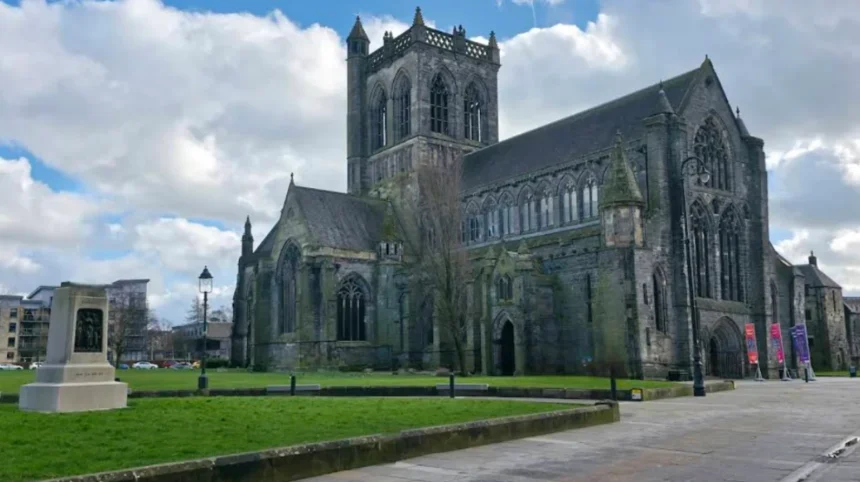
Paisley Abbey is a medieval architectural landmark in Renfrewshire, Scotland, established in 1163 as a Cluniac priory by Walter Fitz Alan, the first High Steward of Scotland, before achieving full abbey status in the year 1245.
- Where is Paisley Abbey located in relation to Glasgow?
- What are the architectural highlights to see inside?
- Why is the abbey significant to the Scottish Royal Family?
- How can you visit the abbey from Glasgow?
- What are the top things to do nearby in Renfrewshire?
- How does the abbey impact the cultural regeneration of Paisley?
The historical genesis of this religious institution links to the consolidation of Anglo-Norman aristocratic power in western Scotland. King David I of Scotland granted extensive lands to Anglo-Norman settlers during the 12th century to stabilize his northern borders and establish feudal administrative systems. Walter Fitz Alan received a royal charter in 1161 conveying the lands of Renfrew, Paisley, Pollok, and Cathcart (Thomas, n.d.). To demonstrate religious piety and secure political legitimacy, Walter Fitz Alan signed a foundation charter in 1163 with the Cluniac monks of Wenlock Priory in Shropshire, England, to establish a monastic house on his newly acquired Scottish territories.
The initial monastic house operated under the jurisdiction of Wenlock Priory, housing a community of 13 Cluniac monks who adhered to the strict Benedictine Rule. The strategic position of the priory on the banks of the White Cart Water facilitated local trade, agricultural management, and regional transport networks. The spiritual and financial influence of the institution expanded through successive royal and aristocratic donations of land, fishing rights, and rectory tithes. Recognizing its growing regional autonomy and economic power, Pope Honorius III elevated the priory to the status of a fully independent abbey in 1245.
The structural development of the abbey suffered a major catastrophic interruption during the Wars of Scottish Independence. In 1307, the military forces of King Edward I of England burned the original Romanesque abbey buildings to the ground as retribution for the Stewart family’s active support of King Robert the Bruce. The monastic community initiated a comprehensive, long-term reconstruction program during the 14th century, replacing the destroyed Romanesque foundations with a grander Gothic architectural design. The structural layout featured a long nave, a central tower, and highly detailed decorative stonework, incorporating specialized stonemasons’ marks that documented the specific migratory craftspeople working across central and southern Scotland (Wallace, 2020).
The architectural expansion continued until the mid-16th century, right up to the systemic structural crisis of the Protestant Reformation. In 1553, the central tower of the abbey collapsed due to systemic foundation instabilities and structural design flaws, severely damaging the transepts and the choir sections of the church. The Scottish Reformation of 1560 subsequently ended the monastic function of Paisley Abbey. The state outlawed the Catholic monastic order, dissolved the community of monks, and stripped the interior fittings. The damaged choir and transepts fell into total ruin, while the local Protestant parish preserved the intact 14th-century nave to serve as the reformed parish church for the town of Paisley.
Where is Paisley Abbey located in relation to Glasgow?
Paisley Abbey is located in the town center of Paisley, within the Renfrewshire council area of Scotland, positioned exactly seven miles west of Glasgow city center and less than two miles east of Glasgow International Airport.
The geographic position of Paisley Abbey places it within the broader Glasgow conurbation and the historic county of Renfrewshire. The physical address of the site centers on Abbey Close, Paisley, PA1 1JG, situated directly adjacent to the White Cart Water river and opposite the historic 1920s Art Deco Russell Institute building (Lee, 2018). This central urban placement means the abbey serves as the historical anchor of the Paisley town center, surrounded by public spaces, municipal offices, and commercial retail zones.
The accessibility of the monument from Glasgow depends on highly integrated transport networks. The primary rail link runs directly from Glasgow Central Station to Paisley Gilmour Street Station, which sits exactly 0.3 miles northwest of the abbey grounds. ScotRail operates frequent train services on this line, providing an average travel time of 10 to 12 minutes between the two urban centers (Lee, 2018). This proximity makes the abbey a highly accessible destination for domestic commuters and international travelers based inside the city of Glasgow.
Road transport infrastructure connects the two locations via the M8 motorway corridor, which forms the main vehicular artery across west-central Scotland. Drivers traveling from central Glasgow exit the motorway at Junction 27 or Junction 29 to enter the Paisley town center. The drive covers approximately 11 miles via the motorway network, taking 15 to 25 minutes depending on real-time traffic volumes.
The physical proximity to Glasgow International Airport provides a direct link for international visitors entering Scotland. The airport terminal sits less than 10 minutes away from the abbey by local bus services or short taxi rides (Lee, 2018). This close positioning makes Paisley Abbey the closest major medieval historic monument to Scotland’s primary international aviation hub, serving as an immediate cultural entry point for arriving tourism flows.
What are the architectural highlights to see inside?
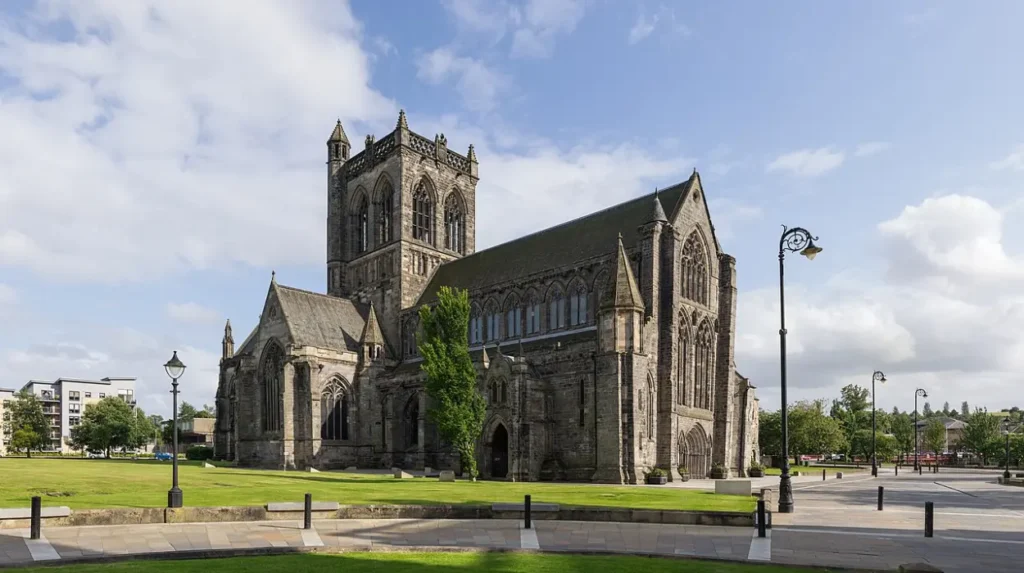
The primary architectural highlights inside Paisley Abbey include the exceptionally preserved 14th-century Gothic nave, the meticulously restored 15th-century St. Mirin Chapel, the monumental royal tombs of the early Stewart monarchs, and a series of unique 19th-century stained-glass windows.
The structural interior of the abbey presents a clear physical timeline of Scottish ecclesiastical architecture spanning over 800 years. The nave represents the architectural core of the visitor experience, featuring a grand triforium—a shallow arched gallery above the main nave arcade—with unique, deeply molded pointed arches supported by heavy stone piers. The soaring stone vaulted ceilings and the clerestory windows work together to channel natural light directly down into the main congregational spaces, emphasizing the structural verticality characteristic of the Decorated Gothic architectural style.
The St. Mirin Chapel sits on the south transept of the abbey, completed in 1499 to honor the 6th-century Irish monk who first brought Christianity to the local area. The chapel features a brilliant, uniquely detailed stone frieze carved into the eastern wall, which depicts various narrative scenes from the life and miracles of Saint Mirin. The physical space inside the chapel delivers an intimate architectural atmosphere, utilizing detailed rib vaulting and historical stonemason carvings that survived the iconoclasm of the 1560 Scottish Reformation.
The abbey serves as a highly significant royal mausoleum for the early House of Stewart, holding the physical remains of multiple historical figures. Visitors can view the highly ornate stone effigy tomb of Marjorie Bruce, the daughter of King Robert the Bruce, whose marriage to Walter Stewart directly founded the royal Stewart dynasty. The choir section also houses the reconstructed tomb monuments of King Robert III of Scotland, who was buried at the abbey in 1406, alongside memorials dedicated to the early High Stewards of Scotland (Durkan, 1999).
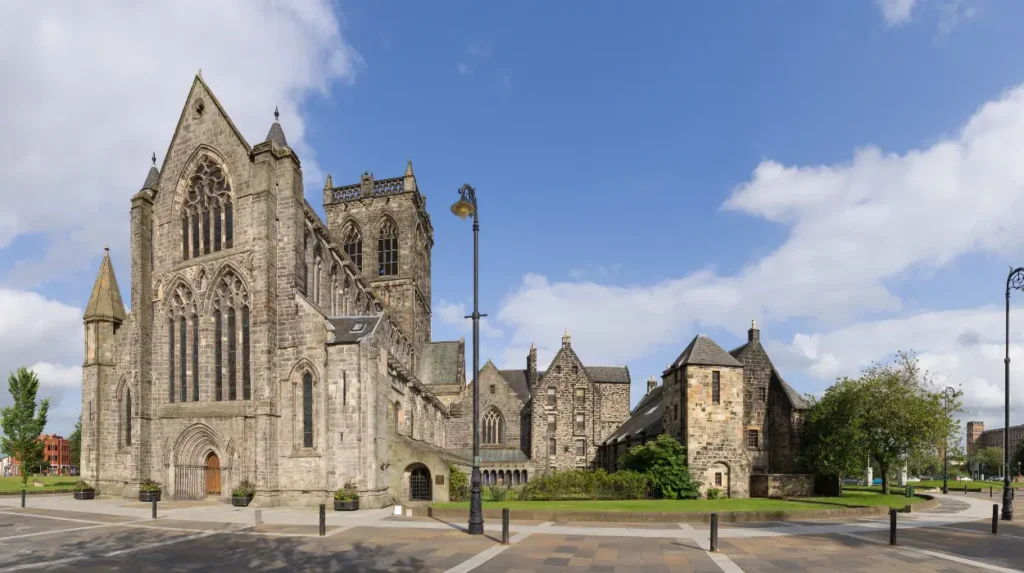
The exterior and interior stone carvings contain specialized historical details that capture substantial public attention. During a comprehensive exterior restoration program executed in 1991, stone carvers from an Edinburgh masonry firm replaced twelve crumbling medieval gargoyles on the north transept wall. One of these stonemasons carved a highly detailed replica of the xenomorph creature from the 1979 Hollywood science-fiction film Alien. This specific modern carving demonstrates the continuous, evolving nature of artisanal interventions on medieval heritage structures.
Why is the abbey significant to the Scottish Royal Family?
Paisley Abbey is structurally significant to the Scottish Royal Family because it serves as the ancestral burial ground of the House of Stewart and stands as the direct birthplace of King Robert II, the first Stewart monarch.
The political connection between the abbey and the Scottish Crown developed through the hereditary office of the High Steward of Scotland. The founder of the abbey, Walter Fitz Alan, established the institution as the primary spiritual sanctuary and final resting place for his family lineage. His direct descendants continued to patronize the abbey, expanding its wealth and land assets while solidifying its status as an elite aristocratic mausoleum. When the Stewart line ascended to the throne of Scotland in the 14th century, the abbey automatically transformed into an essential royal burial site.
The most critical historical event linking the abbey to the royal succession occurred in the year 1316. Marjorie Bruce, daughter of King Robert the Bruce and wife of Walter Stewart, was thrown violently from her horse near the abbey while heavily pregnant. She suffered fatal injuries but was rushed to Paisley Abbey, where doctors delivered her child via an emergency caesarean section. Marjorie Bruce died shortly after the birth, but her surviving infant son grew up to become King Robert II of Scotland, ascending the throne in 1371 and formally initiating the royal Stewart dynasty that eventually unified the Scottish and English crowns.
The abbey houses the final resting places of several prominent members of the early royal family:
- Marjorie Bruce (died 1316), daughter of King Robert the Bruce and mother of King Robert II.
- Robert III, King of Scots (died 1406), who explicitly requested burial at Paisley rather than the traditional royal site at Scone.
- Elizabeth Mure (died 1355), the first wife of King Robert II and queen consort of Scotland.
- Euphemia de Ross (died 1386), the second wife of King Robert II and queen consort of Scotland.
The tomb of King Robert III remains a prominent focal point inside the choir of the abbey. Queen Victoria of the United Kingdom visited the abbey in 1888 and commissioned a grand, commemorative limestone canopy monument to be placed over the burial vault of her royal ancestor. This 19th-century royal intervention emphasizes the continuous, long-term genealogical significance of Paisley Abbey to successive generations of British monarchs, linking the medieval rulers of Scotland directly to the modern British Crown.
Explore More Area Guide
How To Access Paisley Abbey History From Glasgow: Complete Visitor Guide
What You Must Know Before Reading East End News in Glasgow
How can you visit the abbey from Glasgow?
You can visit Paisley Abbey from Glasgow by taking a 10-minute direct ScotRail train from Glasgow Central to Paisley Gilmour Street, followed by a short 5-minute walk, or by driving 20 minutes via the M8 motorway.
The operational infrastructure supporting a visitor excursion from Glasgow is highly efficient, accommodating multiple transit preferences. For rail travelers, trains run continuously throughout the day from Glasgow Central Station, with departures operating approximately every 5 to 10 minutes. Upon arriving at Paisley Gilmour Street Station, visitors exit the main terminal, walk south along Gauze Street, and cross the bridge over the White Cart Water to reach the entry gates at Abbey Close.
| Transport Mode | Route / Detail | Average Travel Time |
| ScotRail Train | Glasgow Central to Paisley Gilmour Street | 10–12 minutes |
| First Bus (No. 9) | Glasgow City Centre to Paisley Town Centre | 40–50 minutes |
| Personal Vehicle | M8 Motorway Westbound (Exit Junction 27) | 15–25 minutes |
| Bicycle / Active Travel | National Cycle Route 7 (Duchray to Glasgow) | 45–60 minutes |
For visitors choosing bus transportation, McGill’s and First Glasgow operate regular bus routes connecting Glasgow city center directly to Paisley town center. The First Glasgow Service Number 9 travels from Union Street in Glasgow directly to Gauze Street, dropping passengers off directly adjacent to the abbey grounds. While the bus route takes longer than the train, it provides an alternative path through the western suburbs of the city.
Active travel enthusiasts can access the abbey using the National Cycle Network. National Cycle Route 7 runs directly from Glasgow city center along the path of the historic Glasgow, Paisley, and Johnstone Canal, offering a completely traffic-free asphalt path for cyclists and walkers. This scenic route brings visitors directly into the east side of Paisley, terminating near the abbey precinct and requiring approximately 45 minutes of cycling time.
The abbey maintains regular opening hours for tourists, independent travelers, and worshippers alike. The standard visiting hours run from Tuesday through Saturday, open between 10:00 AM and 3:30 PM, though the church remains open on Sundays for formal religious services. Admission to the main sanctuary and the St. Mirin Chapel is free of charge, though the local conservation trust encourages voluntary donations to fund ongoing structural maintenance. The on-site shop sells guidebooks, and the local café provides refreshments inside the cloister courtyard.
What are the top things to do nearby in Renfrewshire?
The top attractions to visit near the abbey in Renfrewshire include the Paisley Museum and Art Gallery, the historic Thomas Coats Memorial Baptist Church, the Weaver’s Cottage in Kilbarchan, and the scenic expanses of the Clyde Muirshiel Regional Park.
The cultural assets surrounding Paisley Abbey allow visitors to construct a comprehensive day-long itinerary within the local area. The Paisley Museum and Art Gallery, located on the High Street, has undergone a massive £45 million comprehensive modernization project to transform it into a world-class visitor hub. The museum houses a massive collection of historic woven shawls and textile machinery, documenting the global impact of the famous “Paisley Pattern” that drove the local economy during the Industrial Revolution (Wilson, 2024).
A short walk west of the museum leads to the Thomas Coats Memorial Baptist Church, an architectural masterpiece often described as the “Baptist Cathedral of Europe.” Built in 1894 by the wealthy Coats textile manufacturing family, this red sandstone building features a magnificent crown spire that dominates the local skyline. The interior contains grand marble carvings, a massive pipe organ, and detailed wood paneling, highlighting the immense industrial wealth generated in 19th-century Renfrewshire.
For visitors interested in industrial heritage, the National Trust for Scotland operates the Weaver’s Cottage in the nearby historic village of Kilbarchan, situated five miles west of the abbey. This preserved 1723 cottage features original handlooms and domestic displays that demonstrate exactly how traditional hand-loom weavers lived and worked before the mechanization of the textile mills. Costumed guides run live operational demonstrations of the historic weaving process for educational groups and tourists.
Nature enthusiasts and outdoor recreation hikers can travel further west to explore Clyde Muirshiel Regional Park, which forms the largest regional park in Scotland. Spanning over 108 square miles of protected wilderness, the park offers outdoor activities including sailing on Castle Semple Loch, walking the scenic trails at Muirshiel, and viewing panoramic vistas of the Firth of Clyde from the top of Windy Hill (Back, 0000). This natural asset provides a stark contrast to the urban industrial history of the Paisley town center, giving visitors a complete view of Renfrewshire’s geography.
How does the abbey impact the cultural regeneration of Paisley?
Paisley Abbey impacts the cultural regeneration of Paisley by serving as the central architectural anchor for major public festivals, international heritage tourism initiatives, and community-led urban renewal strategies designed to counter post-industrial economic decline.
The local municipal authority, Renfrewshire Council, utilizes the iconic image and physical space of the abbey as the cornerstone of its long-term economic development frameworks. Following the systemic decline of the local textile manufacturing sector in the late 20th century, Paisley suffered from high levels of urban deprivation and negative territorial stigma (Wilson, 2024). To counter these post-industrial challenges, local planners shifted their focus toward culture-led economic development, positioning the abbey as a prime asset to drive high-volume tourism and civic pride (Madgin, 2025).
The physical square surrounding the monument, Abbey Close, has been specially redesigned into a pedestrian-friendly event space capable of hosting large-scale outdoor public gatherings. The site serves as the main venue for annual events, including the Paisley Halloween Festival—one of the largest creative street theater events in the United Kingdom—and the Paisley Food and Drink Festival. These public events attract tens of thousands of visitors from across central Scotland, generating significant economic spending for local hospitality businesses, restaurants, and retail shops.
The abbey plays an essential role in international heritage tourism marketing campaigns that position Paisley as a key destination alongside neighboring Glasgow. By highlighting its unique architectural links to the Royal House of Stewart and its deep collection of authentic medieval stonemason history, marketing agencies draw cultural tourists who normally limit their visits to Edinburgh Castle or Glasgow Cathedral (McKean, 0000). This targeted tourism diversion helps redistribute visitor wealth into the Renfrewshire economy, supporting local employment in the tourism and creative arts sectors.
Furthermore, the continuous preservation of the abbey fosters strong emotional attachment and communal identity among local residents (Madgin, 2025). The preservation of this ancient space provides a tangible link to a prosperous pre-industrial past, helping to bridge the gap between historical pride and contemporary urban development. As an active, functioning parish church and a world-class tourist attraction, Paisley Abbey continues to demonstrate how historic preservation can drive modern economic and cultural survival.
What is Paisley Abbey?
Paisley Abbey is a medieval church and former Cluniac monastery in Paisley, Renfrewshire, Scotland. Founded in 1163 by Walter Fitz Alan, it became an independent abbey in 1245 and remains one of Scotland’s most important religious and historic landmarks.