The Glasgow Central Station incident of March 2026 stands as one of the most significant disruption events in the modern history of Scottish transport infrastructure. On 8 March 2026, a major fire erupted at Union Corner, a historic B-listed building directly adjacent and attached to Glasgow Central Station. The emergency triggered a multi-day fire suppression effort, forced the immediate total closure of Scotland’s busiest railway hub, and necessitated the complete structural demolition of the affected historic property.
- What Exactly Happened During the Glasgow Central Station Incident in March 2026?
- Why Did the Incident Cause Total Closure of Scotland’s Busiest Rail Hub?
- How Did Glasgow City Council Manage the Demolition of the Stricken Building?
- What Are the Ongoing Economic Impacts on Local Businesses and Public Transport?
- Why Does This Event Highlight the Vulnerability of Glasgow’s Heritage Architecture?
- What Are the Regulatory and Safety Implications for the Global Vape and Battery Retail Sector?
- What Are the Next Steps for the Site and Future Rail Infrastructure Resilience?
Public interest and search engine traffic regarding this incident remain exceptionally high. This sustained attention stems from the profound economic, logistical, and architectural implications of the disaster. The event serves as a critical case study for structural engineers, urban planners, and fire safety experts globally regarding the vulnerability of heritage architecture, the logistical hazards of metropolitan transport hubs, and the emerging challenges of commercial fire risks in dense urban centers.
What Exactly Happened During the Glasgow Central Station Incident in March 2026?
The Glasgow Central Station incident of March 2026 was a catastrophic four-day structural fire that began on 8 March 2026 inside a ground-floor commercial unit at Union Corner, a five-storey heritage building connected directly to the railway terminal.
The Chronology of the Outbreak
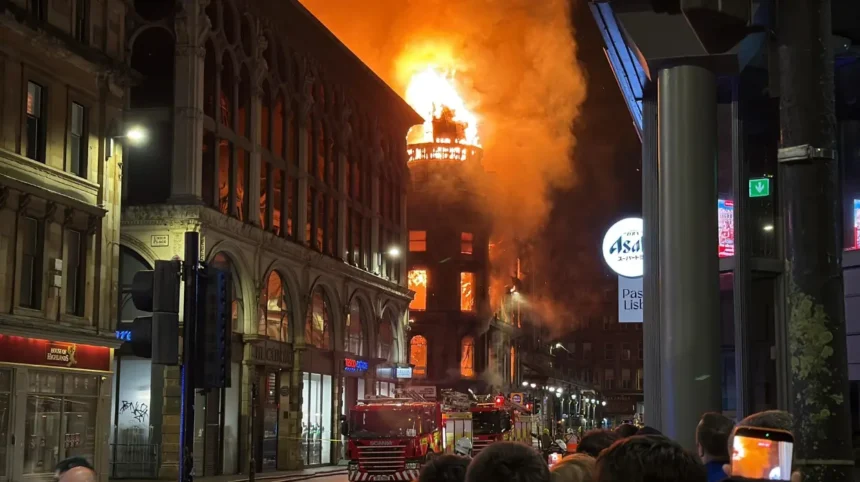
At 15:40 UTC on Sunday, 8 March 2026, the Scottish Fire and Rescue Service received emergency calls detailing a fire at Union Corner. This building occupied the prominent intersection of Union Street and Gordon Street in central Glasgow. Initial witness accounts indicated that an explosion occurred inside a ground-floor retail vape shop immediately prior to the visible manifestation of flames and heavy black smoke.
The fire propagated vertically and horizontally through the timber-framed interior floors of the five-storey structure. First responders immediately initiated a large-scale evacuation of the retail premises, the immediate street perimeters, and the high-level concourse of Glasgow Central Station. The Scottish Fire and Rescue Service deployed more than 250 firefighters and 60 emergency appliances at the absolute peak of the operations to contain the blaze and prevent lateral transmission into the main terminal building of Glasgow Central Station.
Fire Suppression Challenges
The containment operation lasted for four consecutive days, with fire crews remaining actively engaged on the scene until 11 March 2026. Firefighters encountered extreme difficulties in suppressing the core of the fire due to the structural design of the historic property and the specific materials involved.
Academic and professional assessments highlighted specific compounding variables. Structural engineering reports showed that the building featured traditional construction elements, such as lath-and-plaster walls and void-heavy floor joists, which allowed the fire to bypass traditional barriers. Furthermore, fire science investigators identified that the retail unit contained a high volume of consumer electronics, specifically lithium-ion battery cells used in electronic cigarettes.
These cells are susceptible to thermal runaway, a chemical process where an internal failure or external heat source causes an uncontainable rise in temperature and pressure, leading to self-sustaining fires and explosive gas discharges. Professor Guillermo Rein, a prominent fire science expert at Imperial College London, stated that lithium-ion battery fires resist standard water suppression because the internal cells are physically protected by outer casings, generating intense local heat and recurring reignition loops that overwhelm localized fire teams.
Why Did the Incident Cause Total Closure of Scotland’s Busiest Rail Hub?
Glasgow Central Station was fully closed because the severe structural degradation of the directly attached Union Corner building posed an immediate, life-threatening risk of a progressive facade collapse onto the station concourse and external pedestrian exit zones.
Infrastructure Proximity and Shared Loadings
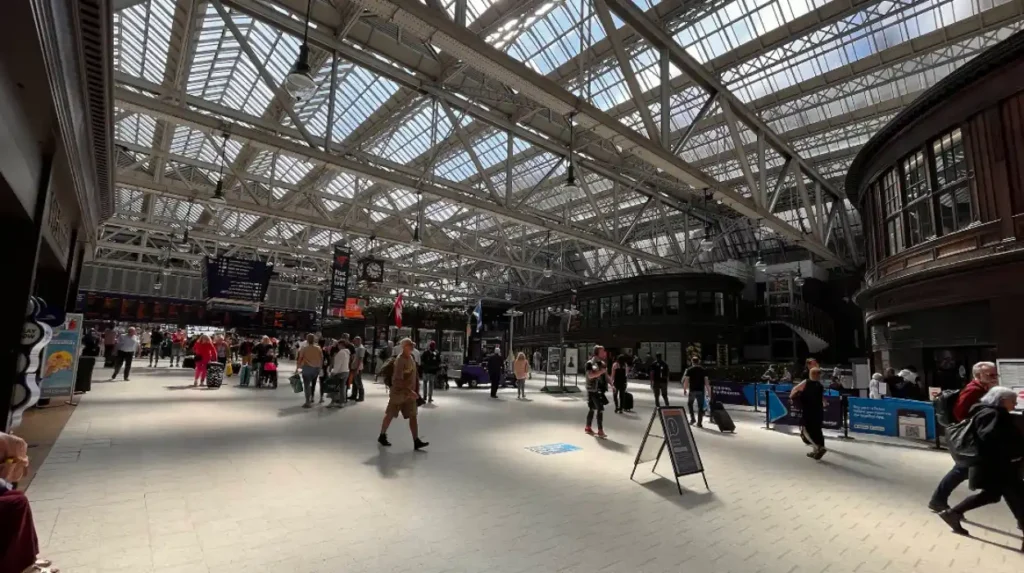
Glasgow Central Station is the busiest railway terminal in Scotland, accommodating an average of more than 32 million passenger entries and exits annually under normal operating conditions. The physical architecture of the station is deeply integrated into the surrounding city blocks.
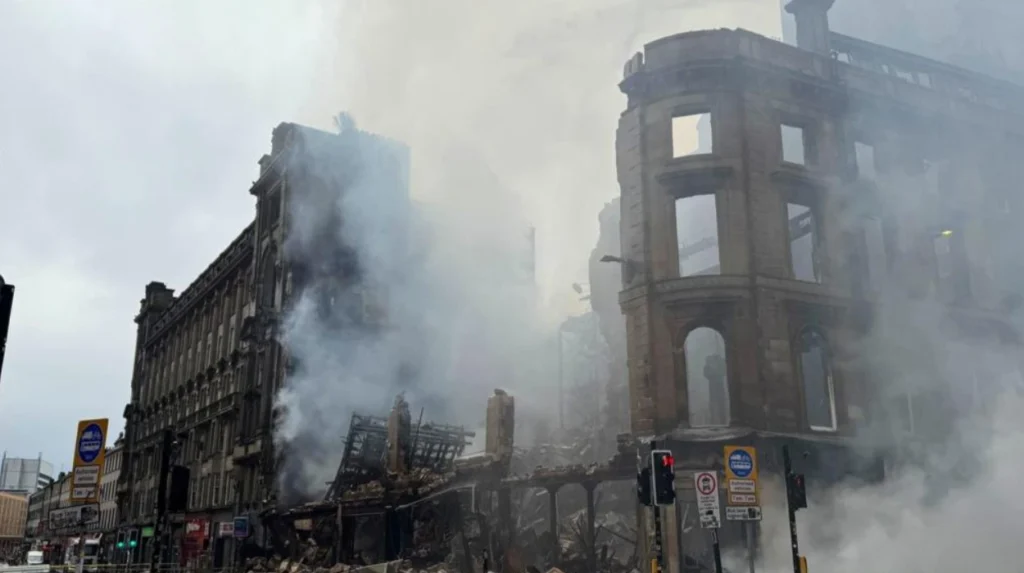
The Union Corner building, which caught fire, shared structural boundary elements with the station’s western perimeter walls and directly abutted the primary pedestrian entrance corridors on Gordon Street and Union Street. As the interior floors of Union Corner collapsed during the fire, the external sandstone masonry lost its lateral support, rendering the 100-foot-tall stone walls highly unstable and susceptible to a sudden collapse onto the tracks, platforms, and public walkways below.
The Phased Transport Disruption
Network Rail, the national railway infrastructure manager, ordered a complete suspension of all rail services at Glasgow Central Station on the afternoon of 8 March 2026 to guarantee public safety. The transport halt caused extensive, multi-week disruptions across the UK rail network:
- The West Coast Main Line: Intercity passenger trains traveling north from England were forced to terminate prematurely at Motherwell Station, approximately 12 miles south of Glasgow.
- Low-Level Services: The underground low-level platforms of Glasgow Central Station were initially shut down. Trains were permitted to pass through the underground tunnels without stopping on 11 March 2026, utilizing nearby Anderston Station and Argyle Street Station as temporary passenger diversion hubs.
- High-Level Platforms: The main terminal platforms remained completely non-operational until 18 March 2026, when partial services resumed on select eastern tracks. Full platform access was not restored until 25 March 2026, following extensive structural evaluations by Network Rail engineers.
How Did Glasgow City Council Manage the Demolition of the Stricken Building?
Glasgow City Council managed the demolition of the Union Corner building by executing an emergency structural intervention on 12 March 2026, utilizing specialized hand-tool deconstruction techniques to preserve the adjoining railway infrastructure.
The Emergency Declaration
Following the official handover of the site by the Scottish Fire and Rescue Service, the Glasgow City Council Building Standards team conducted a comprehensive structural integrity assessment. On 12 March 2026, the municipal authority announced that the remaining shell of Union Corner was in a state of progressive failure and required immediate demolition under emergency public safety legislation. The official council declaration noted that uncontrolled collapse was imminent, which threatened to destroy the adjacent Victorian glass canopy and support columns of Glasgow Central Station.
The Technical Execution of Deconstruction
Demolition contractors commenced physical operations on 13 March 2026 and concluded the structural teardown on 20 March 2026. Due to the high risk of vibration-induced failures in the adjacent station architecture, engineers prohibited the use of standard heavy impact machinery, such as wrecking balls or high-energy hydraulic breakers.
Instead, contractors deployed a top-down manual deconstruction methodology. Workers operating from high-reach mechanical platforms dismantled the upper four floors brick-by-brick and stone-by-stone using handheld pneumatic tools and manual cutting gear. This precise approach prevented structural shockwaves from transferring through the shared foundations into the main rail terminal, effectively isolating the damage to the original footprint of Union Corner.
Explore More Area Guide
Smart Ways to Secure Fares Ghedjemis Contract in Glasgow
What Should You Know Before Getting Neil Young Tickets in Glasgow?
What Are the Ongoing Economic Impacts on Local Businesses and Public Transport?
The ongoing economic impacts include the total operational destruction of multiple independent retail units, a multi-million pound loss in regional rail revenue, and a prolonged street exclusion zone lasting until July 2026.
Disruption to Retail and Commerce
The Union Street fire completely destroyed or severely compromised all commercial tenants operating within the Union Corner structure. These businesses included independent creative studios, specialized retail shops, and local service providers.
The complete loss of specialized physical infrastructure, archival artwork, and commercial equipment left dozens of workers without a physical place of business. To mitigate the immediate financial shock and prevent insolvency during the long-term insurance adjustment period, local community groups and business associations launched coordinated fundraising campaigns, which generated over £150,000 in emergency capital within the first 14 days following the incident.
Transport Redirection and the Exclusion Zone
While Glasgow Central Station successfully resumed full rail services on 25 March 2026, the external perimeter experienced long-term restrictions. On 24 April 2026, Glasgow City Council confirmed that a strict structural exclusion zone would remain in place around the footprints of Union Street and Gordon Street until at least July 2026 to facilitate underground utility reinforcement and site stabilization.
This exclusion zone created significant, ongoing operational challenges for municipal transit systems. Union Street serves as one of the primary north-south bus corridors and passenger drop-off hubs within the Glasgow city center. First Bus, the primary regional bus operator, had to permanently reroute 14 distinct bus lines, resulting in systemic transit delays, increased traffic congestion on alternate arteries like Hope Street and Renfield Street, and a measurable decline in foot traffic for surrounding downtown merchants.
Why Does This Event Highlight the Vulnerability of Glasgow’s Heritage Architecture?
This event highlights structural vulnerabilities by demonstrating that Glasgow’s historic stone buildings feature highly combustible timber interiors, uncompartmentalized architectural voids, and outdated fire barriers that cannot contain modern commercial blazes.
The Structural Reality of B-Listed Properties
The Union Corner building was a designated B-listed structure, indicating its regional architectural and historical significance. Constructed primarily during the late 19th century using Scottish sandstone, the building shared design characteristics common to thousands of historic properties across the city center.
While the external sandstone walls provided substantial load-bearing strength and an illusion of structural permanence, the interior framing relied entirely on pitch-pine timber floor joists and internal wooden support partitions. Once a fire breaches the surface finish of a room, it gains direct access to these hidden dry timber elements, turning the interior of the building into a highly active combustion chamber while the stone exterior traps the heat inside.
The Pattern of Urban Conflagrations
The March 2026 incident re-ignited intense public and political debate regarding the systemic safety of historic buildings in Scotland. Commentators, urban historians, and politicians, including Scottish Labour MSP Paul Sweeney, quickly observed a troubling historical continuity between this event and previous urban disasters in the municipality.
The acrid smoke and rapid destruction of Union Corner directly mirrored the devastating fires that severely damaged the world-renowned Glasgow School of Art Mackintosh building in 2014 and 2018. Architectural critics argue that the city’s historic fabric is exceptionally vulnerable because these heritage structures are frequently retrofitted with high-risk commercial operations without receiving equivalent upgrades to their structural fire compartmentalization, such as retrofitted automatic fire sprinkler systems, intumescent fire barriers, and robust fire-rated drywall enclosures.
What Are the Regulatory and Safety Implications for the Global Vape and Battery Retail Sector?
The regulatory implications include intensified demands for mandatory registration systems for electronic cigarette retailers, stricter enforcement of battery storage laws, and a comprehensive re-evaluation of commercial insurance underwriting for historic properties.
Licensing and Enforcement Discrepancies
In the immediate aftermath of the fire, municipal investigations uncovered critical regulatory gaps regarding the commercial tenant where the fire originated. Official municipal records published by Glasgow City Council’s Trading Standards team revealed that while the specific vape shop had passed basic consumer product compliance checks, the business was not formally registered on the official Scottish retail register for tobacco and nicotine vapor products.
This revelation exposed a significant enforcement gap in tracking urban retail entities. It has led to direct calls within the Scottish Parliament for a comprehensive overhaul of the Tobacco and Primary Medical Services (Scotland) Act 2010 to introduce mandatory, highly restrictive spatial licensing systems that prevent high-density battery storage units from operating within or directly adjacent to critical national transport infrastructure.
The Evolution of Commercial Fire Safety Protocols
The involvement of lithium-ion technology in a major transit-adjacent disaster has accelerated international regulatory scrutiny. The Institution of Fire Engineers and various international public safety bodies are utilizing data from the Glasgow Central incident to draft updated safety guidelines for mixed-use commercial developments.
The proposed changes focus on three main areas:
- Mandatory Thermal Containment: Requiring all commercial retailers stocking more than a specific threshold of lithium-ion power cells to store inventory inside certified fire-rated containment safes.
- Specialized Suppression Systems: Installing specialized fire suppression agents, such as aqueous vermiculite dispersions, which are uniquely capable of cooling and extinguishing thermal runaway reactions where traditional water systems fail.
- Insurance Risk Re-pricing: Commercial insurers are significantly raising premiums and enforcing stricter compliance audits for businesses operating inside historic, non-compartmentalized structures, effectively forcing a structural migration of high-risk retail out of vulnerable urban heritage zones.
What Are the Next Steps for the Site and Future Rail Infrastructure Resilience?
The next steps involve the engineering stabilization of the vacant plot, the permanent restoration of the station exits by July 2026, and the implementation of real-time structural monitoring across Network Rail properties.
Site Stabilization and Reconstruction Debates
Following the completion of the emergency deconstruction in late March 2026, the immediate priority shifted to securing the subterranean vaults and foundations that connect the former Union Corner building to the low-level rail lines. Engineers are currently injecting structural grouting and installing heavy steel shoring walls to reinforce the exposed western flank of Glasgow Central Station.
Concurrently, a major urban planning debate is underway regarding the future of the vacant corner site. Historic environment Scotland and local architectural preservation groups are advocating for a contextual reconstruction project that replicates the original Victorian facade using sustainable modern fire-rated composite materials. Conversely, transport logistics planners are proposing an expansion of Glasgow Central Station’s terminal footprint to build wider pedestrian access gates and modern, integrated transit facilities that can better accommodate future passenger growth.
National Infrastructure Fortification
On 22 April 2026, King Charles III met with emergency first responders and frontline Network Rail engineers at Dumfries House to officially recognize the successful preservation of Glasgow Central Station’s core assets. Following this high-profile review, Network Rail announced a comprehensive infrastructure resilience program across all major UK terminals.
The strategy includes installing continuous acoustic and thermal monitoring sensors along structural boundary walls shared with external commercial properties. This technology allows rail operations teams to detect abnormal heat signatures or structural vibrations instantly, enabling rapid emergency isolation hours before a fire can breach a terminal’s perimeter, thereby protecting vital national transport links from external commercial disruptions.