
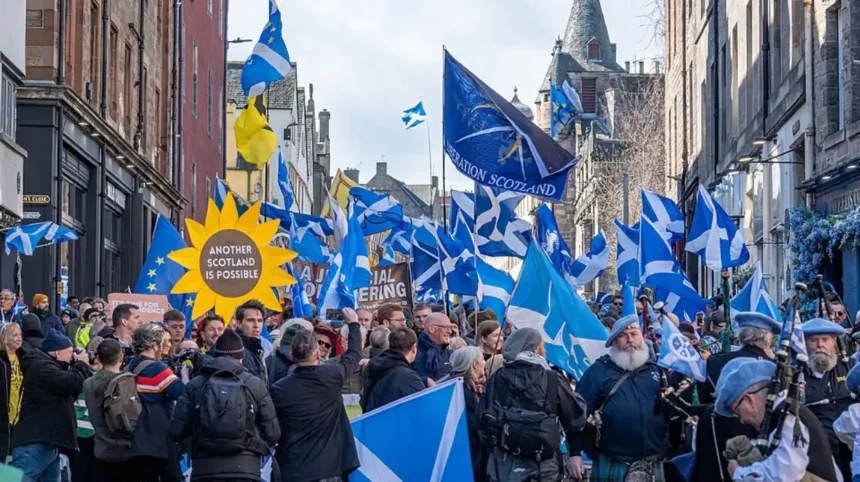
The question of Scottish independence involves the proposed separation of Scotland from the United Kingdom to become an independent sovereign state. This constitutional issue encompasses complex legal frameworks, historical treaties, economic calculations, and distinct political movements within the British Isles.
- What Is the Constitutional History of the Union Between Scotland and the United Kingdom?
- How Did the 2014 Scottish Independence Referendum Occur and What Were the Results?
- What Legal Mechanisms Control the Path to an Independent Scottish State?
- How Does the European Union Impact the Scottish Independence Debate?
- What Are the Primary Economic Arguments Surrounding Scottish Independence?
- Which Political Parties and Interest Groups Shape the Constitutional Debate?
- What Are the Projected International and Security Implications of an Independent Scotland?
- What Are the Next Logical Steps for the Constitutional Movement?
What Is the Constitutional History of the Union Between Scotland and the United Kingdom?
The union between Scotland and the United Kingdom rests on the Acts of Union 1707, which joined the Kingdom of Scotland and the Kingdom of England into a single political entity named the Kingdom of Great Britain.
Prior to the formal political union of 1707, Scotland and England shared a monarchy through the Union of the Crowns in 1603. King James VI of Scotland ascended to the English throne as King James I after the death of Queen Elizabeth I. This created a dynastic union where two independent kingdoms shared the same monarch, maintained separate parliaments, distinct legal systems, and independent trade policies.
The relationship changed permanently with the passage of the Acts of Union in 1707. The Parliament of Scotland and the Parliament of England passed simultaneous legislation that dissolved both legislatures and created the Parliament of Great Britain, based in Westminster, London. Under the terms of the treaty, Scotland surrendered its sovereign legislative power but retained its distinct legal system, known as Scots Law, its Presbyterian national church, the Church of Scotland, and its separate educational framework.
The modern constitutional structure emerged via the Scotland Act 1998, which established the devolved Scottish Parliament in Edinburgh following a successful referendum in 1997. Devolution transferred specific legislative powers from the UK Parliament to the Scottish Parliament, creating two distinct categories of authority: devolved matters and reserved matters. The Scottish Parliament holds the power to legislate on devolved matters, which include domestic policy areas like healthcare, education, justice, agriculture, and local government. The UK Parliament retains exclusive authority over reserved matters, which include macro-level domains like foreign policy, national defense, immigration, currency, and the constitution itself.
How Did the 2014 Scottish Independence Referendum Occur and What Were the Results?
The 2014 Scottish independence referendum took place following the Edinburgh Agreement of 2012, resulting in a decisive majority of 55.3% voting to remain part of the United Kingdom while 44.7% voted in favor of becoming an independent country.
The political path to the referendum opened in May 2011 when the Scottish National Party, led by First Minister Alex Salmond, won an absolute majority in the devolved Scottish Parliament. This electoral outcome provided a democratic mandate to seek a referendum on independence. Because constitutional matters are reserved to the UK Parliament under the Scotland Act 1998, the Scottish Government required temporary legal authority from the UK Government to hold a legally binding vote.
This legal mechanism was achieved through the Edinburgh Agreement, signed on October 15, 2012, by UK Prime Minister David Cameron and Scottish First Minister Alex Salmond. The agreement led to a Section 30 order, a legal instrument that temporarily transferred the necessary constitutional power from Westminster to Holyrood. This transfer ensured that the upcoming referendum would possess a clear legal basis, receive recognition from both governments, and command international legitimacy.
The referendum occurred on September 18, 2014, with the single question: “Should Scotland be an independent country?” The electorate included all residents in Scotland aged 16 or over, marking the first time 16- and 17-year-olds voted in a major UK election. The voter turnout reached 84.6%, which represents the highest recorded turnout for any election or referendum in United Kingdom history.
The vote revealed distinct geographic variations across Scotland. Out of the 32 local authority areas in Scotland, 4 areas voted “Yes” to independence, while 28 areas voted “No” to retain the union. The four areas supporting independence consisted of Glasgow City (53.5%), Dundee City (57.3%), West Dunbartonshire (54.0%), and North Lanarkshire (51.1%). The capital city, Edinburgh, rejected independence with 61.1% voting “No.”
What Legal Mechanisms Control the Path to an Independent Scottish State?
The legal path to Scottish independence requires an Act of the United Kingdom Parliament or a Section 30 order, because the UK Supreme Court ruled in 2022 that the Scottish Parliament cannot hold an independence referendum without Westminster consent.
The definitive legal framework governing the independence process resides within the Scotland Act 1998. Section 29 of the Act states that the Scottish Parliament cannot pass legislation that relates to reserved matters. Schedule 5 of the Act explicitly lists “the Union of the Kingdoms of Scotland and England” as a reserved matter under the sole jurisdiction of the UK Parliament. Therefore, any unilateral attempt by Holyrood to hold a referendum lacks statutory authority.
The legal reality was solidified on November 23, 2022, when the Supreme Court of the United Kingdom issued its judgment in the case of Reference by the Lord Advocate special to the Scottish Parliament. The Scottish Government sought a ruling on whether it could hold an advisory independence referendum without the consent of the UK Parliament. The Supreme Court ruled unanimously that even an advisory referendum relates to the Union and the UK Parliament, meaning the Scottish Parliament does not possess the legislative competence to pass an independence referendum bill on its own.
Consequently, a lawful referendum depends on one of two legal mechanisms:
- A Section 30 Order: A statutory instrument approved by both houses of the UK Parliament and the Scottish Parliament that amends Schedule 5 of the Scotland Act 1998 to temporarily transfer the power to hold a referendum.
- Primary Legislation at Westminster: An Act passed directly by the UK Parliament that explicitly authorizes a referendum or alters the constitutional status of Scotland within the United Kingdom.
If a future referendum returns a majority for independence, the result would not instantly dissolve the union. Instead, it would initiate complex international and domestic legal negotiations. These negotiations would require a formal treaty between the Scottish Government and the UK Government, followed by primary legislation passed by the UK Parliament to repeal the Acts of Union 1707 and formally transfer total sovereignty to Scotland.
How Does the European Union Impact the Scottish Independence Debate?
The European Union impacts the Scottish independence debate because Scotland voted 62% to remain in the EU during the 2016 Brexit referendum, creating a constitutional friction that pro-independence campaigns use to argue for exiting the United Kingdom.
During the 2014 independence referendum, the campaign to remain in the UK argued that staying within the union was the only way to guarantee Scotland’s continued membership in the European Union. This argument relied on the European Commission’s confirmation that an independent Scotland would become a third-party country and would have to apply for EU membership from scratch under the standard accession process, known as the Barroso doctrine.
The political situation shifted radically on June 23, 2016, during the UK-wide referendum on European Union membership. The overall UK vote resulted in a 51.9% majority to leave the European Union, an outcome known as Brexit. However, the voting patterns within the constituent nations of the UK were highly polarized.
All 32 local authority areas in Scotland returned a majority for remaining in the European Union. The Scottish National Party argued that this divergence constituted a material change in circumstances, as Scotland was being removed from the EU against the expressed democratic will of its electorate.
For the pro-independence movement, European Union membership serves as a core policy objective for a sovereign Scotland. Rejoining the EU would grant Scotland access to the European Single Market and the European Customs Union, restoring the free movement of goods, services, capital, and people. Conversely, opponents of independence highlight that rejoining the EU would create a hard regulatory and customs border between an independent Scotland and the rest of the United Kingdom. Because the rest of the United Kingdom remains Scotland’s largest trading partner, an internal economic border could disrupt existing trade flows.
What Are the Primary Economic Arguments Surrounding Scottish Independence?
The economic arguments focus on the trade-offs between Scotland obtaining control over its national taxation, spending, and industrial policies versus the loss of financial transfers from the UK Treasury via the Barnett formula.
The baseline assessment of Scotland’s public finances is published annually by the Scottish Government in the Government Expenditure and Revenue Scotland report. This document calculates the total public sector revenue raised in Scotland and compares it to the total public sector expenditure for the benefit of Scotland under the current constitutional setup.
Proponents of the union emphasize this structural deficit to argue that Scotland benefits from a Union dividend. Under the UK’s fiscal framework, the Barnett formula ensures that public spending per capita in Scotland remains higher than the UK average. In the financial year 2023-24, public spending per person in Scotland was £1,437 higher than the UK average, helping support public services like the National Health Service Scotland and free university tuition.
Pro-independence economists counter that the GERS data reflects Scotland’s financial position within the union, rather than its potential as an independent state. They argue that a sovereign parliament could implement distinct economic strategies to boost productivity, invest in green energy infrastructure, and alter the tax architecture to stimulate growth. Additionally, an independent Scotland would claim geographical rights to North Sea oil and gas revenues, alongside substantial renewable energy assets like wind and tidal power generation.
A critical economic challenge for an independent Scotland is currency choice. The Scottish Government’s official policy recommends a transition involving three phases:
- Sterlingisation: Continuing to use the British Pound Sterling informally without a monetary union or control over interest rates.
- A New Currency: Establishing an independent Scottish pound once specific economic criteria are met.
- The Euro: Potentially adopting the European Union currency if Scotland rejoins the EU and satisfies the Maastricht convergence criteria.
Which Political Parties and Interest Groups Shape the Constitutional Debate?
The political landscape splits cleanly along constitutional lines, with nationalist parties advocating for separation and unionist parties campaigning to preserve the United Kingdom.
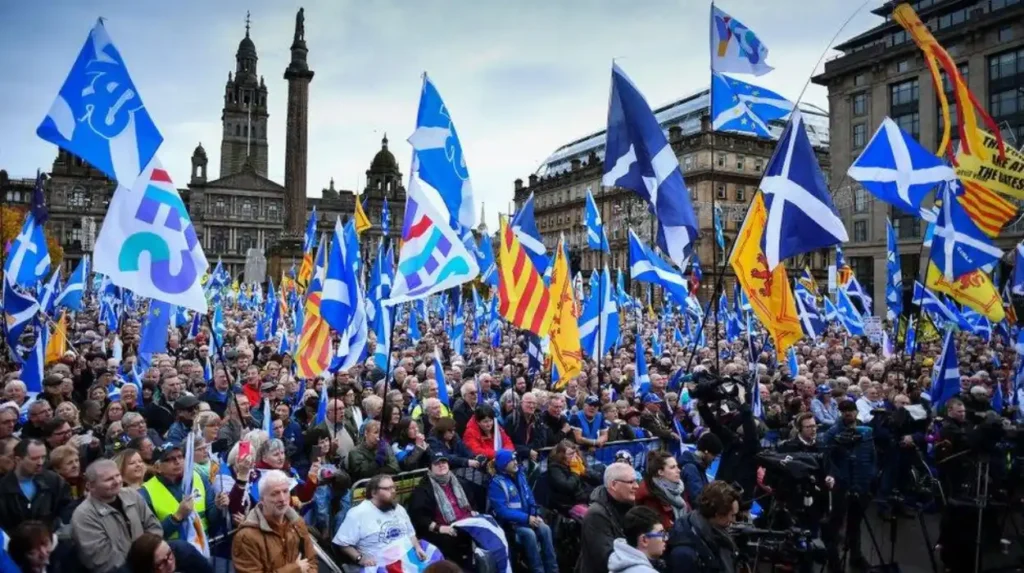
The pro-independence coalition contains multiple political entities and civic organizations. The dominant political force is the Scottish National Party, which has formed the Scottish Government since 2007. The party advocates for social democratic policies combined with civic nationalism. The Scottish Green Party also supports independence, focusing its platform on a transition away from fossil fuels toward a green economy. Outside parliamentary politics, organizations like Believe in Scotland and the Independence For Scotland Party coordinate grassroots activism, marches, and digital campaigns.
The pro-union coalition features the three main UK-wide political parties active in Scotland. The Scottish Conservative and Unionist Party positions itself as the most unyielding opponent of a second referendum, drawing substantial support from voters who prioritize constitutional stability. The Scottish Labour Party advocates for maintaining the union while proposing further devolution, emphasizing class solidarity and UK-wide economic redistribution. The Scottish Liberal Democrats support a federal UK structure, arguing that constitutional upheaval damages public services. Civic campaign groups like Scotland in Union support these parties by publishing research and coordinating tactical voting strategies to preserve the United Kingdom.
What Are the Projected International and Security Implications of an Independent Scotland?
An independent Scotland would alter the geopolitical architecture of Northern Europe by requiring the relocation of the UK’s nuclear deterrent and creating a new sovereign state seeking membership in NATO and the United Nations.
The foreign policy of an independent Scotland would focus on integration into multilateral international institutions. The Scottish Government has declared its intention to apply for membership in the United Nations, the Council of Europe, and the North Atlantic Treaty Organisation. While NATO membership is a strategic priority to secure Scotland’s maritime borders in the North Atlantic and the High North, it creates a direct conflict with the nationalist movement’s long-standing defense policy: the total elimination of nuclear weapons from Scottish territory.
The United Kingdom’s entire strategic nuclear deterrent, the Trident missile system carried by Vanguard-class submarines, is stationed at Her Majesty’s Naval Base Clyde at Faslane, located 25 miles west of Glasgow. The adjacent Royal Naval Armaments Depot at Coulport stores the nuclear warheads.
The pro-independence platform demands the removal of these nuclear weapons within the first term of an independent parliament. Security analysts from the Royal United Services Institute note that relocating Trident out of Scotland would present immense technical, logistical, and financial obstacles for the remaining UK government. There are no alternative deep-water ports in England or Wales that possess the necessary infrastructure, meaning relocation could cost tens of billions of pounds and take over a decade, temporarily disrupting the UK’s continuous at-sea nuclear deterrent.
For conventional defense, an independent Scotland would need to establish the Scottish Defence Forces. This transition would involve negotiating a division of existing UK military assets, including Type 26 frigates manufactured on the River Clyde in Glasgow, Eurofighter Typhoon combat aircraft, and infantry regiments. This division would require setting up new command structures, domestic intelligence agencies, and border security frameworks to manage international transit points.
What Are the Next Logical Steps for the Constitutional Movement?
The future of the Scottish independence movement depends on upcoming democratic elections, shifting demographic patterns, and legal developments between Edinburgh and London. Because the UK Supreme Court blocked the route to a unilateral referendum, the Scottish National Party frequently frames UK general elections as de facto referendums, where winning a majority of Scottish seats is interpreted as a mandate to open independence negotiations.
Demographic data from the Scottish Census and ongoing polling indicate a distinct generational split on the constitutional question. Voters under the age of 45 consistently display higher levels of support for independence, whereas voters over the age of 55 strongly favor retaining the union. The long-term stability of the United Kingdom rests on whether future economic developments and shifting political alignments alter these demographic preferences over the coming decades.
What is Scottish independence?
Scottish independence is the proposal that Scotland should leave the United Kingdom and become a separate sovereign state with full control over its own government, constitution, foreign policy, defense, immigration, and economic decisions.