Key Points
- Record Transfer: Celtic have completed an £11 million deal to sign Danish striker Kasper Høgh from Norwegian side Bodø/Glimt.
- Wage Structure Impact: Former Aberdeen and Everton chief executive Keith Wyness revealed that Høgh will instantly become one of the top earners at Celtic Park.
- Financial Disparity: The move highlights the economic gap between the Scottish Premiership and top European leagues like the English Premier League.
- Squad Dynamics: Høgh’s salary placement establishes new expectations within the Celtic dressing room as the club prepares for domestic and European competitions.
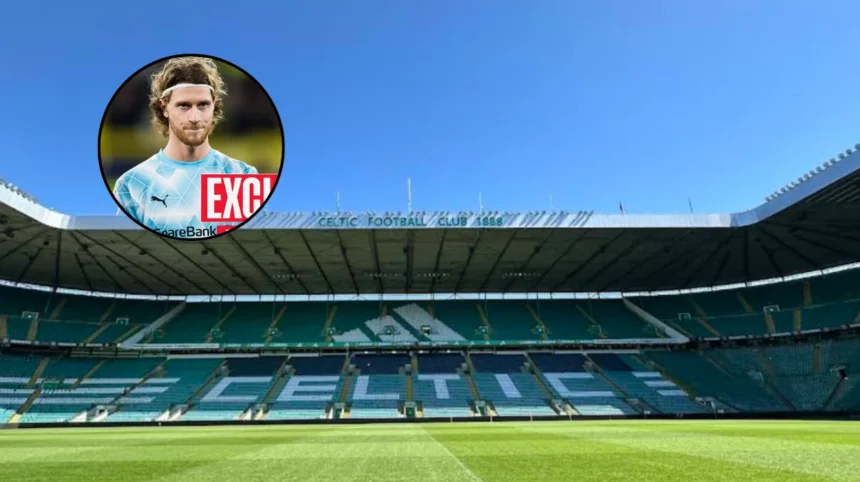
Celtic FC (Glasgow Express) July 31, 2026 – Danish forward Kasper Høgh has officially sealed a landmark £11 million move to Scottish Premiership champions Celtic from Bodø/Glimt. The transfer makes the 25-year-old one of the most expensive signings in Scottish football history and elevates him immediately to the upper echelon of Celtic’s wage structure. Former Aberdeen and Everton chief executive Keith Wyness provided expert analysis on the financial mechanics behind the deal, pointing out how the contractual terms reflect both Celtic’s ambition and the wider economic realities of European football.
How does Kasper Høgh’s salary compare with Celtic’s top earners?
As reported by Football Insider, Keith Wyness stated that “Kasper Høgh will have immediately become one of the highest earners at Celtic Park.” The Scottish champions have maintained a structured payroll system in recent seasons, but acquiring a marquee target from an established European performer required a competitive salary package.
According to financial estimates discussed by Wyness, top-bracket players at Celtic typically command weekly wages in the region of £30,000 to £45,000. With Høgh’s arrival on an £11 million transfer fee, his remuneration package is designed to align with his status as a premier attacking focal point for the club.
What does this transfer reveal about the Scottish Premiership financial gap?
As reported by Football Insider, Keith Wyness noted that while Celtic are capable of sanctioning an £11 million fee, the overall financial scope remains distinct from elite English clubs. Wyness pointed out:
“Celtic’s move to sign striker Kasper Høgh from Bodø/Glimt shows the disparity between the Scottish Premiership and the Premier League.”
While Premier League outfits frequently deploy equivalent fees for squad depth, an £11 million commitment represents a substantial financial investment for Scottish Premiership clubs, reliant primarily on European tournament distribution and domestic commercial revenues.
What is the background behind Celtic’s record acquisition of Kasper Høgh?
Celtic’s recruitment drive leading up to the 2026/27 campaign centered on securing a high-calibre center-forward capable of performing in both domestic competition and UEFA Champions League fixtures. Kasper Høgh developed a strong reputation at Norwegian club Bodø/Glimt, where his goalscoring output and physical presence in European ties attracted interest across the continent.
Following extensive negotiations between Celtic officials and Bodø/Glimt representatives, an £11 million agreement was reached. The striker completed his medical in London before finalizing terms in Glasgow, marking one of the significant moves in Scottish transfer history.
How will this development affect Celtic, the squad, and Scottish football?
The arrival of Kasper Høgh as one of the club’s highest earners carries direct implications for several stakeholders:
- For the Celtic Dressing Room: Establishing a new top-tier earner can shift wage benchmark expectations during future contract renewals for senior squad members.
- For Celtic Supporters: The investment signals clear ambition from board leadership to maintain domestic dominance and improve competitiveness in European football.
- For Scottish Premiership Rivals: The £11 million transfer accentuates the growing financial divergence between Celtic and the rest of the Scottish top flight.