Key Points
- Project Milestone: Lead contractor GRAHAM and student accommodation provider Unite Students have officially completed the ‘topping out’ structural phase of the 21-storey Alexander Quay development.
- Capital Investment: The scheme represents a £126 million investment aimed at increasing student bed capacity in Glasgow ahead of the 2027/28 academic year.
- Bed Capacity & Layout: The property will deliver 934 beds arranged across a combination of cluster flats and self-contained studio apartments.
- Strategic Location: Situated at Central Quay in Glasgow’s West End north of the River Clyde, the building is positioned to serve students attending the University of Glasgow, a top-100 world institution.
- Urban Regeneration: The development brings a long-disused brownfield site back into functional service while targeting a BREEAM ‘Excellent’ environmental rating.
- Student & Community Amenities: Facilities inside the complex include a social marketplace café, study areas, a gym, a yoga room, screen rooms, and a garden room with a outdoor terrace.
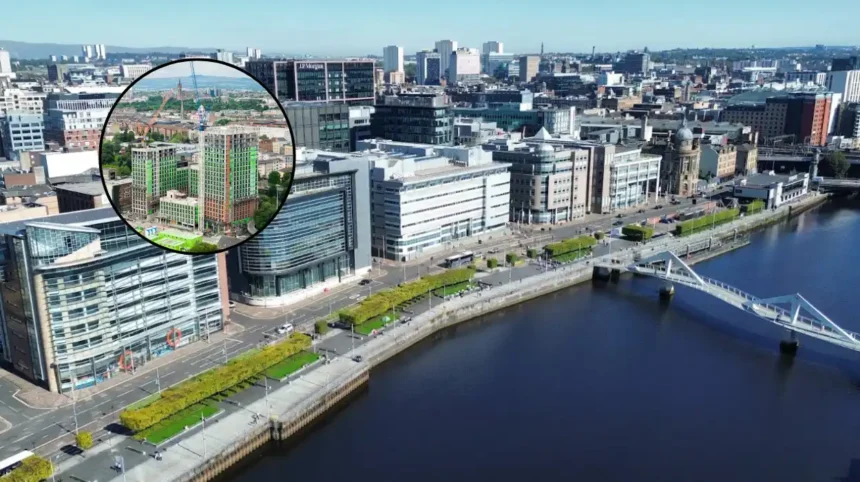
Glasgow (Glasgow Express) August 25, 2026 –Structural work on the 21-storey Alexander Quay development in Glasgow’s West End has reached its maximum height, marking the official topping out of the £126 million flagship scheme. Lead contractor GRAHAM hosted the topping out ceremony alongside project developer Unite Students to celebrate the structural milestone of the 934-bed purpose-built student accommodation (PBSA) building, previously referred to as Central Quay.
Located north of the River Clyde, the building is designed to bolster accommodation provision near the University of Glasgow. The completion of the primary concrete frame and roof superstructure signifies that the project remains on schedule for its intended operational opening in time for the 2027/28 academic term.
What features and facilities will the £126 million property include?
As reported by staff writers at Scottish Housing News and confirmed in project technical specifications released by GRAHAM, the multi-million-pound build contains a mix of living options designed to meet varying student requirements, incorporating both multi-bedroom cluster flats and self-contained individual studios.
The interior footprint of Alexander Quay has been planned to accommodate modern student lifestyle demands through dedicated study and social spaces. Residents will have access to an internal social marketplace café, several quiet and collaborative study zones, a fully equipped gymnasium, a dedicated yoga studio, digital screen rooms for media viewing, and a top-floor garden room featuring an accessible outdoor terrace.
What did the key stakeholders say during the topping out ceremony?
As reported by the media team at Scottish Construction Now, key representatives from both the lead contractor and the developer set out the operational, local economic, and sustainability goals of the project during the event.
Describing the structural progress achieved on site, Director at GRAHAM Chris MacLeod stated:
“Reaching topping out at Alexander Quay marks significant structural progress on a scheme that will deliver 934 much-needed student beds in Glasgow. The development brings a long-disused brownfield site back into service, and its BREEAM Excellent target sets a high sustainability standard for the build. Once complete, Alexander Quay will serve both the city’s students and the people who live in the surrounding community.”
Highlighting the strategic alignment with higher education institutions and housing delivery targets, Group Development Director at Unite Students Tom Brewerton commented:
“We’re excited to reach another important milestone at Alexander Quay and a step closer to next year’s completion. This new property will significantly increase the supply of high quality, affordable accommodation in Glasgow, supporting the growth of our university partners. We’re continuing to take a disciplined approach to off campus development and accelerating our alignment with the UK’s strongest universities.”
Background of the Alexander Quay development
The site at Central Quay north of the River Clyde had previously remained vacant and underutilised for an extended period, representing a long-standing brownfield redevelopment priority for Glasgow City Council. Unite Students acquired the land parcel in late 2024 to expand its operational footprint in the city. Groundwork and main construction activities were entrusted to long-term delivery partner GRAHAM, who officially commenced main build operations on site in early 2025.
Glasgow has faced acute pressure on its residential housing supply over recent years, driven by rising enrolments across its major tertiary education institutions, including the University of Glasgow and Strathclyde University. The local private rental sector (PRS) has experienced heightened competition between domestic families and the student population. The development of Alexander Quay forms part of a wider strategic initiative by major PBSA operators to absorb university-driven housing demand into dedicated, managed blocks. Upon full completion, Alexander Quay will expand Unite Students’ portfolio in Glasgow to over 3,200 managed beds.
Prediction: How will this development affect students, local residents, and the Glasgow housing market?
The structural completion and upcoming delivery of the 934-bed Alexander Quay complex will create direct downstream effects across three primary groups:
- For Higher Education Students: The influx of 934 managed beds in Glasgow’s West End will relieve severe room shortages for domestic and international students attending the University of Glasgow. By offering purpose-built amenities—such as high-speed study areas, wellness rooms, and on-site social hubs—the development provides an modern, self-contained living environment designed around academic schedules.
- For Local Residents and Families in Glasgow: The introduction of high-density student accommodation is anticipated to lessen student competition for standard residential properties in the private rented sector. As students move into purpose-built units, traditional HMOs (Houses in Multiple Occupation) and family flats in surrounding neighbourhoods like Anderston, Finnieston, and Partick are more likely to return to the general housing market for local working households.
- For the Local Economy and Urban Landscape: The physical transformation of a long-standing brownfield site at Central Quay will help reactivate the waterfront corridor along the River Clyde. Increased footfall from hundreds of student residents will supply sustained retail and leisure trade to local businesses along the West End and city centre borders, while the building’s target BREEAM ‘Excellent’ environmental credentials establish an elevated sustainability standard for future commercial developments across the city.