Key Points
- The Appeal: Glasgow developer Adam Bruce, representing New West Properties Ltd, has officially launched an appeal to the Scottish Government after local planning authorities blocked his residential project.
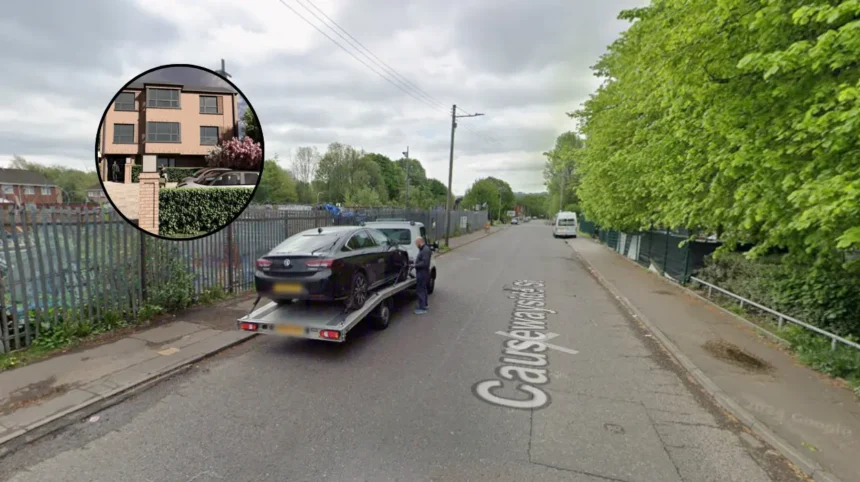
- The Proposal: The developer is seeking to erect a three-storey residential block consisting of six flats on a vacant plot of land located at Causewayside Street in Tollcross, situated near Vale of Clyde FC’s Fullarton Park.
- The Rejection Grounds: Glasgow City Council planners rejected the initial planning application, citing an “unjustified” loss of protected amenity green space, poor architectural design, a lack of appropriate on-site parking, daylight and overshadowing issues for future residents, and the absence of a required flood risk assessment.
- Developer’s Counterargument: The applicant strongly disputes the council’s assessment, labeling the site a “tree-less, derelict industrial site overgrown with weeds” rather than a haven for wildlife or public green space, adding that the plot would likely become an industrial scrapyard or container storage yard if the flats are blocked.
- Proposed Compromise: Within the submitted appeal documents, the developer has offered a fallback option to scale back the project from six flats to four units if local parking availability remains a definitive dealbreaker for government reporters.
Glasgow (Glasgow Express) July 11, 2026 – New West Properties Ltd has escalated a local planning dispute to national authorities following the formal rejection of a residential development scheme in the city’s East End, it was confirmed on July 11, 2026. The independent developer, Adam Bruce, submitted a formal appeal to the Planning and Environmental Appeals Division (DPEA) of the Scottish Government, seeking to overturn a previous decision by Glasgow City Council planners who blocked the construction of six new flats on a narrow, vacant urban plot located at Causewayside Street. The municipal planning authority had previously knocked back the application on the grounds that the project represented an unacceptable infringement on local environmental infrastructure, lacked adequate car parking provisions, and suffered from substantial residential design flaws.
- Will the Scottish Government Overturn the Council’s Rejection of the Causewayside Street Residential Scheme?
- What Design Deficiencies and Environmental Concerns Led Local Planners to Terminate the Project?
- How Has Developer Adam Bruce Countered the Claims of Glasgow City Council in the Official Appeal?
- What Alternative Solutions and Compromises Have Been Put Forward to the Government Reporter?
- Background of the Tollcross Planning Context
- Prediction: How This Development Appeal Will Affect East End Residents and the Local Housing Market
Will the Scottish Government Overturn the Council’s Rejection of the Causewayside Street Residential Scheme?
As documented in the official planning register and reported by local government correspondents, the planning row focuses on a strip of land situated adjacent to Fullarton Park, the home ground of the junior football club Vale of Clyde FC.
New West Properties Ltd had envisioned a three-storey building on the site, meticulously detailed to feature a mix of one-bedroom and two-bedroom flats designed as a small-scale urban infill project.
The ground floor was drawn to accommodate one single-bedroom unit and one double-bedroom unit, while the first and second floors were each designed to host two separate two-bedroom apartments.
However, municipal planning officials at Glasgow City Council issued a definitive refusal notice, stating that the proposal “would result in the development of a protected amenity greenspace site that has not been allocated for development” within the local development plan.
According to the formal decision notice published by the council’s planning department, the residential building would exert an “unacceptable impact on the natural environment,” leading to the permanent loss of an open urban space that could otherwise benefit the surrounding neighborhood.
What Design Deficiencies and Environmental Concerns Led Local Planners to Terminate the Project?
Beyond the loss of the physical land footprint, local council planners highlighted extensive architectural and structural concerns regarding the layout of the proposed block. In the official report compiling the reasons for refusal, planners noted that the development severely lacked an “appropriate level of parking” for an influx of new residents, which they argued could exacerbate traffic congestion and street-side parking pressures on Causewayside Street.
Furthermore, municipal authorities criticised the internal living conditions proposed for the future occupants. The council’s evaluation team concluded that the proposed rooms and communal shared areas would inevitably
“experience poor daylight, sunlight, outlook and overshadowing.”
The proximity to adjacent buildings raised immediate red flags regarding spatial density, causing planners to declare the layout a “poor design” that failed to uphold modern urban living standards.
Additionally, the local authority cited a technical omission in the application packet, stating that a comprehensive flood risk assessment was mandatory and had not been adequately provided by the developer to guarantee the long-term safety of the site.
How Has Developer Adam Bruce Countered the Claims of Glasgow City Council in the Official Appeal?
In the newly lodged appeal documentation submitted to the Scottish Government, Adam Bruce of New West Properties Ltd launched a robust defense of the scheme, strictly challenging the environmental descriptions utilized by the local authority. Writing in the grounds of appeal, Bruce argued that it is entirely
“fanciful to describe the site as ‘amenity green space.'”
The developer countered the council’s characterization by asserting that the location is fundamentally a “private derelict industrial site” that has been disused for approximately 25 years and has previously been utilized for the ad-hoc storage of metal items.
“It’s a tree-less, derelict industrial site overgrown with weeds,”
the applicant’s appeal dossier states. Bruce argued that the plot is far from being a community asset or an environmental stronghold, describing the current state of the land as an active urban “eyesore.”
The appeal documents explicitly warn that if the Scottish Government does not grant planning permission for the residential flats, the land will inevitably be diverted back into commercial or industrial use, potentially operating as a “scrapyard or a container storage yard,” which the developer implies would be significantly more detrimental to the visual amenity of the Tollcross community.
What Alternative Solutions and Compromises Have Been Put Forward to the Government Reporter?
To systematically address the individual reasons behind the council’s rejection, the appellant has laid out several structural clarifications and potential modifications for the appointed government reporter to consider.
On the critical matter of parking deficits, the appeal maintains that on-site parking spaces have been integrated into the plot design wherever possible, and argues that ample on-street parking remains readily available throughout the immediate vicinity.
Nevertheless, recognizing that parking density is a primary concern for local planners, New West Properties Ltd included a conditional compromise within the appeal paperwork. The applicant has explicitly offered to reduce the scale of the entire scheme down from six flats to four residential units if the government reporter deems that “the number of spaces is a dealbreaker.”
Addressing the council’s assertions regarding light deprivation and density, the appeal states:
“There are no overshadowing, overlooking or privacy issues whatsoever. Neighbouring properties are the same height or lower.”
The developer also dismissed the council’s demands for a mandatory flood risk assessment, describing it as an “expensive, unnecessary report.”
Bruce justified this stance by pointing out the specific topography of the local area, stating that the vacant plot sits physically “higher than the adjacent public road,” which he argues inherently protects the proposed foundations from localized water accumulation.
The Scottish Government’s Planning and Environmental Appeals Division is now expected to formally appoint a reporter to review the case files, conduct an independent site inspection, and deliver a final, binding judgment on whether the Tollcross infill development can proceed.
Background of the Tollcross Planning Context
The planning dispute surrounding Causewayside Street highlights a broader, ongoing structural challenge within Glasgow’s East End, where municipal authorities frequently attempt to balance the urgent need for new housing stocks against the preservation of urban green spaces.
Over the last decade, Glasgow City Council has actively enforced stricter statutory policies under its Open Space Strategy and the National Planning Framework 4 (NPF4).
These overarching legal frameworks place a strong emphasis on protecting any urban land parcels that provide natural drainage, alleviate the urban heat island effect, or act as local biodiversity corridors, even if those sites are technically vacant or classified as brownfield drop-offs.
Historically, Tollcross has transitioned from a heavily industrialised manufacturing hub into a dense, mixed-use residential suburb.
This historical shift has left behind a complex patchwork of narrow infill plots interspersed between traditional stone tenements, post-war social housing blocks, and commercial commercial yards.
Because large-scale open land is highly limited in the East End, small-scale independent developers regularly target vacant industrial remnants for residential conversion.
However, because many of these parcels sit directly adjacent to community hubs—such as local sports facilities like Vale of Clyde FC’s Fullarton Park or local business institutions like Causewayside Street’s long-standing Elder’s Bar—any new structural additions face intense scrutiny regarding how they alter the spatial density, sunlight distribution, and traffic flow of long-established neighborhoods.
Prediction: How This Development Appeal Will Affect East End Residents and the Local Housing Market
Should the Scottish Government’s appointed reporter ultimately choose to overturn Glasgow City Council’s rejection and grant planning permission for the Causewayside Street project, the decision will directly alter the immediate micro-environment for residents living in the Tollcross area.
For local property owners and neighbors, the construction phase will introduce temporary logistical friction, specifically regarding heavy machinery access and heightened traffic on a narrow urban thoroughfare. However, the long-term resolution of the site will permanently eliminate a 25-year-old vacant plot.
By transforming what the developer describes as a weed-covered eyesore into managed residential apartments, the development could stabilize local property presentation, removing the risk of the land degenerating into a commercial container yard or a noisy, disruptive industrial scrapyard.
For the broader East End housing market and prospective tenants, a successful appeal would introduce much-needed modern, small-scale residential units into a high-demand urban zone.
Conversely, if the reporter upholds the council’s refusal, it will establish a strict legal precedent confirming that the Scottish Government intends to back municipal decisions prioritizing urban green space protection over private brownfield residential infill.
This outcome would likely deter independent developers from pursuing smaller, technically complex infill plots across Glasgow, steering investment away from tight urban pockets and leaving historical industrial gaps vacant for the foreseeable future.