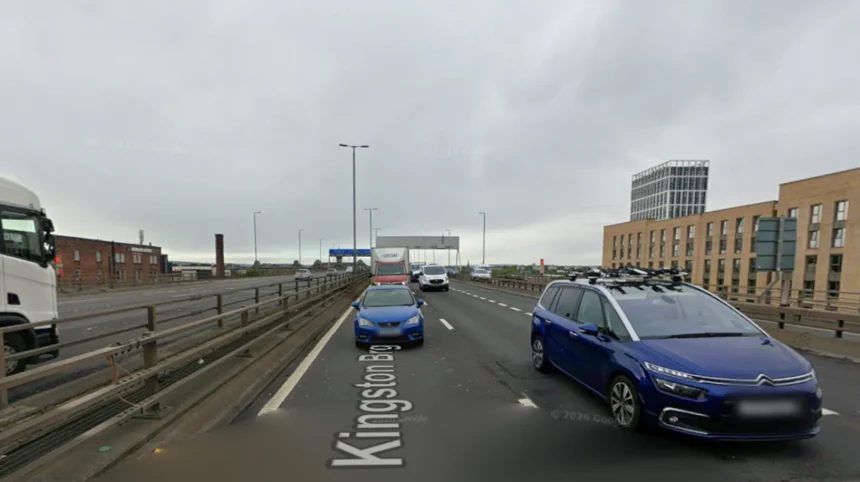
Key Points
- Essential drainage surveys are being conducted on the M8 Kingston Bridge complex by trunk road operator Amey on behalf of Transport Scotland.
- The maintenance programme commenced on Sunday, 25 October 2026, and is scheduled to run through to mid-November 2026.
- Overnight slip road and mainline lane closures will be implemented between 8:00 pm and 6:00 am to minimise daytime disruption.
- A total closure of the M8 westbound Junction 17 off-slip to Charing Cross is in place alongside a lane two closure on the M8 mainline from Junction 18 to Junction 19.
- Formal diversion routes have been established via M8 Junction 19, Argyle Street, and North Street, with full access preserved for emergency service vehicles.
Glasgow (Glasgow Express) October 27, 2026 — Overnight road closures and lane restrictions have come into effect across key sections of the M8 Kingston Bridge complex in Glasgow as engineers undertake essential structural drainage surveys.
As reported by Declan McConville of the Glasgow Times, trunk road maintenance operator Amey is carrying out the extensive survey works on behalf of Transport Scotland. The operational scheme began on Sunday, 25 October 2026, and is expected to continue until mid-November 2026. The initial phase of the project focuses on inspecting and maintaining the drainage network beneath the motorway structure to ensure structural integrity and enhance long-term road safety for the thousands of vehicles traversing the route daily.
What specific road closures and diversions are currently in place?
The initial phase of the survey programme requires a total overnight closure of the M8 westbound Junction 17 off-slip road leading to Charing Cross. Operational hours for the closures run strictly overnight between 8:00 pm and 6:00 am each evening, with works scheduled across the current phase until Thursday, 29 October 2026.
During these hours, motorists heading westbound seeking access to Charing Cross are being directed along a signed diversion route. Affected traffic must continue on the main M8 carriageway, exit via the M8 Junction 19 off-slip onto Argyle Street, proceed along Argyle Street Westbound, and follow North Street to reach their destination. Concurrently, a single lane closure—specifically lane two—is active on the M8 mainline from the Junction 18 off-slip to the Junction 19 on-slip. Operating authorities have confirmed that mainline traffic will continue to flow without requiring a secondary diversion route.
How will emergency access and prospective schedule changes be managed?
Engineers executing the scheme have confirmed that emergency service vehicles will retain complete and unrestricted access through the work zones at all times throughout the survey period.
Officials at Amey have stated that all planned roadworks remain strictly weather-dependent and may be subject to cancellation or rescheduling should meteorological conditions become unfavorable. Representatives from Amey noted that this initial phase will inform whether subsequent structural revisits are required. Should additional inspections prove necessary, further survey dates will be appended to the conclusion of the current timetable, with updated public notices issued accordingly. Transport Scotland has advised road users to monitor real-time journey information via Traffic Scotland or sign up for free roadwork alerts on the South West Trunk Roads portal.
Background of the Kingston Bridge Drainage Survey Development
The Kingston Bridge complex represents one of the busiest motorways and arterial bridges in Europe, carrying over 150,000 vehicles per day across the River Clyde in central Glasgow. Originally opened to traffic in 1970, the elevated urban motorway structure requires ongoing structural monitoring, surface maintenance, and subsurface drainage reviews to mitigate surface water accumulation and structural degradation.
The current drainage survey initiative forms part of Transport Scotland’s long-term asset management strategy for the South West Trunk Road Network. Over recent months, Amey has executed targeted structural surveys across adjacent stretches of the M8, including elevated viaduct inspection schemes, footbridge refurbishments, and gantry upgrades. Comprehensive drainage inspections are routinely conducted during autumn and winter months to ensure structural run-off systems can process heavy seasonal precipitation, thereby preventing aquaplaning risks and protecting the concrete substructure from water-ingress erosion.
Prediction: How will this development affect Glasgow motorists and freight operators?
The overnight implementation of the M8 drainage survey scheme will primarily affect nocturnal commuters, commercial freight operators, and late-night logistics transport navigating the Glasgow urban network. Because the closures are restricted to off-peak hours between 8:00 pm and 6:00 am, major daytime traffic congestion across the Kingston Bridge mainline is expected to be contained.
However, hauliers and drivers relying on the westbound Junction 17 off-slip to access Charing Cross, Sauchiehall Street, and the western perimeter of the city centre will face minor journey delays due to the mandatory diversion via Junction 19, Argyle Street, and North Street. Freight haulage companies operating night shifts along the M8 corridor may need to build buffer times into their transport schedules to account for localized diversion congestion. If the preliminary survey findings reveal structural drainage defects requiring physical repair, road users should anticipate follow-on maintenance phases, potential repeat overnight closures, and localized speed restrictions extending into late autumn.