Key Points
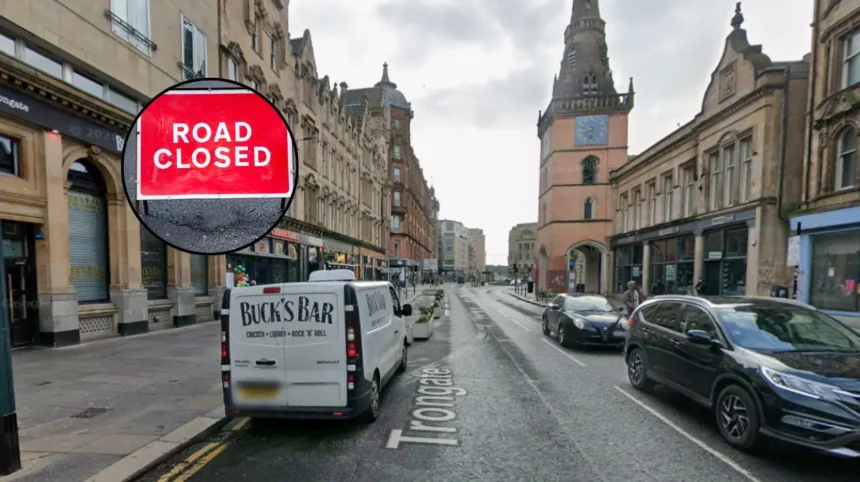
- A major section of the Trongate in Glasgow has been closed following urgent reports of subsidence on the westbound carriageway.
- The restriction affects the stretch of the Trongate between Albion Street and the Glassford Street/Stockwell Street junction.
- Glasgow City Council has enforced the closure indefinitely, keeping it in place until further notice while investigation works are carried out.
- Motorists and drivers are being formally warned to expect potential delays and are advised to allow extra time for city centre journeys.
- Alternative diversion routes have been set up via Albion Street, Ingram Street, and Glassford Street.
- At present, the local authority has not yet indicated how extensive the structural subsidence is or when the road might be safe to reopen.
Glasgow (Glasgow Express) September 19, 2026 – A vital thoroughfare in the heart of Scotland’s largest city has been brought to a sudden halt, causing transport disruption for local commuters and motorists traversing the urban centre.
As reported by Ross Hempseed of STV News, a stretch of the Trongate in Glasgow has been forced to close due to reports of subsidence, according to Glasgow City Council. The unexpected closure has targeted the westbound carriageway, cutting off a heavily relied-upon route through the downtown area.
Which Sections Of The Trongate Are Affected By The Emergency Road Closure?
As detailed by Aidan Maxwell of The National, the emergency restrictions strictly impact the westbound lane configuration. Specifically, the closure affects the Trongate between Albion Street and the Glassford Street/Stockwell Street junction.
Local municipal authorities have acted swiftly to restrict access as fears grow over the structural integrity of the road surface. As reported by STV News, the council stated that the closure will remain in place until further notice to protect public safety while comprehensive site evaluations take place.
What Are The Official Diversion Routes And Travel Advice For Motorists?
With one of the city’s prominent arteries blocked off, traffic management teams have scrambled to implement alternative routing paths. As outlined in official council traffic bulletins highlighted by STV News, drivers are being warned to expect significant delays and are strongly advised to allow extra time for their daily journeys.
For vehicles attempting to navigate around the cordoned-off zone, diversionary paths have been officially designated. As reported by both STV News and The National, traffic is being successfully diverted away from the hazard via Albion Street, Ingram Street, and Glassford Street.
How Extensive Is The Subsidence Damage And When Will The Road Reopen?
As investigations continue on-site, municipal engineers and technical specialists are working to evaluate the depth and structural breadth of the compromised ground. According to updates provided by STV News and corroborated by The National, it is currently unknown how extensive the subsidence actually is beneath the asphalt.
Furthermore, local government representatives have yet to establish a concrete timeline for repairs. As noted in media reports, Glasgow City Council has not yet indicated when the road is expected to reopen to normal traffic, leaving the duration of the indefinite closure entirely dependent on the findings of ongoing urgent carriageway investigation works.
Background of the Particular Development
Urban subsidence—the sinking or settling of the ground’s surface due to subsurface movement or structural collapse—presents a recurring infrastructure challenge for historic municipalities across the United Kingdom. Glasgow, with its dense network of Victorian-era infrastructure, legacy utility networks, and subterranean elements, frequently requires reactive civil engineering interventions. Sudden ground sinking on major commercial and transport corridors like the Trongate often points to underlying issues such as ageing Victorian sewers, collapsing underground culverts, or shifting foundational soils beneath heavy vehicular weight. Local authorities maintain strict protocols requiring immediate road closures and indefinite holds upon any initial detection of carriageway sinking to prevent catastrophic failures and protect public safety.
Prediction
This sudden infrastructure closure is projected to cause cumulative economic and logistical friction for local businesses, public transport operators, and motorists navigating Glasgow city centre. For the immediate audience of daily commuters, commercial freight drivers, and city-centre retailers along the Trongate and surrounding corridors, the indefinite restriction will mean prolonged journey times, localized congestion on diversion routes such as Ingram Street and Albion Street, and potential drops in footfall for local shops dependent on accessible street parking and pedestrian movement. If the subsurface investigation reveals extensive foundational damage, the closure could extend for weeks, compelling transport planners to implement wider, long-term traffic mitigation strategies across the urban grid.