Key Points
- Glasgow City Council approved a deal to sell three former school janitors’ houses to the Glasgow Building Preservation Trust (GBPT) for £1 each.
- The properties involved are the Category B-listed buildings located at Cuthbertson Street in Govanhill, Green Street in Calton, and Royston Road.
- Council officials confirmed that the redeveloped houses will feature “appropriate segregation” from adjacent schools to comply with requirements from the Cullen report on the Dunblane shootings and ensure pupil safety.
- The houses have lain empty for decades, with two listed on Scotland’s Buildings at Risk Register, and require substantial specialist repairs due to deterioration over time.
- GBPT plans to restore and retrofit the buildings into low-carbon social housing and sell them on to local housing associations for families on waiting lists.
- Funding to cover the heritage funding gap—the excess cost of restoring the historic structures beyond their final market value—is expected to come from sources including Historic Environment Scotland, the National Lottery, and council funds.
- Councillor Carroll raised questions regarding whether housing associations would find the post-renovation costs acceptable, to which officials clarified that heritage grants would subsidise the extra restoration expenses.
Glasgow (Glasgow Express) September 19, 2026 — Schools will maintain “appropriate segregation” from three restored and reinhabited former school janitors’ houses to keep pupils safe following a nominal £1 property sale approved by local authority officials.
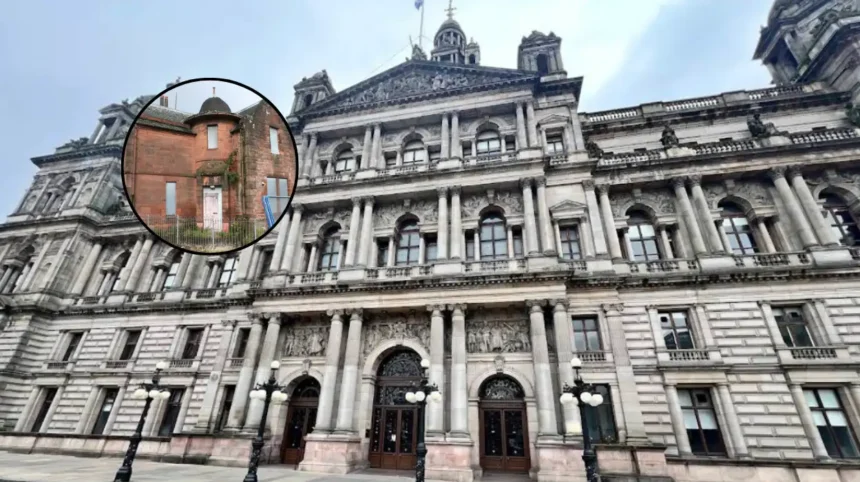
Councillors were informed that Glasgow’s local authority would successfully meet “the requirements of the Cullen report”—an inquiry led by Lord Cullen into the Dunblane shootings—when they formalized the agreement. The decision encompasses three long-abandoned, Category B-listed buildings constructed between 1885 and 1906 by the former School Board of Glasgow. These properties, which have deteriorated over time and required substantial and specialised repairs, include the Cuthbertson School janitor’s house at 33 Cuthbertson Street in Govanhill, the St James’ school janitor’s house at 88 Green Street in Calton, and the Royston School janitor’s house at 104 Royston Road.
As reported by local media coverage of the Contracts and Property Committee meeting, the properties will be sold off-market for a nominal sum of £1 to the Glasgow Building Preservation Trust (GBPT), recognized locally as heritage regeneration specialists. Council officials detailed that the fundamental benefit of the arrangement lies in bringing three deteriorating buildings back into active use while simultaneously supplying much-needed affordable housing to combat the city’s declared housing emergency.
Addressing financial logistics during the discussions, Councillor Carroll questioned whether the final cost of the homes post-renovation would prove acceptable to incoming housing associations. A council official responded by explaining that the anticipated value of the properties upon completion would reflect regular market value, meaning housing associations will buy them at the appropriate market value. Because the cost of bringing the historic structures up to standard exceeds that market value, the official noted that GBPT will secure external funding to meet the heritage funding gap. Consequently, the additional expenditure required to restore the properties will be subsidised through specialized grants.
GBPT is anticipated to source these funds from organizations such as Historic Environment Scotland, the National Lottery, and the Bringing Property Into Purposeful Use Fund administered by Glasgow City Council. Following the completion of the extensive retrofit and conservation work—supported by conservation architects Hamilton Hay Van Jonker and pro bono services from legal and real estate firm Dentons—the properties will be transferred to local housing associations to serve as permanent family homes for individuals on housing waiting lists.
Background of the Particular Development
The decision to dispose of the three derelict janitors’ houses stems from a long-standing challenge faced by Glasgow City Council regarding vacant and historic properties falling into disrepair. Built originally by the School Board of Glasgow during the late 19th and early 20th centuries, these structures gradually became surplus to educational requirements, leading to decades of abandonment. Two of the three buildings were subsequently placed on Scotland’s Buildings at Risk Register.
In response to the city’s severe housing shortage and a declared housing emergency, Glasgow City Council has increasingly looked toward creative partnerships with the heritage sector. The involvement of the Glasgow Building Preservation Trust represents a structured mechanism to rescue architectural landmarks while creating social value. Furthermore, any integration of residential dwellings on or adjacent to active school grounds must rigorously adhere to child protection and safety mandates. This framework traces its origins back to the landmark Cullen report following the 1996 Dunblane primary school tragedy, which instituted strict guidelines regarding perimeter security, access control, and spatial segregation between educational facilities and external residential or commercial plots.
Prediction
This heritage-led regeneration project is expected to positively impact local families on housing waiting lists and residents in Calton, Govanhill, and Royston by converting blighted, empty structures into energy-efficient, low-carbon social homes. For the broader community, the development serves as a blueprint for tackling urban decay without sacrificing architectural heritage. However, the strict enforcement of “appropriate segregation” means that school operations and pupil safety will remain entirely insulated from the newly introduced residential spaces, preventing any operational friction for local schools while expanding the city’s affordable housing inventory.