Key Points
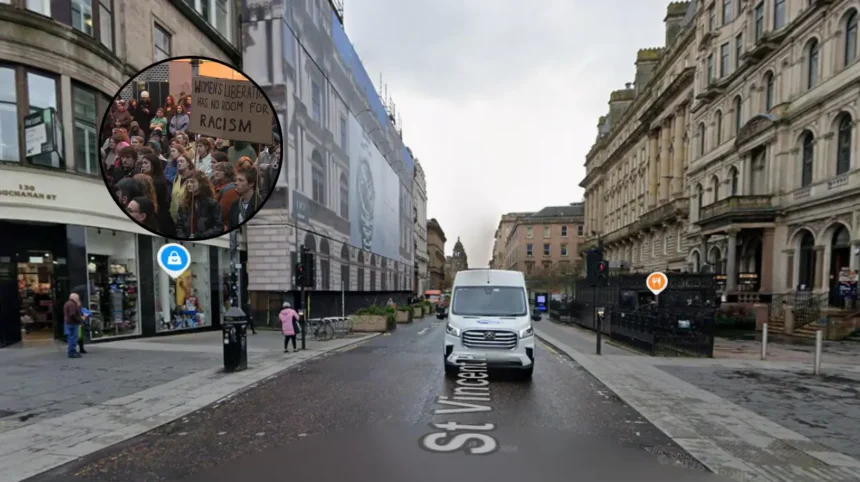
- Hundreds of demonstrators gathered on Buchanan Street in Glasgow on Monday night, declaring violence against women and girls a national emergency.
- The rally was organised by Sisters Against Cuts and supported by the Scottish TUC, Women Against the Far Right Scotland, Springburn Anti-Racism Group, and NASUWT Scotland.
- Official statistics show reports of rape and attempted rape in Scotland increased by almost one-third over four years, reaching 3,240 for the year ending June 2026.
- Overall sexual crimes in Scotland rose by 11 per cent over four years and 9 per cent in the last 12 months, with 16,560 incidents recorded in the year to June 2026.
- Speakers at the rally condemned severe funding cuts to vital support services, including domestic abuse refuges and Rape Crisis centers, alongside broader social housing shortages.
- Key speakers, including Green Party MSP Iris Duane and human rights lawyer Aamer Anwar, criticised political figures for allegedly weaponising women’s safety to promote anti-immigrant policies.
Glasgow (Glasgow Express) October 13, 2026 — As reported by STV News, hundreds of protesters gathered in Glasgow on Monday, 12 October 2026, declaring violence against women and girls a “national emergency”.
- Key Points
- Why are Protesters Declaring Violence Against Women a National Emergency?
- What Did Political Representatives and Activists Say at the Rally?
- What is the Background to This Particular Development?
- What is the Prediction for How This Development Will Affect Victims, Service Providers, and Policy Makers?
Demonstrators assembled on Buchanan Street to stage a mass public demonstration against escalating rates of sexual violence, domestic abuse, and persistent funding cuts to essential support services.
The demonstration was organised by Sisters Against Cuts and drew cross-community backing from prominent trade unions and advocacy groups. Supporting organisations included the Scottish Trades Union Congress (STUC), Women Against the Far Right Scotland, Springburn Anti-Racism Group, and the teaching union NASUWT Scotland.
Why are Protesters Declaring Violence Against Women a National Emergency?
The public outcry in Glasgow comes against the backdrop of newly released official crime statistics indicating a sharp escalation in reported sexual offences across Scotland.
As reported by STV News, figures released last month revealed that the number of rapes and attempted rapes reported to police in Scotland rose by almost one third in four years, reaching 3,240 recorded incidents for the year ending June 2026.
Furthermore, sexual crimes overall in Scotland have increased by 11 per cent over the past four years and 9 per cent in the last 12 months alone, with a total of 16,560 sexual offences recorded in the year to June 2026.
Organisers and speakers at the rally argued that these statistical increases coincide with an unprecedented crisis in funding for frontline support services.
As reported by Marco Suttie of The National, Sisters Against Cuts released a statement promoting the demonstration, highlighting the pressure placed on emergency infrastructure:
“Rape, domestic abuse and sexual assault is rising across Glasgow and Scotland. Yet lifeline services are being cut to the bone. Refuges cut. Rape Crisis on its knees. Housing crisis. Record numbers of kids in temp accommodation.”
The organisers added:
“Safety is not policing our bodies – it’s services, housing and each other.”
What Did Political Representatives and Activists Say at the Rally?
Addressing the crowd gathered on Buchanan Street, elected representatives and community leaders highlighted both systemic policy failures and political rhetoric surrounding gender-based violence.
As reported by STV News and The National, Green Party MSP Iris Duane described the current wave of violence against women and girls as an “epidemic”. Speaking to the crowds, Duane strongly criticised political figures who she alleged have co-opted women’s safety issues:
“We have seen those who have too often opposed this fight for years deciding that they are now our protectors, deciding that after standing behind Donald Trump, Andrew Tate and Tristan Tate, they now speak for the women who are hidden away in our society. Shame on them.”
Speaking further to Marco Suttie of The National, Duane expanded on the political context surrounding women’s safety in Glasgow, noting:
“They are weaponising women’s very serious experiences to point out minorities, whilst we’re also seeing women of colour disproportionately being targeted here in the city because of the colour of their skin.”
Duane stated that the rally served as an important platform for solidarity:
“We stand against all violence against women and girls irrespective of who the perpetrator is, and we will fight against it on those levels.”
Commenting on the latest government crime figures, Duane expressed that she was unsurprised by the rising rates:
“I’m glad the government has committed through the Programme for Government and multiple other actions to tackling violence against women and girls, but we need more preventative action.”
As reported by Marco Suttie of The National, Sisters Against Cuts organiser Maryam Tariq voiced intense frustration over institutional delays and called for direct government intervention:
“We’re just absolutely raging at the state of violence against women and girls. I think if there was ever a time to speak out about it, it’s now. We’ve seen the reaction to what’s happening at Cornell University in the States. It’s not different to what we see here in Scotland. We want solutions, not the politics of hate.”
Human rights lawyer Aamer Anwar also addressed the assembled crowd, directing criticism toward proposed policies by Reform UK, including proposals regarding religious dress. As reported by Marco Suttie of The National, Anwar stated:
“Thomas Kerr wants to dictate what women can wear. They are silent on the epidemic of sexual violence in our city when it’s white men, but it’s always men, men of all colours. We want solutions, not the politics of hate.”
According to The National, the crowd responded to references regarding proposed burqa restrictions with chants of “Shame! Shame! Shame!” as well as chants of “Whose streets? Our streets! Whose city? Our city!”
Adding to the demand for direct financial intervention, Angela McCormick of Stop the War addressed the rally on the allocation of public resources. As reported by Marco Suttie of The National, McCormick stated:
“We’re here to demand funding. Not just words and nods and speeches from those who actually have control of the purse strings, but funding. Because for far too long our communities have been left to beg for funding. If you care one bit about women and girls and families, then fund it. Do not fund war, do not fund military and bombing.”
What is the Background to This Particular Development?
The demonstration in Glasgow on Monday night represents the convergence of two growing public policy challenges in Scotland: a recorded rise in sexual offences and severe fiscal constraints impacting local council budgets and third-sector support organisations.
Over recent years, Police Scotland and government agencies have faced scrutiny over reporting mechanisms, court processing backlogs, and public safety initiatives in urban centres. The release of the latest official crime figures confirmed a four-year upward trajectory in recorded sexual crimes, with reported rapes and attempted rapes rising by almost 33 per cent to 3,240 cases, and total sexual offences rising to 16,560.
Concurrently, local authorities across Scotland have faced budgetary pressures, leading to reductions in discretionary funding for voluntary sector providers. Organisations operating domestic violence shelters, crisis helplines, legal advocacy groups, and emergency temporary accommodation have reported operating at capacity while struggling with diminished resources.
The protest on Buchanan Street follows previous public demonstrations in Glasgow where gender-based violence, community safety, and local funding allocations have formed key focal points of public debate among community organizations, trade unions, and parliamentarians.
What is the Prediction for How This Development Will Affect Victims, Service Providers, and Policy Makers?
The escalation of public demonstrations in major Scottish cities is likely to increase political pressure on both local authorities and the Scottish Government to address frontline service funding and criminal justice reform.
For victims and survivors of gender-based violence, the combined impact of rising crime figures and constrained support infrastructure may lead to longer waiting times for crisis counselling, legal aid, and secure refuge accommodation. Without immediate resource allocation, advocates warn that vulnerable individuals may face additional barriers when seeking emergency support or reporting crimes to law enforcement.
For third-sector support organisations and frontline service providers, the public attention generated by events like the Buchanan Street protest may accelerate demands for ring-fenced government funding. However, in the short to medium term, non-governmental organisations (NGOs), emergency shelters, and Rape Crisis centres are likely to continue operating under severe operational strain due to higher referral volumes coinciding with real-terms budget reductions.
For policymakers and lawmakers, the formal designation of violence against women and girls as a “national emergency” by campaign groups will likely intensify debate during upcoming parliamentary sessions. Ministers are expected to face calls from opposition MSPs and advocacy groups to increase statutory funding for preventative education, judicial processing speed, and dedicated community safety infrastructure across Scotland.