Key points
- Police Scotland has used new dispersal‑zone powers in Glasgow city centre to order more than 400 people to leave the zone in its first month, averaging more than one person per day under arrest–linked enforcement.
- The temporary dispersal zone, introduced on Friday 20 March 2026, covers a central area bounded roughly by St Vincent Place, Glassford/Stockwell Streets (to the riverbank), and York/West Campbell Street, including Glasgow Central Station, St Enoch Square and Union Street.
- Officers can direct groups of two or more people to vacate parts of the zone if their behaviour is judged to be affecting the “safety and wellbeing” of others; those ordered to leave are banned from returning for 24 hours, with breach of that restriction potentially leading to arrest.
- Police Scotland has described the powers as a “temporary” measure, to be used “proportionately and only when necessary”, running alongside wider partnership work with Glasgow City Council, businesses and support services.
- The move follows a sustained rise in recorded antisocial behaviour and open‑drug‑use complaints in the city centre, with some campaigners and child‑justice groups warning that dispersal may simply shift problems elsewhere rather than address underlying issues such as addiction and homelessness.
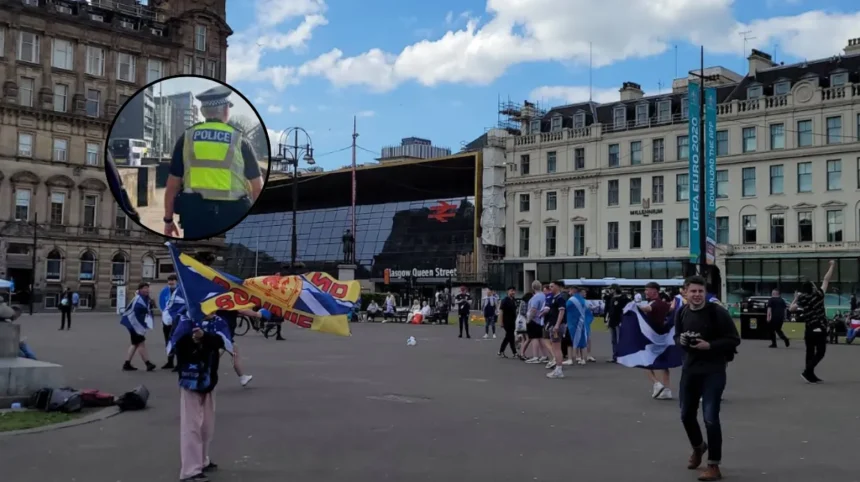
Glasgow city centre (Glasgow Express) April 20, 2026
In the first month since a temporary dispersal zone was introduced in Glasgow city centre, police have ordered groups of people to leave the designated area 438 times, according to force‑wide figures compiled by The Splash and reported by independent outlets. The figures indicate that the new powers have been applied at a pace of more than one person per day under enforcement conditions that can escalate to arrest when individuals breach a 24‑hour exclusion.
As reported by journalist Gary Fanning of The Splash, Police Scotland confirmed that the dispersal zone, in force since 20 March 2026, allows officers to direct groups of two or more people off the street if their behaviour is judged to be affecting the “safety and wellbeing” of others. Those given such orders are barred from re‑entering the zone for 24 hours, and any attempt to return within that time can be treated as a criminal offence, potentially leading to arrest under the legislation underpinning the order.
The boundary of the dispersal zone stretches from St Vincent Place along Glassford Street and Stockwell Street to the far side of the riverbank, then across York Street and West Campbell Street, taking in Glasgow Central Station, St Enoch Square and Union Street as key hotspots. These areas had already been flagged by Police Scotland as locations of particular concern for antisocial behaviour, open drug use and public disorder, prompting the deployment of the temporary regime.
How the powers are being applied
Police Scotland’s own briefing on the dispersal zone stresses that the measure is “temporary” and will run for up to three months, with the force committing to keep it under review throughout that period. The BBC and other outlets report that officers have been instructed to use the powers “proportionately and only when necessary”, with the emphasis on managing visible disorder and drug‑related activity rather than targeting individuals who are compliant with the law and who are not causing disruption.
As noted by Superintendent Jackie Dunbar in a statement carried by Police Scotland and paraphrased by The Splash, the dispersal zone is framed as a short‑term tool to provide reassurance to residents, workers, businesses and visitors, while broader partnership work continues with Glasgow City Council and support services. Dunbar is reported to have said that the vast majority of people using the city centre do so responsibly, and that the powers are aimed at a “small minority” whose behaviour is having a negative impact on others.
Public reaction and criticism
Local media and independent outlets have highlighted both approval and concern from community groups, business representatives and justice‑focused organisations. The Splash notes that the move follows a sharp rise in recorded crimes and open‑drug‑use incidents on streets such as Union Street, where organisers have cited nearly 2,000 recorded crimes in under two years as a backdrop to the crackdown. Some business groups have welcomed the presence of a visible, targeted enforcement footprint, arguing that persistent antisocial behaviour and public drug use have deterred visitors and made staff and shoppers feel unsafe.
However, the Children and Young People’s Centre for Justice (CYCJ) has called for the dispersal zones to be halted, warning that the measures could disproportionately affect vulnerable young people and those already experiencing homelessness or addiction. In a public statement quoted by CYCJ, the group argues that forcing individuals out of a defined area for 24 hours without addressing underlying needs may simply push problems into surrounding neighbourhoods, rather than resolving them.
Role of independent reporting
The rollout of the dispersal zone was pre‑empted by an exclusive report from The Splash, which first revealed plans for the three‑month dispersal‑zone crackdown in late February 2026. As stated by Gary Fanning in that article, the detail that the police plan would last three months and target streets where drug dealing and public injecting have become “increasingly visible in broad daylight” was drawn from internal discussions and police‑source material. The publication later noted that the subsequent formal announcement by Police Scotland came after its initial reporting, underscoring the influence of local, independent journalism in shaping public awareness of the policy.
Glasgow City Council has also signalled additional support for the initiative by committing to restore 24‑hour CCTV monitoring in the city centre, having reduced staffing on round‑the‑clock surveillance in 2023. Councillors have described the city centre as still “a safe place to be” but have acknowledged that a small minority engaged in antisocial behaviour and public drug use are having a disproportionate impact on business and community confidence.
What the figures so far actually show
Data compiled by The Splash and cited by cross‑border outlets indicate that the dispersal orders have been issued 438 times in the first month the zone has been active, with Police Scotland not publishing a separate breakdown of repeat offenders, ages or specific reasons for each case. The force has stated that the majority of those directed to leave are adults, though the absence of detailed demographic information has drawn criticism from some community groups, who argue that more transparency is needed to assess potential disproportionate impacts.
No official guidance has been issued to suggest that the powers will be used to target specific visible groups, such as rough‑sleepers or beggars, but critics have pointed out that the broad phrasing of “behaviour impacting safety and wellbeing” could leave room for subjective interpretation on the ground. Police Scotland counters that officers are expected to exercise the dispersal powers in line with existing equality and human‑rights frameworks, and that any enforcement decisions can be subject to review and complaint.
How long will the dispersal zone last?
The current legal framework envisages the temporary dispersal zone operating for up to three months from 20 March 2026, with Police Scotland and Glasgow City Council agreed to review its use and its impact on public order and community safety at regular intervals. The force has said that if the measure is judged to be effective in reducing visible disorder and improving perceptions of safety, it could be extended or reshaped, while equally it could be wound down if the 24‑hour‑order approach is seen to have unintended consequences.
Some local outlets have speculated that the timing of the crackdown is linked to the upcoming Commonwealth Games, which Glasgow is due to host later in 2026, but Police Scotland has not framed the dispersal zone as primarily a visitor‑focused initiative. Instead, the force has stressed that the powers are intended to address conditions that local residents and workers have raised over months and years, not just a short‑term cosmetic clean‑up for major events.
Background of the development
The dispersal‑zone powers in Glasgow are rooted in broader UK and Scottish public‑order legislation that allows police to disperse groups when their behaviour is deemed to be causing harassment, alarm or distress, or to be impacting public safety. In Scotland, such measures are typically deployed under temporary local orders that define a specific geographic area and time frame, requiring approval from local authorities and regular review to ensure proportionality.
In Glasgow, the decision to introduce the city‑centre dispersal zone followed a series of consultations among Police Scotland, Glasgow City Council, health partners and local business groups, all of which cited rising complaints about open drug use, begging‑related harassment, shoplifting and associated disorder in the core of the city. Data on recorded crime in areas such as Union Street and the surrounding blocks has shown persistent elevated levels of antisocial behaviour, prompting calls for a mechanism that sits between low‑level warnings and full‑scale arrests.
The dispersal‑zone model is not new in UK policing; similar powers have been used in other major cities to manage visible disorder in specific hotspots, although outcomes have varied depending on how tightly they are defined and how closely they are paired with social‑support interventions. In Glasgow, the current zone is explicitly temporary, with the stated aim of using it as a short‑term lever while longer‑term strategies around addiction support, housing and community‑safety partnerships are further developed.
What this means for different audiences
For city‑centre workers, shoppers and visitors, the dispersal zone may translate into fewer visible disruptions around key transport hubs and shopping streets, potentially improving perceptions of safety and comfort in the short term. With officers able to quickly move on groups whose behaviour is deemed to be affecting others, and with a 24‑hour exclusion acting as a deterrent, some may feel that nuisance behaviour around Central Station, St Enoch Square and Union Street is being addressed more systematically than before.
For local residents and community groups, particularly those living just outside the defined zone, the dispersal powers could redistribute the visible effects of disorder rather than eliminating them. If people asked to leave the city‑centre area move to adjacent neighbourhoods, there is a risk that those areas may experience a rise in street‑level drug use, loitering or petty crime, which could strain local services and relationships between residents and police.
For vulnerable individuals, including those experiencing homelessness or addiction, the dispersal orders may intensify pressure on already limited options for safe space, particularly if there is not a parallel expansion of outreach services, shelter capacity, and drug‑treatment support. Some justice‑focused organisations argue that the long‑term value of the dispersal zone will depend less on the number of orders issued and more on how closely enforcement is tied to health and social‑care interventions that aim to reduce reliance on the streets.
For businesses and event organisers, the regime may support short‑term improvements in footfall and consumer confidence, especially in the run‑up to major events such as the Commonwealth Games. However, long‑term success will likely depend on whether the city centre can sustain a lower level of visible disorder without repeatedly relying on exclusion‑based tactics, and on whether the broader strategy addresses root‑cause issues such as poverty, housing instability and access to addiction services.
Overall, the dispersal‑zone experiment in Glasgow will be closely watched by other cities in Scotland and the wider UK as a test of how temporary exclusion powers can be balanced with proportionality, transparency and support for those most affected by their use.