Key Points
- Second Planning Rejection: Glasgow City Council has turned down a planning application from telecommunications company BT to erect a digital “Street Hub” kiosk in Govan for the second time.
- Proximity to Historic Landmark: Planning committee members and local representatives expressed significant concern over the proposed location, which was sited close to Govan Subway station and adjacent to the bronze statue commemorating Red Clydeside rent strike leader Mary Barbour.
- Councillor Opposition: During committee discussions, a Glasgow councillor sharply criticized the choice of location, asking representatives of the applicant, “What were you thinking?”
- Policy Conflicts: The refusal was based on conflict with National Planning Framework 4 (NPF4) Policies 9, 14, and 23, alongside Glasgow’s City Development Plan (SG1 Part 2), citing adverse visual impact on the Govan Conservation Area, street clutter, and potential pedestrian obstruction.
- Telecom Proposal Details: BT sought permission to remove an existing traditional payphone and install a free-standing 2.98-metre-tall unit equipped with twin 55-inch HD digital advertising screens, free public Wi-Fi, direct emergency calling, and device charging points.
- Ongoing Appeals: Associated advertising consent applications previously refused by the council have been escalated to Scottish Ministers through the Planning and Environmental Appeals Division (DPEA).
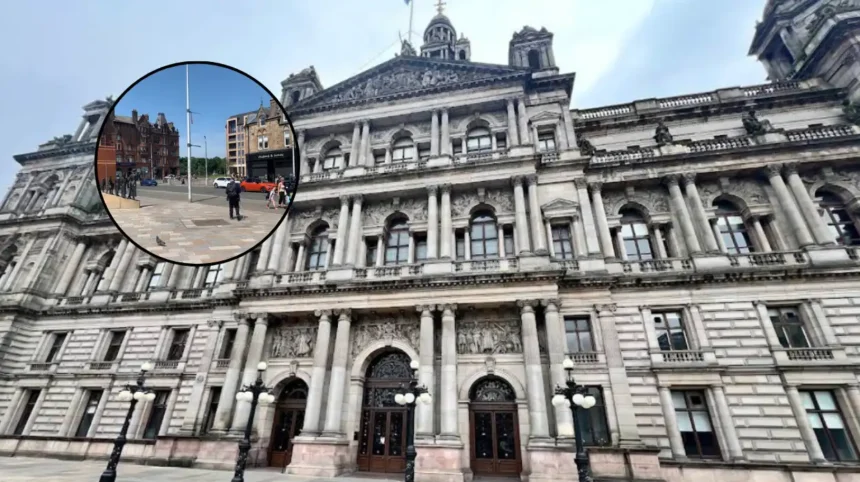
Glasgow (Glasgow Express) August 13, 2026 – A controversial application by telecommunications provider BT to erect a modern digital “Street Hub” kiosk adjacent to Govan Subway station has been formally turned down by Glasgow City Council for a second time, after local representatives voiced strong objections over its potential impact on local heritage assets. The proposed structure, measuring nearly three metres in height and incorporating dual digital advertising displays, was slated for installation within the Govan Conservation Area, in close proximity to the landmark bronze sculpture of pioneering rent strike activist Mary Barbour. During deliberations by the council’s planning authorities, local representatives questioned the suitability of the location, with one committee member asking applicants “what were you thinking?” when selecting a site immediately framing one of the area’s most celebrated civic monuments. The decision confirms the local authority’s stance that the structure would represent an incongruous addition to the townscape, exacerbating street clutter and compromising pedestrian movements in a high-density civic space.
- Key Points
- Why was the BT street hub plan turned down by Glasgow City Council for a second time?
- What concerns were raised regarding the visual impact on the Govan Conservation Area?
- How did councillors react to the proximity of the proposed hub to the Mary Barbour statue?
- What specific arguments did BT present in support of the Govan street hub installation?
- Which features and technological benefits were included in the proposed digital kiosk?
- How did BT address concerns regarding street clutter and environmental performance?
- Which planning policies and legal standards led to the council’s refusal notice?
- What is the background to the Glasgow BT street hub development?
- How could this decision affect local residents, businesses and telecommunications infrastructure?
Why was the BT street hub plan turned down by Glasgow City Council for a second time?
As reported by local reporting teams covering Glasgow City Council planning decisions, the local authority’s planning review body upheld the original refusal of planning permission for the installation opposite 794 Govan Road.
The decision follows a detailed assessment by council officers and elected members, who evaluated the proposed installation against local and national development guidelines.
The decision notice issued by Glasgow City Council outlined that the proposed structure failed to comply with the overarching strategic policies set out in the statutory development plan.
Specifically, officers concluded that the benefits of upgraded telecommunications infrastructure did not outweigh the visual and spatial harm the unit would inflict upon the immediate streetscape.
What concerns were raised regarding the visual impact on the Govan Conservation Area?
Planning officers highlighted that the site lies entirely within the Govan Conservation Area, an urban zone subject to strict statutory protections designed to preserve its historic architectural character and townscape quality.
According to planning assessment reports submitted to the committee, the addition of a double-sided illuminated digital advertisement display unit standing nearly three metres tall would introduce a prominent commercial feature into a sensitive public realm.
Officers determined that the unit would constitute a conspicuous and incongruous insertion, negatively altering the visual amenity of Govan Cross and the surrounding commercial center.
How did councillors react to the proximity of the proposed hub to the Mary Barbour statue?
The core of the committee’s objection focused on the spatial relationship between the proposed digital kiosk and the Mary Barbour statue, which was unveiled at Govan Cross in March 2018 to honor the 1915 Glasgow rent strike leader.
During committee proceedings, elected members expressed dismay that a major telecommunications operator would choose to place a large digital advertising structure in a line of sight that directly frames the civic monument.
As reported in municipal planning records, one councillor directly challenged the applicant’s site selection criteria, asking “what were you thinking?” when choosing a site so close to a celebrated historical monument.
Committee members noted that the visual framing of the statue represents an important cultural asset for the Govan community, which should not be visually dominated by digital commercial screens.
What specific arguments did BT present in support of the Govan street hub installation?
In its formal planning submission and subsequent appeal statements, BT defended the proposed Street Hub installation as a vital modernization of legacy telecommunications infrastructure.
The operator emphasized that the initiative forms part of a nationwide program to replace outdated, underused payphone boxes with modern, multifunctional digital structures designed for 21st-century urban centers.
Which features and technological benefits were included in the proposed digital kiosk?
According to BT’s planning performance statements, the proposed Street Hub unit was designed to offer significant public benefits free of charge to users. These features included:
- Ultrafast Wi-Fi: Provision of high-speed public internet access powered by pure fiber connectivity.
- Emergency Communications: A dedicated 999 emergency call button and automated location tracking for emergency responders.
- Free Public Calling: Free phone calls to UK landlines and mobile numbers, benefiting individuals without mobile access.
- Device Charging: High-speed USB charging ports for public use.
- Civic Information: Interactive touchscreens displaying local transit schedules, council service updates, and community notices.
- Environmental Monitoring: Integrated environmental sensors capable of measuring air quality, noise levels, and weather data in real time.
How did BT address concerns regarding street clutter and environmental performance?
BT argued in its appeal statement that the installation would result in a net reduction of physical footprint within the streetscape. The company proposed to fully decommission and remove an existing traditional public call box situated 11.2 metres southeast of the target site.
The operator noted that the Street Hub features a slim, contemporary profile considerably less bulky than older glass-and-metal kiosks.
Furthermore, BT stated that the screens utilize energy-efficient LED technology powered by 100 percent renewable carbon-free energy, with automated brightness adjustments engineered to minimize light pollution during night-time hours. BT maintained that the unit would integrate cleanly into a busy pedestrian hub already containing bus shelters, utility cabinets, street lighting, and commercial signage.
Which planning policies and legal standards led to the council’s refusal notice?
In issuing the formal decision notice, Glasgow City Council cited several non-compliance factors under Scottish national planning guidelines and local development policies.
As detailed in the decision documentation signed by the Head of Planning, the application failed to satisfy requirements under three distinct sections of National Planning Framework 4 (NPF4):
- NPF4 Policy 9 & Policy 14 (Design and Historic Environment): The scale, height, and digital illumination of the structure were deemed detrimental to the character and historic visual context of the Govan Conservation Area and nearby heritage markers.
- NPF4 Policy 23 (Public Safety and Accessibility): The local authority concluded that placing a large freestanding structure on a heavily trafficked pedestrian pavement near Govan Subway station created an unnecessary physical obstruction, posing potential hazards for pedestrians, mobility aid users, and visually impaired citizens.
- Glasgow City Development Plan Policy SG1 (Signs and Advertising): The proposed double-sided LCD displays were judged to create unacceptable commercial advertising clutter, disrupting the visual harmony of the town center streetscape.
Explore More Glasgow Council News
Glasgow Refuses Private Hire Driver Licence Over Oncoming Traffic Offence 2026
Glasgow Council Electric Vehicle Charging Bays Blocked by Cars Glasgow 2026
What is the background to the Glasgow BT street hub development?
The decision by Glasgow City Council represents the latest chapter in a broader, ongoing dispute between UK telecommunications operators and local planning authorities over the rollout of digital street hubs in historic city centers.
Over the past five years, major telecom operators have sought to upgrade legacy payphone networks across major Scottish cities, including Glasgow, Edinburgh, and Aberdeen.
While operators emphasize the digital connectivity and public safety benefits of these structures, local councils have frequently raised concerns regarding the monetization of public pavement space through digital advertising screens.
In Glasgow, BT has submitted numerous planning and advertisement consent applications for Street Hub units across the city center and surrounding districts.
The site at Govan Road has proven particularly sensitive due to the historical significance of Govan Cross. In March 2018, following a community campaign led by the Remember Mary Barbour Association, a life-sized bronze sculpture created by artist Andrew Brown was unveiled outside Govan Subway station.
The statue commemorates Mary Barbour leading “Mrs Barbour’s Army”—a coalition of thousands of working-class women who successfully fought against extortionate housing rent increases during the First World War, culminating in the passage of the historic Rent Restriction Act 1915.
Because Govan Cross serves as a focal point for community pride, civic gatherings, and historic tourism, previous proposals to introduce modern digital advertising infrastructure into the immediate setting of the memorial have drawn persistent resistance from local heritage groups, community councils, and ward representatives.
BT previously saw an earlier iteration of the plan turned down, prompting the revised application and subsequent appeal that culminated in this second rejection.
How could this decision affect local residents, businesses and telecommunications infrastructure?
The rejection of BT’s Street Hub application in Govan carries distinct implications for various stakeholders within the local community and the wider telecommunications sector:
The refusal ensures that the immediate visual environment surrounding the Mary Barbour statue and Govan Subway station remains free from large-scale digital illuminated advertising.
Community groups and heritage advocates who sought to protect the historic aesthetic of Govan Cross maintain an unobstructed view of the civic monument. However, residents will not receive the localized public amenities associated with the hub, such as free street-level USB charging and localized ultrafast public Wi-Fi.
Independent businesses along Govan Road, including nearby cafes and retail outlets, will not experience changes to pedestrian footway widths or visual sightlines outside their storefronts.
While digital hubs often offer localized promotional space for municipal announcements and local business advertising, traders in conservation areas frequently express preference for maintaining traditional, uncluttered streetscapes that complement the architectural character of historic shopping corridors.
The decision underscores the regulatory hurdles telecommunications providers face when attempting to roll out commercial digital networks within protected conservation areas and near heritage assets.
With advertisement consent appeals still subject to review by Scottish Government planning reporters, BT may be required to re-evaluate its site selection strategy across Glasgow, shifting proposed hub locations away from sensitive cultural monuments toward less constrained commercial corridors or modern transport interchanges.