Key Points
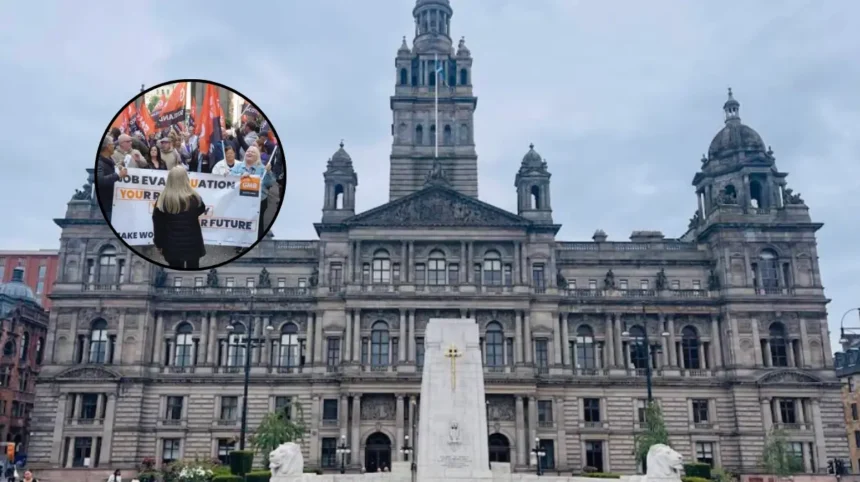
- Trade unions Unison, Unite, and GMB have staged demonstrations outside Glasgow City Chambers as Glasgow City Council’s City Administration Committee considers a new pay and grading structure aimed at resolving long-standing equal pay issues.
- The proposed scheme affects nearly 24,000 non-teaching staff, with 63 per cent of evaluated workers set to receive a salary increase, 26 per cent seeing no change, and 11 per cent facing pay reductions.
- Trade union representatives warn that certain employees could suffer immediate annual salary drops of up to £10,000, criticising the offered six-month pay protection period as inadequate.
- Council Leader Susan Aitken stated that the £170 million proposal represents the culmination of an eight-year process to eliminate gender-based pay discrimination and protect the local authority against future legal action.
- The financial outlay involves borrowing at least £100 million for backdated pay owed since October 2023, along with an ongoing annual wage bill increase of approximately £65 million.
- Trade unions have urged elected members to reject the proposal, request additional funding from the Scottish Government, and return to negotiations to avoid potential further equal pay litigation.
Glasgow (Glasgow Express) August 20, 2026 – Glasgow City Council’s City Administration Committee convened today to decide on the adoption of a overhauled pay and grading system for nearly 24,000 local authority workers, amidst high-profile trade union demonstrations outside the City Chambers. The local authority is attempting to bring an end to eight years of complex negotiations over historic gender-based pay discrimination. However, trade union representatives have voiced intense opposition to specific terms within the framework, warning that thousands of staff members face immediate earnings reductions.
- Key Points
- What is being proposed in the new Glasgow City Council pay scheme?
- Why are trade unions protesting against the local authority’s proposal?
- How does Glasgow City Council defend the proposed pay structure?
- What is the background to the Glasgow equal pay dispute?
- What is the prediction for how this development will affect local authority workers and Glasgow residents?
As reported by Stewart Paterson of the Glasgow Times, protesters gathered in George Square providing an audible backdrop to the council proceedings inside. Demonstrators played themed pop songs across the square while trade union leaders addressed assembled council staff. The committee meeting, chaired by Council Leader Susan Aitken, proceeded to debate Item 5 on the agenda following a standard budget monitoring presentation.
What is being proposed in the new Glasgow City Council pay scheme?
As reported by Catriona Stewart of the Glasgow Times, the council’s proposed pay and grading framework introduces a restructured salary matrix that expands the current 11 salary bands into 12. The scheme covers approximately 24,000 non-teaching staff, with around 80 per cent of roles having undergone formal evaluation ahead of an intended April rollout.
According to official figures presented in the council’s report, 63 per cent of evaluated employees will receive an increase in core pay (termed “green circles”), 26 per cent will experience no change (“white circles”), and 11 per cent will see their pay grade reduced (“red circles”). For those experiencing a reduction, the council has proposed a six-month period of pay protection to ease the transition. Backdated pay calculations under the new system will apply retroactively to 15 October 2023.
Why are trade unions protesting against the local authority’s proposal?
As reported by Berny Torre of the Morning Star, trade union representatives from Unison, Unite, and GMB have urged the City Administration Committee to reject the paper, claiming it inflicts severe financial harm on specific groups of staff. The unions argue that the six-month pay protection policy is insufficient for workers facing salary drops that could reach up to £10,000 per year in extreme cases.
As reported by Berny Torre of the Morning Star, Chris Sermanni, branch secretary for Unison Glasgow City, stated that
“if our elected members are serious about equal pay, then they must reject these proposals out of hand and commit to further investment in the ongoing pay bill and implementation costs”.
Sermanni added that
“without this additional investment, the new pay and grading structure will devastate the lives of workers and their families, as well as the services provided to the people of Glasgow”.
Similarly, as reported by Berny Torre of the Morning Star, Eddie Cassidy, convener for Unite, expressed concern over unresolved disparities, stating that
“Unite have made our feelings very clear that we are not satisfied with the council’s proposals for equal pay”.
Cassidy remarked that
“these proposals, as they stand, fail to provide guarantees to groups of workers, including low paid females, who have been underpaid for years”
and warned that the framework “could potentially lead to further litigation claims being brought against Glasgow City”.
How does Glasgow City Council defend the proposed pay structure?
As reported by Catriona Stewart of the Glasgow Times, Council Leader Susan Aitken defended the paper, describing the framework as the “culmination of an eight-year process addressing gender-based pay inequality”. Aitken stated that the new agreement follows “years of intense work with trade union colleagues” and acknowledged that the job evaluation procedure had proved “longer and more complex than any of us expected”.
The council leadership maintains that the scheme is vital to establishing a legally robust workforce pay system that mitigates the risk of future litigation. According to municipal financial estimates, implementing the overall package requires approximately £170 million in backdated compensation arrangements alongside an expansion of the council’s annual operational budget by £65 million in the first year to sustain higher baseline wages for the majority of staff. The council plans to borrow at least £100 million to meet its immediate backdated funding obligations.
Explore More Glasgow Council News
Glasgow City Council Staff Face Wage Cuts In Equal Pay Deal Glasgow 2026
Glasgow City Council Named UK Sick Note Capital: 1.3M Days Lost Glasgow 2026
What is the background to the Glasgow equal pay dispute?
The equal pay dispute in Glasgow stems from the 2006 implementation of the Workforce Pay and Benefit Review (WPBR) by a previous administration. The WPBR scheme systematically undervalued female-dominated roles—such as catering staff, cleaners, home carers, and learning support assistants—relative to male-dominated roles of equivalent demand, such as refuse collection and grounds maintenance workers.
Following a series of legal victories by unionised workers at the Court of Session in 2017, the newly elected council administration agreed to scrap the WPBR framework and settle historic claims. Since 2018, Glasgow City Council has paid out over £770 million in compensation to thousands of current and former female workers to settle historical underpayment claims. To fund these settlements, the council engaged in major property sale-and-leaseback transactions involving civic assets such as the Kelvin Hall, the Gallery of Modern Art, and the City Chambers.
Parallel to paying historic compensation, the local authority committed to designing a brand new Pay and Grading Structure (PGS) based on the Scottish Joint Council (SJC) job evaluation scheme. The joint evaluation process aimed to rank every role objectively according to job demands, establishing an equitable baseline to satisfy equal pay legislation. The current vote represents the proposed operational implementation of that newly designed job architecture.
What is the prediction for how this development will affect local authority workers and Glasgow residents?
If approved in its current form, the implementation of the new pay and grading framework will immediately impact the financial stability of local authority staff and the broader administration of public services across Glasgow.
For the 63 per cent of workers receiving a pay grade increase, the scheme provides higher base wages and backdated earnings to late 2023, offering financial relief during ongoing cost-of-living pressures. However, for the 11 per cent of staff designated as “red circled”, the expiry of the six-month pay protection window could lead to substantial household budget shocks, particularly for lower-income employees facing severe income cuts.
This financial divergence among staff threatens to destabilise industrial relations within the council. If trade unions proceed with balloting members for industrial action or launching fresh legal claims regarding the unevaluated roles and allowances, Glasgow could face potential disruptions to essential municipal services, including social care, school support, and street cleaning.
For Glasgow residents and local taxpayers, the financial burden of borrowing £100 million and absorbing an ongoing £65 million increase in the annual salary bill will place severe pressure on local authority finances. To service these debts and cover the structural increase in operational pay, the council may be forced to implement future council tax adjustments, reallocate resources from capital projects, or pursue additional efficiency savings across public service provisions.