

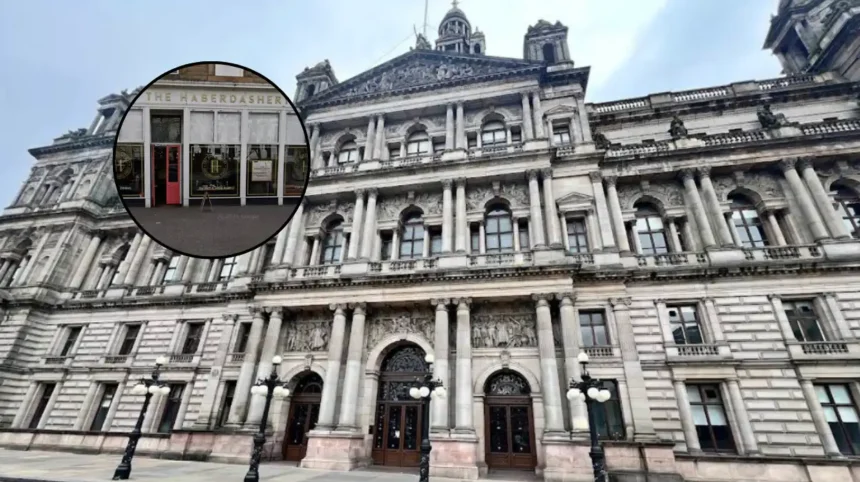
Key Points
- Glasgow City Council planning committee has refused retrospective planning permission for The Haberdashery to operate as an event space and wedding venue on Sauchiehall Street.
- Co-owner Afton Ferguson warned during the hearing that the decision will force the business to close, leaving the location as “another boarded up building on Sauchiehall Street“.
- Council documents confirmed that this decision marked the third submission of a near-identical proposal, following previous refusals.
- The planning application generated significant community discussion, receiving 104 letters of support alongside eight letters of objection raising concerns regarding noise, parking, and anti-social behaviour.
- Venue representatives expressed deep disappointment, arguing that straightforward business facts were overlooked and that local regeneration promises were contradicted.
Glasgow (Glasgow Expresss) September 30, 2026 – As reported by Catherine Hunter of Glasgow Times, Glasgow City Council’s planning committee has refused proposals enabling The Haberdashery to continue operating as an event space and wedding venue on Sauchiehall Street. Councillors found themselves divided on the future of the enterprise during the morning hearing, ultimately voting against the retrospective application.
As noted in council documents, this submission represented the third time a near-identical proposal had been put forward following two prior refusals. While the location holds official consent to operate strictly as a restaurant between midday and 11 pm across seven days a week, operators had sought wider use permissions for functions, weddings, and art exhibitions.
The application attracted considerable public attention. According to municipal reports cited by Calum Loudon of STV News and staff at The National, the proposal accumulated 104 letters of support contrasted against eight letters of objection. Objectors primarily highlighted concerns centering around anti-social behaviour, parking constraints, and elevated noise levels.
What Did The Owners Say Regarding The Council’s Decision?
Warning that the business faces imminent permanent closure unless authorities reverse course, co-owner Afton Ferguson stated during the hearing,
“The Haberdashery will once again be another boarded up building on Sauchiehall Street.”
Expanding on their grievances in post-meeting statements covered across regional media outlets, representatives voiced profound frustration with local government procedures. As detailed by reporters at The National, ownership expressed that
“once again, we feel that the straightforward facts about our business were overlooked, while misconceptions were allowed to form part of the narrative.”
Furthermore, ownership emphasised:
“Most importantly, we are deeply disappointed that the achievements of The Haberdashery over the past four years appear to have been given little or no weight in today’s decision. We have worked hard to establish a successful, responsible and well-loved business on Sauchiehall Street and would like to thank the councillors who recognised this.”
Directly questioning local municipal ambitions regarding urban renewal, the proprietors added:
“At a time when Glasgow City Council is publicly promoting the regeneration and revitalisation of the area, it is incredibly difficult to understand how closing down an established and successful local business aligns with that ambition. Glasgow City Council has once again proved that all it can do is over-promise for our city and under-deliver.”
Background of the Particular Development
The controversy surrounding The Haberdashery at 545 Sauchiehall Street stems from a structural mismatch between its permitted use class and its actual daily function over the past four years. While the site possesses lawful authorization to function strictly as a daytime and evening restaurant, operators organically expanded its commercial scope into a popular independent wedding venue, art gallery, and multi-purpose function space hosting weekend events stretching toward midnight.
Tensions escalated significantly when residents residing in apartments directly above the premises—who moved into the building in 2024, two years after the venue had already been functioning—began lodging formal noise and disturbance complaints with environmental health teams. This triggered municipal intervention, culminating in an initial restriction on late-night events and subsequent planning battles. Despite operators arguing that they maintain a fully licensed premises and that the “agent of change” principle should apply to incoming residents, successive planning committee reviews have consistently rejected retrospective bids to legitimise the expanded event format.
Prediction
This development carries immediate negative implications for local business owners, couples with booked functions, and the wider commercial ecosystem of Sauchiehall Street. For the proprietors, the council’s refusal threatens the total liquidation of a four-year investment, turning a functioning hospitality hub into another vacant commercial storefront on a street that has already faced severe economic and infrastructural challenges. For the local community and consumers, the closure removes an active, well-supported independent venue, reducing local event capacity and potentially denting investor confidence among other small businesses looking to establish themselves in Glasgow’s struggling retail and hospitality corridors.