Key Points
- Glasgow City Council faced severe backlash after informing 23,000 non-teaching staff that they would be dismissed and re-engaged under new contracts following a breakdown in equal pay negotiations.
- Following a late intervention by the Scottish Government and discussions with trade unions including Unite, GMB, and Unison, the local authority agreed to pause the fire and re-hire plans.
- Workforce convener Councillor Allan Casey confirmed that the pause allows an Acas package to be put back on the table for intensive negotiations.
- Political figures, including Scottish Greens MSP Iris Duane, had strongly condemned the move, describing the proposed firing and rehiring as potentially “the biggest act of workplace vandalism in a generation.”
- In a separate local development, Category Is Books, an independent queer bookshop in Govanhill, suffered a second window-smashing incident within weeks, prompting owners to reopen a fundraiser to install protective roller shutters.
- Tickets for upcoming community and political discussion events hosted by The Bell at Drygate Brewery on October 15 have sold at a rapid pace, with nearly 200 places snapped up.
Glasgow (Glasgow Express) September 28, 2026 — Equal pay negotiations involving thousands of public sector employees descended into acute turmoil last week when talks between municipal leaders and trade unions dramatically collapsed. As reported by The Bell, the local authority responded to the breakdown by issuing notices informing roughly 23,000 staff members that they would be dismissed and re-engaged under new contractual terms, utilizing a controversial tactic frequently termed “fire and rehire”.
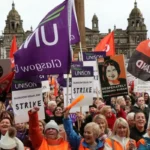
The dispute centers on a new 12-level pay and grading structure approved by the council last month, intended to rectify long-running equal pay claims. However, implementation scheduled for April 2027 revealed that approximately 11% of the workforce would face reduced earnings under the proposed arrangements. Trade unions fiercely opposed these reductions, leading to a standstill that prompted the council’s drastic administrative maneuver. Describing the atmosphere on the ground, a union member told The Bell that the situation was “mare than kicking off”.
Political reactions were swift and severe. Scottish Greens MSP Iris Duane condemned the policy prior to its suspension, stating that the proposed firing and rehiring of 23,000 workers would constitute “the biggest act of workplace vandalism in a generation”. Similarly, Glasgow Greens council group co-leader Lana Reid-McConnell emphasized that collective agreement remained the only appropriate mechanism to resolve historical pay discrimination without undermining labor standards.
How did the Scottish Government intervention halt the council’s plans?
The escalating industrial crisis was temporarily halted on Friday evening when a Scottish Government intervention forced a strategic retreat by municipal authorities. Following emergency discussions involving the Scottish Government, the local authority, and the joint trade unions (Unite, GMB, and Unison), an understanding was reached to suspend the dismissal notices.
Providing an update on the breakthrough, workforce convener Councillor Allan Casey stated:
“I’m pleased that we’ve reached a position following a meeting with the Scottish Government and the three unions where a pause has been agreed, allowing the Acas package to be put back on the table and creating the space for further intensive negotiations with the joint trade unions.”
Councillor Casey added,
“Our goal remains clear: to secure collective agreement on a new pay and grading scheme that is free from discrimination and can be put to the workforce in a ballot”.
This sudden pivot averted an immediate escalation, returning the dispute to formal conciliation channels via Acas while granting negotiators a crucial window to draft a consensus-driven pay package.
Why has Glasgow’s independent queer bookshop faced renewed targeted vandalism?
Away from the chambers of local government, community tensions flared in the Southside of Glasgow, where independent queer bookshop Category Is Books in Govanhill was targeted by vandals for the second time in a matter of weeks.
The shop, which has operated safely for eight years, was previously targeted in an incident where a front window was shattered and the word “TRANS” was explicitly defaced, highlighting transphobic motivations. Although an initial crowdfunding campaign launched in mid-September rapidly surpassed its £10,000 target within 12 hours to finance protective roller shutters, perpetrators struck again before the security installations could be completed.
Detailing the incident on social media, the shop’s owners stated:
“There was another window smash on the bookshop last night. It is pretty bad. We’ve taped it up and contacting insurance etc as before. Everyone is OK.”
The community response was immediate and supportive. Elected officials, including Scottish Greens MSP for Glasgow Southside Holly Bruce, offered immediate advocacy and solidarity. Concurrently, the public rallied once more, pushing a reopened fundraiser past the £21,000 threshold to cover dual window replacements and the expedited manufacturing of the new security shutters.
What can attendees expect from the upcoming civic discussion events in Glasgow?
Amidst industrial friction and localized community challenges, civic discourse across the city remains active, demonstrated by intense public demand for upcoming regional events. Organisers at The Bell confirmed that ticket sales for their upcoming October 15 panel discussion—hosted at Drygate Brewery to debate whether Glasgow is experiencing a broader urban resurgence—have outpaced expectations. With nearly 200 tickets sold within days, organizers noted that fewer than 100 seats remained available for the public debate.
Background of the particular development
The intersecting crises facing Glasgow underscore deep structural pressures across municipal finance, labor relations, and community safety. The equal pay dispute stems from historic systemic inequalities within local government remuneration structures that have generated protracted legal and financial liabilities for Glasgow City Council over successive decades. Efforts to resolve these liabilities through modern grading schemes have repeatedly collided with fiscal constraints and union opposition, culminating in the controversial use of dismissal and re-engagement threats—a mechanism historically criticized by political parties across Scotland. Simultaneously, Glasgow’s vibrant independent and marginalized community spaces continue to navigate localized security challenges, reflecting broader cultural flashpoints regarding inclusion, safety, and civic protection in urban neighborhoods.
Prediction
The suspension of the fire and re-hire notices creates a fragile window of opportunity for council leaders and trade unions to negotiate a sustainable settlement ahead of the proposed April 2027 implementation date. For the 23,000 non-teaching council staff and their households, this development provides immediate relief from the anxiety of arbitrary wage reductions and altered contractual terms. However, if intensive negotiations facilitated by Acas fail to yield a compromise acceptable to the workforce, the council will face immense political and operational pressure, potentially reigniting industrial unrest that could severely disrupt municipal services across Glasgow. For local businesses and community organizations like Category Is Books, the strong solidarity and financial backing demonstrated by the public indicate a resilient local network capable of absorbing targeted hostility, though heightened security measures will likely become a permanent fixture for vulnerable civic spaces across the city.