Key Points
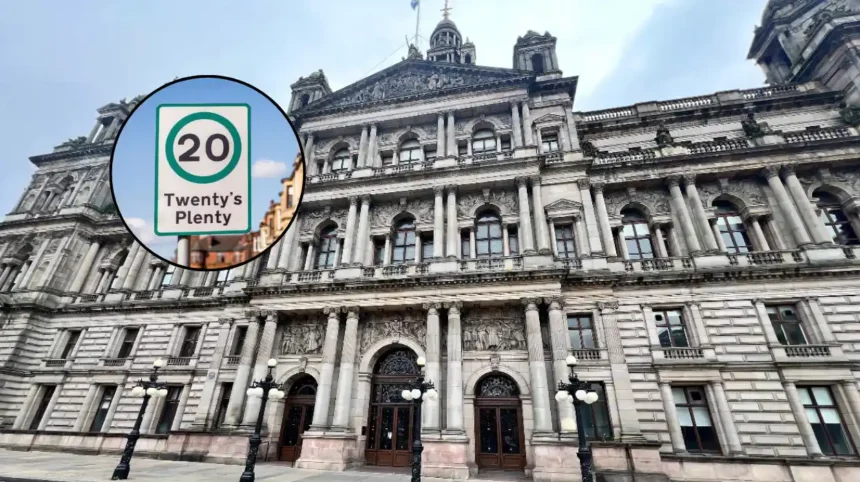
- Glasgow City Council plans to lower speed limits to 20mph across nearly 800 streets in the south and east of the city.
- The legal order takes effect on 22 September 2026, with new road markings and signs going up starting in September.
- The changes target residential roads, school routes, and busy community areas in Southside Central, Calton, East Centre, and Shettleston, plus parts of Haghill, Ruchazie, and Strathbungo.
- The scheme forms part of a £41 million Scottish Government road safety project—with £2.5 million allocated to Glasgow—and will cover around 3,800 streets across the city when finished.
- Local residents and business owners can attend a public drop-in event at Parkhead Library on Thursday, 3 September 2026, from 3pm to 7pm.
Glasgow (Glasgow Express) August 29, 2026 – As reported by Kevin Maguire of the Glasgow Times, Glasgow City Council has officially announced that nearly 800 streets across the south and east of the city will be brought under a mandatory 20mph speed limit as part of the latest phase of its citywide road safety expansion scheme.
- Key Points
- Which Wards and Neighbourhoods Will Be Affected by the New Speed Limits?
- What Have Local Authority and Government Officials Stated Regarding the Scheme?
- How Can Residents and Local Businesses Engage with Council Plans?
- Background of the Glasgow 20mph Network Development
- Prediction: How This Development Will Affect Road Users and Local Residents
The traffic intervention represents the completion of Phase 1 of the council’s broader 20mph programme. This operational phase follows the primary implementation of lower speed restrictions in Govan earlier in 2026 and aligns with wider Scottish National Strategy guidelines for built-up areas. The underlying legal order for the remaining Phase 1 streets is set to take effect on September 22, 2026, after which contractors will commence the physical installation of updated speed restriction signage and painted road markings.
Which Wards and Neighbourhoods Will Be Affected by the New Speed Limits?
The speed reductions are primarily designated for residential thoroughfares, primary routes leading to educational facilities, and roads carrying substantial local community traffic. The municipal wards directly impacted by this phase include:
- Southside Central
- Calton
- East Centre
- Shettleston
To maintain speed control consistency across adjoining municipal boundaries, a selected number of streets within the neighbouring districts of Haghill, Ruchazie, and Strathbungo have also been integrated into the Phase 1 legal order.
According to data released by Glasgow City Council, once the full multi-phase rollout reaches completion, the 20mph restriction network will encompass approximately 3,800 streets and street sections across the local authority area. This structure will establish one of the most comprehensive reduced-speed urban networks anywhere in Scotland.
What Have Local Authority and Government Officials Stated Regarding the Scheme?
As reported by Kevin Maguire of the Glasgow Times, Councillor Angus Millar, City Convener for Transport and Climate, issued an official statement outlining the council’s justification for the decision:
“This next phase of the default 20mph rollout will bring safer speed limits to almost 800 more local neighbourhood streets across the city. Lower speed limits save lives and help make our communities safer, particularly for children travelling to and from school. That’s why we’re rolling out 20mph limits in neighbourhoods across the city, helping to reduce the risk of collisions and lessen the severity of injuries if incidents do occur. Installation of this latest phase starts next month, and I would encourage residents and businesses to come along to the drop-in event to find out more and to look out for the new signs and road markings as the work progresses.”
The municipality’s strategic rollout is supported by wider Scottish Government transport funding. As detailed by the reporter, Cabinet Secretary for Transport Stephen Flynn confirmed the financial framework behind the regional initiative:
“We all want our local streets to be as safe as possible and the £41 million that the Scottish Government is investing in road safety shows just how important that aim is to us all. Reducing speeds in busy streets is a big part of the work we are doing to lower the likelihood of serious incidents, while also having the benefit of making local areas a better place to live and work.”
Official figures from Transport Scotland and local government records indicate that out of the total £41 million national safety investment, £2.5 million in Scottish Government grant funding has been directly allocated to assist Glasgow City Council with the technical execution of its local plans.
Explore More Glasgow Council News
Glasgow Council, SNIB and Aviva Back £270m Homes Plan in Possilpark 2026
Council Approves Over 30 Social Homes in Castlemilk 2026
How Can Residents and Local Businesses Engage with Council Plans?
To facilitate community inquiry regarding specific street changes, Glasgow City Council has scheduled a public drop-in session.
- Location: Parkhead Library
- Date: Thursday, September 3, 2026
- Time: 3:00 pm to 7:00 pm
During this session, council officers will provide spatial maps detailing street inclusions, answer queries regarding operational logistics, and outline the phased timeline for physical street sign installations. The council has also published an interactive digital mapping tool online, allowing drivers, residents, and commercial operators to check whether individual streets fall within the revised regulatory boundary.
Background of the Glasgow 20mph Network Development
The implementation of lower speed restrictions across Glasgow is part of a multi-year infrastructure strategy aligned with Scotland’s National Strategy for 20mph Speed Limits.
Following thorough technical assessments of approximately 5,900 named streets and street segments within Glasgow currently designated at either 20mph or 30mph, council transport planners established fixed evaluation criteria. The review concluded that approximately 3,800 streets currently set at 30mph should be lowered to 20mph. Meanwhile, 1,400 streets already set at 20mph will retain their existing limits, and approximately 700 arterial streets currently at 30mph will be maintained at 30mph to support core traffic flow. Roads with existing speed limits of 40mph or above remain entirely unaffected by these regulatory adjustments.
Prioritisation of areas during the phased rollout has been determined using historic collision data, with specific focus on reducing casualty risks for vulnerable road users, including pedestrians and cyclists. Phase 1 initially commenced in Govan (designated Phase 1A) in June 2026 before expanding to Southside Central, Calton, East Centre, and Shettleston in September 2026. Subsequent planned phases are scheduled to incorporate Drumchapel/Anniesland, Hillhead, Maryhill, and Partick East/Kelvindale under Phase 2, followed by Cardonald, Pollokshields, and Langside under Phase 3.
Prediction: How This Development Will Affect Road Users and Local Residents
The transition of nearly 800 roads to a default 20mph limit is projected to generate measurable shifts in urban transport dynamics across Glasgow:
- Impact on Drivers and Logistics: Motorists and commercial delivery vehicles operating in the south and east of Glasgow should anticipate marginally increased journey times on secondary residential routes. Drive-time patterns on major arterial corridors will remain largely unaffected, as 30mph and 40mph designations on primary thoroughfares remain intact. However, compliance monitoring by Police Scotland will require drivers to adapt their speed control habits in heavily populated residential areas.
- Impact on Pedestrians and Vulnerable Road Users: Statistical transport models suggest that lower vehicular speeds directly reduce collision severity and stopping distances. Local communities, particularly schoolchildren, elderly residents, and cyclists, are expected to experience safer crossing conditions and lowered risks of severe injury near residential hubs and school gates.
- Impact on Local Communities and Urban Environment: Lowering urban driving speeds reduces localized vehicle noise and localized exhaust emissions caused by rapid acceleration. Over time, these conditions typically encourage higher levels of active travel, such as walking and cycling, within residential neighbourhoods.