Key Points
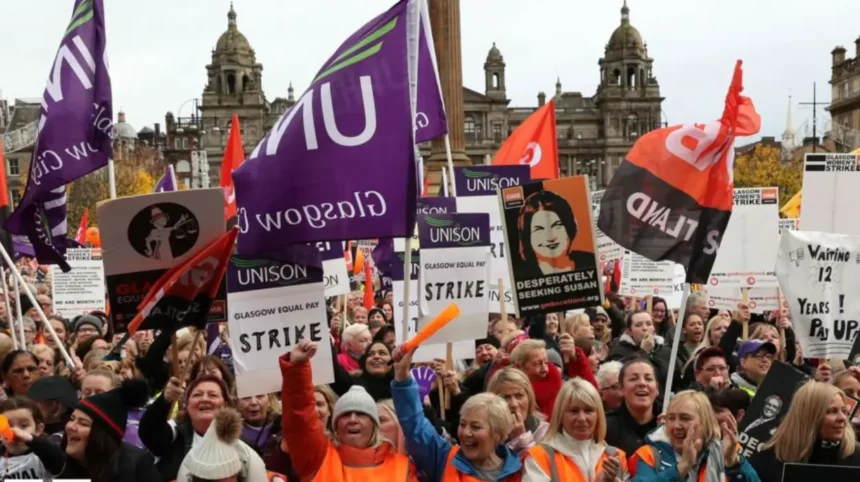
- Glasgow City Council announced plans to issue dismissal notices to between 23,000 and 25,000 non-teaching staff, initiating a controversial “fire and rehire” strategy.
- The decision follows the collapse of negotiations with trade union Unison over a new pay and grading structure designed to settle long-running equal pay claims.
- While other unions, GMB and Unite, agreed to ballot their members on a cash-injection offer, Unison withdrew from talks, accusing council figures of bullying staff with arbitrary deadlines.
- Under the proposed changes, scheduled to take effect from 1 January, approximately 63% of affected staff are in line for a pay rise, while 11% face salary reductions, with the steepest individual loss reaching £11,500 annually.
- Chief executive Susanne Millar stated that the revised contracts are necessary to lawfully bring a discriminatory pay and grading structure to an end.
- Political figures and union leaders, including Scottish Labour leader Michael Marra and Unison regional organiser Mandy McDowall, strongly condemned the council’s approach, warning that the local authority risks being labelled a pariah employer.
Glasgow (Glasgow Express) September 28, 2026 — Glasgow City Council confirmed that all non-teaching staff will receive notice of dismissal before being rehired on revised contracts, with individual letters due to be issued. The new arrangements are scheduled to take effect from 1 January.
The drastic move comes after talks with trade union Unison collapsed, prompting the council to state it had “no option” but to implement the changes. As reported by Andrew Learmonth, Political Editor of The Herald, the local authority added that other unions, GMB and Unite, had agreed to ballot their members on an offer that “would have seen a substantial injection of cash to fund additional back pay and take the possibility of dismissals off the table”.
However, Unison withdrew from discussions. Unison accused senior figures of “bosses trying to bully (staff) with arbitrary deadlines”.
What led to the breakdown in pay and grading negotiations?
The council has grappled with equal pay problems for years, including a major strike in 2018 involving more than 8,000 mainly female workers. A settlement covering over 15,000 historic claims was reached in 2019 at a cost of around £505 million, though further liabilities have persisted.
In a message to staff, chief executive Susanne Millar stated that the revised contracts are “what is needed to lawfully bring our discriminatory pay and grading structure to an end and replace it with a non-discriminatory scheme”.
Under the proposed framework, figures presented to councillors showed that approximately 63% of staff are in line for a pay rise, while 11% face a cut. The steepest individual loss amounts to £11,500 a year, with losses falling disproportionately on higher-graded staff.
How have trade unions and political figures responded?
The announcement has triggered severe backlash from union representatives and opposition politicians.
As reported by The Herald, Mandy McDowall, Unison’s regional organiser for Scotland, warned that “Glasgow City Council risks being labelled a pariah employer if it refuses to negotiate in good faith with its staff”, adding:
“Council employees deserve a fair deal and Unison will continue to work with their managers to secure one”.
Similarly, Unite industrial officer Graham McNabb urged the authority to “remove direct threats to our membership in its proposed new pay and grading structure”, stating:
“If they go down this reckless path, then it will be met with the full force of Unite”.
Political criticism was led by Scottish Labour leader Michael Marra, who slammed the strategy. As highlighted by The Herald, Marra argued the plan “may not break the letter of the law, but it certainly breaks the spirit of it”. He added:
“All parties need to get round the table and hammer out a deal. Working people should never be threatened like this again”.
Background of the particular development
The structural overhaul attempted by Glasgow City Council is deeply rooted in a decade-long struggle over gender pay inequality. Historically, municipal grading schemes across various UK local authorities undervalued roles traditionally dominated by women—such as catering, cleaning, and social care—compared to male-dominated manual roles like refuse collection. This discrepancy culminated in Glasgow’s landmark 2018 strike and a massive £505 million financial settlement in 2019. Despite these payouts, the underlying grading architectures remained uncorrected, exposing the council to continuous legal vulnerabilities. To permanently resolve these liabilities without triggering systemic financial collapse, the administration formulated a modernized pay framework, which unfortunately created localized friction by reducing compensation for a minority of upper-band employees, ultimately catalyzing the current dispute.
Prediction on how this development affects the workforce and local governance
The deployment of a “fire and rehire” tactic on a scale affecting up to 25,000 public sector workers sets a high-stakes precedent for municipal labor relations across the United Kingdom. For the affected workforce—spanning nursery workers, administrative personnel, and refuse collectors—the immediate psychological impact involves profound job insecurity and plummeting morale, even with assurances of re-engagement. If trade unions escalate toward industrial action, day-to-day public service delivery in Glasgow faces severe disruption. Politically and institutionally, the council risks prolonged industrial strife, reputational damage as a fair employer, and potential legislative or governmental interventions if public sector unions successfully mobilize nationwide opposition against fire-and-rehire practices in local government.