Key Points:
- Renfrewshire Council has approved planning permission for Tech Terrace, a speculative industrial development within the Advanced Manufacturing Innovation District Scotland (AMIDS), near Glasgow Airport.The 30,000 sq ft development will provide flexible commercial units aimed at the advanced manufacturing and life sciences sectors.The project has £4.74 million in Scottish Enterprise funding and is being delivered through a joint venture between Renfrewshire Council and Buccleuch Property, with Halliday Fraser Munro Architects.Units will range from 200 sq m to 3,200 sq m, or about 2,150 sq ft to 34,400 sq ft, for academic spin-outs, research and development space, and growing businesses needing laboratories, clean rooms or offices.Tech Terrace is part of the wider AMIDS masterplan, which has planning permission in principle for up to 750,000 sq ft of high-value manufacturing space across a fully serviced 52-hectare site.
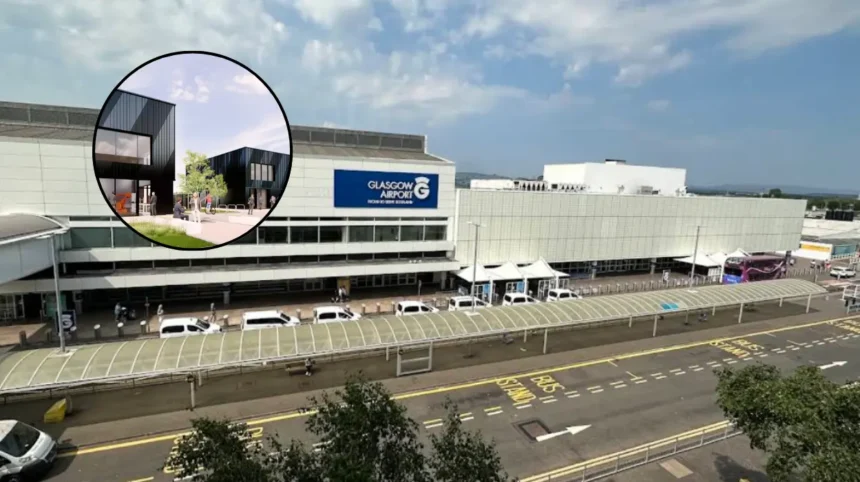
Renfrewshire (Glasgow Express) August 24, 2026 — Renfrewshire Council has officially granted planning consent for ‘Tech Terrace’, a 30,000 sq ft speculative industrial development located at the Advanced Manufacturing Innovation District Scotland (AMIDS) adjacent to Glasgow Airport.
- Key Points:
- What is the Tech Terrace development and who is behind the project?
- Why is speculative space required at the Advanced Manufacturing Innovation District Scotland?
- Background to the AMIDS development
- Prediction: How will this development affect regional advanced manufacturing and life sciences occupiers?
What is the Tech Terrace development and who is behind the project?
As detailed in project plans submitted by joint venture partners Renfrewshire Council and commercial property developer Buccleuch Property, along with lead design partners Halliday Fraser Munro Architects, the new development will deliver a flexible multi-unit complex aimed at expanding Scotland’s capability in high-value production and life sciences.
The scheme is supported by a £4.74m grant awarded by Scottish Enterprise, the national economic development agency.
The development spans roughly 30,000 sq ft (approx. 2,900 sq m to 3,000 sq m) and will offer flexible commercial units ranging in scale from 200 sq m up to 3,200 sq m.
The space has been designed specifically for next-generation occupiers seeking tailored research and development (R&D) facilities, specialized laboratory space, clean rooms, modern offices, and advanced light manufacturing capacity.
Tech Terrace sits within the broader 52-hectare AMIDS campus masterplan, which already holds planning permission in principle to accommodate up to 750,000 sq ft (75,000 sq m) of commercial and manufacturing footprint. Located at Netherton, directly between the White Cart River and Glasgow International Airport, the site is positioned as Scotland’s premier hub for industrial innovation.
The speculative nature of the build directly addresses a growing regional shortage of ready-to-occupy, high-specification accommodation for early-stage and growing commercial ventures.
Occupiers targeted for the site include expanding businesses in precision medicine, pharmaceutical development, space technology, photonics, electronics, and zero-emission technologies.
Why is speculative space required at the Advanced Manufacturing Innovation District Scotland?
According to market demand research conducted on behalf of AMIDS, the wider Glasgow City Region faces an ongoing supply deficit exceeding 220,000 sq ft per year for specialized, modern manufacturing property.
The creation of Tech Terrace is intended to alleviate this spatial constraint by providing immediate footprint options for academic spin-outs and scaling enterprises that might otherwise be forced to locate outside the region due to a lack of suitable physical infrastructure.
The site infrastructure at AMIDS has been built out through significant public-sector capital, including funding delivered via the Glasgow City Region City Deal and the UK Government’s Levelling Up Fund.
The site is fully serviced and features sustainable infrastructure, notably a 5th-generation low-carbon district heating network designed to supply low-carbon heating and hot water to campus occupiers.
Transport links to the campus have been further enhanced by major regional capital investments, including the new Renfrew Bridge crossing over the River Clyde and direct arterial access to Junction 28 of the M8 motorway, alongside pedestrian and cycle infrastructure connecting directly to Glasgow Airport and Paisley.
Background to the AMIDS development
The Advanced Manufacturing Innovation District Scotland was created as a strategic partnership between Renfrewshire Council and Scottish enterprise stakeholders to establish a world-class, high-value manufacturing cluster.
The overarching ambition of the district is to bridge the gap between academic research and commercial industrial output, supporting sustainable economic growth and growing Scotland’s export capabilities.
The campus is anchored by major national innovation institutions. These include the headquarters of the National Manufacturing Institute Scotland (NMIS), operated in partnership with the University of Strathclyde, and the UK’s Medicines Manufacturing Innovation Centre (MMIC), operated by CPI. Additionally, construction has progressed on CPI’s Oligonucleotide Manufacturing Innovation Centre of Excellence (OMICE), expanding the site’s life sciences expertise.
The broader district also encompasses established industrial hubs at Inchinnan Business Park and Westway, hosting major multinational operators such as Boeing, Rolls-Royce, Thermo Fisher Scientific, Peak Scientific, and Terumo Aortic.
Prediction: How will this development affect regional advanced manufacturing and life sciences occupiers?
The approval and construction of Tech Terrace is expected to directly alter the operational trajectory for small-to-medium enterprises (SMEs) and academic spin-outs within the Scottish life sciences and advanced engineering sectors.
Historically, early-stage science and engineering companies emerging from Scottish universities have faced delays transitioning from prototype design to full-scale commercial manufacturing due to the scarcity of speculatively built, high-specification laboratory and clean-room space.
By providing flexible floorplates ranging from 200 sq m, Tech Terrace will allow spin-outs to secure purpose-built physical accommodation directly adjacent to world-class research catapults like NMIS and MMIC. This proximity reduces the operational friction, capital expenditure, and lead times required to bring new products to market.
For the wider Glasgow City Region economy, the availability of turnkey R&D and manufacturing accommodation decreases the likelihood that high-growth technology companies will relocate to other parts of the UK or overseas once they outgrow initial university incubator spaces.
Furthermore, the site’s co-location with international transport routes via Glasgow Airport and the M8 motorway provides regional occupiers with enhanced logistics connections for export-focused supply chains, making the region more competitive for inward international investment.