Key Points
- Tense Standoff in Glasgow City Centre: Anti-immigration demonstrators and anti-racism counter-protesters engaged in a volatile, face-to-face stand-off, requiring massive deployments of Police Scotland officers to prevent direct physical violence.
- Geographic Shifts: While previous large-scale demonstrations concentrated heavily in George Square, recent mobilisations have actively migrated across major commercial thoroughfares, including the top of Buchanan Street by the Glasgow Royal Concert Hall.
- Competing Visuals and Ideologies: Anti-immigration groups displayed Union Flags and placards demanding an end to asylum housing policies, while anti-racism coalitions counter-mobilised with trade union banners, migrant welcoming slogans, and heavy acoustic sound systems to drown out opposition speeches.
- Organisational Disruptions: The anti-immigration “unity rally” saw significant internal leadership changes right before the event, with grassroots networks stepping in to coordinate logistics after high-profile online figures withdrew due to personal disclosures.
- Extensive Police Mobilisation: Police Scotland deployed lines of metal barricades, mounted units, and riot-gear units to construct containment cordons, keeping the opposing factions structurally separated.
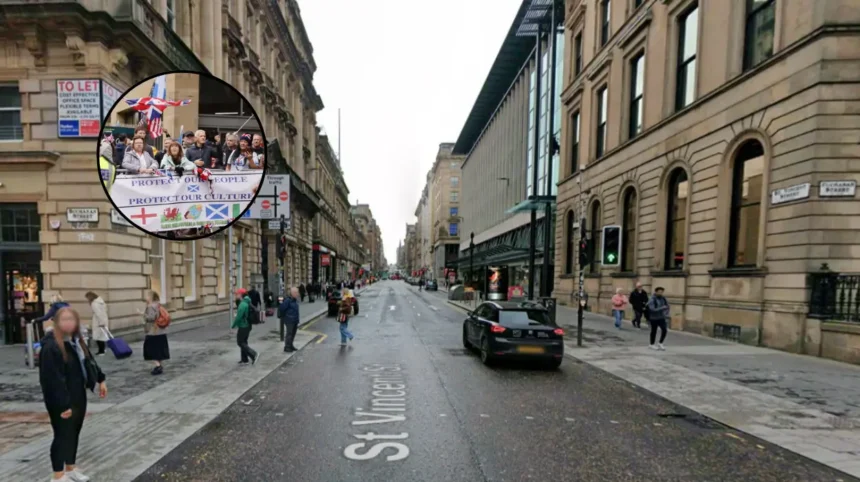
Glasgow (Glasgow Express) June 13, 2026 – A major deployment of Police Scotland officers successfully contained volatile scenes in central Glasgow today as hundreds of anti-immigration demonstrators clashed vocally with a significantly larger crowd of anti-racist counter-protesters. The tense stand-off, which blocked traffic and heavily disrupted the city’s primary retail district, developed just one week after similar large-scale far-right mobilisations were recorded in London. Police units dressed in tactical gear and mounted on horses worked extensively to maintain a strict physical divide between the factions using heavy metal barriers, preventing direct physical altercations as the two groups exchanged highly charged chants and speeches.
- Key Points
- What Occurred During the Confrontation on Buchanan Street?
- Who Organised the Dual Demonstrations and How Did Leadership Shift?
- How Did Police Scotland Manage the Escalating Scene?
- What Is the Background of This Particular Development?
- Electoral Shifts and Grassroots Campaigns
- Prediction: How Will This Development Affect Local Communities and Businesses?
- Immigrant, Asylum Seeker, and Minority Communities
What Occurred During the Confrontation on Buchanan Street?
The layout of Glasgow’s shopping district became a highly visible ideological battleground as the afternoon unfolded. Anti-immigration protesters gathered at the steps leading up to the Glasgow Royal Concert Hall at the top of Buchanan Street.
Simultaneously, a vast wall of anti-racism counter-protesters occupied the lower portions of the pedestrianised thoroughfare, effectively boxing the initial rally in against the concert hall infrastructure.
As reported by Libby Brooks of The Guardian, the visual division between the two groups was stark. The statue of the late Scottish statesman Donald Dewar, often referred to as the father of the modern Holyrood parliament, was completely encircled by anti-immigration demonstrators waving Union Flags bearing slogans such as “Stop the boats” and “Unite the kingdom.”
Directly opposing them down the street, representatives from various Scottish trade unions, anti-racism campaigns, and Palestinian solidarity groups held mass placards reading “Bairns not bigots,” “Aye welcome refugees,” and “God hates fascists.”
According to field reports published by The Guardian, the atmosphere remained highly febrile throughout the afternoon. Those attempting to deliver speeches from the steps of the Royal Concert Hall struggled continuously to project their messages.
The counter-protesters deployed a superior, high-powered acoustic sound system that blasted out mainstream pop tracks by artists such as Abba and Chappell Roan, successfully drowning out the orators above them. This audio blockade was accompanied by continuous, rhythmic chants of “shame on you” from the anti-racist ranks.
Who Organised the Dual Demonstrations and How Did Leadership Shift?
The administrative origin of the demonstrations reveals a complex shifting of grassroots and political elements.
The anti-immigration assembly was initially publicised and driven online by local podcaster John Watt under the banner of a “unity rally.” However, the structural leadership of the event altered rapidly in the days leading up to the gathering.
As documented by the Daily Record editorial team, investigative reporting revealed that John Watt had previously been convicted in 2018 of domestic abuse against two former partners.
Following the public resurfacing of these court records, Watt released a statement via social media channels announcing that he was officially pulling out of organizing or attending the event
“due to unforeseen circumstances.”
In the vacuum left by his departure, alternative right-wing community networks stepped in to maintain the momentum of the gathering. Organisations such as
“Save Our Future & Our Kids Futures”
—a group that has actively coordinated ongoing localized protests outside an asylum seeker accommodation hotel in Falkirk—encouraged their regional support bases to travel to Glasgow to occupy the steps.
On the counter-protest side, the mobilization was orchestrated by a broad-based left-wing coalition. Stand Up to Racism Scotland (SUTR), operating in tandem with the Scottish Trades Union Congress (STUC) and various refugee rights charities, issued mass notices across their networks to ensure they outnumbered the anti-immigration assembly.
Statements on Multiculturalism and Economic Austerity
As detailed in official press releases collected by Positive Action in Housing, Talat Ahmed, the convenor for Stand Up to Racism Scotland, stated that:
“Our rally was about celebrating and defending multiculturalism and diversity and saying loud and clear that refugees are welcome here and aren’t to blame for the problems in society. And that the far right, with their toxic politics of hate and division, are not welcome in Scotland.”
Commenting on the structural environment that allows these anti-immigration rallies to form, Linda Somerville, the Deputy General Secretary of the Scottish Trades Union Congress (STUC), stated that:
“We have long warned that the far-right poses a dangerous threat in the UK, spreading racist hate amongst communities that are often marginalised and under-resourced. The cruel impacts of austerity, compounded by the drip feed of anti-migrant rhetoric from parts of the media and some politicians has created these conditions.”
How Did Police Scotland Manage the Escalating Scene?
The operational response from law enforcement was immediate and highly structured, drawing on lessons learned from past public order disturbances in the city.
Fearing a breach of peace that could spill into the surrounding commercial properties, Police Scotland enacted a strict containment strategy.
Dozens of officers formed physical cordons at the intersection points of Buchanan Street. The application of metal crowd-control barriers allowed the police to keep a neutral buffer zone between the bottom of the concert hall steps and the advancing frontline of the SUTR counter-protest. Mounted police units were positioned at key flanks to monitor crowd density and prevent any breakout groups from attempting to encircle the opposing side.
Due to these tightly controlled static lines, the day concluded without major reported outbreaks of physical violence or widespread property damage, though the city centre remained under heavy guard well into the evening.
What Is the Background of This Particular Development?
To understand the volatile dynamics witnessed on Buchanan Street, the situation must be viewed through the lens of political shifts and recurring urban street demonstrations across Scotland over the past several years.
The modern template for these dual-mobilisations was firmly established a year prior, on September 7, 2024. During that period, a massive anti-immigration rally was heavily promoted online by high-profile English far-right figurehead Tommy Robinson, who asserted via social media that “the British are rising.”
This prompted a major counter-mobilization by SUTR and nine national trade unions in George Square.
The 2024 event saw thousands of anti-racist protesters take over the majority of George Square, structurally overshadowing the anti-immigration groups in a dynamic very similar to what played out on Buchanan Street.
Electoral Shifts and Grassroots Campaigns
The societal friction has been further amplified by institutional political changes within Scotland. In the UK General Election, the right-wing populist party Reform UK secured approximately 7 percent of the total vote share inside Scotland.
Anti-racism groups have frequently pointed to this statistical breakthrough, alongside the rise of nationalist parties in continental Europe, as evidence of a normalizing anti-immigration sentiment that is migrating from digital spaces onto physical streets.
Concurrently, a UK-wide patriotic and nationalist movement known as “Operation Raise the Colours” emerged. This campaign involves groups systematically tying Union Flags and St.
George’s Crosses to municipal lampposts, painting roundabouts, and organizing local rallies. While supporters frame the movement as pure patriotism, organizations like Hope Not Hate track it as an attempt by far-right actors to test public spaces and institutional boundaries, setting the stage for the street standoffs now occurring in major cities like Glasgow.
Explore More City Centre News
321 New Student Apartments Ready in Glasgow City Centre 2026
Franco Manca Closes Mitchell Street Restaurant: Glasgow 2026
Prediction: How Will This Development Affect Local Communities and Businesses?
The ongoing pattern of heavily policed, reactionary street demonstrations is poised to exert distinct operational and psychological pressures on specific segments of the Glasgow population.
For business owners, employees, and shoppers frequenting the Buchanan Street retail corridor—historically dubbed Glasgow’s “Style Mile”—these frequent weekend standoffs present a direct economic challenge. The physical blocking of the Glasgow Royal Concert Hall steps and the heavy deployment of police containment cordons suppress foot traffic into nearby commercial spaces.
If these demonstrations become a fixed bi-weekly or monthly occurrence, retail management will likely face increased operational costs related to private security hires, alongside unpredictable weekend revenue losses due to consumers avoiding the city centre entirely during peak protest hours.
Immigrant, Asylum Seeker, and Minority Communities
For the city’s vulnerable demographics, particularly refugees and asylum seekers residing in temporary accommodation or localized hotels, the visible presence of organized anti-immigration groups in heartland public spaces creates an ongoing environment of anxiety.
Although the counter-protests consistently outnumber the anti-immigration rallies, the highly visible display of anti-migrant signage near major civic structures changes the perceived safety of public transit hubs and urban centers.
Conversely, the massive, highly organized presence of trade unions and community solidarity networks functions as a reassurance mechanism, signaling that institutional Glasgow remains actively protective of its multicultural framework. However, the consistent ideological polarization suggests that central Glasgow will remain a frequent tactical target for both nationalist organizers and anti-racist coalitions moving forward.