Glasgow features a bifurcated nightlife ecosystem where distinct geographic zones cater to contrasting social preferences. The choice between Finnieston and the City Centre represents a fundamental choice between a culinary-led, independent neighborhood experience and a high-volume, centralized clubbing district. Understanding the structural, cultural, and operational differences between these two zones is essential for navigating Glasgow nightlife.
- What Defines the Nightlife Identity of Finnieston?
- What Defines the Nightlife Identity of Glasgow City Centre?
- How Do the Operating Hours and Licences Differ Between the Two Zones?
- What Type of Venues Dominate the Finnieston Nightlife Scene?
- What Type of Venues Dominate the Glasgow City Centre Scene?
- How Does the Music and Entertainment Profile Compare?
- What Are the Demographic and Socioeconomic Differences?
- How Do Accessibility, Safety, and Transport Infrastructure Compare?
- Summary of Key Differences Between Finnieston and City Centre Nightlife
- What Is the Future Outlook for Both Nightlife Hubs?
What Defines the Nightlife Identity of Finnieston?
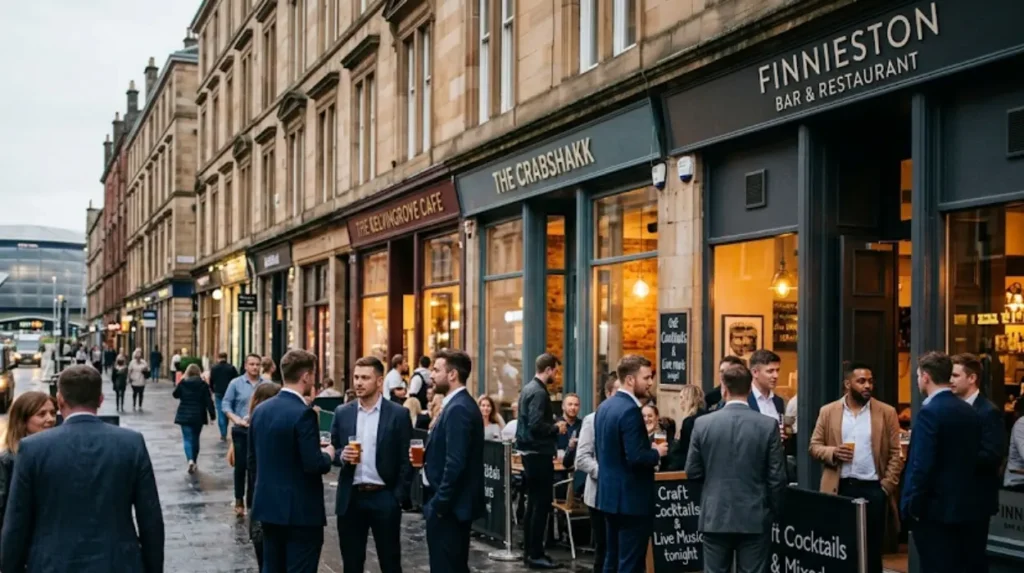
Finnieston nightlife is defined by its food-led, artisanal beverage culture that prioritizes craft cocktails, independent restaurants, and traditional Scottish folk music over late-night clubbing. The neighborhood caters primarily to young professionals, food enthusiasts, and modern cultural consumers.
Historical Evolution from Industrial to Culinary Hub
The geographic strip of Argyle Street known as Finnieston was historically an industrial corridor supporting the docks of the River Clyde. Following the decline of the shipping industry in the late 20th century, the area underwent systematic urban regeneration. The opening of the OVO Hydro and the Scottish Event Campus (SEC) transformed the precinct into an entertainment destination. Independent operators occupied vacant commercial units, creating a dense concentration of award-winning dining establishments and specialty bars.
Key Components of the Finnieston Ecosystem
The hospitality landscape in Finnieston relies on a hybrid model where dining and drinking spaces blur. Establishments focus on high-margin, quality products such as small-batch Scottish gin, imported wines, and locally sourced seafood. The nightlife operates on a localized scale, with independent businesses outnumbering corporate hospitality groups. The structural layout consists of single-floor tenement conversions that encourage a fluid transition from dinner to late-evening drinks.
What Defines the Nightlife Identity of Glasgow City Centre?
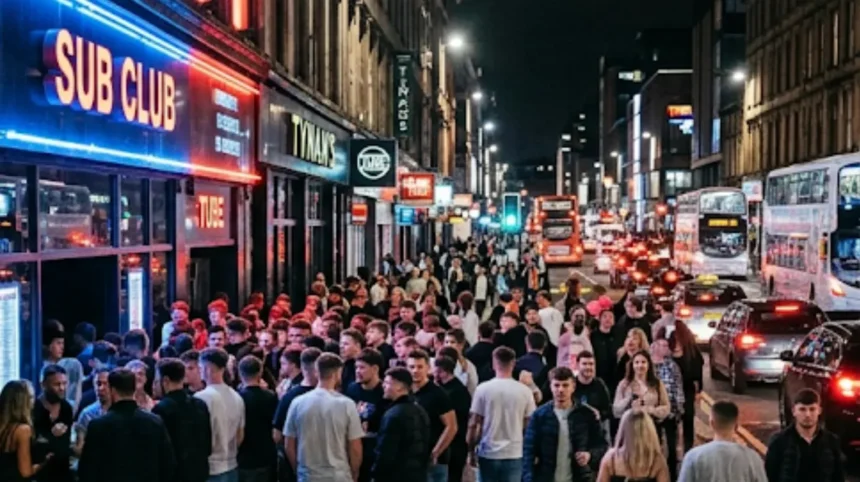
Glasgow City Centre nightlife is defined by its high-density entertainment districts, multi-floor commercial nightclubs, historic music venues, and diverse student-oriented promotional nights. The district functions as a high-volume regional hub that operates until the early morning hours.
Structural Layout of Central Entertainment Districts
The City Centre nightlife is anchored across several major arterial routes, specifically Sauchiehall Street, Bath Street, Jamaica Street, and the Merchant City precinct. Sauchiehall Street serves as the central command for student nightlife and alternative subcultures. Bath Street contains subterranean cocktail bars and basement spaces. Jamaica Street hosts legendary underground electronic dance institutions, while Merchant City offers an upscale, designer lounge environment alongside the primary LGBTQ+ nightlife quarter.
The Scale of Commercial Hospitality
Unlike the independent nature of the West End, the City Centre is characterized by large-scale venues capable of hosting thousands of patrons simultaneously. These venues rely on corporate operational structures, structured beverage promotions, and international DJ bookings. The infrastructure includes multi-room clubs with distinct musical zones, large-scale bars, and late-night fast-food corridors designed to process massive crowds at closing time.
How Do the Operating Hours and Licences Differ Between the Two Zones?
Finnieston venues generally operate under standard public house and restaurant licences, closing between midnight and 01:00. Glasgow City Centre benefits from late-night entertainment licences, allowing commercial nightclubs and specialized bars to remain open until 03:00 or 04:00.
Licensing Laws and Curfews
The Glasgow City Licensing Board enforces distinct operational limits based on geographical zoning and venue classification. Finnieston is classified primarily as a residential-commercial mixed zone. Consequently, local authorities restrict late-night extensions to protect local residents from noise pollution. Most bars must cease service by midnight on weekdays and 01:00 on Fridays and Saturdays.
In contrast, the City Centre is designated as a primary economic entertainment zone. Venues holding a nightclub licence can routinely serve alcohol until 03:00. Under specific late-night economy pilot schemes, select venues with verified safety and transport infrastructures are granted operational extensions until 04:00.
Impact on Patron Flow and Nightlife Trajectories
The regulatory variance creates a predictable movement pattern among night-time consumers in Glasgow. Finnieston functions predominantly as an “early-to-mid-evening” destination. Patrons arrive between 17:00 and 20:00 for dining and pre-club drinking. As Finnieston venues approach their 01:00 curfew, individuals seeking late-night entertainment migrate eastward via taxis or rail transport into the City Centre to utilize the late-opening nightclubs.
What Type of Venues Dominate the Finnieston Nightlife Scene?
Finnieston is dominated by specialized cocktail lounges, craft beer bars, contemporary Scottish restaurants, and traditional folk music pubs. The architectural footprint consists of intimate, single-room tenement spaces that emphasize table service and premium product presentation.
Specialized Cocktail and Gastronomic Hubs
The modern identity of Finnieston is anchored by venues that merge mixology with culinary arts. These establishments reject mass-market brands in favor of premium spirits and house-made infusions.
- The Finnieston: A specialized bar focusing on sustainable Scottish seafood and an extensive, curated selection of craft gins.
- Kelvingrove Café: A restored former ice cream parlor that specializes in fortified wines, classic cocktail revivals, and high-end brasserie dining.
- Porter & Rye: A venue combining dry-aged beef gastronomy with molecular cocktail techniques.
Traditional Watering Holes and the Highland Triangle
At the western edge of Finnieston lies a historic cluster of pubs known colloquially as the “Highland Triangle.” These establishments maintain deep historical connections to the Gaelic diaspora that migrated to Glasgow.
- The Ben Nevis: A traditional pub famous for its massive inventory of single malt whiskies, rustic wooden design, and regular live sessions of traditional Scottish folk music.
- The Park Bar: A long-standing cultural hub hosting live accordion and fiddle music, drawing a loyal crowd of locals and northern ex-patriates.
- The Islay Inn: A classic pub offering hearty traditional food, cask ales, and live roots music.
What Type of Venues Dominate the Glasgow City Centre Scene?
Glasgow City Centre is dominated by multi-room commercial nightclubs, underground electronic dance spaces, alternative rock bars, and historic live music halls. The venues are architecturally expansive, utilizing basements, old warehouses, and multi-floor commercial buildings.
Large-Scale Commercial Nightclubs
The City Centre contains Scotland’s largest late-night institutions, built to handle massive foot traffic through multi-room audio programming.
- The Garage: Located on Sauchiehall Street, this is Scotland’s largest nightclub by capacity, featuring six distinct rooms playing everything from commercial pop to indie rock, operating 365 days a year.
- The Buff Club: Tucked away down a cobbled lane off Bath Street, this multi-level club focuses on vintage soul, funk, disco, and retro classics for an alternative student demographic.
Underground Electronic and Alternative Spaces
The city center holds a global reputation for electronic music, driven by intimate basement spaces with advanced sound engineering.
- Sub Club: Located on Jamaica Street and open since 1987, it is one of the world’s longest-running underground dance clubs, world-renowned for its “Bodysonic” vibrating dance floor and house music residencies like Subculture.
- La Cheetah: A subterranean basement venue in the Merchant City known for booking cutting-edge international techno, electro, and house DJs.
- Cathouse Rock Club: A multi-floor institution dedicated entirely to rock, metal, punk, and alternative subcultures, serving as a primary youth hub for decades.
How Does the Music and Entertainment Profile Compare?
Finnieston focuses on acoustic, live traditional folk, jazz, and low-amplitude ambient background music designed to allow conversation. The City Centre prioritizes high-decibel electronic dance music, alternative rock DJs, commercial pop, and touring live concert acts.
Acoustic Realism versus Amplified Bass
The sensory environments of the two areas are polar opposites. In Finnieston, entertainment is integrated into the social space without dominating it. Live music relies on acoustic instruments, unamplified vocals, and informal sessions where musicians sit among patrons. The sonic goal is to complement the dining and drinking experience.
The City Centre utilizes commercial sound systems, custom speaker stacks, and resident or touring DJs. Entertainment is the primary product rather than a background element. Venues invest heavily in lighting rigs, visual projection mapping, and acoustic insulation to deliver high-intensity sensory experiences that define traditional clubbing.
Live Concert Infrastructure
While Finnieston sits next to the massive OVO Hydro for stadium-level arena pop concerts, it lacks mid-tier grassroots venues. The City Centre contains the historic core of Glasgow’s UNESCO City of Music status. Institutions like King Tut’s Wah Wah Hut provide the essential platform for emerging indie bands, while venues like The Classic Grand handle diverse mid-scale alternative, rock, and punk touring acts.
What Are the Demographic and Socioeconomic Differences?
Finnieston attracts a demographic consisting of young professionals, academics, food industry workers, and tourists aged 25 to 50 with higher disposable income. The City Centre caters to a younger population aged 18 to 25, dominated by university students and weekend regional visitors.
Affluence and Spend Per Capita
The financial dynamics of Finnieston nightlife reflect its premium positioning. Higher product acquisition costs, artisanal ingredients, and menu-driven concepts result in a significantly higher spend per capita. Patrons expect premium table service and are willing to pay elevated prices for specialty products.
The City Centre operates heavily on volume-driven economics. Due to competition for the massive student market from local institutions like the University of Strathclyde, Glasgow Caledonian University, and the University of Glasgow, central venues rely on low-cost drink promotions. Mid-week club nights offer cheap entry rates and discounted beverage packages to maintain high capacity.
Dress Codes and Social Intent
Social expectations vary strictly between the zones. Finnieston favors a relaxed style often described as “smart-casual” or “hipster chic.” Because the evening revolves around dining and socializing, comfort and personal style take precedence.
The City Centre enforces traditional commercial nightlife dress codes, particularly in its premium lounges or mainstream clubs. Many central venues bar entry for sports apparel, branded workwear, or casual footwear, requiring a more deliberate, formal dress standard for weekend admission.
Explore More Area Guide
Full Cast Announced for The Silence of the Lambs Glasgow 2026
Comprehensive Guide to the Best Weekly Farmers Markets for Local Produce in Glasgow
How Do Accessibility, Safety, and Transport Infrastructure Compare?
The City Centre serves as the central transport hub for Greater Glasgow, offering continuous access to major train stations, subway loops, night buses, and taxi ranks. Finnieston relies on localized transport links, resulting in higher transit friction during peak closing hours.
Transport Links and Hub Density
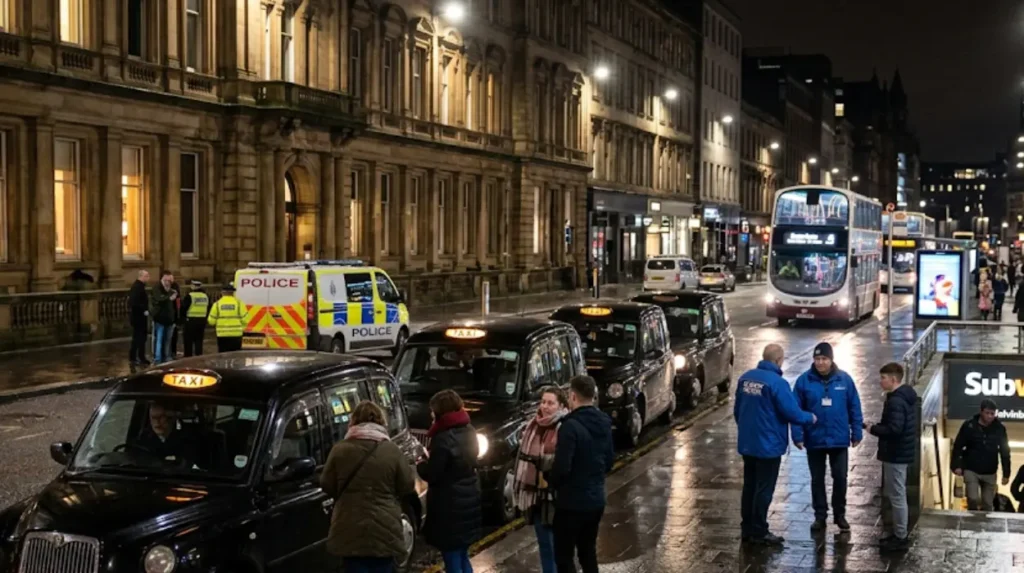
The City Centre is designed for mass transit. Central Station and Queen Street Station provide direct rail links across Scotland, while the Buchanan Street Bus Station and multiple Subway stations offer rapid inner-city travel. When venues close at 03:00, black hackney taxi ranks are highly concentrated across central streets, and designated night bus routes depart from central squares.
Finnieston is served primarily by the Exhibition Centre rail station and local bus routes along Argyle Street. The Subway loop does not pass directly through the hospitality strip, requiring a 10-to-15-minute walk to Kelvingrove or Hillhead stations.
Night-time Safety and Environment
Safety dynamics are influenced by crowd density. The City Centre features a heavy, visible police presence and the Glasgow Street Pastors initiative to manage the friction that comes with thousands of intoxicated patrons leaving clubs at 03:00.
Finnieston benefits from a calmer environment due to its staggered dining schedules and earlier closing hours. Street noise is lower, and the crowd disperses gradually over several hours rather than all at once at a single closing time.
Summary of Key Differences Between Finnieston and City Centre Nightlife
The distinct operational characteristics of Glasgow’s primary nightlife zones are summarized below.
| Feature | Finnieston Nightlife | City Centre Nightlife |
| Primary Venue Type | Independent cocktail bars, food-led lounges, traditional folk pubs | Multi-floor commercial nightclubs, underground dance spaces, live music venues |
| Average Closing Time | 00:00 – 01:00 | 03:00 – 04:00 |
| Core Audience | Professionals, food lovers, cultural tourists (Ages 25–50) | University students, weekend regional visitors (Ages 18–25) |
| Sonic Profile | Acoustic folk, low-tempo jazz, curated ambient background audio | High-decibel electronic techno, alternative rock, commercial pop |
| Economic Model | High spend per capita, premium pricing, independent operators | High-volume sales, student discount drink promotions, corporate chains |
| Transport Access | Local rail station, localized bus lines, walking transit | Dual national rail terminals, central subway loop, night bus hubs, taxi ranks |
What Is the Future Outlook for Both Nightlife Hubs?
The future of Glasgow nightlife points toward a deeper specialization: Finnieston is cementing its status as an elite daytime-to-evening culinary arts destination, while the City Centre is adapting its large-scale commercial venues into flexible, multi-use event spaces to survive changing youth drinking habits.
Sustainability and Environmental Innovations
Faced with changing economic conditions, venues in both areas are adopting new operating models. A prime example is SWG3, located on the border of Finnieston. This multi-room warehouse complex pioneered the “BODYHEAT” system, an innovative environmental technology that captures the body heat generated by dancing clubbers and recycles it to heat and cool the entire building. This focus on sustainability is increasingly attractive to eco-conscious consumers.
Shifts in Consumer Behavior
Macroeconomic shifts are changing how both zones operate. Younger generations are drinking less alcohol, causing a decline in traditional, volume-dependent nightclubs in the City Centre. Central venues are forced to diversify by introducing experiential entertainment, such as interactive gaming bars, live comedy, and indoor street food markets.
Meanwhile, Finnieston’s focus on premium, experiential dining and high-end drinking insulates it from these trends. This ensures the neighborhood remains highly resilient as consumers prioritize quality over quantity in their nights out.
Is Finnieston or Glasgow City Centre better for nightlife?
It depends on the experience you’re looking for. Finnieston is better for independent bars, restaurants, cocktails, and relaxed evenings, while Glasgow City Centre is better for late-night clubs, live music venues, and dancing until the early hours.