NHS Greater Glasgow and Clyde is the biggest employer in Glasgow, employing around 41,000 staff compared to JPMorgan’s 2,600 and Glasgow City Council’s roughly 8,850 employees. Staff earn according to NHS Scotland’s Agenda for Change pay bands, with healthcare assistants starting at £10.93–£15.34 per hour and staff nurses earning £26,200–£48,300 annually.
- Is NHS Greater Glasgow and Clyde the Largest Employer in Glasgow?
- What Jobs Does NHS Greater Glasgow and Clyde Offer?
- How Much Do Healthcare Assistants Earn at NHS Greater Glasgow?
- What Is the Salary Range for Staff Nurses at NHS Greater Glasgow?
- How Much Do Senior NHS Roles Like Band 7 and Band 8 Earn?
- Do NHS Greater Glasgow Employees Receive Benefits Beyond Base Pay?
- Is NHS Pay in Glasgow Higher Than Other UK Regions?
- What Makes NHSGGC the Largest NHS Board in Scotland?
- How Does NHSGGC’s Employment Compare to Glasgow’s Other Major Employers?
- What Is the Future Outlook for NHS Greater Glasgow as Glasgow’s Top Employer?
Is NHS Greater Glasgow and Clyde the Largest Employer in Glasgow?
Yes, NHS Greater Glasgow and Clyde is Glasgow’s biggest employer with approximately 41,000 staff, far exceeding other major employers like JPMorgan Chase (2,600 employees) and Glasgow City Council (8,850 employees). This makes it the largest single employer in the city by headcount.
NHS Greater Glasgow and Clyde (NHSGGC) is the largest NHS organisation in Scotland and one of the largest in the United Kingdom. The board serves a population of 1.3 million people across Glasgow City, East Dunbartonshire, East Renfrewshire, Inverclyde, Renfrewshire, and West Dunbartonshire. Its annual budget reaches £4.4 billion, funding 23 hospitals, 232 GP surgeries, 279 dental locations, and over 72 health centres.
Glasgow’s employment landscape includes several significant employers. JPMorgan Chase employs around 2,600 people in Glasgow and holds the title of Scotland’s largest technology employer. Glasgow City Council, Scotland’s largest of 32 local authorities, has approximately 8,850 employees providing front-line services to Glasgow residents. Virgin Money operates between 5,001–10,000 employees across its business, headquartered at 177 Bothwell Street in Glasgow.
Other major Glasgow employers include retail and warehouse operations, universities such as the University of Glasgow, and manufacturing facilities. None approach NHSGGC’s 41,000-staff headcount. The NHS board’s scale reflects its responsibility for emergency care (408,000 attendances annually), emergency admissions (130,000), elective admissions (187,000), and outpatient services (1.1 million).
NHSGGC’s position as Glasgow’s largest employer carries significant economic impact. The board represents a major portion of the city’s public sector workforce and contributes substantially to Glasgow City Region’s leading industry category: Public administration, education, and health. Its Living Wage accreditation makes it the largest NHS Board in Scotland with this designation.
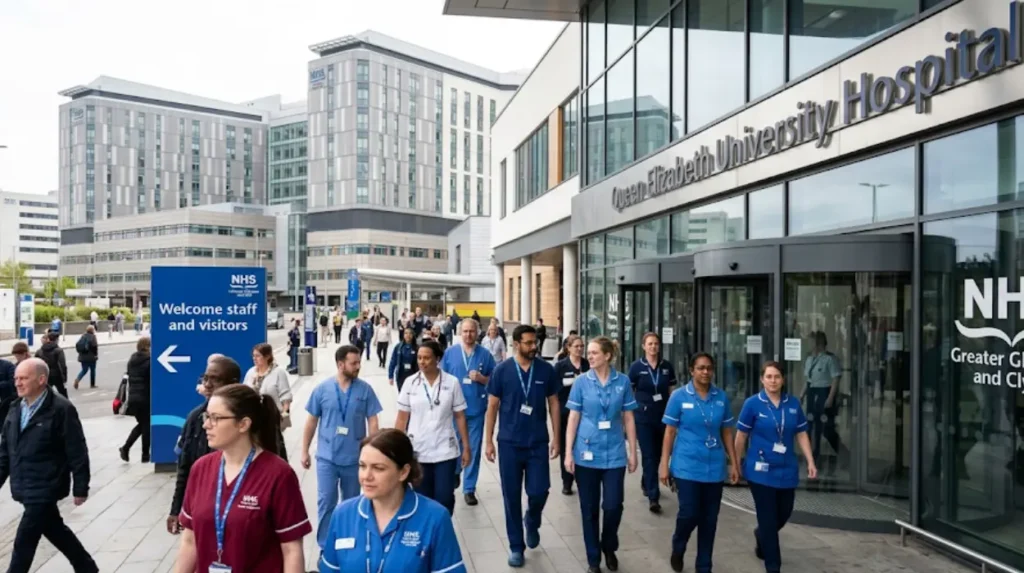
What Jobs Does NHS Greater Glasgow and Clyde Offer?
NHSGGC offers over 100 job types across clinical, administrative, and support roles, including staff nurses, healthcare assistants, admin assistants, receptionists, healthcare support workers, paramedics, porters, and GP contractors. Examples include clinical roles (nurses, doctors), administrative positions (payroll officers, admin assistants), and support staff (healthcare assistants, receptionists).
The board operates 23 hospitals of different types, contracts with 232 GP surgeries featuring 1,300 General Practicians, and maintains dental services across 279 locations. It also runs almost 187 optician practices, over 72 health centres and clinics, and more than 283 pharmacies.
Clinical roles dominate NHSGGC’s workforce. Staff nurses form a core professional group, handling patient care across medical, surgical, emergency, and specialist departments. Healthcare assistants provide fundamental patient support including mobility assistance, feeding, and hygiene care. Healthcare support workers perform similar duties with additional responsibilities for patient monitoring and basic clinical tasks. Paramedics handle emergency transport and acute care response. Porters manage hospital logistics including equipment movement and patient transfers.
Administrative and professional services roles support clinical operations. Admin assistants handle correspondence, scheduling, and record maintenance. Receptionists manage front-desk operations, patient registration, and inquiries. Payroll officers process staff payments, as evidenced by recent NHSGGC payroll officer positions in Band 4 (£31,537–£34,303). General Practicians work under contract rather than direct employment, generating 13.3 million GP contacts annually.
Support services encompass cleaning, catering, maintenance, and security staff. These roles maintain hospital hygiene, provide food services, ensure building functionality, and secure facilities. Clinical support roles include radiographers, physiotherapists, occupational therapists, pharmacists, and laboratory technicians who deliver specialized healthcare services.
How Much Do Healthcare Assistants Earn at NHS Greater Glasgow?
Healthcare assistants at NHS Greater Glasgow and Clyde earn £10.93–£15.34 per hour, which aligns with NHS Scotland Band 2 pay ranging from £24,647–£26,763 annually (£12.78–£13.87 hourly) for 2024–25. This exceeds the UK minimum wage of £12.21 per hour for workers aged 21 and over.
NHS Scotland follows the Agenda for Change pay structure, which organizes staff into bands based on role complexity and responsibility. Band 2 covers entry-level healthcare support roles including porters and healthcare assistants. The 2024–25 pay settlement delivered a 5.5% uplift across all bands, with experienced Band 2 porters receiving £1,395 additional annually.
Healthcare assistant pay varies by experience and location. Entry-level assistants start at the lower Band 2 point (£24,647 annually), while experienced assistants progress to the upper point (£26,763). Hourly rates translate to £12.78–£13.87 for a 37-hour week. Self-reported data from 138 workers shows actual pay ranging £10.93–£15.34 per hour, reflecting variations in shift patterns, overtime, and additional responsibilities.
The Real Living Wage for Rest of UK (excluding London) is £12.60 hourly. NHSGGC’s healthcare assistant pay exceeds this threshold, with most workers earning above average market rates for their role. The board maintains Living Wage accreditation, ensuring all staff receive compensation covering basic living costs.
Pay progression occurs automatically through designated steps within each band. Healthcare assistants typically progress through Band 2 over 2–3 years based on experience and performance. Additional earnings come from night shifts, weekend work, and overtime, which carry enhanced pay rates under NHS Scotland’s working conditions framework.
What Is the Salary Range for Staff Nurses at NHS Greater Glasgow?
Staff nurses at NHS Greater Glasgow and Clyde earn £26,200–£48,300 per year, corresponding to NHS Scotland Band 5 pay from £31,892–£39,735 annually after the 2024–25 5.5% pay uplift. Experienced staff nurses receive £2,072 additional annually compared to previous year rates.
Band 5 represents the standard entry point for qualified registered nurses in NHS Scotland. The 2024–25 pay scale sets Band 5 at £30,229 (entry) to £37,664 (experienced), rising to £31,892–£39,735 after the 5.5% uplift. This translates to hourly rates of £16.53–£20.60 for a 37-hour week.
Self-reported data from Breakroom Quiz participants shows staff nurse salaries ranging £26,200–£48,300, exceeding official Band 5 scales. This variation reflects specialized nursing roles, seniority beyond standard progression, and additional responsibilities such as ward management or clinical specialization. Senior staff nurses in specialist areas may reach Band 6 or Band 7 pay levels.
Nursing career progression follows clear pathways. Newly qualified nurses enter at Band 5 entry point (£31,892). After 2 years, they progress to the middle point (£34,077), and after additional experience reach the experienced point (£39,735). Senior nurses advancing to ward manager roles move to Band 6 (£39,912–£48,635) or Band 7 (£48,788–£56,747). Consultant nurses and clinical experts may reach higher bands.
The 2024–25 pay settlement delivered £2,072 additional for experienced staff nurses. This 5.5% uplift applied uniformly across all Agenda for Change bands, totaling £448 million committed for NHS Scotland pay in that year. Nurses also receive enhanced pay for night shifts, weekend work, and overtime under NHS Scotland’s working conditions.
Explore More Area Guide
Best Paying Graduate Jobs and Corporate Schemes Available in Glasgow Right Now
How Much Do JPMorgan and Virgin Money Really Pay Staff in Glasgow?
How Much Do Senior NHS Roles Like Band 7 and Band 8 Earn?
Senior NHS roles at NHSGGC earn significantly higher salaries: Band 7 managers earn £48,788–£56,747 annually, Band 8a specialists earn £60,126–£70,986, Band 8b senior managers earn £70,986–£83,837, and Band 8c directors earn up to £83,837+ after the 2024–25 5.5% pay uplift. Experienced Band 7 staff receive £2,958 additional annually.
Band 7 covers senior nursing roles including ward managers, clinical nurse specialists, and advanced practitioners. The 2024–25 pay scale ranges £48,010–£53,789, rising to £50,651–£56,747 after the 5.5% uplift. Hourly rates reach £26.25–£29.41 for a 37-hour week.
Band 8a includes consultant nurses, clinical directors, and senior specialist roles. Pay ranges £56,992–£60,126 (pre-uplift), increasing to £60,126–£63,126 after uplift. Hourly rates reach £31.16–£36.79. These roles require advanced clinical expertise, often with postgraduate qualifications and specialized certifications.
Band 8b covers senior management positions including director-level roles and executive nurses. Pay spans £67,285–£79,466, rising to £70,986–£83,837 after uplift. Band 8c represents the highest operational level, including chief nursing officers and board-level directors, with pay exceeding £83,837 annually.
Paramedics at Band 6 earn £39,912–£48,635 annually, with experienced paramedics receiving £2,535 additional. Band 6 also covers senior technical roles including radiographers and senior therapists. Hourly rates reach £21.60–£25.21.
Management progression follows structured pathways. Senior nurses advancing from Band 5 progress through Band 6 (senior nurse/ward sister) to Band 7 (ward manager). Clinical specialists may reach Band 8a without managing large teams. Executive roles require additional qualifications in leadership and management.
Do NHS Greater Glasgow Employees Receive Benefits Beyond Base Pay?
NHSGGC employees receive comprehensive benefits including proper sick pay, Blue Light Card discounts, paid annual leave, pension through NHS Scotland Pension Scheme, and enhanced pay for night/weekend shifts, though most staff do not receive paid breaks. Most workers earn above minimum wage and above average market rates for their roles.
The NHS Scotland Pension Scheme provides defined-benefit retirement coverage including life assurance. Employees contribute a percentage of salary, with the employer covering the remainder. Pension benefits calculate based on salary and years of service, providing guaranteed retirement income rather than investment-based outcomes.
Annual leave entitlements follow NHS Scotland standards. Most staff receive 27–43 days annually depending on seniority and role, including public holidays. Leave accrues progressively with service length. Enhanced pay rates apply for night shifts (typically 30% enhancement), weekend work (20–30%), and overtime (50% for ordinary overtime, 75% for double-time).
Sick pay coverage is comprehensive. Most NHSGGC employees receive proper sick pay following NHS Scotland’s schedule: full pay for the first year of sickness (cumulative), half pay for the second year, combined with statutory sick pay where applicable. This exceeds many private sector employers’ sick pay provisions.
The Blue Light Card discount provides staff discounts across various retailers and services. This gives NHSGGC employees access to reduced prices on groceries, electronics, travel, and leisure activities. The card is available to all NHS staff regardless of role or seniority.
Training and development opportunities are substantial. NHSGGC invests in staff education through dedicated learning facilities, apprenticeship programs, and professional development funding. Nurses receive mandatory training hours, with additional support for specialist qualifications. The board maintains accreditation as a Living Wage employer, ensuring all staff meet living cost thresholds.
Pay breaks are not provided. Most NHSGGC staff work without paid break time during shifts, though rest periods are mandated under working hours regulations. This differs from some private sector employers who offer paid break time.
Is NHS Pay in Glasgow Higher Than Other UK Regions?
NHS pay in Scotland is set nationally through Agenda for Change, so NHSGGC staff earn the same as other Scottish NHS boards. Glasgow does not receive Higher Cost Area Supplement (HCAS) like London staff, but Scottish pay settlements have delivered 5.5% uplifts in 2024–25 and 4.25% in 2025–26. Scottish NHS pay matches England’s base scales without London’s additional £3,000–£4,000 HCAS.
Agenda for Change creates uniform pay across UK NHS boards. Band 5 nurses earn £31,892–£39,735 in Scotland, identical to England’s base rates. However, London staff receive Higher Cost Area Supplement adding £3,108–£4,662 annually depending on location (inner, outer, or non-London). Glasgow does not qualify for HCAS, meaning NHSGGC nurses earn less than London NHS nurses by this amount.
The 2024–25 Scottish pay settlement delivered 5.5% across all bands, totaling £448 million. Examples include £1,395 for experienced Band 2 porters, £1,651 for Band 4 healthcare support workers, £2,072 for Band 5 nurses, and £2,535 for Band 6 paramedics. The 2025–26 agreement adds 4.25%, followed by 3.75% in 2026–27.
Scottish NHS pay compares favorably to Scottish private sector rates. Healthcare assistants earning £12.78–£13.87 hourly exceed Scotland’s average private sector hourly pay for similar roles. Staff nurses at £31,892–£39,735 align with or exceed private sector nursing salaries in Scotland.
London’s HCAS creates the largest UK regional NHS pay gap. Inner London staff receive £4,662 additional, outer London £3,896, and London fringe £3,108. Without HCAS, Glasgow NHS staff earn base rates matching England outside London. This means NHSGGC nurses earn the same as Manchester or Birmingham NHS nurses but £3,000–£4,000 less than London nurses.
Glasgow’s lower living costs compared to London partially offset the pay difference. Housing, transport, and general expenses are significantly lower in Glasgow, making NHSGGC salaries provide comparable or better living standards than equivalent London salaries after expenses.
What Makes NHSGGC the Largest NHS Board in Scotland?
NHSGGC is Scotland’s largest NHS board serving 1.3 million people with 41,000 staff, 23 hospitals, and a £4.4 billion annual budget, compared to other Scottish boards like NHS Lothian (serving 800,000) and NHS Fife (serving 370,000). Its population coverage exceeds any other Scottish board by 500,000+ people.
NHS Scotland divides into 14 regional boards. NHSGGC covers Glasgow City plus five surrounding council areas (East Dunbartonshire, East Renfrewshire, Inverclyde, Renfrewshire, West Dunbartonshire), creating Scotland’s most populous health region. Glasgow City alone has approximately 635,000 residents, with the wider board area reaching 1.3 million.
Service scale reflects population size. NHSGGC handles 408,000 emergency attendances annually, 130,000 emergency admissions, 187,000 elective admissions, and 1.1 million outpatient appointments. It contracts with 232 GP surgeries featuring 1,300 GPs generating 13.3 million GP contacts. Dental services operate across 279 locations, optician practices span 187 sites, and pharmacies exceed 283.
Hospital infrastructure includes 23 facilities of different types: acute hospitals (e.g., Glasgow Royal Infirmary, Western General), specialist hospitals (e.g., Queen Elizabeth University Hospital), psychiatric units, rehabilitation centers, and community hospitals. This diversity enables comprehensive care from emergency medicine to long-term mental health support.
Staff composition reflects service breadth. The 41,000 employees include nurses, doctors, healthcare assistants, paramedics, allied health professionals (radiographers, physiotherapists), administrative staff, support workers, and管理人员. Clinical staff dominate, but administrative and support roles comprise substantial portions reflecting operational complexity.
NHSGGC’s Living Wage accreditation distinguishes it as Scotland’s largest NHS board with this designation. This commitment ensures all 41,000 staff earn at least the Real Living Wage (£12.60 hourly for Rest of UK), exceeding minimum wage requirements and supporting staff retention.
Regional health partnerships enhance NHSGGC’s reach. The board works alongside local authorities (6 council areas), voluntary sector organizations, and Health and Social Care Partnerships delivering integrated care. This partnership model expands service capacity beyond direct employment.
How Does NHSGGC’s Employment Compare to Glasgow’s Other Major Employers?
NHSGGC employs 41,000 staff, dwarfing Glasgow’s second-largest employers: Virgin Money (5,001–10,000), Glasgow City Council (8,850), and JPMorgan Chase (2,600). NHSGGC’s headcount exceeds Virgin Money by 31,000+ employees and Glasgow City Council by 32,150+. No private or public employer in Glasgow approaches NHSGGC’s scale.
JPMorgan Chase employs 2,600 people in Glasgow, making it Scotland’s largest technology employer. While significant for the tech sector, JPMorgan’s workforce represents 6.3% of NHSGGC’s headcount. The bank’s Glasgow office serves as a global tech hub but remains specialized compared to NHSGGC’s comprehensive health services.
Glasgow City Council’s 8,850 employees provide essential public services including education, social care, housing, and infrastructure. As Scotland’s largest of 32 local authorities, the council serves Glasgow’s 635,000 residents. However, its workforce equals only 21.6% of NHSGGC’s size, reflecting the narrower scope of local government versus comprehensive healthcare.
Virgin Money operates 5,001–10,000 employees across 18 departments including finance (765), engineering/technical (503), and operations (370). Headquartered at 177 Bothwell Street, Glasgow, the financial services firm represents the largest private sector employer in Glasgow. Even at its maximum 10,000 employees, Virgin Money equals only 24.4% of NHSGGC’s workforce.
Retail and warehouse operations comprise significant Glasgow employment but lack single-employer concentration. Major retailers like Tesco, Sainsbury’s, and Amazon employ thousands across multiple locations, but no single retail employer exceeds 5,000 Glasgow staff. Universities such as the University of Glasgow employ approximately 5,000–6,000 staff, still 12–15% of NHSGGC’s size.
NHSGGC’s employment dominance reflects healthcare’s scale in Glasgow’s economy. Public administration, education, and health represents Glasgow City Region’s leading industry category. NHSGGC alone accounts for a substantial portion of this sector’s workforce, making it central to Glasgow’s economic landscape.
The employment gap between NHSGGC and other employers has structural causes. Healthcare requires massive staffing for 24/7 operations across hospitals, clinics, and community services. Private sector employers optimize for efficiency with smaller headcounts. Local government serves narrower functions than comprehensive healthcare delivery.

What Is the Future Outlook for NHS Greater Glasgow as Glasgow’s Top Employer?
NHSGGC will remain Glasgow’s largest employer through 2027–2030 as Scotland commits £448 million for 2024–25 NHS pay, adds 4.25% for 2025–26, and 3.75% for 2026–27, supporting staff retention and service expansion. No emerging employer projects approaching 41,000 staff exist in Glasgow’s development plans.
Scotland’s NHS pay commitments ensure staff retention through increased earnings. The 5.5% uplift in 2024–25 delivered £1,395–£2,535 additional annually across bands. Future increases (4.25% + 3.75%) maintain pay competitiveness against private sector alternatives. This reduces staff turnover risks that could threaten NHSGGC’s employment dominance.
Population growth in Glasgow and surrounding areas will increase healthcare demand. Glasgow City’s population rose steadily, with the NHSGGC board area reaching 1.3 million. Rising demand for emergency care, elective procedures, and GP services requires sustained or expanded staffing. NHSGGC’s 41,000 employees may grow to meet demand.
Major hospital infrastructure projects support service expansion. Queen Elizabeth University Hospital represents significant investment in Glasgow’s acute care capacity. Additional community health centres, mental health facilities, and specialized treatment units require staff. These developments strengthen NHSGGC’s role as Glasgow’s primary healthcare employer.
Private sector growth in Glasgow focuses on technology, finance, and professional services. JPMorgan’s 2,600 employees and Virgin Money’s 5,001–10,000 represent significant but limited scale. No private employer announces plans for 20,000+ Glasgow staff. Tech sector expansion remains specialized, not matching healthcare’s headcount requirements.
Healthcare workforce challenges include national nursing shortages and aging staff. NHSGGC must recruit competitively to maintain 41,000 staff. Pay increases, pension benefits, and Living Wage accreditation support recruitment. Failure to address workforce shortages could reduce headcount, though no competitor approaches replacing NHSGGC’s scale even with modest reductions.
Integration of health and social care through Health and Social Care Partnerships expands NHSGGC’s reach without proportional headcount growth. Six partnerships across the board area deliver integrated services, potentially increasing efficiency while maintaining staff numbers. This model strengthens NHSGGC’s position without requiring massive hiring.
NHSGGC’s employment dominance remains secure through 2030 based on healthcare’s structural scale, population growth, committed investment, and lack of competing employers at comparable size. The board will continue as Glasgow’s biggest employer, employing 4–5 times more staff than any alternative.
Is NHS Greater Glasgow and Clyde the largest employer in Glasgow?
Yes, NHS Greater Glasgow and Clyde (NHSGGC) is the largest employer in Glasgow, employing approximately 41,000 staff. This workforce is significantly larger than other major employers such as JPMorgan, which employs around 2,600 people, and Glasgow City Council, which has approximately 8,850 employees. NHSGGC is also the largest NHS board in Scotland.