

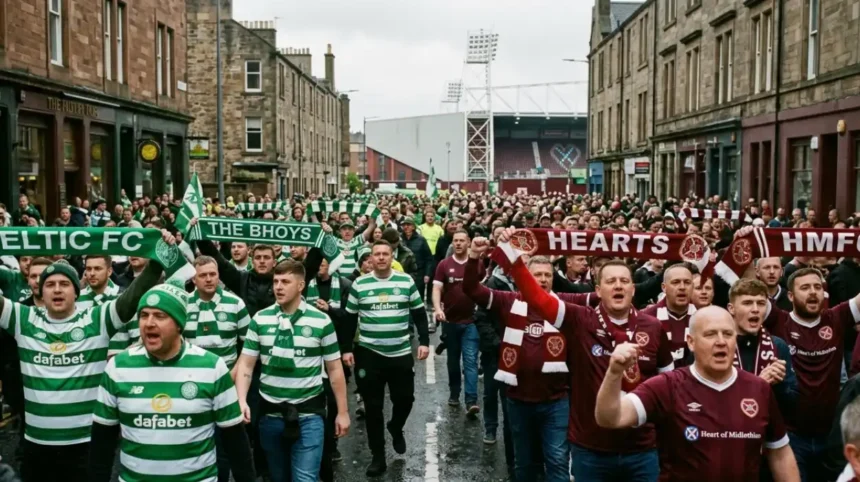
The fixture between Celtic Football Club and Heart of Midlothian Football Club stands as one of the most historically significant, competitive, and culturally resonant matchups in European football. Representing the two largest metropolitan economies in Scotland—Glasgow and Edinburgh—this fixture transcends basic athletic competition, directly reflecting the industrial, social, and political evolutions of the Central Belt. This comprehensive article analyzes the structural components, historical milestones, statistical records, tactical evolutions, and the systemic societal impact of the Celtic versus Heart of Midlothian rivalry.
- What is the history of the Celtic v Hearts fixture?
- Foundational Era and First Competitive Matches
- Mid-20th Century Dynamics and Tense Title Races
- Modern Era Professionalization
- What are the head-to-head statistics between Celtic and Hearts?
- All-Time Competitive Match Balance
- Major Domestic Cup Finals
- Record Scorelines and Attendance Benchmarks
- How did the May 2026 title decider reshape the rivalry?
- Pre-Match Structural Stakes and League Context
- Match Timeline and Technical Analysis
- Immediate Sports and Societal Impacts
- What are the operational and stadium dynamics of the fixture?
- Architectural Profiles and Spatial Pressures
- Safety Protocols and Policing Models
- Financial and Commercial Matchday Yields
- How do tactical systems differ between Celtic and Hearts?
- Celtic’s Tactical Methodology and Positional Play
- Heart of Midlothian’s Strategic Structural Model
- Head-to-Head Tactical Adjustments
- What is the socio-economic impact of this football rivalry?
- East-West Regional and Cultural Identity
- Tourism and Hospitality Revenue Influx
- Influence on Sports Governance and Media Infrastructure
- What are the future projections for Celtic v Hearts fixtures?
What is the history of the Celtic v Hearts fixture?
The Celtic versus Heart of Midlothian fixture began on August 23, 1890, when Celtic defeated Heart of Midlothian 5–0 in their first official league meeting. The clubs have competed continuously across elite Scottish football competitions for over 130 years.
Foundational Era and First Competitive Matches
Celtic Football Club was formally established in November 1887 by Brother Walfrid, a Marist brother, as a charitable institution to alleviate poverty in the East End of Glasgow. Heart of Midlothian Football Club was formed earlier, in 1874, taking its name from a local dancing club which was originally influenced by the Old Tolbooth prison described in Sir Walter Scott’s historical novel.
The structural evolution of the fixture solidified with the formation of the Scottish Football League in 1890. The inaugural league meeting at Tynecastle Park established Celtic as an early dominant force, but Heart of Midlothian countered by securing league championships in the 1894–1895 and 1896–1897 seasons. This established a persistent competitive tension between the industrial powerhouse of Glasgow and the capital city of Edinburgh.
Mid-20th Century Dynamics and Tense Title Races
The competitive balance fluctuated significantly during the 20th century. In the late 1950s, Heart of Midlothian, managed by Tommy Walker and led by the prolific “Terrible Trio” forward line—consisting of Willie Bauld, Alfie Conn, and Jimmy Wardhaugh—became one of the few structural counterweights to the Glasgow clubs. Heart of Midlothian won the league title in the 1957–1958 and 1959–1960 seasons, generating highly contested matches against a Celtic side that was rebuilding prior to the managerial appointment of Jock Stein in 1965.
The most historically critical final-day league decider prior to the modern era occurred on May 3, 1986. Heart of Midlothian entered the final day of the season at Dens Park requiring only a draw against Dundee to secure the league championship. Two late goals from Albert Kidd for Dundee, combined with Celtic defeating St Mirren 5–0 at Love Street, allowed Celtic to win the absolute league title on goal difference, cementing a permanent psychological and historical edge in the fixture.
Modern Era Professionalization
In the 21st century, the fixture evolved within a highly stratified financial landscape. Celtic established sustained fiscal dominance through consistent participation in the Union of European Football Associations (UEFA) Champions League, maximizing broadcasting revenues and global commercial partnerships. Heart of Midlothian navigated structural transformations, including a period of major financial instability under owner Vladimir Romanov that culminated in administration in 2013 and a subsequent transition to fan ownership via the Foundation of Hearts in 2021.
Despite these structural disparities, the fixture remained a highly volatile encounter, often serving as a definitive marker for domestic cup campaigns and league placements. The introduction of modern sports science, data analytics, and expanded scouting networks modified the preparation models for both organizations, preserving the fixture as an intense physical and tactical showcase within the Scottish Premiership.
What are the head-to-head statistics between Celtic and Hearts?
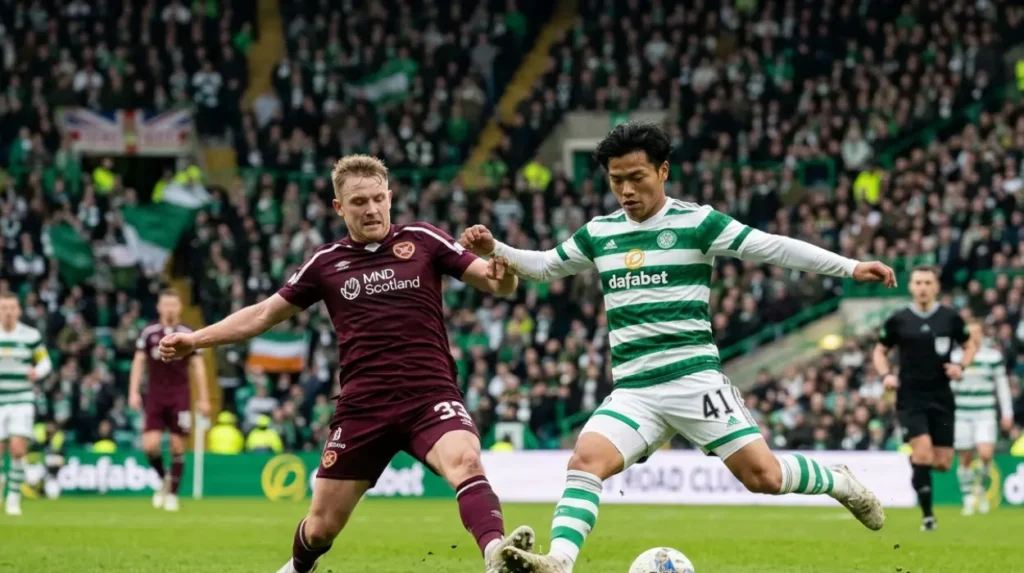
Celtic holds the definitive historical advantage in head-to-head encounters against Heart of Midlothian, accumulating over 200 victories across all competitive senior competitions, including the Scottish Premiership, the Scottish Cup, and the Scottish League Cup.
All-Time Competitive Match Balance
The comprehensive record of fixtures indicates a structural superiority for Celtic, driven primarily by long periods of sustained success at Celtic Park. In regular league play since 1890, Celtic has maintained a win probability exceeding 55 percent in head-to-head matches. Heart of Midlothian has achieved approximately 20 percent of total victories, with the remaining encounters ending in draws.
Major Domestic Cup Finals
The clubs have frequently contested major domestic cup finals at Hampden Park, Scotland’s national stadium. These matches represent critical historical milestones:
- The 1901 Scottish Cup Final: Heart of Midlothian defeated Celtic 4–3 in a highly documented match at historic Arthurlie Park.
- The 1956 Scottish Cup Final: Heart of Midlothian secured a 3–1 victory over Celtic before a crowd of 132,840 spectators, disrupting Celtic’s mid-century cup ambitions.
- The 2019 Scottish Cup Final: Celtic defeated Heart of Midlothian 2–1 on May 25, 2019, through two goals from forward Odsonne Édouard, securing a historic domestic Treble Treble.
- The 2020 Scottish Cup Final: Played on December 20, 2020, following delays caused by the coronavirus pandemic, this match ended 3–3 after extra time. Celtic won 4–3 on penalties to finalize a Quadruple Treble.
Record Scorelines and Attendance Benchmarks
The statistical extremes of the fixture highlight its historical volatility. Celtic’s largest recorded victory over Heart of Midlothian occurred on December 1, 2013, in a Scottish Cup fourth-round tie at Tynecastle Park, where Celtic secured a 7–0 victory. Conversely, Heart of Midlothian’s most significant modern league victory occurred on December 17, 2017, defeating Celtic 4–0 at Tynecastle Park. This result decisively concluded Celtic’s historic 69-game unbeaten domestic run under manager Brendan Rodgers. Attendance figures at Celtic Park consistently reach the stadium’s modern capacity of 60,411, while matches at Tynecastle Park routinely sell out its 19,852 seating capacity, maximizing matchday commercial revenues.
How did the May 2026 title decider reshape the rivalry?
The league match on Saturday, May 16, 2026, at Celtic Park directly decided the Scottish Premiership title. Celtic defeated Heart of Midlothian 3–1 with two late goals, securing their fifth consecutive league championship.
Pre-Match Structural Stakes and League Context
The 38th and final matchday of the 2025–2026 Scottish Premiership season presented an extraordinary competitive scenario. Heart of Midlothian, managed by Derek McInnes, had led the league standings continuously since September 2025, attempting to become the first club outside the Old Firm of Celtic and Rangers to win the top flight since Aberdeen in 1985. Heart of Midlothian entered the match at Celtic Park needing only a single point to secure the championship. Celtic, operating under interim manager Martin O’Neill following a highly inconsistent season, required an absolute victory to surpass Heart of Midlothian in the standings and claim the league title.
Match Timeline and Technical Analysis
The match progressed through distinct tactical phases that tested the strategic depth of both coaching staffs. Heart of Midlothian executed a highly disciplined defensive mid-block system, limiting spaces between their defensive and midfield lines. In the 42nd minute, striker Lawrence Shankland converted a precise header to give Heart of Midlothian a 1–0 lead, momentarily placing the Edinburgh club on the verge of historical success.
During first-half stoppage time, Celtic was awarded a penalty kick following a defensive foul in the penalty area. Midfielder Arne Engels converted the penalty in the 45+4th minute, establishing a 1–1 equilibrium at the interval. The second half developed as a sustained offensive assault by Celtic against a tiring Heart of Midlothian low defensive block. The decisive tactical breakthrough occurred in the 87th minute. Following an extensive Video Assistant Referee (VAR) review that overturned an initial offside decision, winger Daizen Maeda scored to put Celtic ahead 2–1. In the 90+8th minute of extended stoppage time, substitute forward Callum Osmand scored on a counter-attack, finalizing the 3–1 scoreline.
Immediate Sports and Societal Impacts
The victory allowed Celtic to claim its 56th Scottish league championship, officially surpassing Rangers for the highest number of absolute league titles won in Scottish football history. The conclusion of the match resulted in a brief pitch invasion by home supporters at Celtic Park, requiring stadium security and Police Scotland personnel to implement standard crowd control measures. For Heart of Midlothian, the defeat ended an exceptional 37-match league campaign, denying the club its first league championship since 1960. The match set a new Scottish broadcasting viewership record for a non-derby domestic fixture, illustrating the vast commercial appeal of the title decider.
What are the operational and stadium dynamics of the fixture?
The operational dynamics of the Celtic versus Heart of Midlothian fixture involve strict infrastructure management, high-security logistical protocols, and distinct architectural environments that alter team strategies depending on the venue.
Architectural Profiles and Spatial Pressures
The physical characteristics of the two home venues fundamentally influence the tactical and environmental nature of each match. Celtic Park, situated in Parkhead in the East End of Glasgow, features an expansive pitch measuring 105 meters by 68 meters. The stadium’s large dimensions allow teams to maximize wide offensive play and employ rapid switches of play. The bowl-shaped grandstands generate significant acoustic amplification, creating a intense environment for visiting clubs.
In contrast, Tynecastle Park, located in the Gorgie district of Edinburgh, possesses a more compact configuration. The grandstands are constructed in immediate proximity to the touchlines, creating an intimidating, high-pressure atmosphere. The tighter pitch dimensions restrict space, reducing the time players have for ball control and heavily favoring teams that utilize aggressive pressing systems, high-intensity physical tackling, and direct vertical transition models.
Safety Protocols and Policing Models
Due to the intense competitive rivalry and historical friction between the respective supporter bases, Police Scotland and club stadium operations teams categorize this fixture as a high-risk sporting event. Matchday operations require distinct deployment models to prevent public disorder:
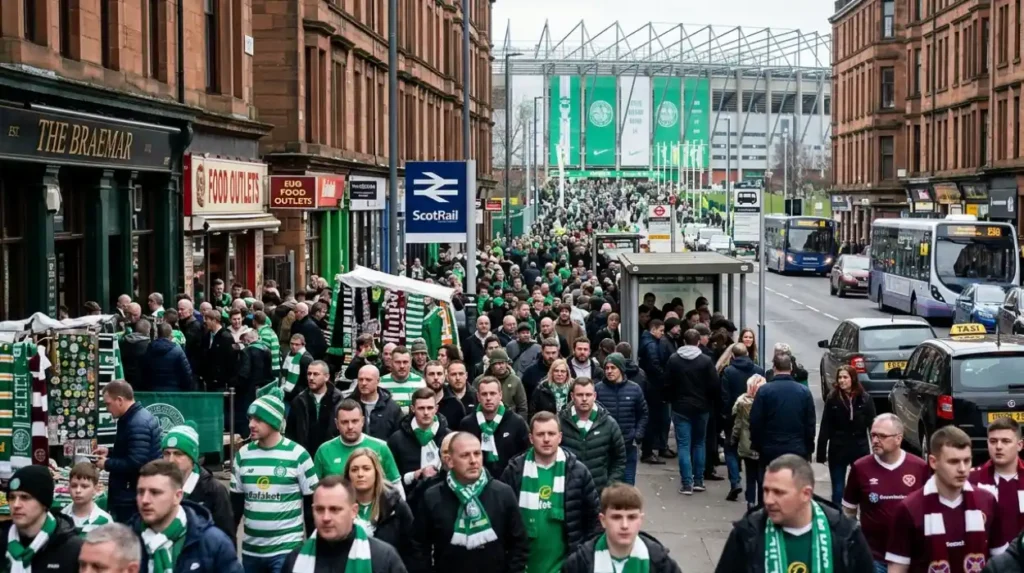
- Supporter Segregation Zones: Strict physical cordons are established outside the stadiums, separating traveling fans from home fans from the moment they arrive at local transport hubs, such as Dalmarnock and Bridgeton stations in Glasgow, or Haymarket station in Edinburgh.
- Dedicated Transport Convoys: Transport providers arrange dedicated rail carriages and chartered supporter buses to manage the movement of away fans directly to the stadium gates.
- Encapsulated Ticketing Systems: Digital ticketing verification systems are deployed to prevent away fans from buying tickets in home support sections, maintaining a strict physical barrier within the stands.
Financial and Commercial Matchday Yields
The fixture functions as a major economic driver for both clubs and their respective municipality economies. A sold-out match at Celtic Park generates more than £2 million in combined ticket sales, hospitality packages, merchandising, and catering concessions. For Heart of Midlothian, hosting Celtic at Tynecastle Park guarantees maximum broadcasting rights allocations from the Scottish Professional Football League (SPFL) television partners, alongside premium stadium advertising rates. The hospitality sectors in both Glasgow and Edinburgh experience substantial revenue increases on matchdays, benefiting local hotels, restaurants, and public transportation networks.
How do tactical systems differ between Celtic and Hearts?
Celtic traditionally implements a high-possession, attack-oriented tactical system focused on positional play and wing isolation, whereas Heart of Midlothian frequently utilizes a compact defensive shape reliant on direct transitions and physical counter-pressing.
Celtic’s Tactical Methodology and Positional Play
Celtic’s footballing philosophy emphasizes sustained territorial dominance and rapid ball circulation. Operating typically within a 4-3-3 or 4-2-3-1 structural formation, the team utilizes inverted full-backs who migrate into central midfield areas during the build-up phase. This tactical movement creates numerical overloads in the center of the pitch, allowing central midfielders to dictate the tempo of the match.
The primary offensive objective is to isolate technical wingers in 1v1 situations against opponent full-backs, leading to low crosses into the penalty area. Defensively, Celtic applies an immediate counter-press upon losing possession, attempting to win the ball back within the opponent’s defensive third before their defensive shape can adjust.
Heart of Midlothian’s Strategic Structural Model
Heart of Midlothian often counters Celtic’s structural model by deploying a disciplined low-to-mid defensive block, frequently utilizing a 3-5-2 or a rigid 4-4-2 formation. This tactical framework prioritizes central compactness, forcing Celtic’s passing patterns into wide areas where they can be contained by the touchline.
The midfield unit focuses on aggressive physical duels to disrupt Celtic’s passing rhythm. Heart of Midlothian’s offensive strategy relies on direct vertical long-ball transitions, bypassing the opponent’s press to locate physical target forwards who can hold up play and bring late-running central midfielders into the attack. Set-piece situations, including corner kicks and long throw-ins, are meticulously drilled to exploit any height or positional disadvantages in the opponent’s defensive unit.
Head-to-Head Tactical Adjustments
When the two systems clash, the match dynamics depend heavily on pitch size and early goals. At Celtic Park, Celtic’s ability to stretch the play often forces Heart of Midlothian into an increasingly deep defensive posture, testing their concentration and physical endurance over 90 minutes.
At Tynecastle Park, the reduced spaces allow Heart of Midlothian’s aggressive pressing system to function with greater efficiency, frequently disrupting Celtic’s building phase from the back and forcing turnovers in dangerous areas. Tactical flexibility, such as adjusting the height of the defensive line or changing substitute profiles in the final 30 minutes, remains critical in deciding the outcome of these tactical encounters.
What is the socio-economic impact of this football rivalry?
The Celtic versus Heart of Midlothian rivalry reflects and influences regional economic trends, urban transport infrastructure planning, tourism, and the broader sociological landscape of Central Scotland.
East-West Regional and Cultural Identity
The fixture provides a prominent sporting manifestation of the traditional cultural and socio-economic dynamics between Glasgow and Edinburgh. Glasgow, historically built on heavy engineering, shipbuilding, and industrial manufacturing along the River Clyde, developed a working-class identity that deeply influenced Celtic’s founding values and fan culture.
Edinburgh, acting as the administrative, legal, and financial capital of Scotland, cultivated a different socio-economic environment. This regional contrast adds a layer of civic pride to the matches, with fans viewing the on-pitch results as an assertion of their respective city’s cultural and athletic prominence within Scotland.
Tourism and Hospitality Revenue Influx
Matchdays generate millions of pounds in direct consumer spending across the hospitality, service, and retail sectors. Thousands of traveling supporters move between Glasgow and Edinburgh via the M8 motorway and the ScotRail rail network, maximizing transit revenues. Local businesses experience sharp spikes in demand:
- Food and Beverage Outlets: Public houses, bars, and restaurants located in the Gallowgate and London Road areas near Celtic Park, as well as Gorgie Road and Dalry Road near Tynecastle Park, operate at peak capacity on matchdays.
- Accommodation Providers: International and domestic tourists traveling specifically to experience high-profile Scottish football matches generate significant weekend booking volumes for city-center hotels.
- Retail and Merchandise: Club superstores and independent vendors experience high sales volumes for replica jerseys, matchday programmes, and commemorative memorabilia.
Influence on Sports Governance and Media Infrastructure
The enduring competitive profile of Celtic versus Heart of Midlothian fixtures profoundly shapes the commercial strategy of sports governing bodies like the Scottish Football Association (SFA) and the SPFL. High-profile encounters between these clubs are primary assets used to negotiate international broadcasting contracts with global television networks, ensuring vital financial distributions to the wider pyramid of Scottish football.
Furthermore, the tactical, analytical, and disciplinary talking points emerging from these intense matches provide sustained content for national print, digital, and broadcast media outlets, driving continuous public engagement with the domestic sport.
What are the future projections for Celtic v Hearts fixtures?
Future Celtic versus Heart of Midlothian fixtures will be increasingly shaped by evolving financial models, expanding data tracking technologies, automated stadium infrastructure, and changing European qualification formats.
Financial Stratification and Squad Valuation Trends
The economic division between Celtic and Heart of Midlothian is projected to widen due to the restructuring of continental tournament revenues. Celtic’s access to the expanded league phases of UEFA competitions provides substantial financial windfalls, allowing the Glasgow club to maintain a significantly higher player wage bill and secure premium international talent.
Heart of Midlothian’s long-term financial strategy relies on consistent qualification for the UEFA Conference League or Europa League group stages. This revenue model, combined with disciplined recruitment via data analytics and profitable player sales, is designed to close the resource gap and build a squad capable of challenging Celtic’s domestic dominance.
Integration of Advanced Sporting Technology
The technical execution of the fixture will continue to integrate advanced technological systems designed to optimize athletic performance and officiating accuracy. Both clubs utilize advanced Electronic Performance and Tracking Systems (EPTS) to monitor player workloads, acceleration metrics, and injury risks in real time during training and matches.
On the pitch, the continued evolution of officiating technologies—including semi-automated offside systems, advanced multi-angle VAR reviews, and enhanced communication lines between referees and stadium displays—will alter match management, ensuring greater accuracy while adding new layers of strategic consideration for managers and coaching staffs.
Evolving Supporter Environments and Digital Stadiums
The matchday experience at both venues is undergoing a sustained digital transformation. Stadium operations are progressively implementing fully contactless entry systems, biometric ticketing security options, and high-density 5G connectivity solutions throughout their grandstands to enhance supporter engagement and operational efficiency.
Environmental sustainability initiatives will also reshape stadium logistics, with both Celtic Park and Tynecastle Park introducing comprehensive zero-waste programs, energy-efficient LED stadium lighting grids, and eco-friendly transport partnerships. These upgrades ensure that while the historic intensity of this 130-year-old football rivalry remains intact, its operational execution aligns with modern global sports entertainment standards.
Why is Celtic vs Hearts considered a big rivalry in Scotland?
The rivalry is significant because it represents Scotland’s two biggest cities, Glasgow and Edinburgh. The fixture combines football competition with cultural, economic, and regional pride that has existed for more than 130 years.