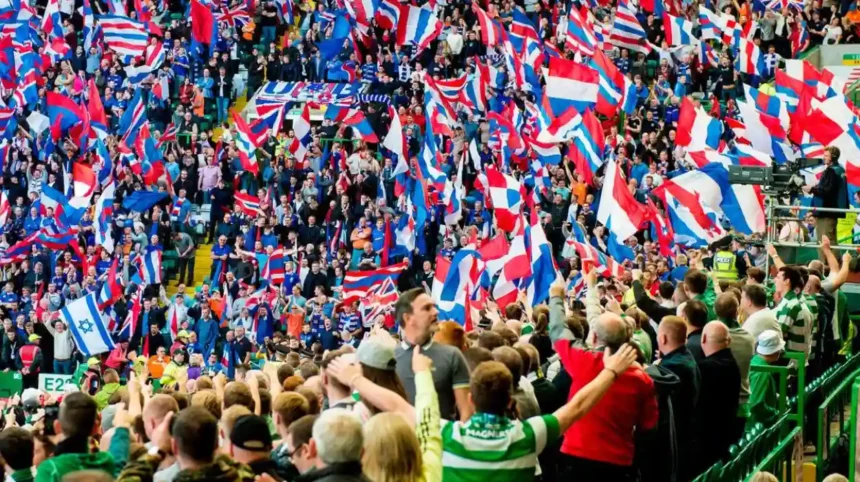
Glasgow has two of Scotland’s most prominent football identities: Celtic Football Club and Rangers Football Club. Their colours are highly recognisable, and clothing can communicate football allegiance in parts of the city, particularly around matchdays, supporter venues and Old Firm fixtures. Government research has specifically identified clothing colour as one of the markers through which some people interpret group identity in west-central Scotland.
- Why do Celtic and Rangers colours matter in Glasgow?
- What colours are associated with Celtic and Rangers?
- How did Celtic and Rangers develop such strong colour identities?
- Is wearing green in Glasgow the same as supporting Celtic?
- Is wearing blue in Glasgow the same as supporting Rangers?
- Does clothing colour have religious or political associations in Glasgow?
- When is it most important to think about Celtic and Rangers colours?
- What clothes should visitors wear in Glasgow on an Old Firm matchday?
- Are Celtic and Rangers colours important in Glasgow workplaces?
- Can tourists safely wear Celtic or Rangers clothing in Glasgow?
- What should students and new residents know about Glasgow football colours?
- How can you recognise strong Celtic or Rangers symbolism in clothing?
- What is the practical clothing rule for Glasgow visitors?
- Why will Celtic and Rangers colours remain relevant in Glasgow?
This does not mean every green, white or blue item of clothing carries a football message. Glasgow is a large, diverse city where people routinely wear these colours for fashion, work, sport and everyday life. Context remains important.
For visitors, students, new residents and anyone unfamiliar with Glasgow’s football culture, understanding the significance of Celtic and Rangers colours helps explain why clothing choices sometimes receive more attention than expected.
Why do Celtic and Rangers colours matter in Glasgow?
Celtic and Rangers colours matter because they represent highly visible football identities with deep historical associations in Glasgow. Green and white identify Celtic, while Rangers are strongly associated with blue, especially royal blue, making clothing context significant.
Celtic Football Club is traditionally associated with green and white, particularly its famous horizontal-hooped home shirt. Rangers Football Club is strongly associated with royal blue, supported by white and red elements in its wider visual identity.
The clubs are commonly known together as the Old Firm, a term used for the historic rivalry between Celtic and Rangers. The rivalry extends well beyond individual matches because both clubs have large supporter communities and long-established cultural identities.
Research commissioned by the Scottish Government found that colour can function as a social marker. Participants in research into sectarianism specifically mentioned clothing colours alongside songs, tunes, flags, surnames and school backgrounds.
The significance is strongest in particular circumstances. A plain green jumper worn for work is not automatically a Celtic statement. A green-and-white scarf worn outside Celtic Park on a Celtic-Rangers matchday communicates a much clearer affiliation.
The same principle applies to blue clothing. A navy coat is ordinary Glasgow clothing. A royal-blue football shirt bearing the Rangers crest is explicit club clothing.
The distinction between colour and club symbolism is therefore essential.

What colours are associated with Celtic and Rangers?
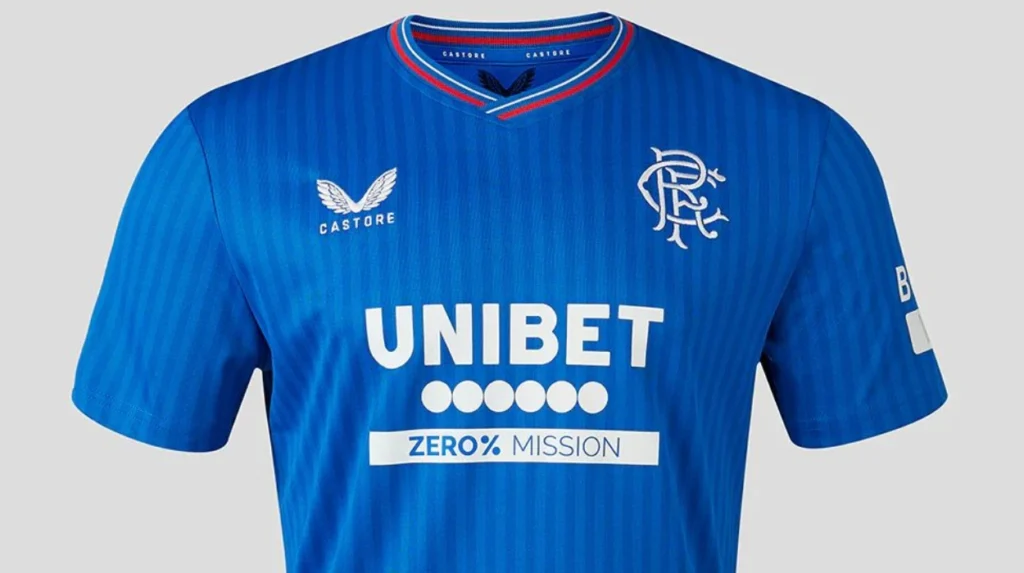
Celtic is identified primarily with green and white, especially the green-and-white Hoops. Rangers is identified primarily with royal blue, with white and red also forming established elements of its football identity and branded clothing.
Celtic’s green-and-white identity has existed for generations. The club’s early teams wore white shirts with green elements before green-and-white striped shirts became established during the late nineteenth century. Celtic switched to the famous Hoops in 1903 while retaining the same green-and-white colours.
The Hoops became one of the most recognisable football shirts in world football. Celtic itself describes the green-and-white Hoops as a defining feature of its identity.
Rangers has an equally strong relationship with blue. The club describes its blue as central to its identity and refers to its established palette as Rangers Blue.
The 2026/27 Rangers home shirt continues that tradition. Rangers describes the current home design as royal blue with subtle pinstripes, alongside white and red details.
This produces a simple visual distinction:
Celtic: green and white, especially hoops.
Rangers: royal blue, commonly combined with white and red.
However, colour alone does not establish someone’s football allegiance. Glasgow residents use green, white and blue throughout ordinary clothing, interior design, sportswear and fashion.
How did Celtic and Rangers develop such strong colour identities?
Celtic and Rangers developed strong colour identities through more than a century of football competition, supporter traditions, club branding and repeated public visibility. Their colours became recognisable symbols through shirts, scarves, flags, stadiums and commercial merchandise.
Celtic was founded in Glasgow in 1887, with its first meeting held at St Mary’s Church in the city’s East End. The club’s early identity developed alongside Glasgow’s Irish immigrant community and charitable origins.
Celtic’s transition from green-and-white stripes to the Hoops occurred in 1903. The first competitive match in the new Hoops was against Partick Thistle on 15 August 1903 at Celtic Park.
Rangers was founded in Glasgow in 1872. Its visual identity subsequently became strongly associated with blue, while its crest and branding developed additional visual elements over time.
The two clubs’ histories developed within the same metropolitan area. Their stadiums are located only a few miles apart, placing their supporter cultures within the same urban environment.
The historical dimension is important because football shirts are not simply modern commercial products. They represent identities that have been reinforced across generations.
University of Glasgow research describes Celtic and Rangers as the two dominant clubs within the historical development of west-of-Scotland football and examines their cultural development from the nineteenth century onwards.
The result is a situation where a particular combination of colour, clothing design and location can communicate much more information than colour alone.
Is wearing green in Glasgow the same as supporting Celtic?
Wearing green in Glasgow does not automatically indicate Celtic support. Green is an ordinary clothing colour used throughout the city. Stronger football associations arise when green appears with white, Hoops, Celtic badges, scarves or other recognisable Celtic symbols.
This distinction is especially important for visitors.
A person wearing a green raincoat, green trainers or a green jumper is not necessarily displaying Celtic allegiance. Green is common in fashion and sportswear.
Government research nevertheless records situations in which people interpreted green clothing as having a Celtic or Irish association. The research included accounts of people avoiding green clothing or green footwear in particular social environments because they understood the potential association.
The context changes the meaning.
For example, these items have different levels of football association:
A plain green T-shirt has a low level of obvious Celtic identification.
A green-and-white striped shirt has a stronger association.
A Celtic Hoops shirt has an explicit association.
A Celtic scarf displaying the club crest is unmistakable supporter clothing.
Location also matters. Green clothing around Celtic Park on a Celtic matchday has a different social context from green clothing in a shopping centre on an ordinary weekday.
The safest interpretation is therefore based on colour + design + symbols + location + occasion, rather than colour alone.
Is wearing blue in Glasgow the same as supporting Rangers?
Wearing blue in Glasgow does not automatically indicate Rangers support. Blue is an everyday clothing colour. The Rangers association becomes stronger when clothing uses royal blue with Rangers branding, football designs, scarves, badges or other recognisable symbols.
Blue is common across British clothing markets. Navy coats, denim jeans, blue shirts and sportswear are ordinary choices.
The shade and design influence interpretation. Rangers’ official identity places particular importance on its blue, and the club’s current branding uses a defined Rangers Blue.
A plain navy jacket therefore carries little specific football information.
A royal-blue football shirt with a Rangers crest carries an explicit message.
A blue-and-white scarf without a club badge sits somewhere between these examples. Its meaning depends on the exact design and surroundings.
Matchday conditions again create the strongest context. Around Ibrox, a royal-blue football shirt is much more likely to be interpreted as Rangers clothing than the same colour worn in a Glasgow office district.
This distinction is useful for people buying clothes in Glasgow. There is no general rule that residents avoid blue. There is no general rule that green is prohibited or inappropriate.
The practical issue is recognisable supporter clothing, not ordinary colour use.
Does clothing colour have religious or political associations in Glasgow?
Celtic and Rangers clothing has historical associations with religious and political identities, but football allegiance does not perfectly correspond with religion or politics. Modern Glasgow contains supporters from varied religious, cultural and political backgrounds.
The relationship between football, religion and identity is documented in Scottish research.
The Scottish Social Attitudes Survey reported that public discussion of sectarianism frequently focuses on the historical relationship between Rangers and Protestantism and Celtic and Catholicism. The same research found that these associations do not describe every supporter.
The survey found that 58% of Scots did not support a Scottish football club, while approximately 12% supported Celtic and 12% supported Rangers.
Importantly, the Scottish Government research stated that support for each club includes people from different religious backgrounds. Historical associations therefore cannot be treated as a reliable way to identify an individual’s religion.
Political symbolism can also enter football culture, particularly through songs, flags and historical references. That symbolism is more specific than simply wearing a colour.
For clothing decisions, this means visitors should avoid making assumptions about someone’s religion based on a shirt colour. A football shirt demonstrates a sporting affiliation more clearly than it demonstrates a person’s personal beliefs.
When is it most important to think about Celtic and Rangers colours?
Colour awareness becomes most relevant on Old Firm matchdays, around Celtic Park and Ibrox, near supporter pubs, during large football gatherings and around major fixtures. Ordinary city-centre shopping and sightseeing normally involve much less football-specific clothing context.
Matchdays create concentrated supporter activity.
Celtic Park becomes a major gathering point for Celtic supporters. Ibrox becomes a major gathering point for Rangers supporters. Public transport, nearby streets, pubs and commercial areas can also experience increased football-related activity.
The Scottish Government’s research found that participants specifically identified football-match days involving Celtic and Rangers as times when people exercised greater caution around clothing and certain locations.
Police Scotland has also documented disorder connected with some Celtic-Rangers fixtures. Following the Scottish Cup quarter-final at Ibrox on 8 March 2026, Police Scotland reported arrests, injuries and an ongoing investigation into disorder.
That does not mean every matchday is dangerous or that ordinary supporters behave aggressively. Police Scotland has repeatedly acknowledged the presence of large numbers of responsible supporters.
It means that football rivalry can produce heightened public activity around major fixtures.
For clothing, the practical rule is simple: the stronger the football context, the more recognisable club colours become.
What clothes should visitors wear in Glasgow on an Old Firm matchday?
Visitors should choose neutral everyday clothing when they are not attending a match. Black, grey, brown, beige, white or non-club-specific designs provide straightforward options when travelling through areas with concentrated Celtic or Rangers support.
Neutral clothing reduces the possibility of an unintended football association.
This does not require visitors to avoid every shade of green or blue. It means avoiding highly recognisable supporter combinations when travelling through matchday areas without supporting either club.
A neutral jacket, plain trainers and ordinary jeans provide practical choices.
Visitors attending a Celtic match should follow stadium and ticket instructions and should wear clothing appropriate for the event. Visitors attending a Rangers match should follow the equivalent stadium guidance.
The most important consideration is not fashion. It is context awareness.
People unfamiliar with Glasgow sometimes assume that a colour automatically identifies a person’s football allegiance. The evidence does not support such a simple interpretation.
The Scottish Government specifically found that markers such as clothing colour were not understood in the same way throughout Scotland and that interpretations were influenced by factors including age, gender and football affiliation.
That makes neutral clothing a practical choice, not a legal requirement.
Are Celtic and Rangers colours important in Glasgow workplaces?
Celtic and Rangers colours are generally less significant in professional workplaces than in football environments. Workplace clothing follows professional standards, while explicit football merchandise can create unnecessary personal or team-related associations in customer-facing settings.
A workplace dress code normally determines appropriate clothing.
A plain green shirt does not need to be treated as Celtic clothing. A blue suit does not represent Rangers. Colour becomes more explicit when clothing contains football crests, club slogans, Hoops or supporter imagery.
Professional settings also contain people with different football affiliations. Avoiding assumptions is therefore important.
The Scottish Government’s research recorded some reports of sectarian attitudes affecting workplace experiences, but it also stated that such accounts were relatively limited within the study.
A professional environment should therefore be distinguished from football supporter culture.
For job interviews, meetings and business events, conventional professional clothing is the clearest approach. It avoids unnecessary football symbolism without requiring people to monitor every colour they wear.
Can tourists safely wear Celtic or Rangers clothing in Glasgow?
Tourists can wear Celtic or Rangers clothing, particularly when attending the relevant club’s match or visiting supporter-oriented environments. Visitors should understand the local context and avoid deliberately displaying rival club symbols in hostile or highly charged situations.
Football shirts are normal supporter clothing.
Celtic and Rangers both operate substantial commercial merchandise programmes. Rangers describes its home shirt as clothing representing the club and its connection with supporters. Celtic similarly identifies its Hoops as a central part of supporter identity.
The issue is not that wearing club clothing is inherently unsafe.
The issue is where and when it is worn.
A Celtic shirt at Celtic Park is normal.
A Rangers shirt at Ibrox is normal.
Wearing either shirt in a neutral tourist environment is generally a straightforward display of football allegiance.
Deliberately wearing one club’s symbols in the concentrated supporter area of its rival on a major matchday is a different situation. It introduces unnecessary confrontation potential.
Police Scotland’s records demonstrate that serious disorder has occurred around some fixtures, including incidents in Glasgow before and after matches.
Visitors should therefore treat club clothing as supporter identification rather than general tourist fashion.
What should students and new residents know about Glasgow football colours?
Students and new residents should recognise Celtic green-and-white and Rangers blue as important football identifiers without assuming that every person wearing those colours supports either club. Context, symbols, matchdays and location provide the strongest clues to football affiliation.
Students often encounter Glasgow football culture through accommodation, universities, workplaces, public transport, pubs and social groups.
A new resident does not need detailed knowledge of every football tradition. Understanding the two principal club identities provides a useful foundation.
The key distinction is between ordinary colour and supporter symbolism.
Green trainers are ordinary clothing.
Green-and-white Hoops are football clothing.
A royal-blue jumper is ordinary clothing.
A Rangers home shirt is football clothing.
The Scottish Government’s research is particularly relevant because participants described football affiliation as a social identity marker in west-central Scotland.
At the same time, the same research found that these identities do not map perfectly onto religion or wider Scottish society.
New residents should therefore avoid questions or assumptions such as treating a colour as proof of someone’s religious identity.
A more accurate approach is to recognise football symbolism while respecting individual identity.
How can you recognise strong Celtic or Rangers symbolism in clothing?
Strong club symbolism normally combines several identifiable elements, such as established club colours, football-shirt designs, crests, scarves, slogans or branded merchandise. A single generic colour provides much weaker evidence of football allegiance than these combinations.
The visual hierarchy is straightforward.
A club crest is one of the strongest indicators.
A replica football shirt is another strong indicator.
A club scarf provides a clear supporter signal.
A distinctive club pattern, such as Celtic’s Hoops, creates a strong association.
A generic colour provides the weakest association.
This distinction explains why Glasgow residents can comfortably wear green, white and blue without constantly communicating a football identity.
Celtic’s Hoops have been established since 1903, making the pattern itself an unusually strong visual identifier.
Rangers’ royal-blue shirt identity has also been reinforced across generations and remains central to its current brand.
The more elements appear together, the clearer the intended football message becomes.
Explore More Area Guide
Celtic or Rangers Match First-Time Guide Glasgow 2026
Old Firm Derby and Everyday Life in Glasgow 2026
What is the practical clothing rule for Glasgow visitors?
The practical rule is to treat ordinary green, white and blue clothing as normal, while recognising that club-branded combinations carry stronger meaning. Extra awareness is sensible around Old Firm matchdays, stadiums, supporter venues and large football gatherings.
There is no general Glasgow dress code banning Celtic or Rangers colours.
There is no universal requirement for visitors to wear neutral clothing.
There is also no reliable basis for identifying a person’s religion from a shirt colour.
The important issue is context.
Glasgow is a city where football forms a visible part of local culture. Celtic and Rangers have exceptionally strong identities, and their colours are among the most recognisable symbols associated with that rivalry.
Government research confirms that clothing colour can function as a social marker in particular environments. It also confirms that these meanings vary between people and places.
For everyday sightseeing, normal clothing is appropriate.
For match attendance, club colours are expected among supporters.
For neutral activities on major matchdays, simple non-club clothing is a practical choice.
The central principle is awareness rather than anxiety. Understanding what the colours can represent helps visitors navigate Glasgow respectfully without treating ordinary fashion as a political or religious statement.
Why will Celtic and Rangers colours remain relevant in Glasgow?
Celtic and Rangers colours will remain relevant because both clubs maintain strong supporter identities, established visual brands and deep historical connections with Glasgow. Their colours continue to appear across football shirts, merchandise, stadium environments, media coverage and matchday culture.
Football clothing remains an important part of modern supporter culture.
Rangers’ current branding explicitly protects its blue identity while updating the club’s visual presentation for modern audiences.
Celtic continues to use the green-and-white Hoops as a central part of its football identity. The club’s own historical material traces the Hoops to 1903.
The continued commercial production of replica shirts also keeps these colours visible beyond stadiums.
The wider social context is more complex. Glasgow’s population includes people with different religions, cultural backgrounds, football affiliations and no football affiliation. Scottish Government research found that the historical Celtic-Catholic and Rangers-Protestant associations do not capture the full diversity of supporters or Scottish society.
Consequently, Celtic green-and-white and Rangers blue will continue to function as powerful football symbols, but they should not be treated as automatic indicators of personal religion, politics or character.
For anyone choosing clothes in Glasgow, the most accurate approach is simple: ordinary colours are ordinary clothes; distinctive club combinations are football statements; and matchday context gives those symbols their greatest significance.
Are Celtic and Rangers colours a big deal in Glasgow?
Yes. Celtic’s green and white and Rangers’ royal blue are strongly recognised football identities in Glasgow. Their significance is particularly noticeable around matchdays, stadiums, supporter venues and Old Firm fixtures.