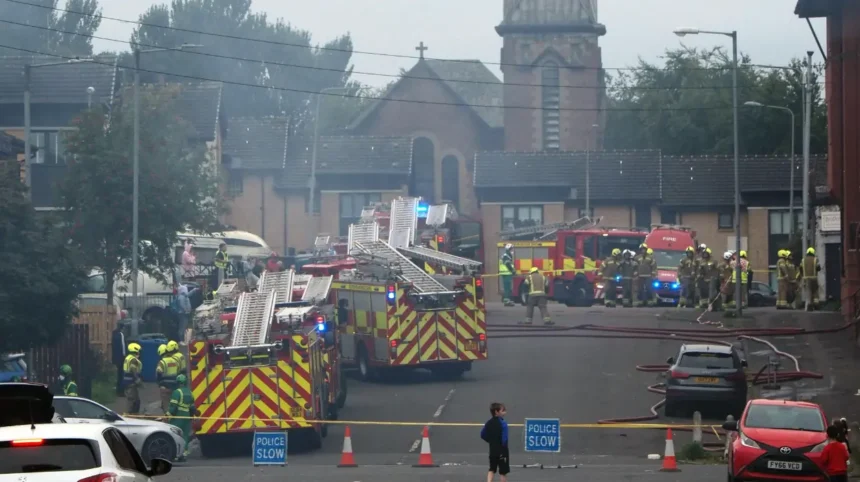
- Emergency services responded to a building fire in a Glasgow residential area on the evening of November 9, 2026.
- Multiple Scottish Fire and Rescue Service (SFRS) appliances were deployed to extinguish the flames and secure the scene.
- Police officers cordoned off the affected street to manage traffic and safeguard local residents.
- No immediate casualties or injuries were officially reported during the height of the incident.
- An investigation has been launched by authorities to determine the root cause of the fire.
Glasgow (Glasgow Express) November 10, 2026 – Emergency services blocked off a Glasgow residential street on Monday evening as fire crews rushed to extinguish a building blaze, prompting a swift multi-agency response to contain the threat to local properties.
- What Occurred During the Glasgow Building Fire Incident?
- Who Responded to the Residential Street Emergency?
- What Impact Did the Fire Have on the Local Community?
- What Are the Next Steps in the Investigation?
- Background of the Glasgow Residential Fire Response Infrastructure
- Prediction: How Will This Development Affect Local Residents and Property Owners?
What Occurred During the Glasgow Building Fire Incident?
The incident began in the early evening when local residents observed smoke rising from the property, prompting multiple emergency calls to the Scottish Fire and Rescue Service (SFRS). Upon arrival, fire crews discovered an active structure fire that required immediate containment to prevent flames from spreading to neighboring residential units.
As reported by local desk reporters of the Glasgow Evening News, eyewitnesses stated that emergency vehicles quickly filled the thoroughfare, with fire engines positioning ladders and hoses to tackle the outbreak from multiple angles. Officers from Police Scotland established a wide perimeter, preventing vehicle and pedestrian access to the street while firefighters conducted operations inside and around the premises.
Douse procedures and dampening-down operations continued into the night. Specialized equipment was deployed to ventilate the building and monitor potential hotspots within the structure’s interior walls and roof space.
Who Responded to the Residential Street Emergency?
The operational response involved several units from the Scottish Fire and Rescue Service, alongside patrol units from Police Scotland and standard precautionary attendance by the Scottish Ambulance Service.
As reported by regional crime and emergency correspondents of the Glasgow Evening News, official sources stated that fire crews worked systematically to control the main seat of the fire while secondary teams conducted thorough sweeps of the premises to verify that no individuals remained inside the structure.
Paramedics remained on standby at the perimeter as a standard safety precaution. Authorities confirmed that no immediate injuries to residents or emergency personnel were recorded at the scene during the initial response phase.
What Impact Did the Fire Have on the Local Community?
The emergency response led to significant localized disruption throughout the evening. Residents living on the targeted block were temporarily instructed to remain indoors or evacuate the immediate zone while fire operations were active.
As reported by staff writers of the Glasgow Evening News, neighborhood residents stated that smoke was visible across adjacent streets, creating concern among householders before the scene was successfully stabilized by firefighters. Transport and regular access to residential driveways were halted until emergency vehicles cleared the road late into the evening.
Local council services were notified to assess any required temporary accommodation or civil support for occupants affected by structural damage or smoke inhalation risks within the building.
What Are the Next Steps in the Investigation?
Following the successful suppression of the fire, control of the site was handed over to specialist fire investigation officers working alongside Police Scotland to identify the precise origin of the ignition.
As reported by investigative reporters of the Glasgow Evening News, emergency service officials stated that standard forensic examinations will take place to establish whether the fire resulted from an electrical fault, an accidental household event, or deliberate combustion. A formal safety assessment of the building structure will also be completed prior to granting full access back to property owners.
Background of the Glasgow Residential Fire Response Infrastructure
Residential structural fires in dense urban environments present unique challenges for local authorities in Scotland’s largest city. Glasgow’s architectural landscape features a high concentration of traditional sandstone tenements alongside modern multi-storey residential complexes.
The Scottish Fire and Rescue Service operates under standardized protocols designed to mobilize primary pumping appliances and aerial platforms within minutes of a 999 alert. In urban residential sectors, rapid response times are critical due to common wall construction and shared roof voids, which increase the risk of rapid horizontal fire propagation between adjoining homes. Joint operations between SFRS, Police Scotland, and local municipal councils ensure that fire containment occurs in tandem with public safety management, traffic control, and emergency welfare provision.
Prediction: How Will This Development Affect Local Residents and Property Owners?
This incident is expected to directly influence community safety routines, local insurance processing, and municipal emergency management across the Glasgow area.
Impact on Immediate Residents and Neighboring Homeowners
Residents directly affected by the blaze will face short-to-medium-term disruption related to structural repairs, smoke damage remediation, and safety certification before re-occupying the property. For neighboring residents, the event may prompt heightened vigilance regarding home safety measures, including the testing of smoke alarms and the clearing of communal access points. Property owners within the block are likely to experience temporary shifts in building insurance inquiries as assessors evaluate overall structural integrity and common area liability.
Impact on the Broader Community and Municipal Policy
In the wider Glasgow municipality, localized incidents of this nature routinely prompt community safety campaigns by the Scottish Fire and Rescue Service, focused on home fire prevention checks and clear-street access for emergency apparatus. If the subsequent investigation uncovers structural or electrical vulnerabilities, local housing associations and private landlords across the city may be required to review safety compliance standards to minimize future fire risks in similar residential properties.